CG1, CG2 - Distances and mid-points
Coordinates let you measure a straight journey without drawing it to scale. CG1 turns horizontal and vertical changes into an exact distance; CG2 locates the point halfway along a segment. You will also work backwards when a length or a mid-point is known but an endpoint is missing.
Distance between two points
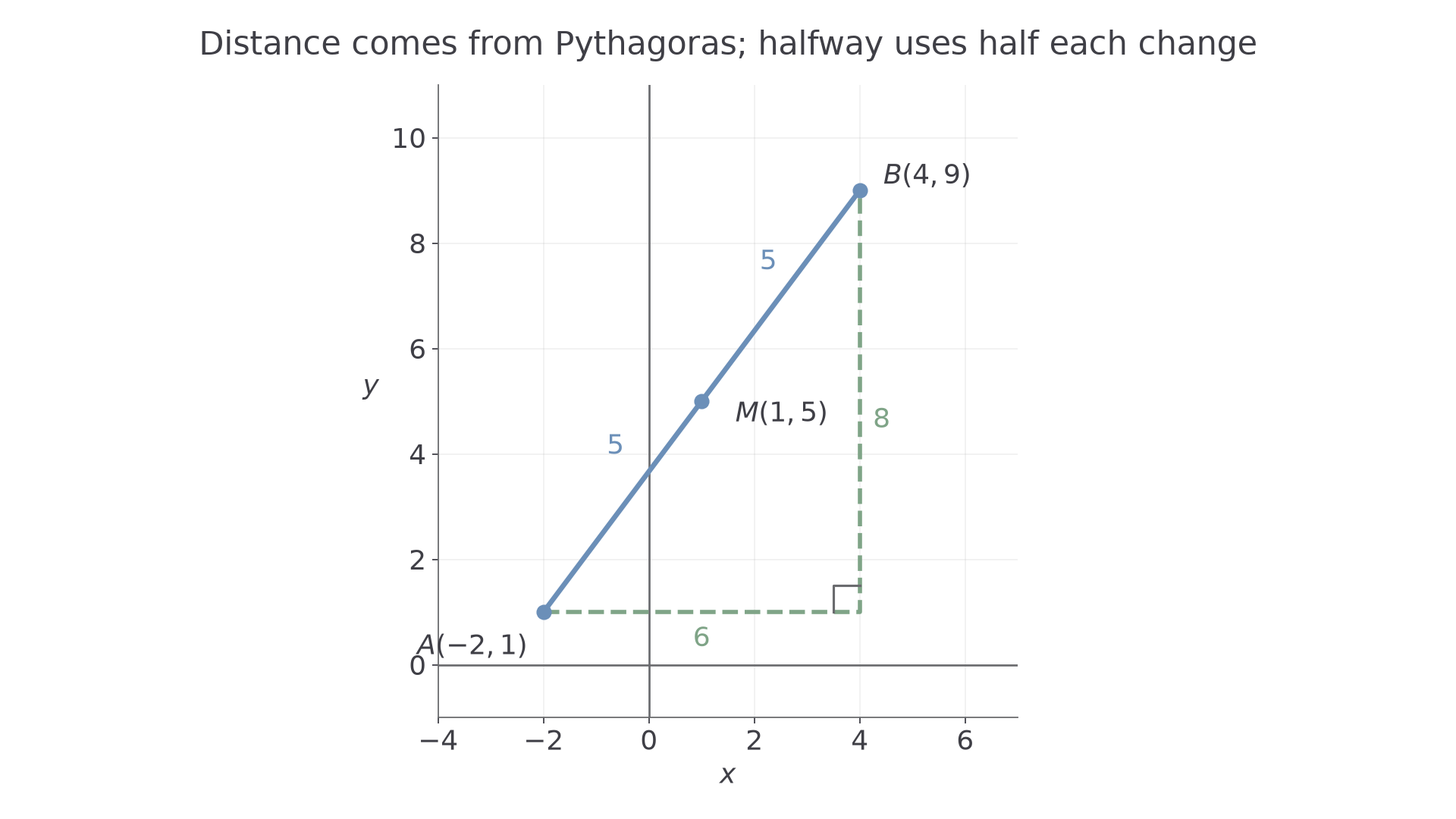
Two delivery points are at and . A road route goes units across and up, a total of . How much shorter is the straight route, and where should a meeting point halfway along it go?
The straight route is the hypotenuse of a right-angled triangle. The coordinate differences give its other two sides. That small triangle is the bridge from GCSE Pythagoras to coordinate geometry.
You already know
For a right-angled triangle with hypotenuse , . Pythagoras' theorem is on the formulae sheet. Keep a non-square square root exact, simplifying it as in the surds lesson.
Subtract coordinates in matching pairs: horizontal change , vertical change . The distance is , so going straight saves units. Notice that distance is never negative, even when one or both changes are negative.
[DIAGRAM: asset_name: Distance and the halfway point; asset_slug: cg18-distance-midpoint; caption: A straight distance of 10 replaces a horizontal and vertical route of 14; description: A coordinate grid shows A at minus 2 comma 1, B at 4 comma 9 and M at 1 comma 5. A blue segment joins A to B with equal halves marked. Dashed sage horizontal and vertical legs have lengths 6 and 8 and meet at a right angle at 4 comma 1.]
Distance between two points
For points and in two dimensions. It also works for horizontal or vertical segments, when one difference is zero, and gives zero when the points coincide.
Not on the formulae sheet: learn it.
The squares make the choice of direction harmless: reversing both subtractions gives the same distance. Consistency still helps prevent slips.
Worked example 1: an exact distance
Question. Find the exact distance between and .
Plan. Find the two coordinate changes, then apply Pythagoras.
Why square the changes? They are perpendicular sides, not pieces of the straight route to add together.
Answer. units.
Check. ; the distance lies between and , as the triangle requires.
The next example changes the vertical change to zero. The same formula still works; there is no need to invent a different distance rule.
Worked example 2: a horizontal segment
Question. Find the distance between and .
Plan. Use the coordinate differences, keeping the zero vertical change.
Why retain the zero? It shows that horizontal distance is a special case of the general result.
Answer. units.
Check. Counting from to on the horizontal axis also gives .
The subtraction inside the square is where negative coordinates need care.
Watch out
Wrong: . Subtracting a negative means adding: . Put negative coordinates in brackets before substituting.
Try a vertical segment this time.
The mid-point of a segment
The halfway point uses half of each coordinate change, so each of its coordinates is the average of the corresponding endpoint coordinates.
For the opening journey, half of the horizontal change is and half of the vertical change is . Starting at therefore puts the meeting point at . Algebra gives the same result: , and similarly for .
Mid-point
The mid-point of a line segment lies on the segment and divides it into two equal lengths. Being equally far from the endpoints is not enough: there are other equidistant points off the segment.
Averages work with negative coordinates too. Halfway between and is , not ; the sign tells you where the point lies.
Mid-point coordinates
For endpoints and , average horizontal coordinates together and vertical coordinates together.
Not on the formulae sheet: learn it.
There is a lovely consequence: a segment's mid-point can have fractional coordinates even when both endpoints lie on grid intersections. A grid does not restrict the points between its lines.
Worked example 3: a whole-number mid-point
Question. Find the mid-point of and .
Plan. Average each matching pair of coordinates.
Why keep the pairs separate? Each coordinate measures a different direction.
Answer. .
Check. From to the changes are ; from to they are also .
Only one feature changes next: an odd coordinate sum makes one coordinate a half-integer.
Worked example 4: a fractional mid-point
Question. Find the mid-point of and .
Plan. Average the coordinate pairs without rounding.
Why leave ? A mid-point does not have to be a grid intersection.
Answer. .
Check. Both half-segments have horizontal change and vertical change .
The mid-point and length answer different questions: location and measurement.
Continue this lesson.
You’re previewing NovaLearn without an account. Create a free account to read the rest.
Create free account