AL9 - Graphing inequalities in two variables
Show all the coordinate pairs satisfying a linear inequality by drawing a boundary and choosing a side. You will distinguish strict from inclusive boundaries, shade unwanted regions and identify the points satisfying several inequalities at once. A picture can display infinitely many answers without listing them.
Boundaries and half-planes
How can one triangular patch represent infinitely many solutions to three inequalities? The key is to think of each inequality as a test for points, rather than an instruction to find one number.
For , the point works because ; fails because . Points on sit exactly on the boundary. Moving to one side makes the sum smaller; moving to the other makes it larger.
Boundary line and half-plane
The boundary line is obtained by replacing an inequality sign with equality. It separates the coordinate plane into two half-planes. For example, is the boundary of , and the allowed points lie on the line or on one side of it.
A linear expression changes continuously as you move across the plane. To go from a value below to one above , you must cross the line where it equals . That is why one test point on either side is enough to choose the whole half-plane.
| Inequality | Boundary | How to draw it | Allowed side |
|---|---|---|---|
| Solid, because equality is allowed | On or below | ||
| Dashed, because equality is excluded | Above, excluding the line | ||
| Solid vertical line | On or to the right | ||
| Dashed horizontal line | Below, excluding the line |
These boundary and shading rules are not on the formulae sheet: learn them. In this lesson, shading means unwanted points, so the wanted region stays clear. Always read the question's shading instruction; if it asks for the wanted region to be shaded, follow that instead and label it clearly.
[DIAGRAM: asset_name: Inclusive and strict half-plane boundaries; asset_slug: inequality-boundaries; caption: A solid boundary belongs to the solution; a dashed boundary does not; description: Two coordinate panels. The left shows the solid line y equals x plus 1 with unwanted points above shaded pale clay and the clear wanted side labelled y less than or equal to x plus 1. The right shows dashed vertical line x equals 2 with points on the left shaded pale clay and the clear right side labelled x greater than 2.]
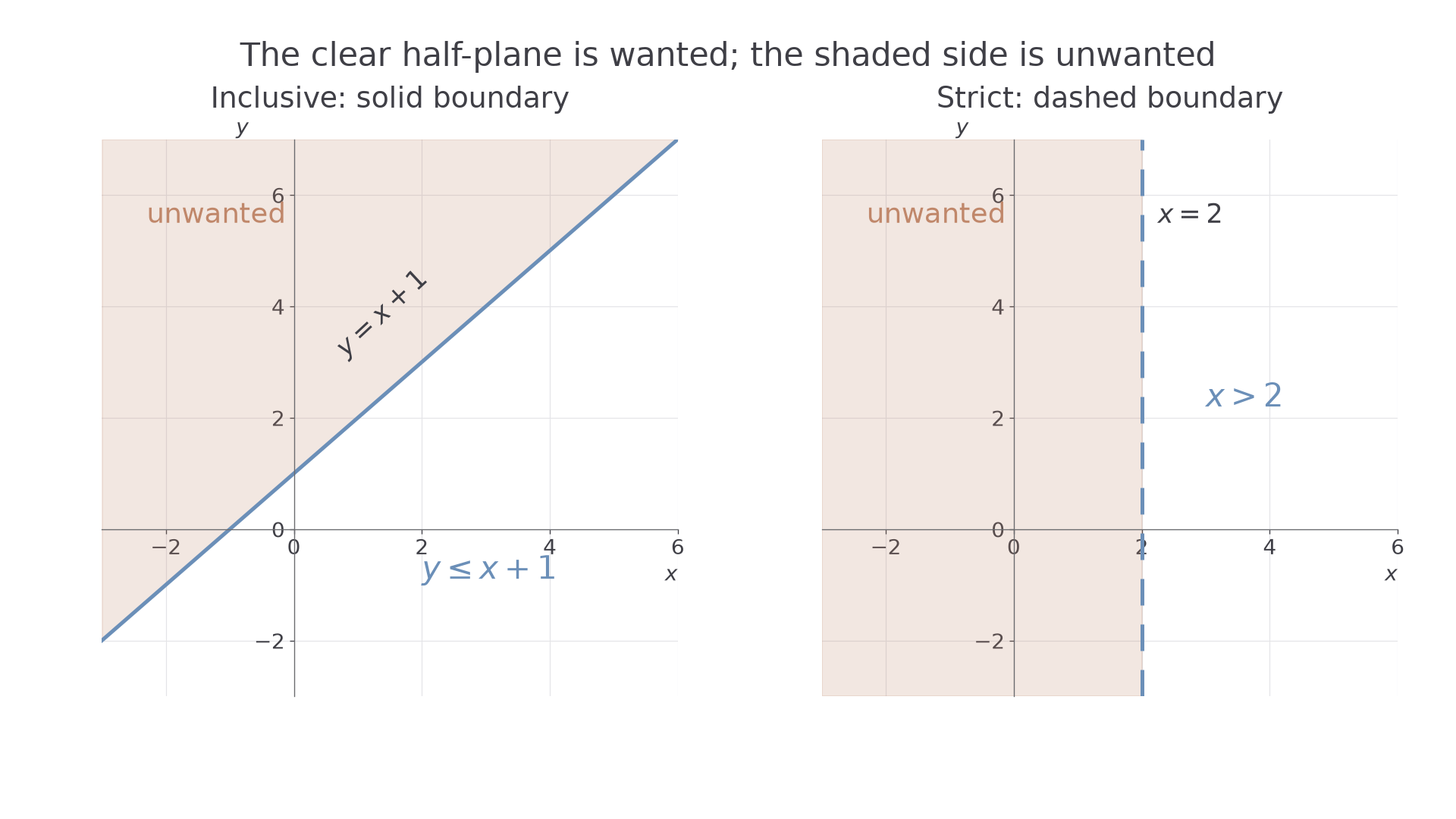
A vertical line needs special care: means right, not above. The inequality restricts the horizontal coordinate regardless of the vertical one.
Key idea
First decide whether the boundary is included; then decide which side is allowed. These are two separate decisions.
Check whether you can make both decisions in a case where is absent.
Choosing the correct side of a line
To illustrate an inequality, draw its boundary accurately and test a point that is not on that boundary.
You already know
Two distinct points fix a straight line. You can rearrange an inequality by applying the same operation to both sides, reversing its direction when you divide by a negative number.
For a sloping line, two intercepts are often convenient. Put to find the -intercept and to find the -intercept. If both intercepts are the origin, choose another convenient value of instead. You need two distinct points to draw a straight line.
Worked example 1: an inclusive half-plane
Question. Describe how to illustrate , shading the unwanted region.
Plan. Draw using its intercepts, test the origin and shade the other side.
Draw a solid line through and . Keep the side containing clear and shade the side above the line, where .
Why test the origin? It makes the arithmetic short and is not on this boundary. You could use any other off-line point.
Answer. A solid boundary , with the side above it shaded as unwanted. The line and the side containing the origin are allowed.
Check. is on the clear side and gives . The shaded point gives .
The second example changes the comparison to . The geometric line stays in the same place, but its style and the wanted side both change.
Worked example 2: a strict half-plane
Question. Describe how to illustrate , shading the unwanted region.
Plan. Use the same boundary intercepts, draw a dashed line and test the origin again.
Draw the boundary dashed. Shade the side containing the origin and leave the side above the line clear.
Why dashed? A point on the boundary gives , which fails the strict inequality.
Answer. A dashed boundary , with the side below it shaded as unwanted. Only points strictly above are allowed.
Check. gives , so it is clear. The boundary point gives , so it is excluded.
If the origin is on the line, it cannot tell you which side works. For , choose , which gives , rather than , which is on the boundary. The side containing is allowed. This method is reliable even when “above” is awkward to see from the original expression.
Watch out
Wrong: test in , see is false, and reject both sides. The point is on the boundary. Right: choose an off-line point, such as , then select its side.
Now change the coefficients and use intercepts to position the boundary.
The region satisfying every inequality
When several inequalities apply, a point is allowed only if it passes every one of them.
For , and , the first two inequalities keep you in the first quadrant, including the axes. The third cuts that quadrant along a sloping line. Their common region is a triangle, but it contains infinitely many coordinate pairs. Even its bottom edge contains for every real between and . A small patch can hold an infinite answer set.
Common region
The common region is the set of points satisfying all the given inequalities simultaneously. It is the intersection of the allowed half-planes, not their combined area.
Shade each unwanted half-plane lightly. Points rejected by even one condition stay shaded; the common region is the remaining clear part. Label it so the intended answer is unmistakable.
Worked example 3: three boundaries
Question. Describe the common region satisfying , and . Give its vertices.
Plan. Restrict to the first quadrant, then find where the sloping boundary meets the axes.
All boundaries are solid. Shade left of the vertical axis, below the horizontal axis and above . The clear triangle is .
Why check all the inequalities? An intersection of two boundary lines is a vertex of the common region only if it also satisfies the other conditions.
Answer. The closed triangle with vertices , and , including its edges.
Check. The interior point satisfies , and .
The next example changes one feature: add . It cuts away part of the previous triangle, rather than adding another allowed piece.
Worked example 4: an additional restriction
Question. Find the common region for , , and . Give its vertices.
Plan. Keep the triangle from Worked example 3 and remove the part below .
Draw solid and shade below it in addition to the previous unwanted regions.
Why does the region shrink? A point now has four tests to pass. Adding a condition can retain or remove old points; it cannot introduce points that failed an earlier condition.
Answer. The closed triangle with vertices , and .
Check. remains allowed. The old allowed point is now rejected because .
[DIAGRAM: asset_name: Common region from four inequalities; asset_slug: common-inequality-region; caption: Every shaded point fails at least one condition; the clear triangle R satisfies them all; description: Coordinate axes and solid boundaries x equals zero, y equals zero, x plus y equals 6 and y equals x. Unwanted half-planes are shaded pale clay, leaving a clear triangular region labelled R with vertices 0 comma 0, 0 comma 6 and 3 comma 3. Boundary labels sit away from the vertices.]
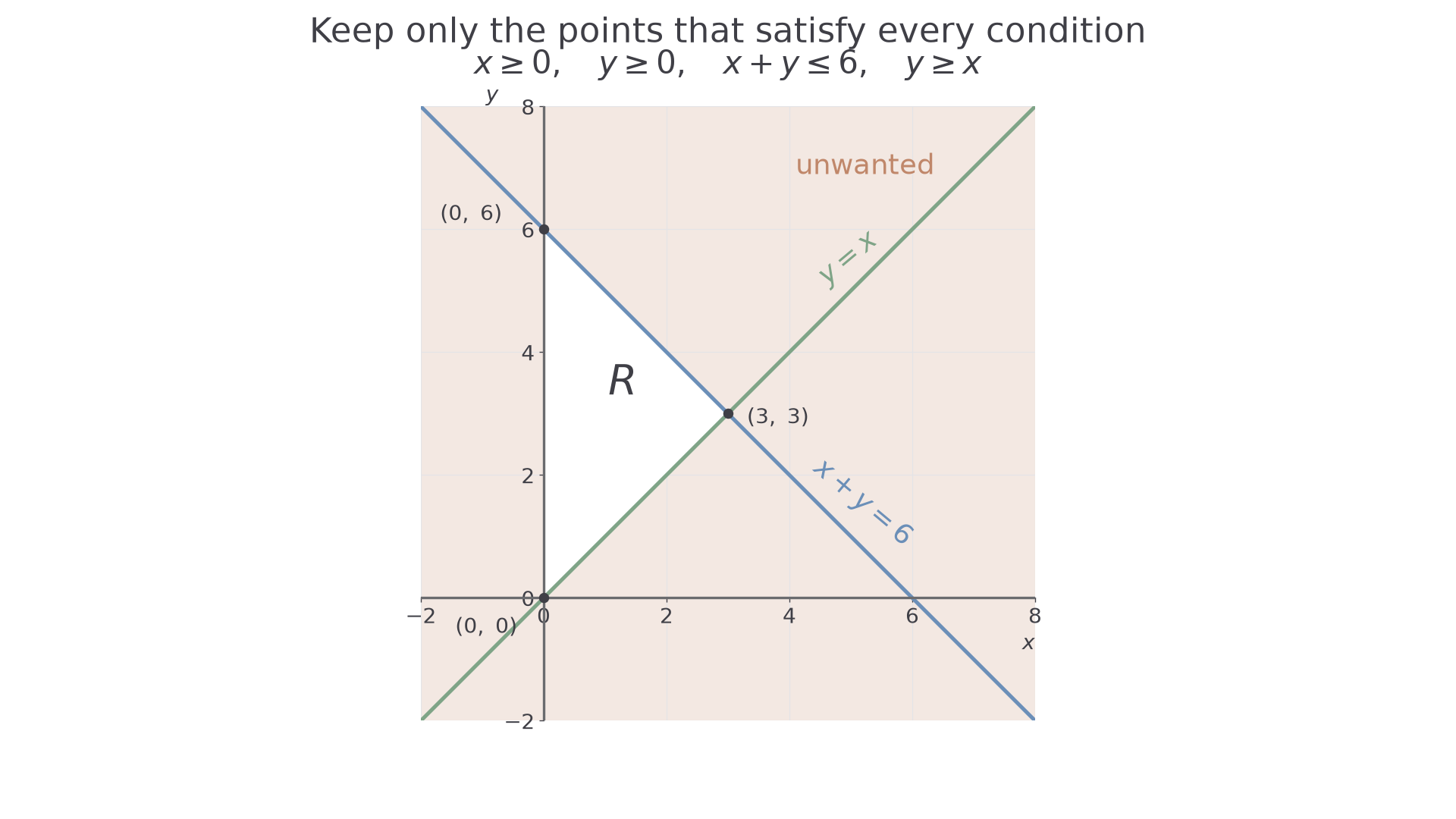
A common region need not be a triangle or even be bounded. For example, , leaves an unbounded quadrant. The contradictory pair , leaves no common region. Do not force a closed polygon when the inequalities do not make one.
Watch out
Wrong: keep a point because it satisfies one of the inequalities. Right: substitute into every condition. “All” means the overlap of allowed sides, not their union.
The next question changes the diagonal boundary's intercepts. Describe the region without needing to submit a drawing.
Quick Recap
- Replace the inequality sign by equality to draw the boundary; use solid lines for inclusive signs and dashed lines for strict signs.
- Test an off-line point to select a half-plane; use left or right for vertical boundaries.
- Shade the unwanted side when instructed, leaving the wanted region clear and labelled.
- For several conditions, keep only points satisfying every inequality; check candidate vertices against all conditions.
The opening triangle represents infinitely many simultaneous solutions because it contains every allowed real coordinate pair, not just its three vertices.