CA14 - Kinematics with variable acceleration
Use differentiation and integration to connect displacement, velocity and acceleration along a straight line. You will find instants of rest and greatest velocity, use initial conditions, and distinguish displacement from total distance when an object reverses direction. Signs tell the story of the motion.
Displacement, velocity and acceleration
Can an object be at rest while its acceleration is non-zero? Yes: at an instant when it turns round. Stranger still, an object can have zero acceleration while moving backwards. These are different questions about motion, and calculus lets you keep them separate.
Choose an origin and one positive direction along the line before calculating. A displacement of means a position in the negative direction from that origin. It does not mean a negative distance travelled.
You already know
A derivative measures rate of change, while integration reverses differentiation. A stationary value of a function is found by setting its derivative equal to zero; checking its nature is a separate step.
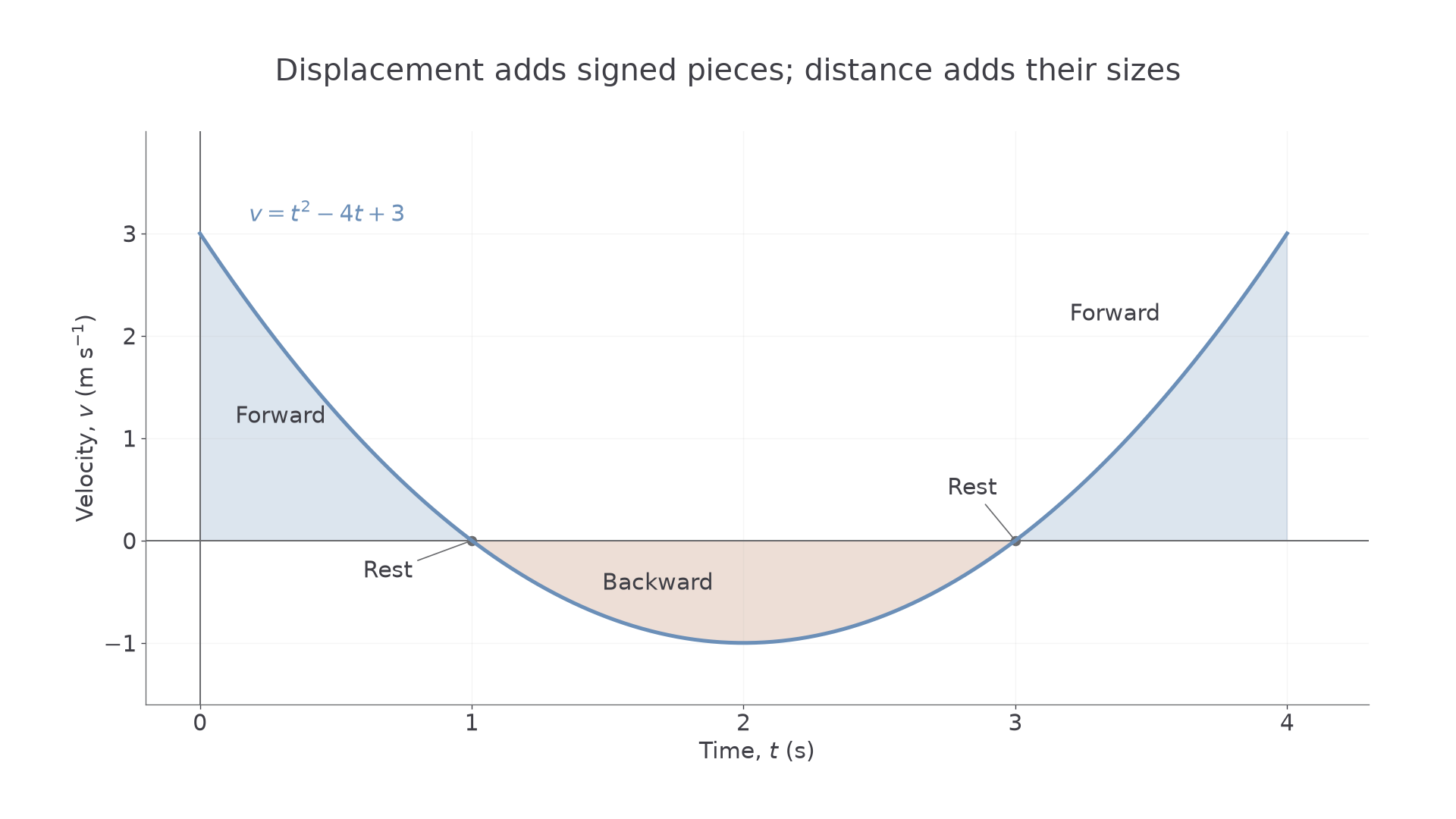
A velocity-time graph makes the signs visible. For , the object is at rest at and . Between those times its velocity is negative: it moves in the chosen negative direction.
[DIAGRAM: asset_name: Velocity signs and direction; asset_slug: kinematics-velocity-signs; caption: The object moves backwards between its two instants of rest; description: The velocity curve v equals t squared minus 4t plus 3 from time 0 to 4 seconds crosses the axis at times 1 and 3. Positive regions are blue and labelled Forward. The negative middle region is clay and labelled Backward. The two crossings are marked Rest.]
Displacement, velocity and acceleration
Displacement is signed position relative to a chosen origin. Velocity is the rate of change of displacement; its sign gives direction. Acceleration is the rate of change of velocity. Speed is the magnitude , so it is never negative. At rest means ; it does not mean .
The graph above has , giving this exact comparison:
| Time | Velocity | Acceleration | What it means |
|---|---|---|---|
| At rest while changing direction | |||
| Moving backwards, with stationary velocity | |||
| At rest while changing direction again |
An acceleration is not a speed. Positive acceleration means velocity is increasing: a negative velocity can increase towards zero while the object slows down. Likewise, negative acceleration can increase speed when the object is already moving negatively. Compare the signs of and , not just the sign of .
The kinematic derivatives
These describe motion along a straight line, using a fixed positive direction. If is in metres and in seconds, is in and in . They are printed in the question paper's formulae.
On the formulae sheet.
At an instant of zero acceleration, the velocity-time graph has zero gradient; the displacement-time graph need not have zero gradient. That is the distinction in the opening puzzle.
Key idea
Set for rest. Set for a stationary velocity, then check whether it is a maximum or minimum.
Now read the signs before reaching for a formula.
Rest and maximum velocity from displacement
Differentiate displacement once for velocity and twice for acceleration, then solve the equation that matches the question.
A displacement formula can contain or , so its acceleration can vary with time. A constant-acceleration formula cannot replace this differentiation. To determine a greatest velocity, use calculus to find stationary velocities and compare them with the interval endpoints; checking a few integer times could miss the true maximum.
Worked example 1: rest and greatest velocity
Question. A particle has displacement metres for , where is in seconds. Find the times when it is at rest and determine its maximum velocity.
Plan. Differentiate for and , solve for rest, then locate and check the maximum of .
Why solve for the maximum? Acceleration is the derivative of velocity. Here changes from positive to negative at , so velocity changes from increasing to decreasing.
Answer. The particle is at rest at and . Its maximum velocity is , at .
Check. Endpoint velocities are and , both less than . Maximum velocity and maximum speed are not the same demand: the speed at is .
The next example changes just the coefficient of . Follow how that moves both the time of rest and the maximum.
Worked example 2: the maximum occurs later
Question. A particle has metres for . Find its instants of rest and determine its maximum velocity.
Plan. Differentiate twice and use the signs of acceleration to establish the greatest velocity.
Why is this a maximum? Acceleration is positive before and negative after , so the velocity rises then falls.
Answer. The particle is at rest at and ; its maximum velocity is , at .
Check. Both endpoint velocities are zero, confirming that the interior maximum is the greatest value on the stated interval.
Keep the quantity being maximised in view throughout the calculation.
Watch out
Wrong: “Set to find maximum velocity.” This locates rest. Right: set , check that velocity changes from increasing to decreasing, then substitute the time into .
When a question says “Determine”, show the differentiation and the maximum argument, rather than only a list of sampled velocities.
Using initial conditions when integrating
Integrate acceleration to find velocity, then integrate velocity to find displacement; each integration introduces its own constant.
The word initial refers to the chosen start time, usually . “Initially at rest” means . “Initially at the origin” means . Neither condition implies the other.
Continue this lesson.
You’re previewing NovaLearn without an account. Create a free account to read the rest.
Create free account