PT1 - Trigonometric ratios of any angle
Extend sine, cosine and tangent beyond right-angled triangles by following a point around a circle. You will find signed and exact values, then sketch and plot the three trigonometric graphs in degrees.
Sine and cosine as coordinates
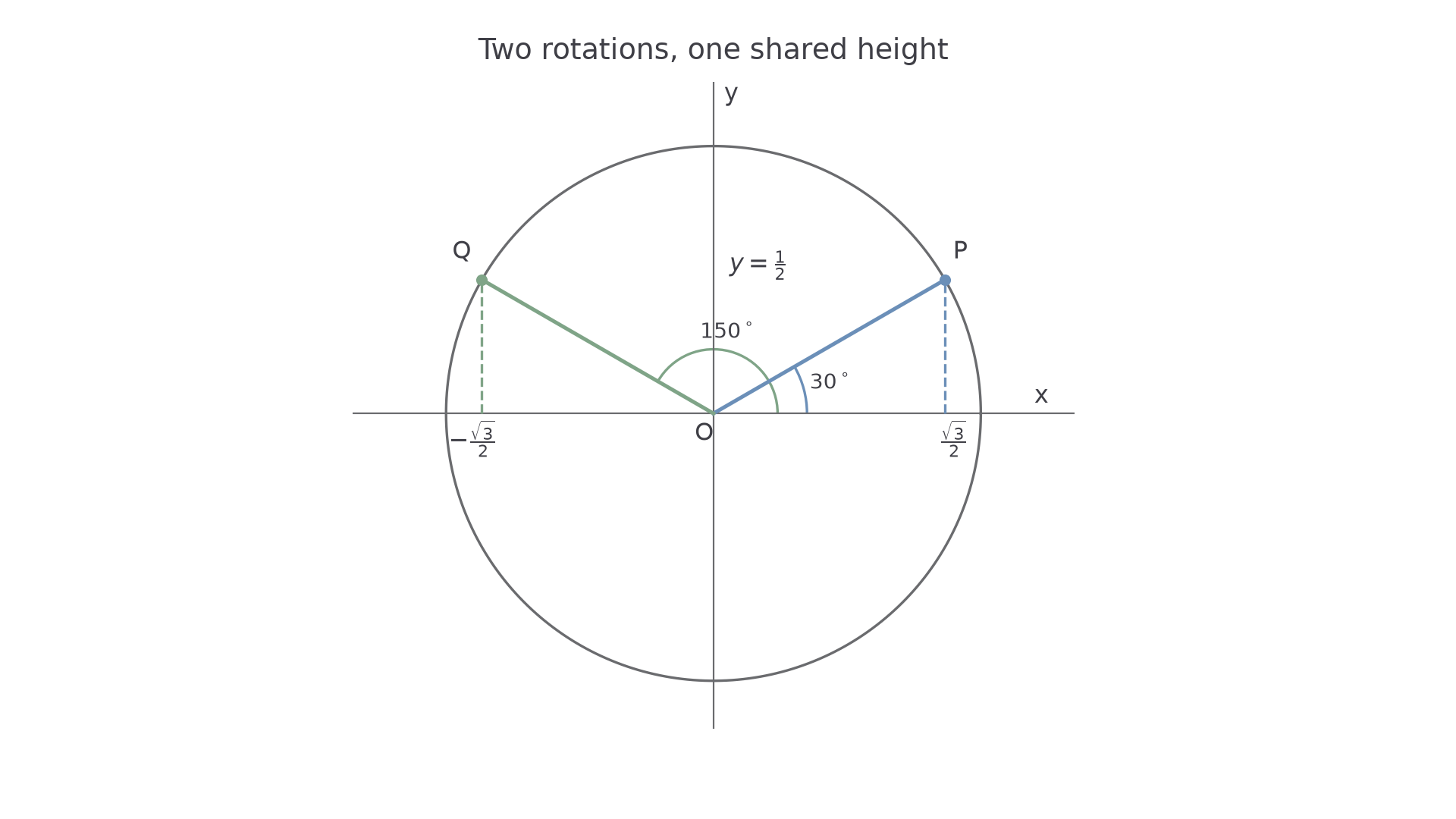
A point travels round a circle of radius . At its height is . Where is it at , and why is its height still ? A right-angled triangle alone cannot contain an angle of , but a rotation can.
You already know
In a right-angled triangle, sine is opposite divided by hypotenuse, cosine is adjacent divided by hypotenuse and tangent is opposite divided by adjacent. Set your calculator to degrees for this course.
Start at . Rotate anticlockwise through an angle ; a negative angle means clockwise. If the new point is , its horizontal coordinate is and its vertical coordinate is . In the first quadrant, dropping a perpendicular produces your familiar right-angled triangle with hypotenuse . The coordinate definition agrees with GCSE trigonometry and still works after the point passes either axis.
[DIAGRAM: asset_name: Sine and cosine round the unit circle; asset_slug: any-angle-unit-circle; caption: Angles of 30 degrees and 150 degrees have the same height but opposite horizontal coordinates; description: A unit circle centred at O has horizontal and vertical coordinate axes. Points P and Q are at rotations of 30 and 150 degrees. Blue radii join O to the points, sage dotted perpendiculars show a shared height of one half and opposite horizontal coordinates root 3 over 2 and minus root 3 over 2. Anticlockwise angle arcs show the rotations.]
Unit-circle definitions
On the circle of radius centred at the origin, the point reached by an anticlockwise rotation of from the positive horizontal axis has coordinates
For example, gives , so and . This definition includes angles outside a single turn.
A complete turn returns the point to exactly the same place. So , and all have the same sine and cosine. This is a useful surprise: infinitely many different rotations can have exactly the same coordinates. The rotation records the journey; the trigonometric values record the destination.
Repeating sine and cosine
These hold for every angle and every integer . A full turn does not change either coordinate.
Not on the formulae sheet: learn it.
The axes also tell you the signs. In quadrant I both coordinates are positive; in II the horizontal coordinate is negative; in III both are negative; in IV only the vertical coordinate is negative. Points on the axes belong to neither neighbouring quadrant.
Key idea
Sine measures signed height and cosine measures signed horizontal position. A negative value describes a direction, not a negative side length.
Use the coordinates to diagnose this claim rather than trying to draw an obtuse angle inside a right-angled triangle.
Signed and exact trigonometric values
Use a small acute reference angle to find the size of a ratio, then use the coordinates to decide its sign.
The reference angle is the acute angle between the terminal radius and the horizontal axis. For example, has reference angle ; has reference angle . On an axis, read the coordinates directly instead. Tangent is the ratio of signed vertical to signed horizontal position, so it is positive in quadrants I and III and negative in II and IV.
Tangent from coordinates
Here and . Thus tangent is undefined at , for integer . The right-angled ratio is on the formulae sheet; this coordinate extension is not.
Not on the formulae sheet: learn it.
The familiar exact values come from a right-angled isosceles triangle with sides , and half of an equilateral triangle with sides . Their ratios give this table; do not round them before using them.
| Angle | Sine | Cosine | Tangent |
|---|---|---|---|
| Undefined |
These exact values are not on the formulae sheet: learn them, or reconstruct them from the two triangles. Reflection in an axis preserves the reference triangle's lengths and changes only the appropriate coordinate sign.
Worked example 1: a quadrant II angle
Question. Find the exact values of , and .
Plan. Use reference angle , then assign the signs from quadrant II.
Why decide signs separately? The reference triangle has positive lengths, whereas the circle has signed coordinates.
Answer. , and , respectively.
Check. A calculator in degree mode gives approximately , and , with the expected signs.
The next example changes only the direction of rotation. Reflecting the point in the horizontal axis changes the height's sign but keeps its horizontal position.
Worked example 2: a negative angle
Question. Find the exact values of , and .
Plan. Add one full turn to locate the point, then use reference angle .
Why add ? It identifies the quadrant without changing the point or any ratio.
Answer. , and , respectively.
Check. Reflection from reverses sine and tangent, while cosine stays negative.
An undefined value must stay undefined, however much a calculator encourages you to type it.
Watch out
Wrong: , because the horizontal coordinate is zero. Right: is undefined. By contrast, .
Try the same method with a different reference angle.
Sketching and plotting sine and cosine
A trigonometric graph records one coordinate as the angle changes, so its waves come directly from circular motion.
For sine, follow the height: at quarter-turn steps from to . For cosine, follow horizontal position: . Both repeat every , stay between and , and continue smoothly to negative angles and beyond one revolution.
Period and amplitude
The period is the smallest positive horizontal shift that repeats the whole graph. The amplitude of a sine or cosine graph is half the distance between its greatest and least values. Both and have period and amplitude .
A sketch shows the main features with labelled key coordinates. A plot uses calculated points on a scale: use enough points to capture the curve, then join them smoothly, rather than with straight chords. For these graphs, quarter-turn points alone give the outline; extra or points make a more accurate plot. Their periods, amplitudes and coordinate patterns are not on the formulae sheet: learn them.
Continue this lesson.
You’re previewing NovaLearn without an account. Create a free account to read the rest.
Create free account