PT2 - Ambiguous case of the sine rule
Recognise when two given sides and a non-included angle describe two different triangles. You will find both possibilities, reject impossible angle combinations, and determine when there are no triangles or exactly one.
Why the same information can give two triangles
A triangle has , and . Can its unknown side have two different lengths? It can: the vertex can occupy two positions, while all three measurements remain exactly the same.
You already know
In triangle , , and . The sine rule pairs sides with opposite angles. An acute angle and its obtuse supplement have the same sine.
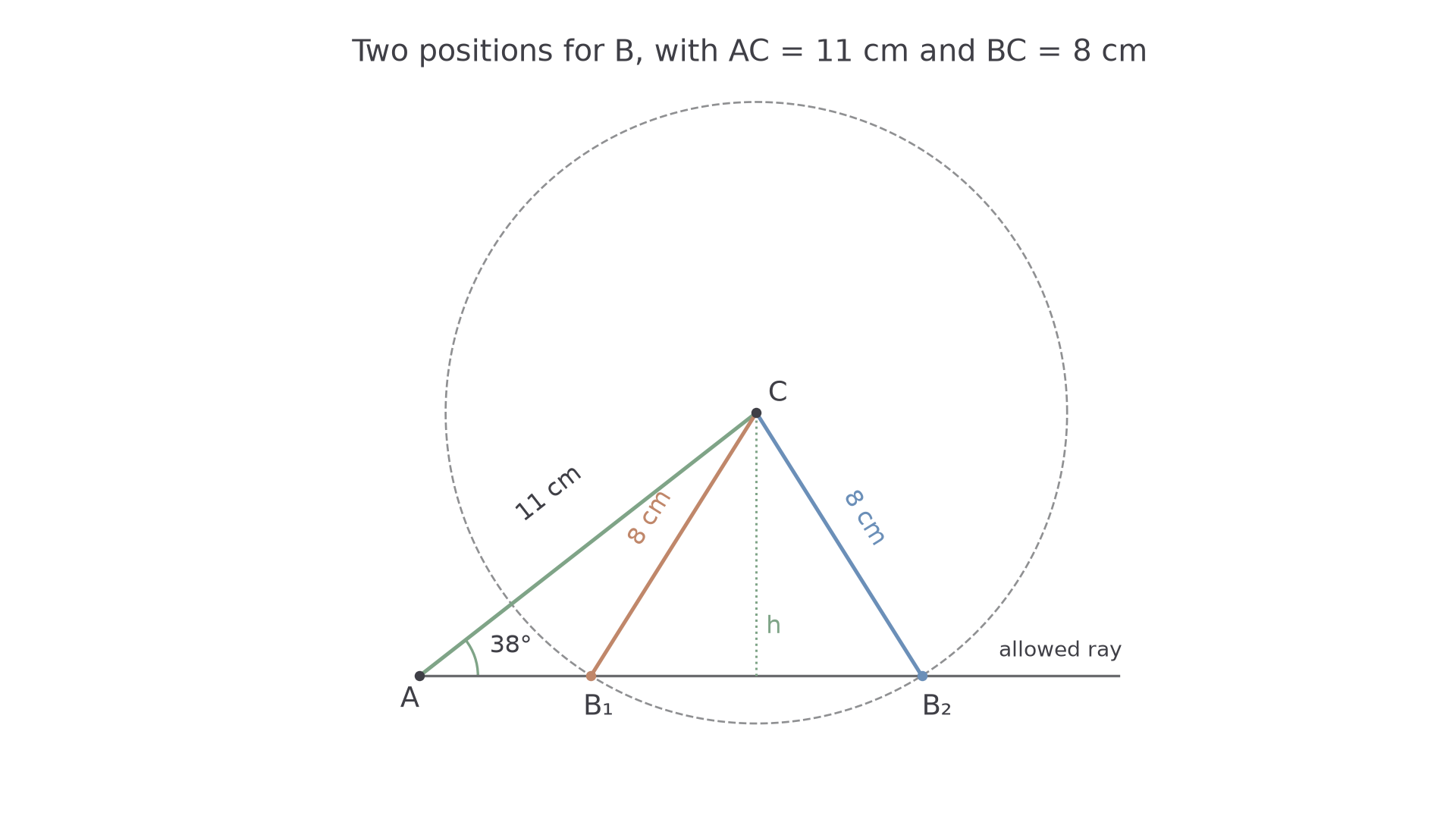
Fix and , then draw the ray from that makes with . Vertex must lie on that ray and be from , so it is an intersection of the ray with the circle of radius centred at . Here there are two intersections. The near position gives an obtuse angle at ; the far position gives an acute one.
[DIAGRAM: asset_name: Two triangles from one side-side-angle description; asset_slug: ambiguous-two-triangles; caption: A circle meets the allowed ray twice, giving two possible positions for B; description: A is at the origin, AC is a fixed side of length 11 at an angle of 38 degrees above a horizontal ray. A circle centred at C of radius 8 meets the positive ray at a near point B1 and a far point B2. The two possible sides from C to B are shown in clay and blue, both labelled 8 centimetres. The two resulting triangles are scalene and neither is right-angled. A dashed perpendicular shows the height from C to the ray.]
Ambiguous case of the sine rule
The ambiguous case occurs when two sides and an angle opposite one of them allow two distinct triangles. It is often called the side-side-angle case: the given angle is not the included angle. For example, the data above allow two triangles. Two sides and their included angle do not have this ambiguity.
The algebra says the same thing as the picture. Suppose sine rule gives , where . The calculator returns the acute principal angle . But has the same sine. Each candidate still has to fit the given angle : its remaining angle must be strictly positive.
At , the two candidates coincide at ; there are not two different triangles. If , no real angle has that sine, so the data are impossible. Even when , the angle-sum check can rule out one or both candidates.
Key idea
Inverse sine supplies a candidate, not a completed triangle. Check the supplementary candidate and require a positive third angle for each.
Find the missing possibility in a case where both angle sums work.
Finding and checking both possibilities
Write both candidate angles before rounding, and complete each triangle separately so that their angles and sides do not become mixed.
Using opposite pairs and , rearrange sine rule first. Keeping the ratio in the written working also shows exactly which measurements you used.
Rearranged sine rule
Here and are positive sides opposite and . This is the supplied sine rule rearranged to find an angle.
On the formulae sheet.
For a ratio strictly between and , the candidate triangle angles are
Retain a candidate only if . This candidate-selection rule is not on the formulae sheet: learn it. Keep unrounded angles in the calculator when finding later lengths.
Worked example 1: two valid triangles
Question. In triangle , , and . Find both possible values of and the corresponding values of . Give angles to 1 decimal place and lengths to 3 significant figures.
Plan. Calculate the two angles with the same sine, find each remaining angle, then use sine rule for each corresponding side.
Both remaining angles are positive. Now keep the two branches separate:
Why find twice? The unknown side is opposite , and changes when changes. Mixing the branches would describe neither triangle.
Answer. with , or with .
Check. In each triangle, agrees with . Both third sides satisfy , as required by the triangle inequality.
The next example changes only side , making it longer than . The supplementary candidate now fails the angle-sum check.
Worked example 2: one candidate must be rejected
Question. In triangle , , and . Find the possible value or values of , and the corresponding , with the same accuracy as before.
Plan. Calculate both sine candidates, reject any with a non-positive remaining angle, then complete the surviving triangle.
Why not report both inverse-sine possibilities? One has an angle sum already exceeding ; it cannot represent a triangle, even though its sine is correct.
Answer. Only is possible, with .
Check. requires , which the accepted candidate satisfies. The rejected angle does not.
The familiar second-angle error uses the wrong full turn.
Watch out
Wrong: after finding , use . A triangle angle must be less than . Right: use , then check the third angle.
When the question asks for two values, show the sine-rule rearrangement and state both final angles. A clear pair of labelled sketches can keep the possibilities apart.
Continue this lesson.
You’re previewing NovaLearn without an account. Create a free account to read the rest.
Create free account