CA15 - Constant acceleration formulae
Recognise when acceleration is constant and choose a formula using the quantities you know. You will calculate velocity, time and displacement, handle negative acceleration consistently, and find total distance when motion reverses. The formulae are short because the underlying velocity-time graph is a straight line.
When acceleration is constant
A model car needs to stop from . If it brakes with the same constant acceleration from , how far will it travel before stopping? Doubling the speed quadruples this model's braking distance. We will find the actual distance and see why the square appears.
You already know
Velocity is signed; speed is its magnitude. Acceleration is the derivative of velocity. An integral of velocity gives displacement change, while total distance requires splitting at any reversal.
Constant acceleration means the velocity changes by equal amounts in equal times throughout the interval. For example, has acceleration at every time. By contrast, has , so acceleration changes. Substituting its acceleration at one particular instant into a constant-acceleration formula would not describe the whole interval.
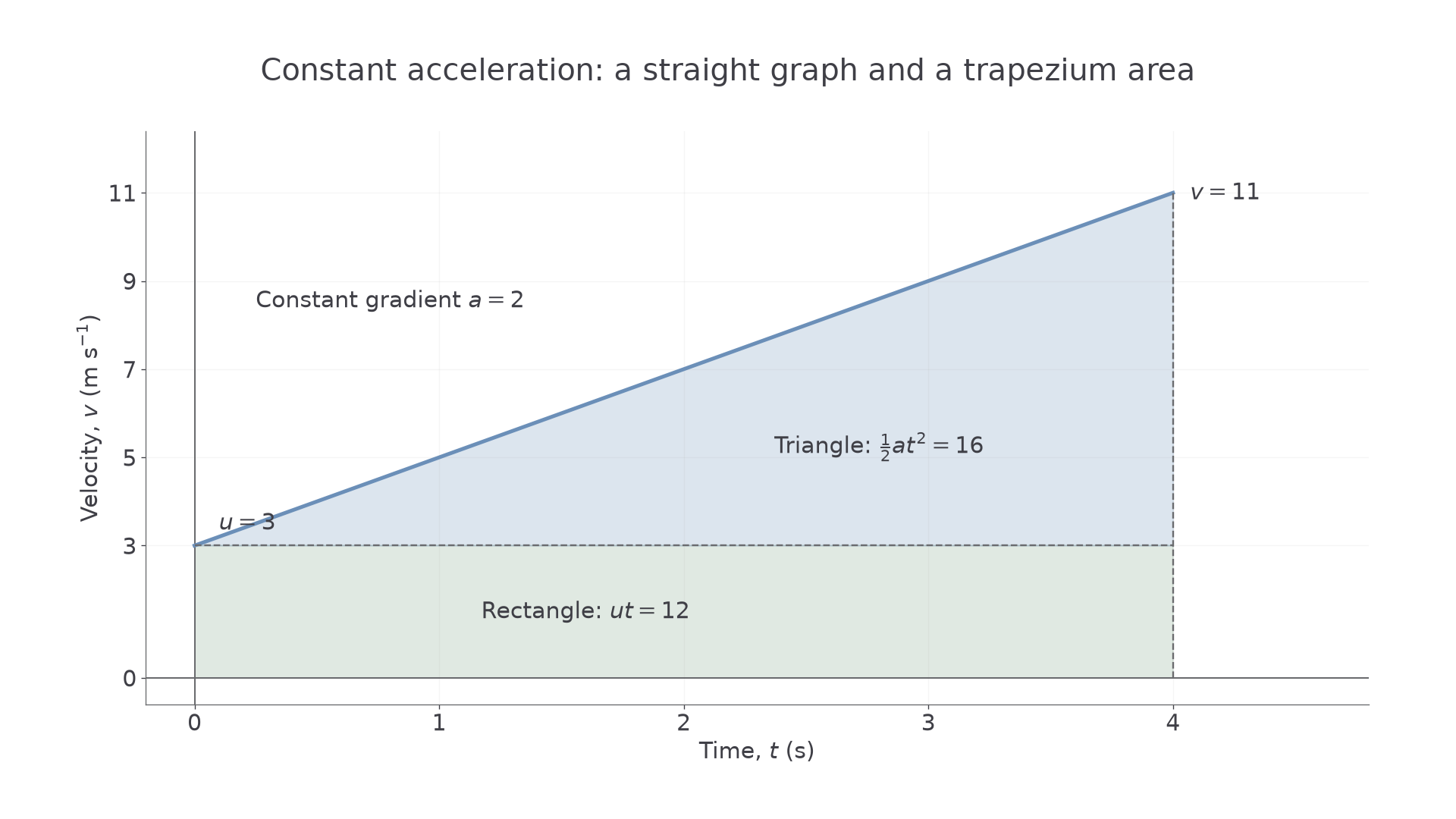
[DIAGRAM: asset_name: Constant acceleration as a straight velocity graph; asset_slug: constant-acceleration-area; caption: Displacement is the rectangle plus triangle under the straight velocity-time graph; description: A velocity-time line starts at velocity 3 when time is 0 and reaches velocity 11 at time 4. Its constant gradient is 2. A sage rectangle below velocity 3 has area ut equals 12. A blue triangle above it has area one half at squared equals 16.]
The five motion quantities
For one interval of straight-line motion, is initial velocity, is final velocity, is constant acceleration, is elapsed time, and is displacement change during the interval. Choose one positive direction and use signed velocities, acceleration and displacement throughout. Time is non-negative.
The graph explains two of the formulae. Its gradient is , so its rise is and its final height is . Its signed area is a rectangle plus a triangle . In the drawn example this gives .
Velocity and displacement after a known time
Use these only while acceleration is constant. Velocities and acceleration must use consistent directions and units. Both are printed in the question paper's formulae.
On the formulae sheet.
Calculus gives the same result: integrating constant gives , and makes . Integrating again gives the position change , taking at the interval's start.
If acceleration changes between stages, apply a formula separately to each constant-acceleration stage. Its final velocity becomes the next stage's initial velocity, and its elapsed time starts afresh. A constant negative acceleration is just as eligible as a constant positive one.
Key idea
Check that acceleration is constant over the whole interval before choosing a constant-acceleration formula.
Look for a constant derivative, rather than merely a familiar polynomial.
Choosing a formula when time is known
List the known quantities and choose a formula that leaves only one unknown.
The five formulae describe the same straight velocity-time graph, but each omits a different quantity. Choosing well saves algebra. Here are the other two formulae involving time.
Two more time formulae
The first uses initial and final velocities; the second omits initial velocity. Both require constant acceleration and are printed in the question paper's formulae.
On the formulae sheet.
The average velocity is because velocity varies linearly. This average need not give total distance if the velocity changes sign; the signed area still gives displacement.
| Known quantities | Useful formula | Quantity omitted |
|---|---|---|
Worked example 1: constant positive acceleration
Question. A particle has initial velocity and constant acceleration . Find its velocity and displacement after .
Plan. Use for velocity and for displacement.
Why these formulae? Each uses the three supplied quantities and has only the quantity being found as an unknown.
Answer. The velocity is and the displacement is .
Check. Average velocity is ; in this gives .
The next example changes only the acceleration, making it negative. Keep the original positive direction.
Worked example 2: constant negative acceleration
Question. A particle has initial velocity and constant acceleration . Find its velocity and displacement after .
Plan. Use the same formulae, retaining the negative acceleration in brackets.
Why is the displacement still positive? The velocity remains positive throughout these two seconds, although the particle is slowing down.
Answer. The velocity is and the displacement is .
Check. Using the formula that omits , . The average-velocity route also gives .
Writing a signed acceleration prevents an unnecessary extra sign change.
Watch out
Wrong: , after already choosing . The formula is . Right: .
Now change the starting velocity and time while keeping acceleration negative.
Finding displacement without time
When time is absent, use the formula connecting the two velocities, acceleration and displacement.
Continue this lesson.
You’re previewing NovaLearn without an account. Create a free account to read the rest.
Create free account