NM6–NM8 - The trapezium rule and area estimates
A curve can enclose an area even when you have only a table of its heights. NM6 builds estimates from rectangles, NM7 replaces their flat tops with trapezia, and NM8 uses the curve's shape to judge the error and improve the estimate. The width of a strip and the quality of the data matter throughout.
Estimating with rectangles
How much area lies under from to , if you use only the heights at whole numbers? Four readings do not describe every point, but they are enough to build two useful estimates.
You already know
For a curve above the axis, represents the area between the curve, the axis and the two ordinates. A rectangle's area is width times height. Here we estimate the area by adding strips rather than integrating a formula.
Divide the interval into strips. In each strip choose the height at its left endpoint or at its right endpoint. For an increasing curve above the axis, a left-endpoint rectangle sits below the curve and a right-endpoint rectangle sits above it. For a decreasing curve, those conclusions reverse.
[DIAGRAM: asset_name: Left and right rectangles; asset_slug: nm6-rectangles; caption: Left and right heights give an underestimate and an overestimate for this increasing curve; description: Two panels show y equals 1 plus x squared from 0 to 3, with three rectangles of width 1. Left-endpoint heights 1, 2 and 5 give area 8 below the curve. Right-endpoint heights 2, 5 and 10 give area 17 above the curve]
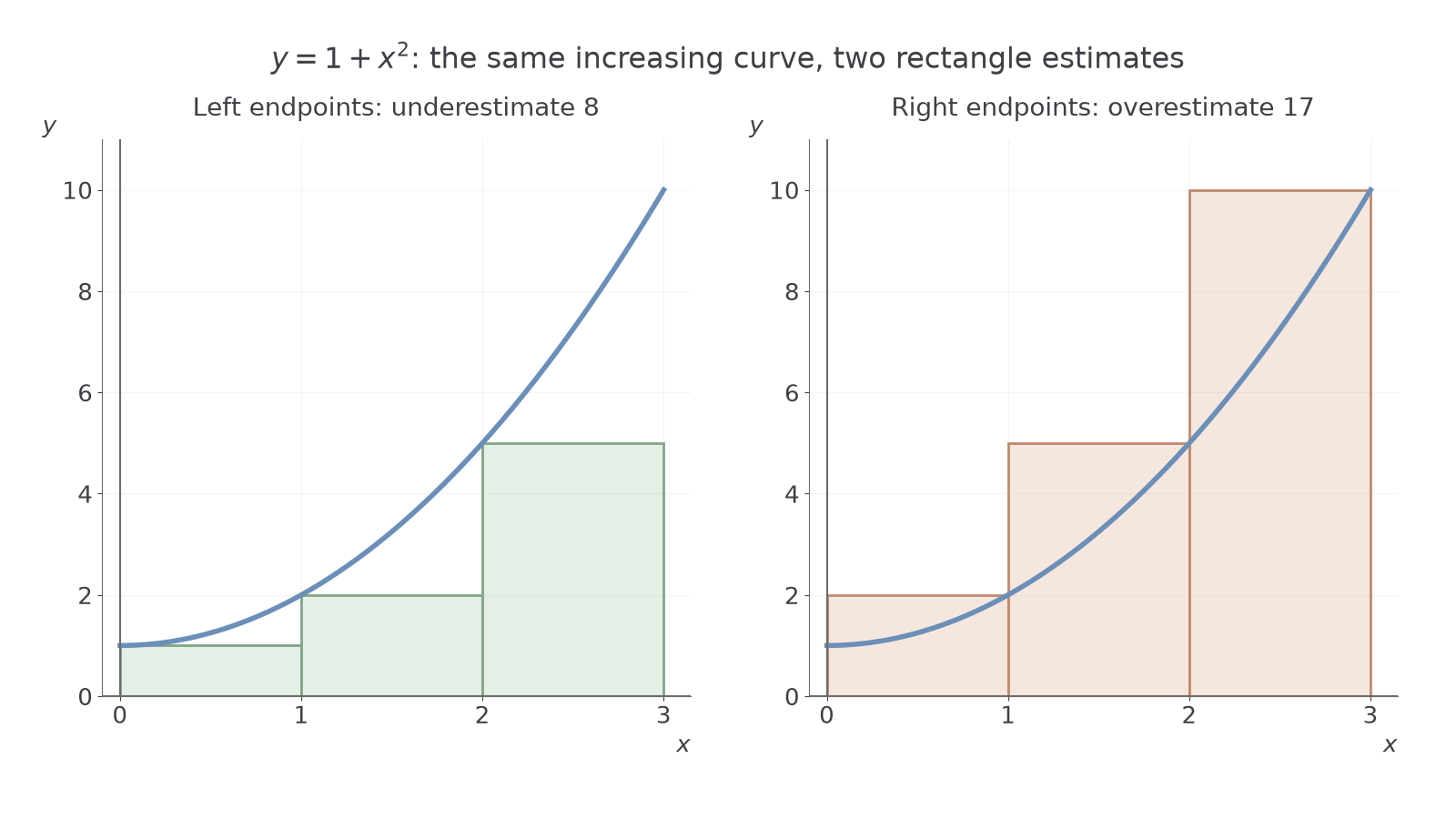
Name the endpoint choice: “rectangular strips” alone does not determine which heights you used.
Equal-width rectangle estimates
These use equal strips between and , with ordinates . For area above the axis, take non-negative heights. uses left endpoints and right endpoints.
Not on the formulae sheet: learn it.
There is one more reading than there are strips: adjacent strips share a boundary.
Worked example 1: left-endpoint rectangles
Question. Use three left-endpoint rectangular strips to estimate the area under from to . State whether the estimate is too small or too large.
Plan. Use width and the heights at , and .
Why omit the height at ? It is the right boundary of the final strip, whereas each left rectangle takes its height from the start of its strip.
Answer. The area estimate is square units. It is an underestimate because the curve is increasing and each left rectangle lies below it.
Check. There are three terms in the sum, matching three strips.
The next example changes only the endpoint choice. The curve and strip widths remain exactly the same.
Worked example 2: right-endpoint rectangles
Question. Use three right-endpoint rectangular strips for the same curve and interval, and state whether the result is too small or too large.
Plan. Use the heights at , and , keeping width .
Why is the result larger? On this increasing curve, moving each rectangle's chosen height to its right endpoint makes it taller throughout the strip.
Answer. The estimate is square units, an overestimate. The actual area lies between and .
Check. : all the shared internal heights cancel when the sums are subtracted.
A sum using every height once would not be either of these rectangle methods.
Watch out
Wrong: for three strips. That counts four rectangles. Right: use three left heights , or three right heights , and name which choice you made.
Now reverse the direction of the curve and decide which bound goes where.
Joining the heights with trapezia
A trapezium follows the slope between neighbouring readings, so it usually fits a smooth curve better than a rectangle of the same width.
For one strip the parallel sides have lengths and ; their perpendicular separation is . Its area is , using the trapezium-area formula on the extra formulae sheet. Adding adjacent strips counts each internal height twice, but the two outside heights once.
Trapezium rule
Use equal-width strips, so there are ordinates, and non-negative heights when calculating geometric area above the axis. This rule is printed on the question paper's formulae page.
On the formulae sheet.
A useful surprise follows straight from the sums: for equal-width strips, the trapezium estimate is exactly the mean of the left- and right-rectangle estimates, . Each trapezium averages the two endpoint heights. This relationship is derived here; it is not on the formulae sheet: learn it as a check, rather than another rule to substitute blindly.
Worked example 3: three trapezia
Question. Use three strips and the trapezium rule to estimate the area under from to .
Plan. Find the strip width, leave the endpoint heights single and double the internal heights.
Why double and ? Each is a boundary height shared by two neighbouring trapezia.
Answer. The area estimate is square units.
Check. The rectangle estimates were and , and .
The second example changes only the spacing. Six strips require seven readings, including the new half-step heights.
Continue this lesson.
You’re previewing NovaLearn without an account. Create a free account to read the rest.
Create free account