AL1, AL3 - Algebraic vocabulary and polynomial operations
Algebra lets you explain a whole pattern with one calculation. AL1 gives you the language for reading expressions, equations, identities and function notation; AL3 gives you the tools to add, subtract and multiply polynomials. You will build from familiar GCSE algebra to calculations with cubic expressions, keeping track of every term and sign.
Reading a polynomial
Why is , without working out either of those million-sized squares? The smaller cases suggest a pattern: and . The difference between consecutive squares is always an odd number. By the end of the lesson, you will be able to explain that pattern for every positive whole number, using algebra rather than a list of calculations.
First, we need to read an algebraic expression precisely. In , the letter can take different values, while the numbers and stay fixed. The expression has three terms: , and . Keep the sign with its term.
You already know
From GCSE, means , and means . Like terms have the same letter part and powers: and are like terms, but and are not.
The words below tell you which job each part of an expression is doing. A coefficient includes its sign, and an index belongs to the quantity immediately before it.
| Word | Meaning | In |
|---|---|---|
| Variable | A symbol whose value can vary | |
| Constant | A quantity whose value is fixed in the calculation | and are constants; is the constant term |
| Coefficient | The number multiplying a specified variable term | The coefficient of is ; the coefficient of is |
| Index | The power to which a quantity is raised; the plural is indices | The index in is |
A constant need not be written as a number. If a question says that is fixed in , then is a constant and is the variable. The role of the symbol matters more than the letter chosen.
Expression
An expression is a mathematical combination of numbers, variables and operations that represents a value. For example, is an expression. The statement is an equation, because it asserts that two expressions are equal.
The expressions used throughout this lesson are polynomials. They have ordinary whole-number powers of the variable, so you can collect their terms in a consistent way.
Polynomial
A polynomial in is a finite sum of terms of the form , where is a constant and is a non-negative integer. Its degree is the largest power of with a non-zero coefficient. For example, is a cubic polynomial, of degree . The expressions and are not polynomials in , because their powers of are not non-negative integers.
There is no term in , so its coefficient is . Writing can help you line up powers later. A non-zero constant such as is a polynomial of degree ; the zero polynomial has no degree under the convention used here. Coefficients can be negative or fractional: is still a polynomial.
Key idea
Read a term as a signed coefficient multiplied by a power of the variable. A missing term has coefficient ; an unwritten coefficient in is .
Check that you can distinguish the coefficient from the index before moving on.
Equations, unknowns and identities
An equals sign makes a statement about two expressions; an identity says that statement holds for every permitted value of the variable.
Compare with . In the first statement, works but does not. In the second, multiplying out the left-hand side gives the right-hand side whatever value you choose for .
Equation and unknown
An equation states that two expressions are equal. An unknown is a quantity whose value you need to find from an equation or other given information. For example, in , is the unknown and its solution is . The expression alone is not an equation.
The same letter can be a variable in one setting and an unknown in another. In the expression , you can vary and obtain different values. Once you ask which value makes true, you are treating as an unknown to find.
Identity
An identity is an equality true for every permitted value of its variable or variables. The symbol emphasises this: . An identity is a special kind of equation. The equation is not an identity, because it is true only when .
To establish a polynomial identity, expand and collect one side until it is exactly the other. For example,
Every line is valid for every real , so . The distributive law behind this expansion is not on the formulae sheet: learn it. We will use it more fully in the last part.
Checking values is useful for spotting a false identity. For instance, works at and , yet fails at , where . One failed case disproves an identity; a few successful cases do not prove it.
Key idea
Solve an equation to find the allowed values of an unknown. Establish an identity by showing that the two expressions agree for every permitted value, using algebra.
The following argument confuses a successful check with a proof.
Function notation and substitution
Function notation gives an expression a name, so you can refer to the same rule without writing it out each time.
If , the instruction means “put into the rule wherever appears”. The letter names the function; does not mean . Other names, such as , work in the same way.
Function notation
A function assigns exactly one output to each permitted input. In , is the input and is the output. For example, . A polynomial rule allows every real input.
Substitute into the complete rule before calculating. Brackets around a negative input make clear which quantity is being squared and which is being multiplied.
Worked example 1: a positive input
Question. Given that , find .
Plan. Replace each by , evaluate the power, then multiply and add.
Why substitute everywhere first? It keeps the input attached to every occurrence of , so no term is left out.
Answer. .
Check. The expression can also be written as . At , this gives .
The next example changes only the sign of the input. The square stays positive, but the linear term changes sign.
Worked example 2: a negative input
Question. Given that , find .
Plan. Replace each by , keeping the brackets until the powers and products are evaluated.
Why is the middle term positive? It is , a product of two negative numbers. The input's minus sign belongs inside the substitution brackets.
Answer. .
Check. In the form , the same input gives .
Most substitution errors with negative numbers come from losing those brackets.
Watch out
Wrong: replacing by when . The negative input is the whole number being squared. Right: . By contrast, at that input: the minus sign outside the square stays outside.
Try another negative input, this time in a rule with different coefficients.
Adding and subtracting polynomials
Adding polynomials means collecting like terms; subtracting a polynomial means subtracting every one of its terms.
Think of as “three lots of plus five lots of ”. The object stays the same; only its coefficient changes. You cannot collect , because the variable parts differ.
It helps to write polynomials in descending powers. Leave a space, or use a zero coefficient, for a missing power. In
the term is missing from , rather than from the calculation. These function names simply save us repeating the expressions.
Collecting like terms
Here and are constants and is a positive integer. Constant terms combine by ordinary addition and subtraction.
Not on the formulae sheet: learn it.
First collect a sum, keeping each power in its own group.
Worked example 3: adding two cubics
Question. Given that and , simplify .
Plan. Write both polynomials with brackets, then combine the coefficients of matching powers.
Why is the linear term ? There is no term in , so its coefficient contributes , not .
Answer. .
Check. At , and , so the sum is . The simplified expression gives .
The next example changes only the operation, from addition to subtraction. That one change affects every sign in the second bracket.
Worked example 4: subtracting a whole polynomial
Question. Given that and , simplify .
Plan. Put the subtracted polynomial in brackets, change all of its signs, then collect like terms.
Why does become ? You are subtracting a negative term: . Treat the outside minus sign as multiplication by .
Answer. .
Check. At , the difference is . The simplified expression gives . This is a useful check, rather than a proof of the whole simplification.
Writing one line with all the signs changed is often quicker than untangling a mistake afterwards.
Watch out
Wrong: . This changes the sign of only the first term in the bracket. Right: .
Keep the missing linear term visible in your next subtraction.
Multiplying polynomials
Multiplying polynomials means multiplying every term in one polynomial by every term in the other, then collecting like terms.
A rectangle explains why. For a positive length , split a rectangle with sides and into four smaller rectangles. Their areas are , , and . Adding those areas gives the same total as multiplying the full side lengths:
[DIAGRAM: asset_name: Four products in a rectangle; asset_slug: polynomial-four-products; caption: Each term in one bracket multiplies each term in the other bracket; description: A rectangle has total width x plus 3 and total height x plus 2. A vertical split separates widths x and 3; a horizontal split separates heights x and 2. The four regions are labelled x squared, 3x, 2x and 6, with matching side-length labels. The two linear regions share a blue fill to show that their areas collect to 5x. The picture represents positive x, while the algebraic expansion holds for every real x.]
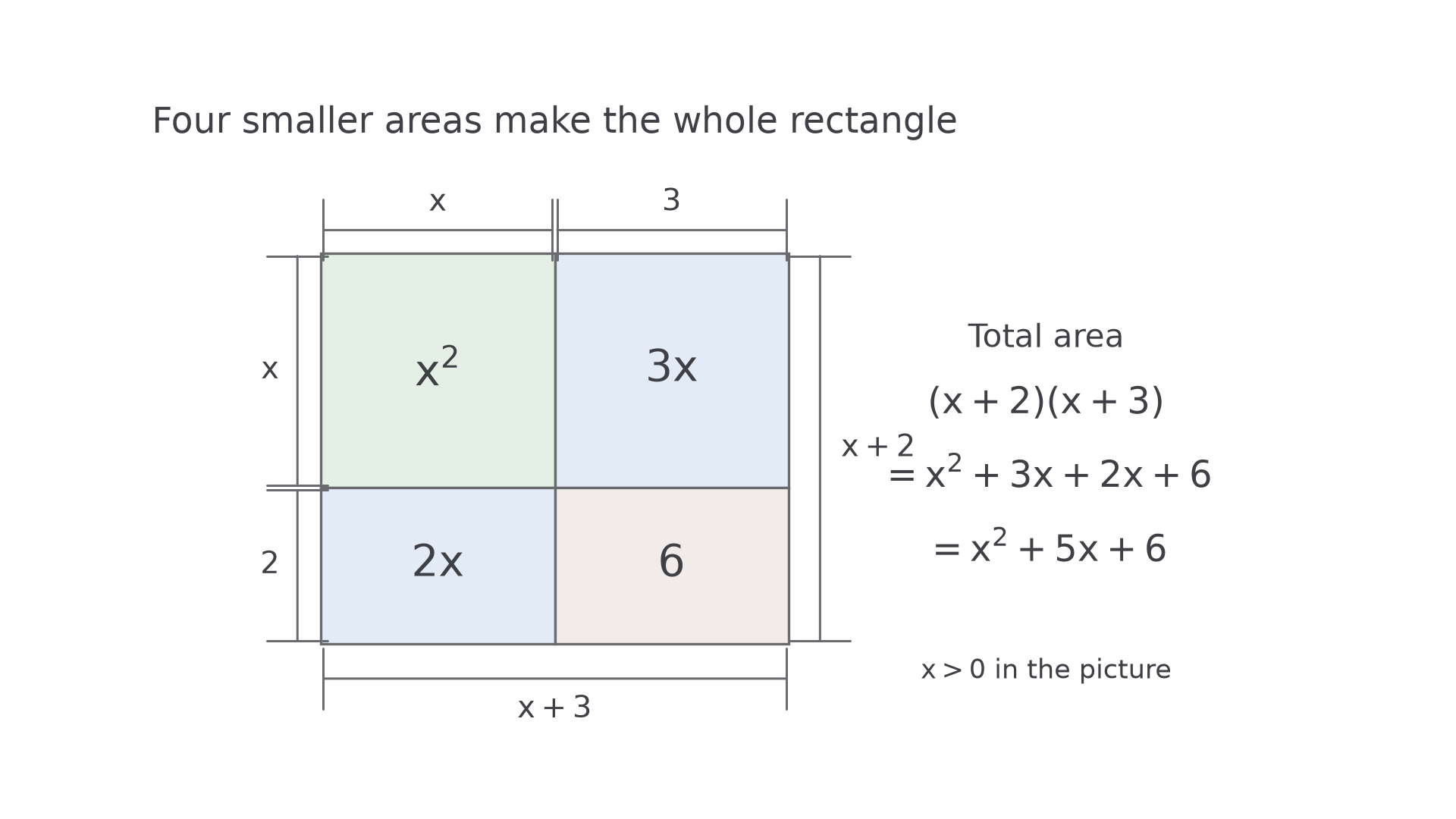
The area picture uses positive lengths, but the algebra rests on the distributive law, which works with negative numbers too. A cubic product simply has more terms to multiply; it needs no new rule.
Distributing and multiplying terms
This holds for all real , and , including negative values. For terms with positive integer indices and ,
Multiply the coefficients and add the indices: . Constants multiply in the usual way.
Not on the formulae sheet: learn it.
For a two-term bracket multiplied by a three-term bracket, expect six products before you collect. You can obtain them in two groups by distributing the first bracket.
Worked example 5: a linear bracket times a quadratic
Question. Expand and simplify .
Plan. Multiply the quadratic by , multiply it by , then collect the six resulting terms.
Why start with two groups? Each group contains all three terms of the quadratic, which makes it harder to miss a product. The first group begins with .
Answer. .
Check. At , the original product is , and the answer gives .
The next example changes only the sign of the constant in the first bracket. All three products in the second group now change sign.
Worked example 6: a negative multiplier
Question. Expand and simplify .
Plan. Multiply the quadratic by and by , then collect matching powers.
Why is the constant ? It comes from , not from squaring . Each product uses one term from each bracket.
Answer. .
Check. At , the original product is , and the answer gives .
The same rule settles the opening puzzle. Squaring a bracket means multiplying two identical brackets, so there are still four products:
At , this gives . For any positive integer , the expression is odd: the pattern comes from the two middle products. This identity is not on the formulae sheet: learn how to obtain it by expanding.
Watch out
Wrong: . This leaves out the two middle products, and . Right: . Squaring a sum does not mean squaring each term separately.
Your expansion is also the evidence that you have used the method correctly, particularly when the question supplies an answer or asks for detailed reasoning.
Exam tip
On a detailed reasoning question, show the products before collecting them. OCR's schemes award no method mark to an answer alone under that instruction. A numerical substitution is a useful check, but it does not replace the algebra.
Now keep the negative multiplier attached to all three terms in a new product.
Quick Recap
- A polynomial has non-negative integer powers of its variable. Read each coefficient with its sign; a missing term has coefficient .
- An equation states an equality; an unknown is a value to find. An identity, written with , holds for every permitted input.
- means substitute everywhere in the function's rule. Put a negative input in brackets before taking powers.
- Add and subtract matching powers. When subtracting a bracket, change every sign inside it.
- Multiply every term by every term, then collect. A squared bracket includes the two middle products.
The opening puzzle follows from : at , the difference is exactly .