AL7, AL8 - Linear and quadratic inequalities
Use inequalities to describe whole ranges of possible values. AL7 supplies the rules for manipulating them; AL8 uses those rules, algebra and graphs to solve linear and quadratic inequalities, including ones you build from a problem. The important decisions are the direction of the sign and whether the boundary belongs in your answer.
Keeping an inequality equivalent
Is a number's square always at least as large as the number itself? Try : its square is , which is smaller. Which other values have this property? We will find the whole range, rather than guess some examples.
An equation usually asks for individual values; an inequality compares values and often has an interval of solutions. For example, includes and negative numbers, but excludes . The condition includes too. A strict sign, or , excludes equality.
Equivalent inequality operations
The same rules apply to non-strict inequalities. Division follows the multiplication rule, and the divisor must be non-zero.
Not on the formulae sheet: learn it.
Why reverse the sign for a negative multiplier? Start with . Multiplying by reflects both numbers across zero: lies to the right of , so . Adding the same number just slides both points together, leaving their order unchanged.
Worked example 1: a negative coefficient
Question. Solve .
Plan. Subtract , then divide by , reversing the inequality.
Why reverse? The divisor is negative. Reversal is about the operation, not about whether a negative number appears somewhere in the question.
Answer. .
Check. At the boundary, , so equality is allowed. On the chosen side, gives ; the other side, , fails.
Now change one feature: retain a second variable while making the subject. Treat as a fixed number during the rearrangement.
Worked example 2: isolating a variable
Question. Write in the form .
Plan. Subtract , then divide by positive .
Why keep the direction? The division is by , which is positive, even though the numerator contains a minus sign.
Answer. .
Check. Put : the original becomes , giving . The rearranged version gives too.
Be especially careful with a variable divisor. Its sign may change, and it could be zero; dividing by it without considering those cases can change the solution set.
Watch out
Wrong: gives . Right: , because division by a negative number reverses the inequality. Do not reverse a sign merely because you subtract something.
Try a rearrangement in which the coefficient you divide by is negative.
Solving a double inequality
A double inequality puts two restrictions on the same expression: both must hold at once.
For example, means “ is greater than and at most ”. On a number line use an open circle at , a filled circle at , and the interval between them. You can operate on all three expressions together or solve the two inequalities separately and combine their answers.
Worked example 3: all three expressions change
Question. In this question you must show detailed reasoning. Solve .
Plan. Subtract from all three expressions, then divide all three by .
Why change both ends? The central expression must remain above its lower bound and below its upper bound after each operation.
Answer. .
Check. gives the excluded lower value ; gives the included upper value . A middle value, , gives .
The next example changes the sign of the coefficient of . Reverse both comparisons when dividing, then write the smaller bound first.
Worked example 4: a negative coefficient between two bounds
Question. Solve .
Plan. Subtract , divide by , then rewrite the bounds in increasing order.
Why does the included end move to the right? The value produces the original included lower bound . Reflection reverses the order of the endpoints, not which endpoint is included.
Answer. .
Check. gives , allowed; gives , excluded.
Keeping the two comparisons visible avoids silently dropping one of them.
Watch out
Wrong: subtracting from gives . The upper end was left unchanged. Right: , because the operation applies to all three expressions.
An effective alternative is to treat the chain as two inequalities joined by “and”.
Exam tip
OCR's double-inequality questions reward correct operations at both ends. If a long chain feels fragile, solve the left and right inequalities separately, then state the values satisfying both. An answer without working does not show detailed reasoning.
Use that approach if you prefer it in the next question.
Using roots and the sign of a quadratic
Solving a quadratic inequality means finding where its graph lies above or below the horizontal axis, rather than just finding the crossings.
You already know
A root makes a polynomial equal to zero. From earlier algebra, use factorisation or completing the square to find quadratic roots, keeping both real roots when there are two.
Start with . Its roots and divide the number line into three intervals. A product is negative when its factors have opposite signs. Between the roots, and , so . Outside, both factors have the same sign, so the product is positive.
[DIAGRAM: asset_name: Quadratic sign and solution intervals; asset_slug: quadratic-sign-intervals; caption: The roots split the number line into intervals where the quadratic keeps its sign; description: Left panel shows y equals x squared minus x minus 6 crossing at minus 2 and 3 with the portion below the axis in blue. Right panel shows the corresponding sign chart, positive then negative then positive, and open endpoints for the interval minus 2 less than x less than 3.]
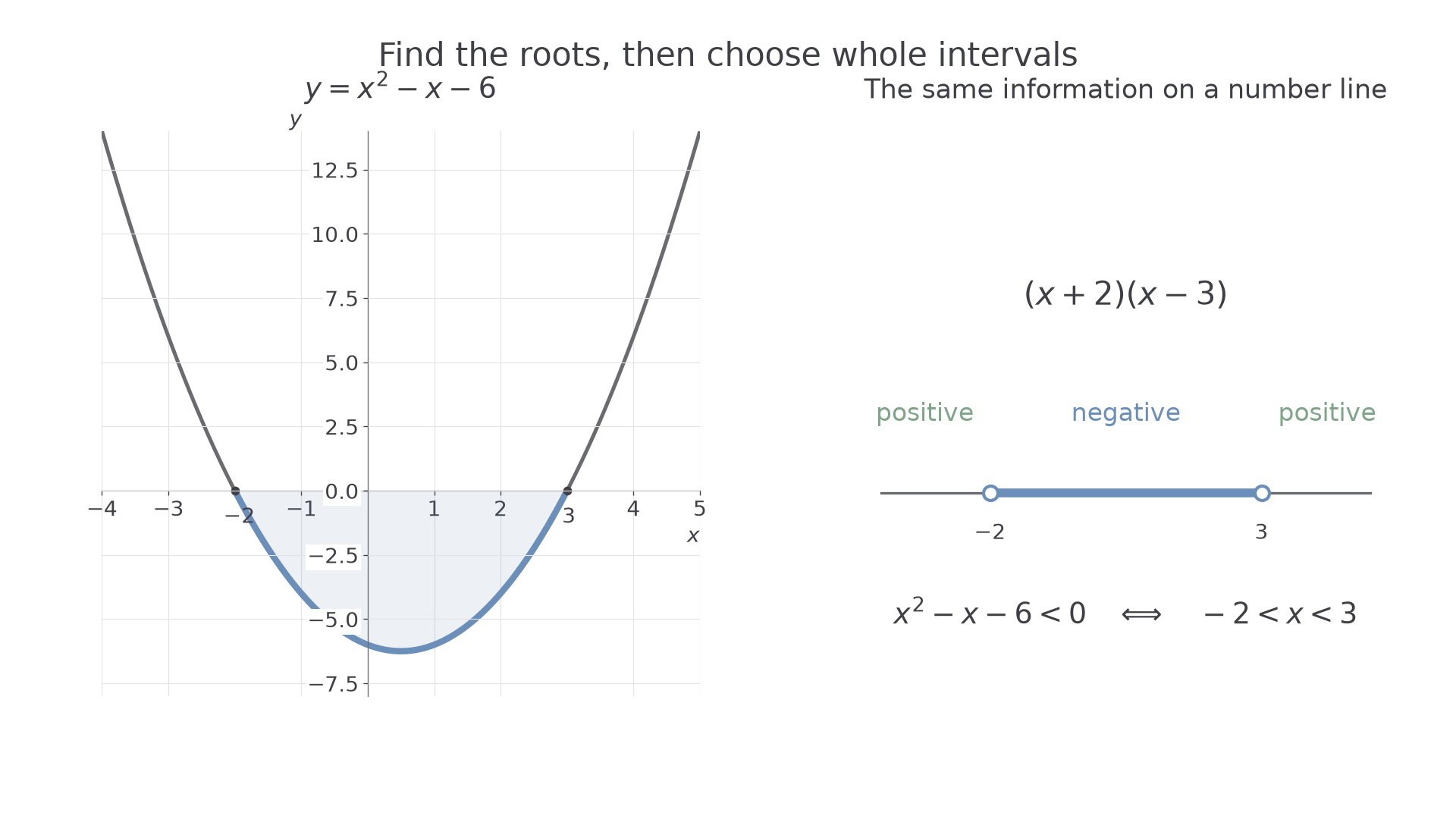
This is also the graph method: read the -values where for a strict negative inequality, or where for a non-negative one. “Above the axis” describes values of ; the answer is still a set of values of .
Sign of a factorised quadratic
If , then between the roots and outside. If , these signs reverse. The roots themselves give .
Not on the formulae sheet: learn it.
Use factorisation, completing the square or the quadratic formula to obtain the roots first. The quadratic formula is on the formulae sheet; this sign decision is not supplied there. A graph can estimate the boundaries, while algebra gives exact ones.
Worked example 5: below the axis
Question. Solve .
Plan. Find the roots and select the interval where the upward-opening parabola is below the axis.
Why between? At the value is . The continuous quadratic cannot change sign inside an interval without another root.
Answer. , with both endpoints excluded.
Check. works; and both give , so neither outside interval works.
The next example changes only the comparison, from negative to non-negative. The roots stay the same, but both the selected region and the endpoint decision change.
Worked example 6: on or above the axis
Question. Solve .
Plan. Use the same roots and select the two outside intervals, including the roots.
Why “or”? Either outside interval works. A number cannot be at most and at least at the same time.
Answer. or .
Check. and give , included. The test values and give positive values, while gives a negative value.
For a negative leading coefficient, either use a downward-opening sketch or multiply the whole inequality by and reverse its sign. Thus is equivalent to . Do not use the “between” rule until you have checked the leading coefficient.
Some quadratics do not cross the axis. Since for every real , the inequality has no real solutions. A repeated root needs care too: holds only at , while holds for every real . A sketch or the non-negativity of a square settles these boundary cases.
Watch out
Wrong: solve by writing only . Those values solve the boundary equation, not the inequality. Right: select and state the whole intervals or .
Now change the roots and make the same sign decision.
Setting up a range from a condition
Words such as “at most”, “more than” and “at least” tell you the sign; the mathematics of the situation supplies the expression.
“At most” means , while “at least” means . A physical restriction such as remains in force while you solve. If a question asks for whole numbers, find the real interval first and then select the permitted integers.
Worked example 7: a cost limit
Question. A hall costs £45 to hire plus £6 per guest. The budget is at most £120. Find the greatest possible whole number of guests.
Plan. Let be the number of guests, form the cost inequality and then impose the whole-number condition.
Why not round to ? This is a maximum, so the chosen integer must still satisfy the inequality.
Answer. At most guests.
Check. , within budget; , over budget.
The next example changes the cost expression from linear to quadratic, so there are two algebraic boundary roots to consider.
Worked example 8: an area limit
Question. A rectangle has width and length . Its area must be at most . Find the possible widths.
Plan. Form the area inequality, solve it and intersect its solution with .
Why remove the negative values? They satisfy the algebraic inequality but cannot be widths. Zero would give a degenerate rectangle, so it is excluded too.
Answer. ; the widths are greater than zero and at most .
Check. At , the area is , allowed. At , it is , too large.
We can now settle the opening puzzle exactly: means . The upward-opening graph is below the axis between its roots, so precisely works. Every fraction strictly between zero and one becomes smaller when squared.
Problem-solving
Write the contextual restriction next to the inequality before solving. Finish by combining the mathematical interval with that restriction; do not silently keep negative lengths or round a maximum upwards.
The direction of the comparison comes from the condition's words, before any algebra begins.
Watch out
Wrong: “area at most ” gives . That selects areas too large. Right: ; “at most” includes equality and all smaller areas.
Change “at most” to “at least” in this rectangle problem and watch the selected interval change.
Quick Recap
- Adding the same quantity preserves an inequality; multiplying or dividing by a negative number reverses it.
- In a double inequality, operate on all three expressions and retain both restrictions.
- For a quadratic, find the boundary roots, use its sign or graph to choose intervals, then decide whether to include the endpoints.
- Translate the condition accurately and apply restrictions such as positive lengths or whole numbers at the end.
The opening puzzle: holds exactly when . A square can indeed be smaller than the number you started with.