CA13 - Area between two curves
Find an area by integrating the vertical gap between its boundaries. You will choose which curve is above the other, find intersection limits and split a region when its upper or lower edge changes. A sketch decides the calculation before any integration begins.
The vertical gap between curves
If you move two curves down by units, does the area between them change? Their heights above the axis change dramatically, but the gap between them stays exactly the same. Area between curves measures that gap, so the answer is no. Integration can ignore where the axis is, provided you subtract the boundaries in the right order.
You already know
A definite integral is evaluated by upper-limit value minus lower-limit value. For geometric area, signed pieces must not cancel. A sketch and the roots tell you where a function changes sign.
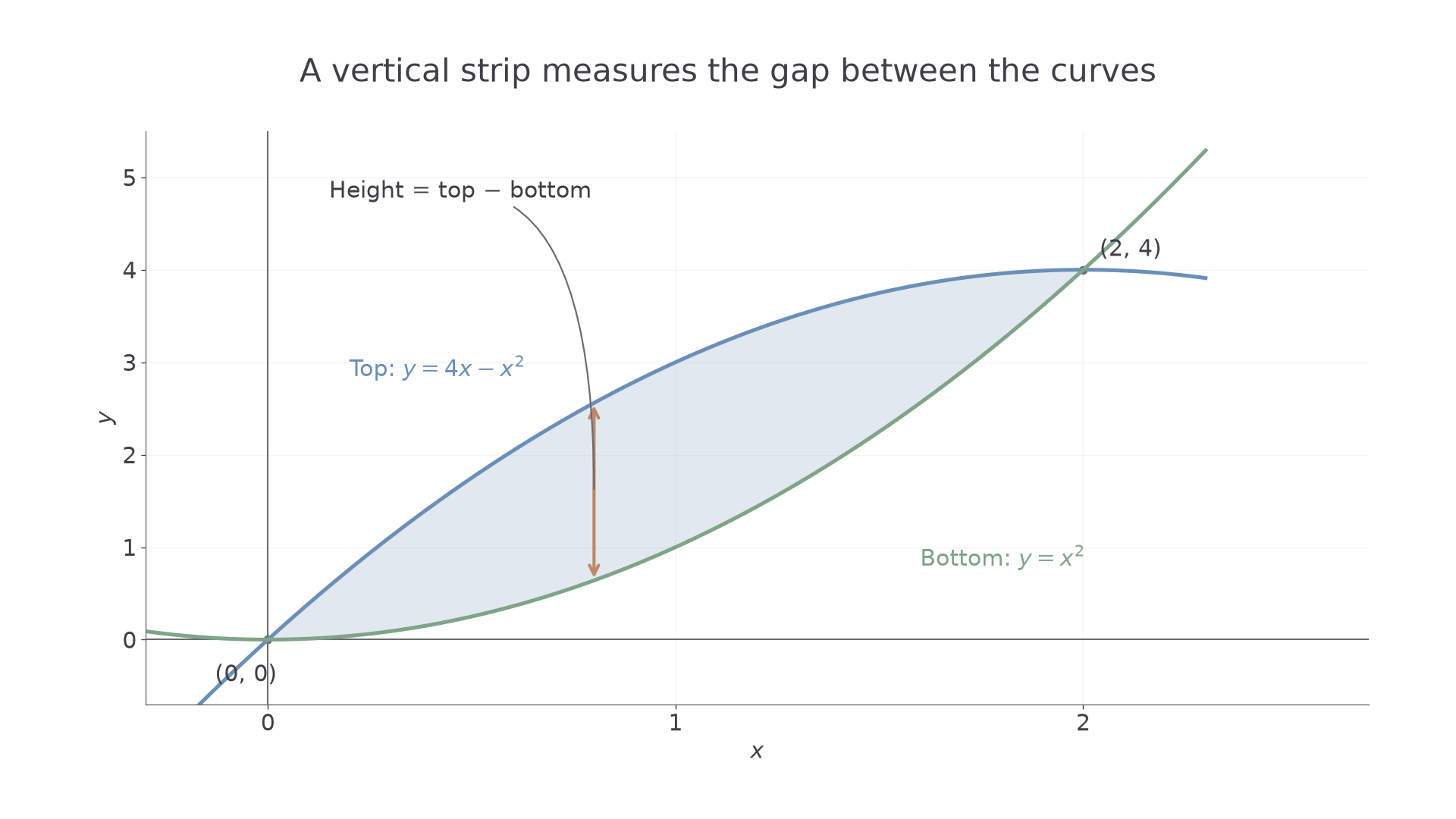
Imagine a narrow vertical strip between two curves. Its height is the upper -coordinate minus the lower one. For example, if the top is at and the bottom at , the strip has height , even though both curves are below the axis. “Top” means the larger -value, not the larger magnitude.
[DIAGRAM: asset_name: A vertical strip between curves; asset_slug: curves-vertical-gap; caption: The strip height is the upper y-coordinate minus the lower one; description: Curves y equals 4x minus x squared and y equals x squared intersect at 0, 0 and 2, 4. The enclosed region is shaded blue. A vertical double arrow at x equals 0.8 marks the gap from the lower curve to the upper curve, labelled height equals top minus bottom.]
Area between two curves
For , if throughout ,
Equivalently, subtract the two definite integrals with the same limits. The integrand is the non-negative vertical gap.
Not on the formulae sheet: learn it.
Subtracting the expressions first usually reduces the amount of integration. Put the whole lower expression in brackets, particularly when it contains a minus sign.
Worked example 1: area between given ordinates
Question. Find the area between , , and .
Plan. Establish which curve is upper, subtract the lower expression, and integrate the gap.
Why establish the order over the whole interval? If the curves crossed inside it, the same subtraction could not represent positive strip heights everywhere.
Answer. The area is square units.
Check. The gap is positive at both ends and has no root inside the interval. The result is positive.
The next example changes only the vertical position: both curves move down by . The same region now includes points below the axis.
Worked example 2: the axis is not a boundary
Question. Find the area between , , and .
Plan. Subtract the entire lower expression; a common vertical shift will cancel.
Why is no split needed at the -axis? The axis is not an edge of this region. The upper and lower curves retain their order throughout.
Answer. The area is still square units.
Check. At , the new gap is , equal to the old gap . In fact , settling the opening question for any common shift.
The subtraction is where most of the sign decisions happen.
Watch out
Wrong: . The minus sign applies to both terms of the lower curve. Right: .
Now keep the same kind of region but change the coefficients; the given ordinates remain your limits.
Finding the enclosing intersections
When two curves enclose a region by themselves, their intersections supply the limits.
At an intersection the two -values are equal. Solve the equations simultaneously by equating them, keep the -coordinates for the integration limits, then use the sketch or the sign of the difference to decide which curve is upper. The intersection -coordinates help you sketch, but do not replace those limits.
Worked example 3: two parabolas enclose a region
Question. Find the exact area enclosed by and .
Plan. Equate the curves to find their intersections, then integrate upper minus lower between them.
Why is upper? The difference is for , as the diagram shows.
Answer. The enclosed area is square units.
Check. The gap has maximum , over width , so the area is less than .
The next example changes one coefficient in the upper parabola. Recalculate the intersections; old limits belong to the old region.
Worked example 4: a narrower enclosed region
Question. Find the exact area enclosed by and .
Plan. Find the new intersection limits, check the order, and integrate their difference.
Why keep the fractional limit? Rounding it is unnecessary and can turn an exact area into an approximation.
Answer. The area is square units.
Check. The new region is narrower and its maximum gap is smaller than before, agreeing with its smaller area.
Every enclosed-area problem has two linked jobs: find the limits, then find the area.
Watch out
Wrong: integrating from to because an intersection is . When integrating with respect to , use its -coordinate , not its height .
For OCR's exact and detailed reasoning questions, show the intersection equation, the chosen integral and the exact evaluation. Those are the decisions a decimal answer cannot display.
Continue this lesson.
You’re previewing NovaLearn without an account. Create a free account to read the rest.
Create free account