AL5 - Completing the square
Completing the square rewrites a quadratic as one squared bracket plus a constant. You will learn why the method works, handle positive and negative leading coefficients, and read off a quadratic's greatest or least value. The new form reveals information that is hard to see in an expanded expression.
Building a complete square
How can you know that never falls below , without trying lots of values of ? The expanded expression hides that lower limit. A squared bracket will make it visible.
You already know
Expanding a squared bracket gives . The middle term appears twice in the multiplication. A square of a real number is never negative.
Start with . For positive , think of a square of side and two strips, each of width . Together they almost make a larger square of side , but its corner of area is missing. Adding completes that square.
[DIAGRAM: asset_name: Completing a square with two strips; asset_slug: completing-square-area; caption: Two strips of area 3x leave a corner of area 9 to complete a square; description: A square with total side length x plus 3 is partitioned into a blue x by x square labelled x squared, two sage rectangles each labelled 3x, and a clay 3 by 3 corner labelled 9. Side labels show x and 3 along the bottom and left. A sentence below states that x squared plus 6x plus 9 equals x plus 3 all squared, for positive x in the area picture.]
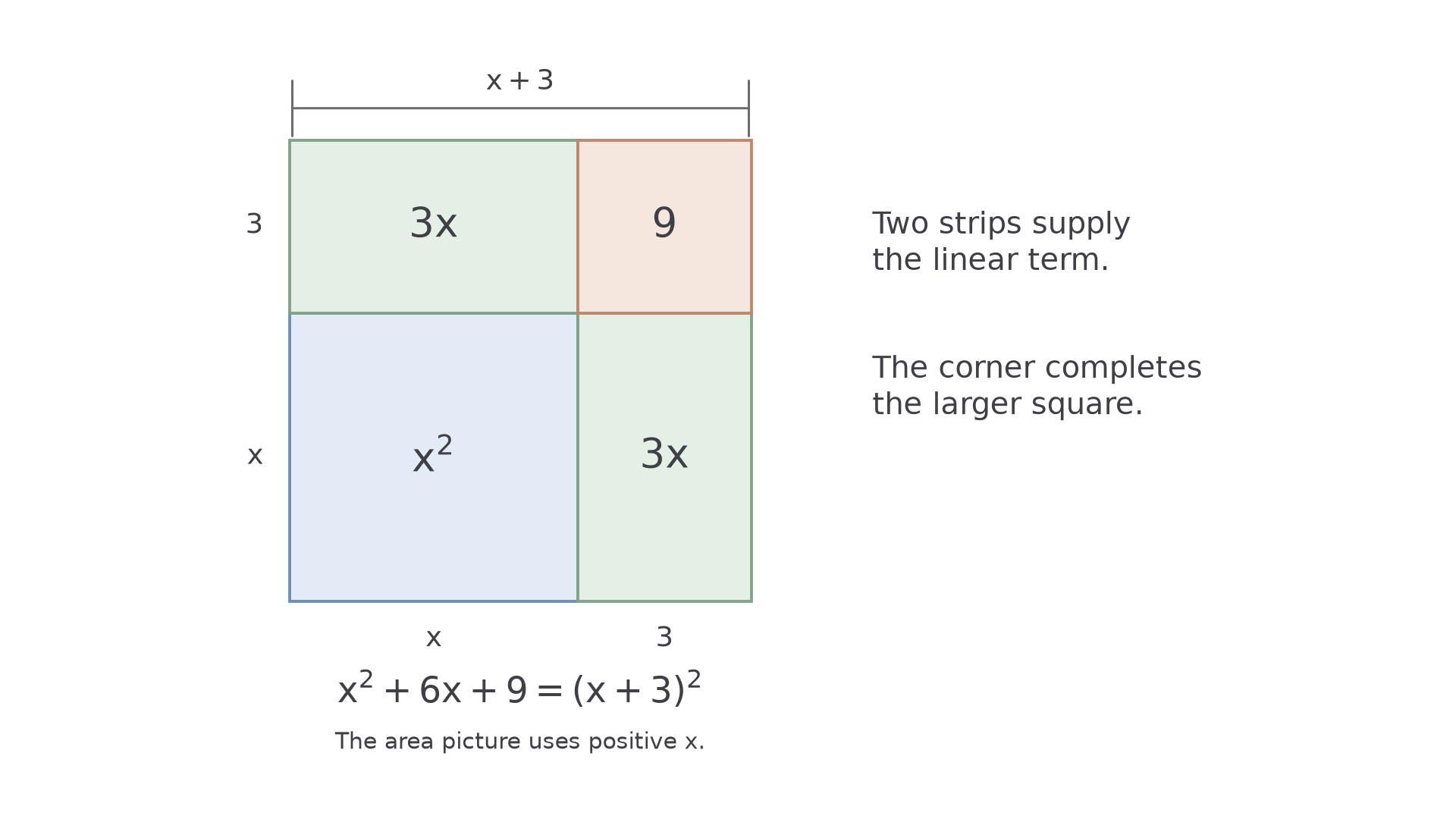
The picture uses positive lengths, but expansion gives the identity for every real . If the expression starts with , adding would change it. Instead, put in the square and subtract the extra : .
Completing the square
Completing the square means rewriting a quadratic polynomial as , with the same value for every real . For example, . The expression is not equivalent: its linear term would be .
The coefficient of tells you the number inside the bracket: halve it, because expansion doubles that number in the middle term.
Completing a monic quadratic
Here and are real constants. A monic quadratic has coefficient on . Halve , square that half, and compensate for the constant introduced.
Not on the formulae sheet: learn it.
Use that compensation explicitly before collecting the constant terms.
Worked example 1: a positive middle term
Question. Write in the form .
Plan. Halve to obtain the bracket number, then subtract the square introduced.
Why subtract ? The bracket already contains it when expanded; subtracting prevents adding anything to the original expression.
Answer. , so and .
Check. .
Now change only the sign of the middle term. The bracket number changes sign, but its square remains positive.
Worked example 2: a negative middle term
Question. Write in the form .
Plan. Halve to get , then compensate for .
Why is the correction still ? Both and equal . The sign changes the linear term, not the squared constant.
Answer. , so and .
Check. Expanding gives .
You can check every completed square by expanding it back; this catches both a wrong bracket and a wrong constant.
Watch out
Wrong: . This doubles the required linear coefficient to . Right: halve , giving .
Keep the coefficient and the bracket number separate in the next calculation.
Leading coefficients and fractional shifts
When the coefficient of is not , first factor it out of the two variable terms so that you complete a monic quadratic inside the bracket.
In , write . The number to halve is now , not . Any correction made inside the bracket is also multiplied by outside it.
Completing any quadratic
Here , and , and are real constants. Factoring out leaves linear coefficient ; half of that is .
Not on the formulae sheet: learn it.
The general identity describes the result, but the short bracket-by-bracket method keeps the correction visible.
Worked example 3: a leading coefficient of two
Question. Write in the form .
Plan. Factor from the variable terms, complete the inner square and multiply the correction by .
Why is the correction , rather than ? The completed square sits inside a bracket multiplied by , so its compensation does too.
Answer. .
Check. .
Now change only the linear coefficient, from to . After factoring out , the inner coefficient is odd, so halving it produces a fraction. Keep that fraction exact.
Worked example 4: a fractional bracket number
Question. Write in the form .
Plan. Factor , halve the inner coefficient , then square the fraction before simplifying the constant.
Why keep instead of rounding? Its square is exactly , so every later step stays exact. There is no need for a decimal approximation.
Answer. .
Check. The constant after expansion is , and the linear term is .
Fractions are also behind a neat numerical fact. The product of two consecutive integers is exactly below the square of their halfway point: , while . Algebra explains every such case:
The identity is not on the formulae sheet: it is another completed square, with and .
Watch out
Wrong: . The correction belongs inside the bracket. Right: .
Try a coefficient that produces a fraction after the first factorisation.
Reading greatest and least values
A completed square isolates the only part that varies, so its sign tells you whether the constant outside is a lower or an upper limit.
For a real input, , with equality exactly when . If , then : its least value is . If , multiplying by reverses the comparison, so : its greatest value is . In both cases that value occurs when the bracket is zero. These facts are not on the formulae sheet: learn them.
The sign inside the bracket is opposite to the input that makes it zero. A form containing reaches its limiting value at .
Worked example 5: a least value
Question. By completing the square, determine the least value of and the value of at which it occurs.
Plan. Complete the square, then use its non-negativity to identify the least possible output.
Why can actually be reached? At , the squared bracket is zero. A lower bound is the least value only if some permitted input attains it.
Answer. Least value , at .
Check. Substitution gives .
Now reverse the sign of the two variable terms, leaving the constant fixed. The square has a negative multiplier, so the same idea gives a greatest value instead.
Worked example 6: a negative leading coefficient
Question. By completing the square, determine the greatest value of and the value of at which it occurs.
Plan. Factor , complete the inner square and use the fact that its negative multiple cannot be positive.
Why is the correction positive here? Multiplying the inner by the outer gives , which is then added to .
Answer. Greatest value , at .
Check. Substitution gives .
We can now settle the opening question in one line: . The square cannot be negative, so the expression cannot fall below , and it equals at . Completing the square has turned a claim about infinitely many inputs into a statement about one square.
Watch out
Wrong: has least value at . The negative multiplier makes a greatest value, and the bracket is zero at . Right: greatest value , attained at .
Read the sign outside the square to decide greatest or least, then solve the bracket equal to zero to locate it. The two signs do different jobs.
Exam tip
If OCR says “By completing the square”, show that form in your working. Give both the limiting value and where it occurs when both are requested; a different method does not fulfil the instruction to complete the square.
Handle both a negative multiplier and a fractional shift in the final question.
Quick Recap
- Complete a monic quadratic by halving the linear coefficient, squaring that half, and compensating for the introduced constant.
- For a non-monic quadratic, factor the leading coefficient from the variable terms first; it multiplies the correction too.
- Fractions inside the bracket are normal. Keep them exact and check by expanding back.
- In , the limiting value is , at : a least value if , a greatest value if .
The opening expression is , so its least value is exactly , attained at .