AL2 - Surds and exact values
Every decimal your calculator gives for is rounded, because the true decimal never ends and never repeats. This lesson shows you how to keep square roots exact: simplify them, collect them, expand brackets that contain them and clear them from the bottom of a fraction. OCR's "exact", "Determine" and "detailed reasoning" questions reward exactly these skills, and you will use them in almost every later topic, from circles to calculus.
Surds and exact values
A surd is a square root that cannot be written as a fraction, and leaving it as a root is the only way to write its value exactly.
Start with a puzzle. The golden ratio, which Euclid described in his Elements around 300 BC, is . Your calculator gives . Now press the reciprocal key: . The digits after the decimal point are identical. Is that a lucky coincidence, or must it happen? By the end of this lesson you will prove the answer in a few lines, without a calculator.
First, a concrete case. Remember from GCSE that means the positive square root of , so . Type into your calculator and it shows . Square that decimal and you get , not 2. The calculator has rounded, and no decimal, however long, squares to exactly 2. The symbol is the only exact way to write this number.
Surd
A surd is a square root of a rational number that is itself irrational: it cannot be written as a fraction of whole numbers. For example, , and are surds. Not an example: and are rational, so they are not surds.
An expression built from surds, such as or , is said to be in surd form. When a question asks for an exact answer, this is the form it expects.
Exact value
An exact answer is one where numbers are not given in rounded form. It often contains an irrational number such as or , left in that form. For example, the exact solution of is (or ). Not an example: , which is rounded.
Surds have a simple picture. By Pythagoras, the diagonal of a 1 by 1 square is , and the diagonal of a 2 by 2 square is . Now look at the grid: the long diagonal is made of two short diagonals placed end to end, so . In the same way, the diagonal of a 3 by 3 square gives .
[DIAGRAM: asset_name: Square diagonals as copies of root 2; asset_slug: surd-diagonals; caption: The diagonals of 1 by 1, 2 by 2 and 3 by 3 squares are 1, 2 and 3 copies of root 2; description: Three squares on a unit grid with sides 1, 2 and 3. Each diagonal is drawn in blue and split at the grid points into unit-square diagonals, each of length root 2. Labels show that 1 squared plus 1 squared is 2 so the diagonal is root 2, 2 squared plus 2 squared is 8 so the diagonal is root 8 which equals 2 root 2, and 3 squared plus 3 squared is 18 so the diagonal is root 18 which equals 3 root 2]
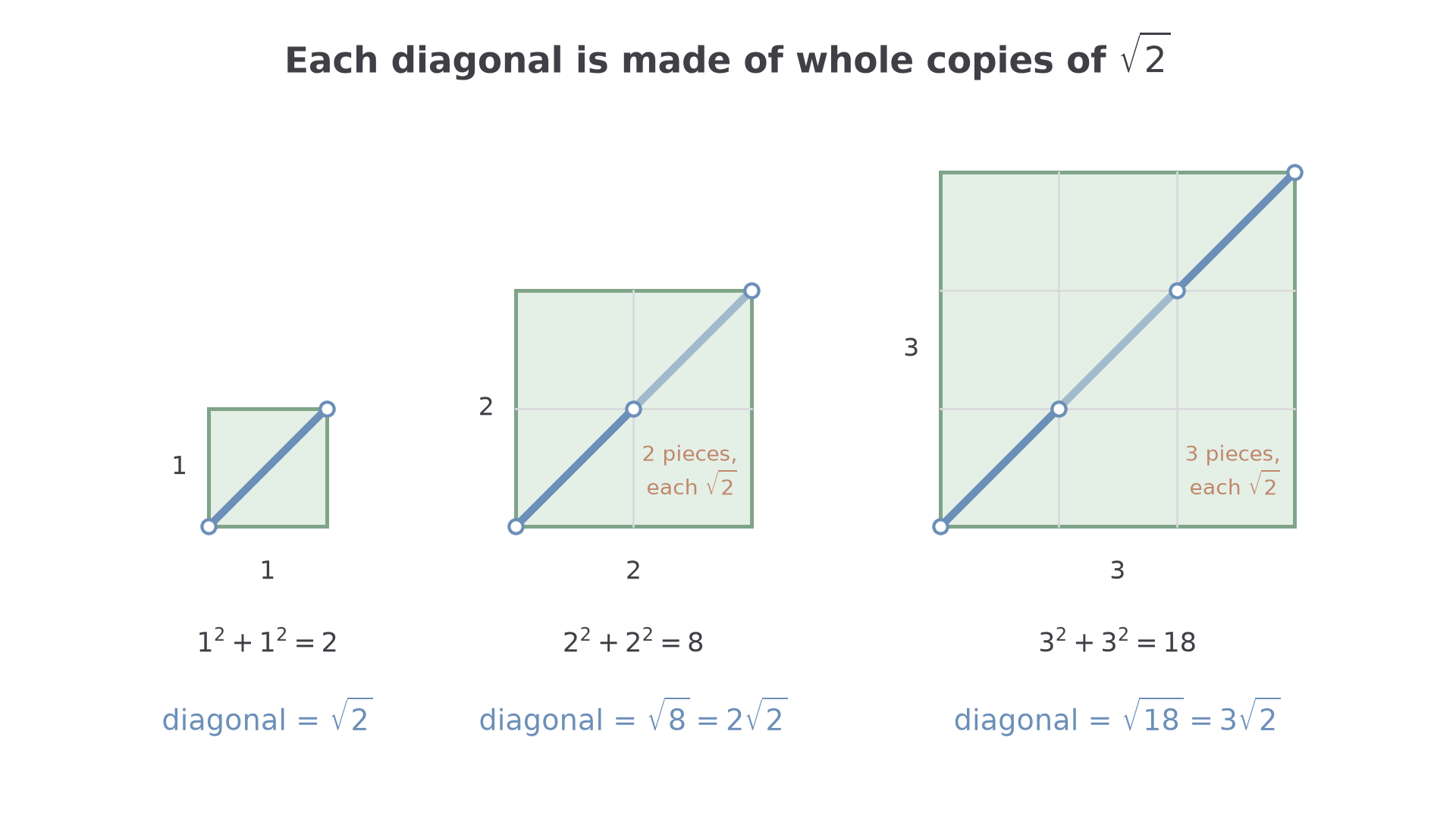
Put the 2 by 2 and 3 by 3 diagonals end to end and you have copies of , so . That is not . Roots of a sum behave very differently from sums of roots.
Watch out
Wrong: . A square root does not split over a plus sign, because , which is more than . Right: .
Multiplication is different, and the reason is short. For and , the numbers and are both non-negative, and they have the same square: . Two non-negative numbers with the same square are equal, so . That is why , exactly as the picture shows. The same argument works for division.
Multiplying and dividing square roots
These hold for and , with for the quotient.
Not on the formulae sheet: learn it.
You will use this rule all the way through the lesson: to split a surd into a whole number times a smaller surd, and to multiply surds together. It never applies to a sum.
Key idea
A surd is an exact number: keep it as a root, and break it up with , never by splitting a sum under the root.
Now test the rule on a student's working.
Simplifying and collecting surds
A surd is in its simplest form when the number under the root has no square factor except 1, and only then can you see which surds can be collected.
To simplify , look for the largest square number that divides (the squares are ). Split it off using , then take its square root. This is the algebra behind the square diagonals in the previous section.
Simplest form of a surd
is in simplest form when is a whole number with no square factor other than 1. For example, and are in simplest form. Not an example: , because , so .
Once surds are simplified, those with the same number under the root are called like surds. They collect exactly like like terms in algebra, with the surd playing the part of the letter: , just as . Unlike surds, such as , cannot be combined into one term.
Worked example 1: simplifying a single surd
Question. Write in the form , where is as small as possible.
Plan. Find the largest square factor of 72, split it off, then take its square root.
Why 36? The square factors of 72 are 4, 9 and 36. Using 4 gives , and 18 still contains the square 9, so you would have to simplify again. Choosing the largest square finishes the job in one step.
Answer.
Check.
The next example adds one new feature: two surds that look unrelated until you simplify them.
Worked example 2: collecting surds that look unlike
Question. Simplify .
Plan. Simplify each surd first; they then become like surds and can be collected.
What changed from Worked example 1? There are two surds, and 12 and 27 share no obvious link. Simplifying each one reveals the common , and only then can they be added.
Answer.
Check. and
The most common slip at this stage comes in the collecting step.
Watch out
Wrong: . When you collect like surds, the surd itself does not change, just as the does not change in . Right: .
When a question names a form such as or , finish by checking that the number under each root has no square factor left.
Exam tip
"Simplify" and "in the form " mean fully simplified: is not finished, but is. Without such an instruction, OCR accepts any correct exact surd form (in June 2024, scored as well as ), but simplifying is never wrong.
Now try one like Worked example 2, with three surds and a subtraction.
Expanding brackets with surds
Brackets containing surds expand exactly like algebraic brackets; the one extra fact you need is .
You already know
From GCSE: multiply every term in the first bracket by every term in the second, then collect like terms. In particular, , with a middle term .
To multiply single surds, multiply the numbers outside the roots together and the numbers inside the roots together, then simplify: . Whenever a surd meets itself it becomes a whole number, so and . That is what makes surd brackets tidy: the squared surd terms drop out as ordinary numbers.
Worked example 3: expanding a product of two brackets
Question. Expand and simplify .
Plan. Multiply each term of the first bracket by each term of the second (four products), then collect the whole numbers and the surds.
Why this step? The last product is : the minus sign comes from the second bracket and the 3 comes from , so it contributes .
Answer.
Check. and
The next example changes one feature: the surd arrives by substitution, so the work is squaring a bracket.
Worked example 4: substituting a surd into a quadratic
Question. Determine the exact value of when .
Plan. Find by squaring the bracket, find , then add 7 and collect.
What changed from Worked example 3? The bracket is squared, so the middle term must appear, and "Determine" means the expansion has to be written down, not just the final number.
Answer.
Check. From , , so . This gives , so and
The error examiners see most often here is in squaring the bracket.
Watch out
Wrong: . This squares each term and drops the middle term . Right: .
OCR is strict about seeing that expansion when the question says "Determine".
Exam tip
"Determine" means the working must be on the page. In June 2025, OCR's scheme for this type of question gave a correct exact value with no working only 1 of the 3 marks.
Now try one like Worked example 4, with a minus sign in the value of .
Rationalising the denominator
Rationalising the denominator means rewriting a fraction so that no surd is left on the bottom, without changing its value.
A surd on the bottom is exact but awkward. Compare with : they are the same number, but the second is easy to estimate (half of is ), easy to combine with other surds, and the form exam answers expect. Before calculators, dividing 1 by by hand was slow, while halving took a moment.
Rationalising the denominator
Rewriting a fraction as an equal fraction whose denominator is rational. For example, . Not an example: is true, but the denominator is still a surd.
The tool is multiplying the top and bottom of the fraction by the same non-zero number, which is multiplying by 1, so the value never changes. If the denominator is a single surd , multiply top and bottom by , because .
If the denominator has two terms, such as , multiplying by does not work: still contains a surd. You need a partner that cancels the surd completely.
Conjugate
The conjugate of is , and the conjugate of is : only the sign of the surd term changes. For example, the conjugate of is . Not an example: is not the conjugate of , because the sign of the whole number has changed too.
A two-term surd expression times its conjugate is always rational. It is a difference of two squares, so the two cross terms cancel and the squared surd is a whole number.
Product of conjugates
This holds for . The cross terms and cancel, and .
Not on the formulae sheet: learn it.
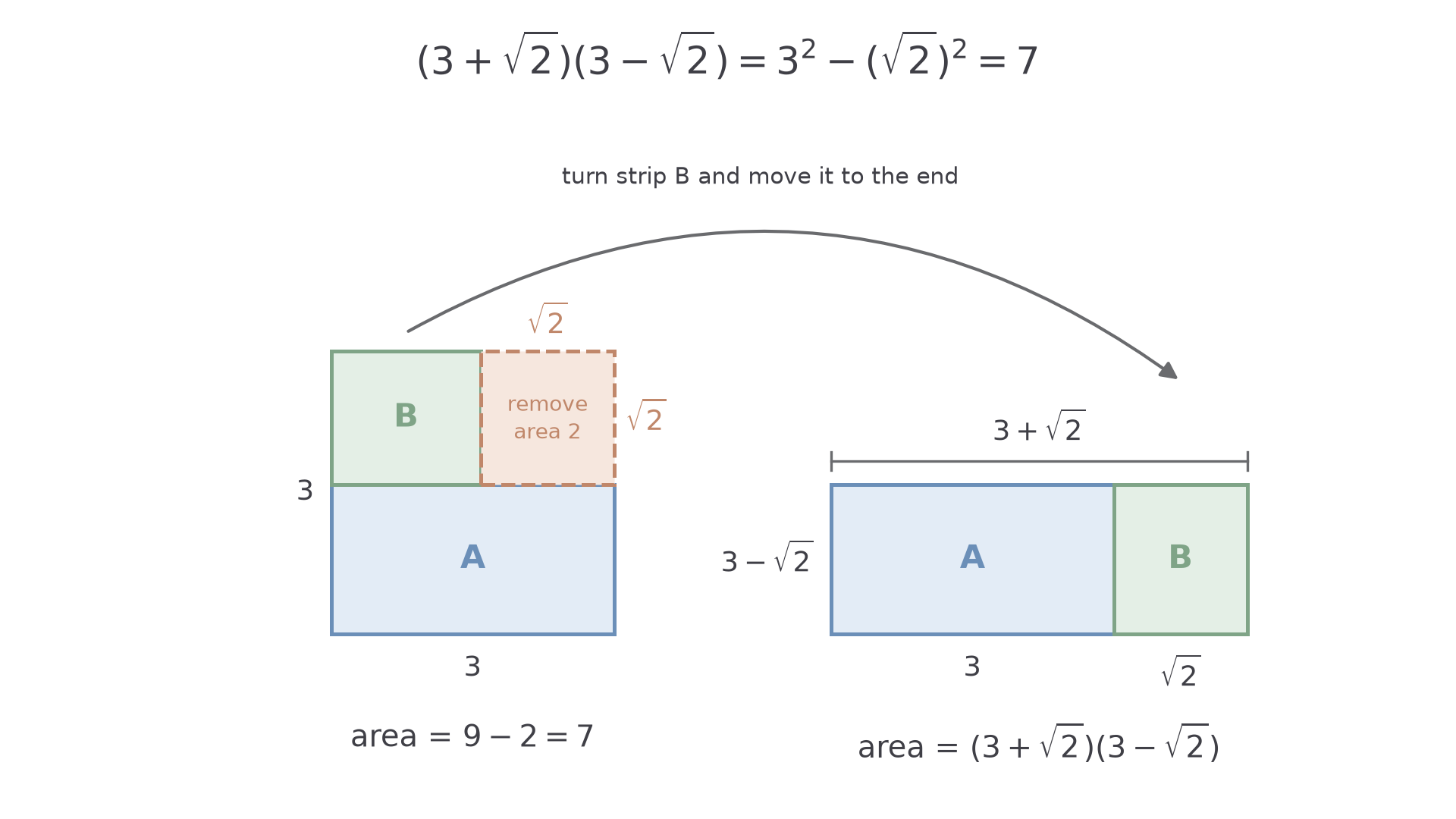
Here is the same fact as a picture, with and . Remove a by square (area 2) from the corner of a 3 by 3 square (area 9), leaving an L-shape of area 7. Cut off strip B, turn it, and place it at the end of piece A: the pieces now make a rectangle long and high. So , a whole number.
[DIAGRAM: asset_name: A conjugate pair as an area; asset_slug: conjugate-area; caption: Why 3 plus root 2 times 3 minus root 2 equals 9 minus 2, which is 7; description: Left, a 3 by 3 square with a root 2 by root 2 corner square marked for removal, leaving a blue piece A that is 3 wide and 3 minus root 2 high and a green strip B that is 3 minus root 2 wide and root 2 high, so the area left is 9 minus 2, which is 7. A curved arrow shows strip B turned and moved to the end of piece A. Right, the two pieces form a rectangle 3 plus root 2 wide and 3 minus root 2 high, so its area, 3 plus root 2 times 3 minus root 2, is also 7]
Now for the method itself, starting with the simpler case of a single surd on the bottom.
Worked example 5: a single surd in the denominator
Question. Rationalise the denominator of , simplifying your answer fully.
Plan. Multiply the top and bottom by , which turns into a whole number, then cancel.
Why and not ? Either works, but is enough: the 2 is already rational, so only the surd needs clearing, and the numbers stay smaller.
Answer.
Check. and
The next example changes one feature: the denominator has two terms, so you need the conjugate.
Worked example 6: a two-term denominator
Question. Write in the form .
Plan. Multiply the top and bottom by the conjugate , so that the denominator becomes .
What changed from Worked example 5? Multiplying by alone would give on the bottom, which still contains a surd. The conjugate is the multiplier that removes it completely.
Answer. , so and .
Check. and
Marks are most often lost in the product of the conjugates.
Watch out
Wrong: . OCR's June 2023 examiners' report names 27 as a popular wrong denominator. The surd product is , so the conjugate product is a difference. Right: .
Now try one like Worked example 6, with a plus sign in the denominator.
Exact answers with detailed reasoning
The hardest surd questions combine all of these skills, and OCR often adds the instruction "In this question you must show detailed reasoning".
That instruction means your solution must be a complete analytical method that a reader can follow from start to finish. You may still use your calculator to check, but a calculator value is not evidence. "Show that" is similar: the answer is given, so all the marks are for the steps that reach it.
To add or subtract two fractions with surd denominators, use the product of the two denominators as the common denominator. When the denominators are conjugates, that product is already rational, so there is nothing left to rationalise.
Problem-solving
Spot conjugate denominators. If two fractions have denominators and , their product is a rational common denominator, so one step does the combining and the rationalising together.
Here is that idea in a detailed reasoning question.
Worked example 7: subtracting fractions with conjugate denominators
Question. In this question you must show detailed reasoning. Simplify .
Plan. Use as the common denominator, expand both numerators, then collect.
Why this common denominator? The denominators are conjugates, so their product is , a whole number. The answer is finished as soon as the numerator is collected.
Answer.
Check. and
The last example changes one feature: the answer is given, so you must reach it with every step shown.
Worked example 8: a "show that" with the golden ratio
Question. Given that , show that .
Plan. Rationalise , simplify separately, and show that the two results are the same.
What changed from Worked example 7? The target is given, so you work on each side until both reach the same expression, then say so. A calculator check that both sides are about earns nothing.
Answer. Both sides equal , so .
Check. , and
This settles the puzzle from the start of the lesson. Because is exactly , the two numbers differ by exactly 1, so they must share every digit after the decimal point. It was never a coincidence: rationalising the denominator proves it.
Watch out
Wrong: . The minus sign in front of the second fraction applies to both terms of its numerator. Right: . OCR's June 2023 examiners' report describes sign errors in the numerator in exactly this type of question.
The way you set out a "show that" matters as much as the algebra.
Exam tip
In a "show that", never start from the given answer as if it were already true. Work from one side to the other, or take both sides to the same expression, and finish with a sentence such as "so ". On detailed reasoning questions OCR's schemes give no method marks to an answer without working.
Now try one like Worked example 8. The number is sometimes called the silver ratio.
Quick Recap
- A surd is an exact irrational root. Keep it as a root, not a rounded decimal, whenever an exact answer is needed.
- Simplify with using the largest square factor, and collect only like surds.
- Expand surd brackets like algebra: , and a squared bracket has a middle term.
- Rationalise by multiplying top and bottom by , and by the conjugate , because .
- "Exact", "Determine", "Show that" and "detailed reasoning" all mean the steps must be written down.
The opening puzzle: , so and differ by exactly 1 and share every digit after the decimal point.