CA1–CA3 - Differentiation and the gradient function
A straight line has one gradient; a curve can have a different gradient at every point. CA2 and CA3 explain what that changing gradient means, while CA1 gives you a quick way to calculate it for polynomials. You will find rates of change and tangent gradients without drawing tiny triangles on a graph.
The gradient at a point
The graph rises by between and . Does that mean its gradient at is ? Move the second point closer and the answer changes. What single number describes the curve's direction exactly at ?
You already know
A line's gradient is vertical change divided by horizontal change. A tangent gives a smooth curve's direction at a chosen point; a chord joins two distinct points on the curve.
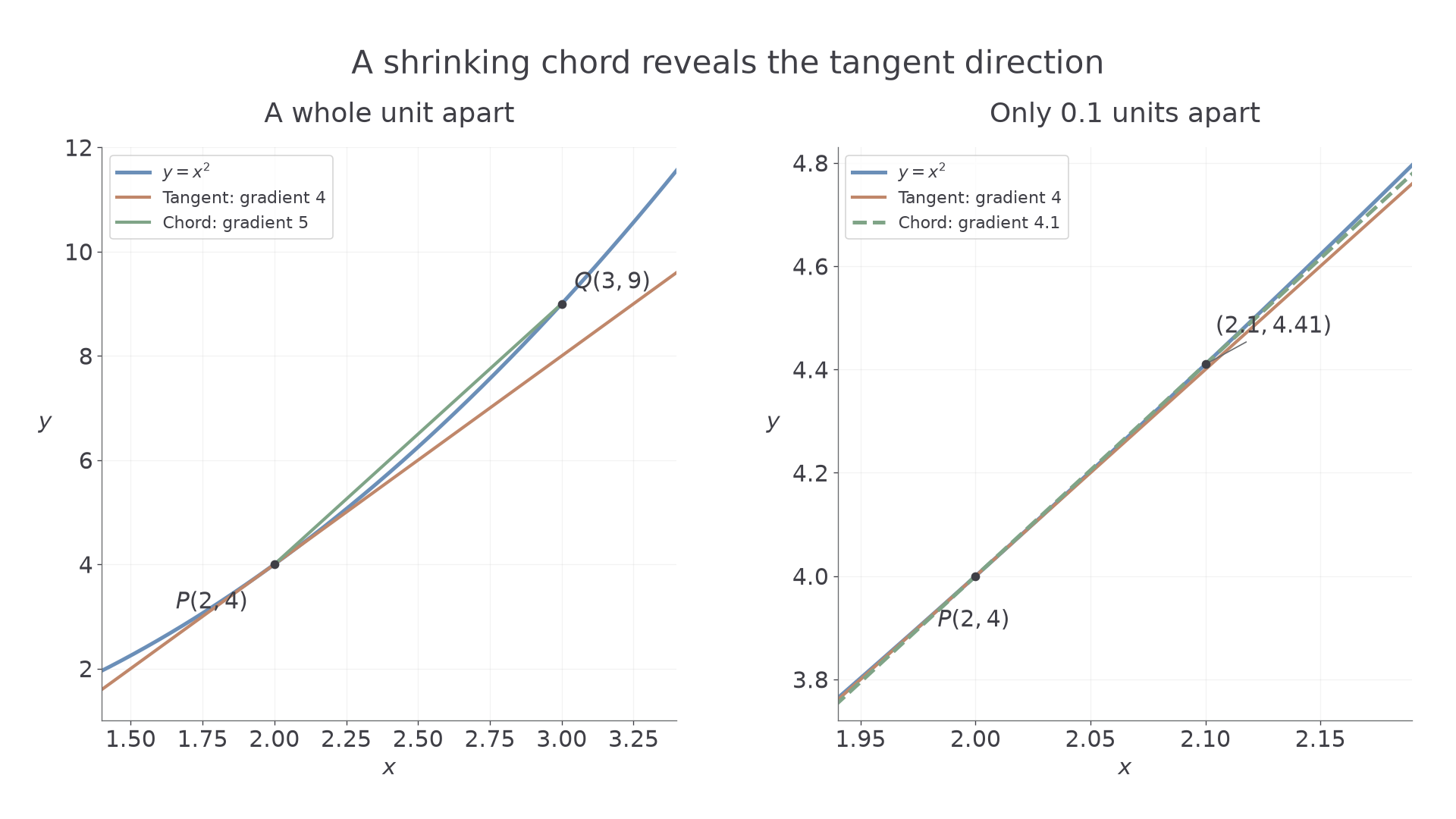
Starting at , join it to . For any non-zero , the chord's gradient is
The chord gradients are , and when , and . From the other side, gives . They approach from both sides. We never divide by zero: we look at the value approached as the horizontal change becomes arbitrarily small. The tangent at therefore has gradient .
[DIAGRAM: asset_name: Chords approaching a tangent; asset_slug: ca30-chord-tangent; caption: Near the point 2 comma 4, the chord direction approaches the tangent direction; description: The curve y equals x squared is blue. A sage chord joins P at 2 comma 4 to Q at 3 comma 9 and has gradient 5. A clay tangent through P has gradient 4. A second panel enlarges the neighbourhood of P and shows a chord to x equals 2.1 with gradient 4.1, almost matching the tangent.]
Derivative and gradient function
The derivative of with respect to , written , gives the instantaneous rate of change of with . For a smooth graph, it is the gradient of the tangent. A derivative expressed in terms of is the gradient function. If , it is also written .
At a general point , the same calculation gives a chord gradient , approaching . Thus the gradient function of is . That explains a neat fact: the tangent at the mid-point's horizontal coordinate has exactly the gradient of any chord of this parabola. The chord from to has gradient , and the tangent at also has gradient . This is exact, however far apart the endpoints are.
The relationship between derivative, tangent gradient and instantaneous rate of change is not on the formulae sheet: learn it. A derivative is not generally the gradient of a chord over a whole interval.
Key idea
The gradient function gives a rule for every point; substituting one value of gives the tangent gradient at that point.
Use that distinction to diagnose the opening mistake.
Differentiating a power
Differentiation turns a polynomial term into its gradient function, using the power to choose both the new coefficient and the new power.
For , the chord calculation starts with . Expanding and dividing by gives , approaching . For , it gave . In both cases, the old power becomes a multiplier and then drops by one. Multiplying the original curve's heights by a constant multiplies every vertical change, and therefore every gradient, by that constant.
The power rule
Here is constant and is a positive integer. A constant has derivative , so the case is handled as a constant rather than by writing an unnecessary negative power. In particular, the derivative of is .
Not on the formulae sheet: learn it.
Read the two operations as a pair: multiply by the old power, then reduce that power by one.
Worked example 1: a positive coefficient
Question. Differentiate with respect to .
Plan. Multiply the coefficient by , then change the power from to .
Why multiply by ? The derivative of is ; scaling the curve by scales its gradients by too.
Answer. .
Check. At , the exact tangent gradient is . The chord from to has gradient , close to .
Change only the coefficient's sign. The power-rule steps stay the same, but the gradient function changes sign.
Worked example 2: a negative coefficient
Question. Differentiate with respect to .
Plan. Keep the negative coefficient when multiplying by the power.
Why does the minus sign remain? Reflecting the curve in the horizontal axis reverses every rise and fall, so it reverses each gradient.
Answer. .
Check. At , the corresponding chord gradient is , approaching .
The old power affects two places in the answer. Completing only one operation produces a familiar error.
Watch out
Wrong: . The coefficient changed but the power did not. Right: . Also, the derivative of is , because a constant graph is horizontal.
Change the coefficient once more, this time to a fraction.
Differentiating a polynomial
Differentiate a polynomial one term at a time, keeping each sign with its term.
Continue this lesson.
You’re previewing NovaLearn without an account. Create a free account to read the rest.
Create free account