CA8–CA10 - Integration as the reverse of differentiation
Differentiation finds a gradient from a curve; integration can work back from the gradient to the curve. CA8 gives the polynomial integration rule, CA9 explains why it reverses differentiation, and the indefinite-integral part of CA10 introduces the constant of integration. You will use one known point to select the right curve from a whole family.
Recovering a curve from its gradient
A curve has gradient at every point and passes through . Is its equation ? That has the right gradient but the wrong height: at , it gives . How can we keep every gradient and still reach the given point?
You already know
The derivative of is , and the derivative of a constant is zero. A vertical translation adds the same constant to every height without changing gradients.
The curves , and all differentiate to . The derivative has lost the constant. Reversing the process must restore that freedom rather than pretending the constant was definitely zero.
Indefinite integral
An indefinite integral represents a family of functions with the same derivative. If , then , where is an arbitrary constant. The expression being integrated is the integrand, and says that is the variable of integration.
The integral sign asks for the reverse operation: “What differentiates to this?” For example, . Different choices of give vertically translated parabolas. An indefinite integral has no upper or lower limits; definite integrals, which have limits and produce a number, come next.
[DIAGRAM: asset_name: A family with the same gradient; asset_slug: ca34-integral-family; caption: All three parabolas have gradient 2x, but only one passes through 3 comma 14; description: Three parabolas y equals x squared, y equals x squared plus 5 and y equals x squared minus 4. The middle-height blue curve y equals x squared plus 5 passes through P at 3 comma 14. Matching small tangent segments at x equals 1 have gradient 2 on each curve.]
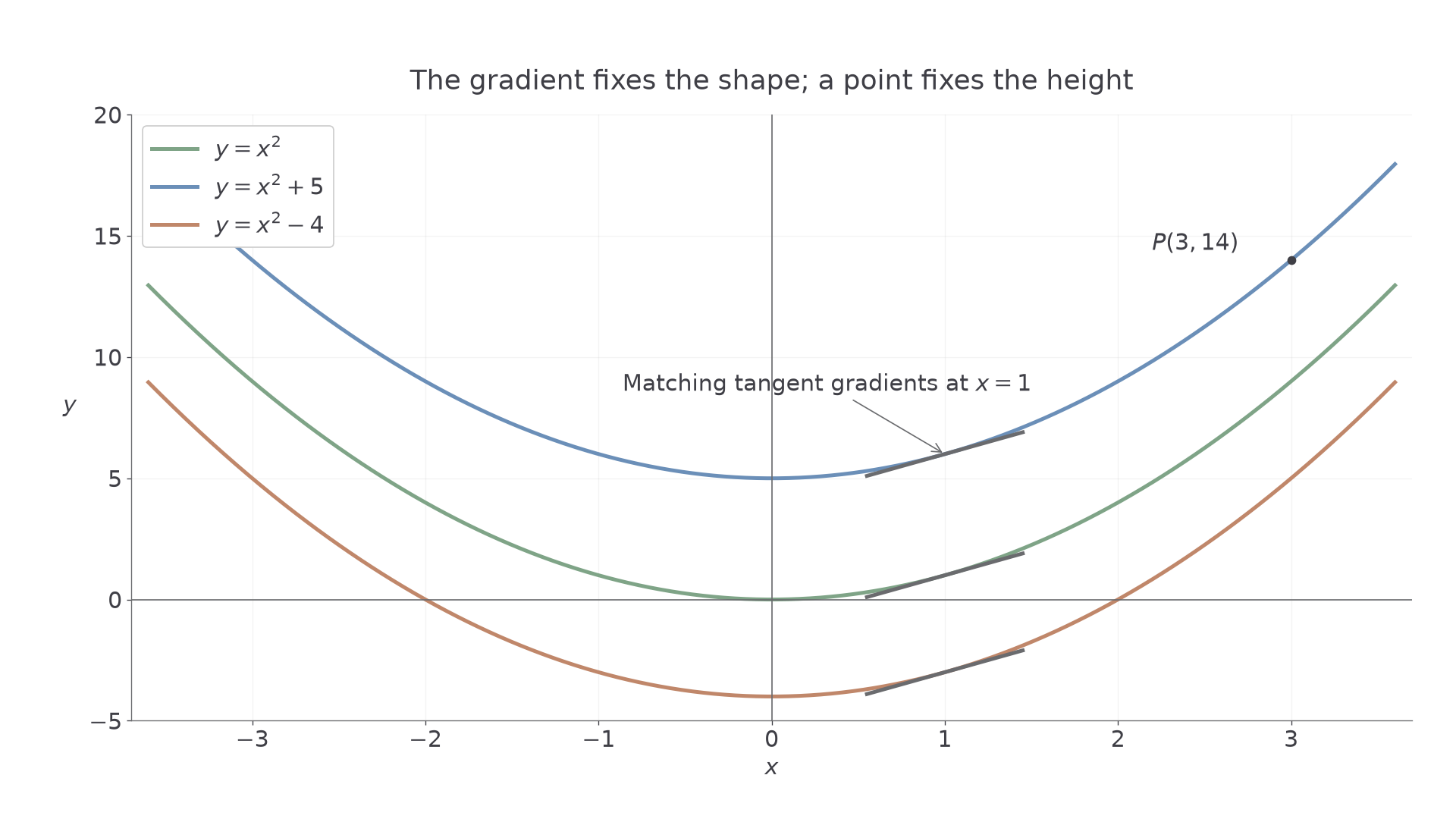
There is an exact reason that the missing information is just a constant for polynomials. Subtract two polynomials with identical derivatives. The difference has derivative zero. Any non-constant term would leave a non-zero derivative term, so the difference must be constant. Even complete gradient information cannot reveal a vertical position without an extra condition.
The inverse relationship and the constant of integration are not on the formulae sheet: learn them.
Key idea
Integration recovers a family of curves; one known point can fix the missing constant and identify one member.
Check what “arbitrary constant” means before learning the rule.
Integrating a power
To reverse the power rule, increase the power by one and divide by the new power.
For example, differentiates to , so to obtain a derivative of just we need . The division compensates for the multiplier that differentiation will produce. Integrating a constant works too: differentiates to , so .
Integrating a polynomial term
Here is constant and is a positive integer or zero. In particular, . The constant can take any real value.
Not on the formulae sheet: learn it.
The check is built into the method: differentiate your answer and see whether the original integrand returns.
Worked example 1: a positive term
Question. Find .
Plan. Increase the power from to , divide the coefficient by and include the arbitrary constant.
Why divide by ? Differentiating a cubic multiplies its coefficient by ; division reverses that multiplication.
Answer. .
Check. , exactly the integrand.
Change only the coefficient's sign. The new power is unchanged; the negative sign must survive.
Worked example 2: a negative term
Question. Find .
Plan. Use the same power increase, retaining the negative coefficient.
Why does the sign stay negative? Differentiating produces ; there is no sign reversal in this inverse operation.
Answer. .
Check. .
A fractional coefficient is not a reason to use decimals. Leave it exact and let the new-power division simplify it.
Watch out
Wrong: , found by dividing by the old power . Right: divide by the new power , giving . Differentiation exposes the wrong answer immediately: gives .
Change the coefficient to a fraction for your turn.
Integrating a polynomial
Integrate a polynomial term by term, then write one constant of integration for the entire answer.
Continue this lesson.
You’re previewing NovaLearn without an account. Create a free account to read the rest.
Create free account