CA10–CA12 - Definite integrals and areas under curves
A definite integral turns an antiderivative into a number by giving it two limits. You will evaluate these integrals, use them to find areas bounded by a curve and recognise when a region must be split because the curve crosses the axis. Keeping the sign straight is what makes the same calculation useful for both geometry and motion.
What the limits mean
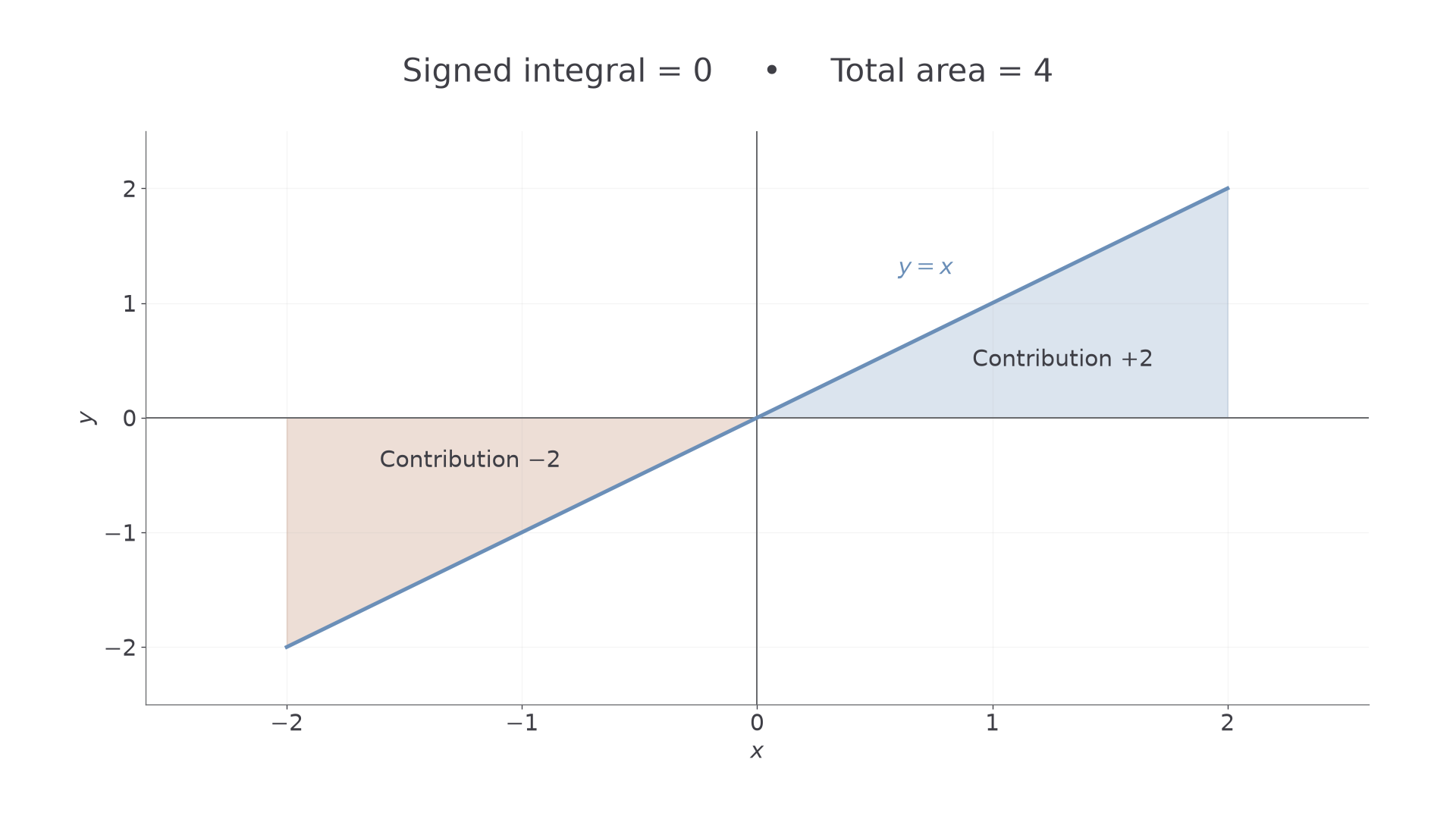
Can an integral be zero when there is clearly a region between the curve and the axis? For the line from to , the two triangles each have area . Yet . The integral counts the lower triangle negatively, so the two contributions cancel. The total geometric area is . Zero can hide quite a lot of space.
You already know
An indefinite integral gives a family of antiderivatives: . Differentiating any member of that family returns .
A definite integral adds two limits: the lower limit tells you where to start, and the upper limit tells you where to finish. Think of very narrow vertical strips. Above the axis their heights are positive; below it their heights are negative. Adding their signed contributions, as the strips become narrower, gives the definite integral. You will evaluate it exactly using antiderivatives, rather than adding lots of strips.
[DIAGRAM: asset_name: Signed integral and total area; asset_slug: definite-signed-area; caption: The two triangles have equal area but opposite signed contributions; description: The graph y equals x between minus 2 and 2. The triangle above the x-axis is shaded blue and labelled integral contribution plus 2. The triangle below is shaded clay and labelled integral contribution minus 2. The caption within the figure states signed integral 0 and total area 4.]
Definite integral
For a continuous function , the definite integral is its signed accumulation from to . For , regions above the axis contribute positively and regions below contribute negatively. It is a number once the function and limits are specified, unlike an indefinite integral, which gives a family of functions.
An ordinate is a vertical line at a specified value of , such as . Two ordinates, a curve and the axis can enclose a region even when the curve does not meet the axis at either end. The ordinates close the sides.
Key idea
A definite integral is signed. Geometric area is non-negative, so an integral and an area need not have the same value.
Use the signs of the two pieces to diagnose this working.
Upper value minus lower value
Evaluate an antiderivative at both limits, then subtract the lower value from the upper value.
For , an antiderivative is . Its change is . This also matches the trapezium under the straight line: parallel sides and , width , area . The antiderivative method continues to work when the top edge is curved.
Evaluating a definite integral
If , then
This applies to the polynomial functions used here. The bracket notation means substitute the upper limit, then subtract the entire lower-limit value.
Not on the formulae sheet: learn it.
There is no in the final answer: . The constants cancel. You may omit while evaluating a definite integral, but must include it in an indefinite integral.
Worked example 1: a positive lower limit
Question. Evaluate .
Plan. Integrate each term, then subtract the whole value at from the value at .
Why the second bracket? All three terms are part of the lower-limit value; the subtraction applies to all of them.
Answer. The integral is .
Check. Differentiating gives , and the positive integrand gives a positive result.
The next example changes only the lower limit to a negative number. Keep its substitution in brackets before doing the subtraction.
Worked example 2: a negative lower limit
Question. Evaluate .
Plan. Use the same antiderivative, substituting carefully into each power.
Why write ? Squaring a negative input gives ; the minus sign already in front of then makes that term .
Answer. The integral is .
Check. The extra interval from to contributes , so the result is more than in Worked example 1.
Negative lower-limit values are harmless if the bracket stays intact.
Watch out
Wrong: . This subtracts only the first term of the lower value. Right: .
Show the antiderivative and both substitutions in a detailed reasoning question; a calculator integral alone does not show that method.
Areas on one side of the axis
For a region wholly on one side of the axis, determine its sign first and then evaluate one integral.
If a curve is above the axis, its vertical height is . If it is below, the geometric height from the curve up to the axis is . This is why a negative integral must be negated to obtain the area. An endpoint on the axis does not cause a problem: that strip simply has zero height.
Continue this lesson.
You’re previewing NovaLearn without an account. Create a free account to read the rest.
Create free account