NM1 - Locating roots by change of sign
Some equations have awkward roots even when the equation itself is short. NM1 gives you a dependable way to trap a root between two numbers, narrow the gap and justify a rounded answer. The signs of the answers matter more than their size.
Why a change of sign traps a root
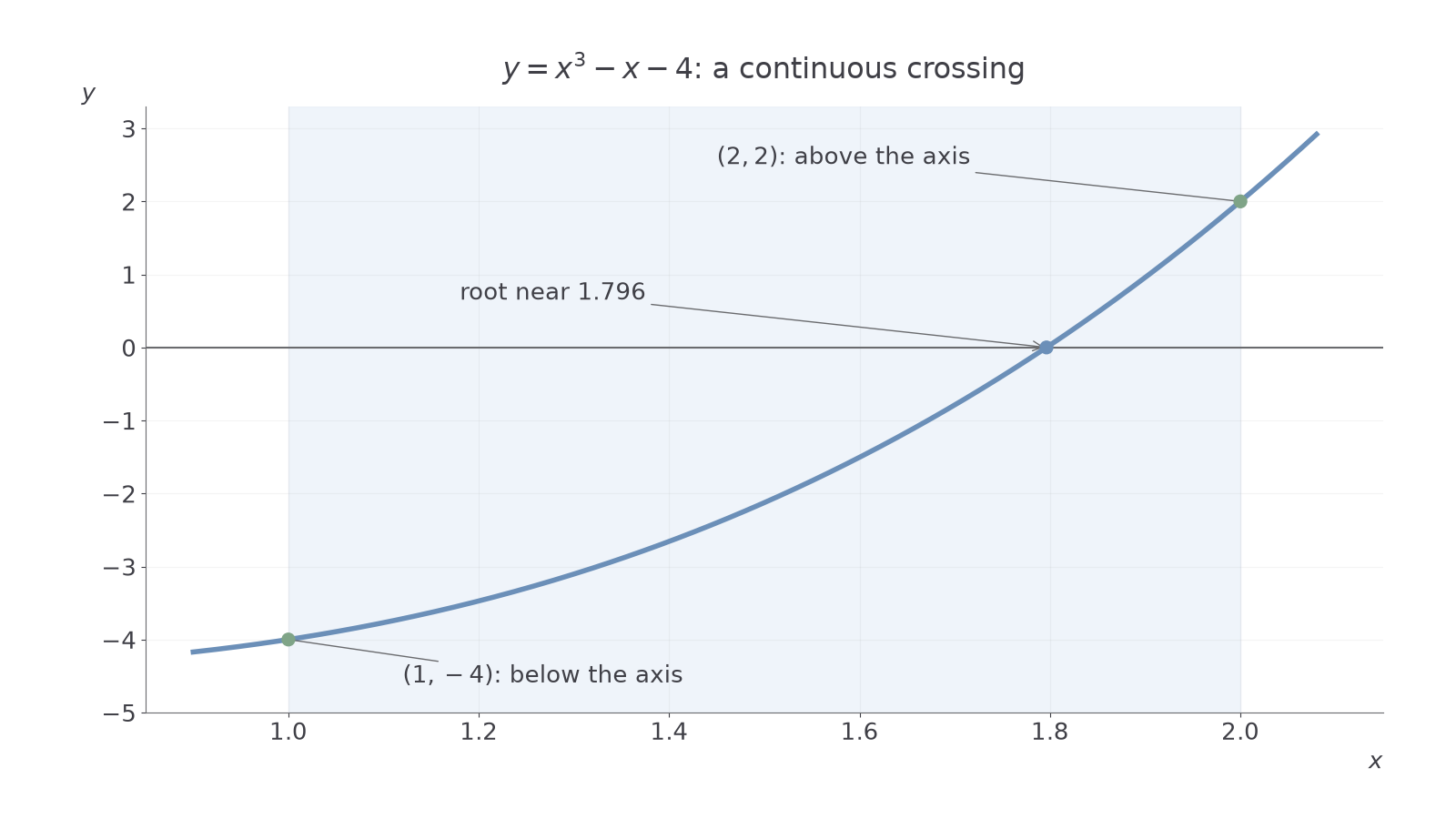
Where does the curve cross the -axis between and ? Neither integer is a solution, and an accurate-looking graph still leaves us guessing about the decimal places. We can turn that guess into a justified answer.
You already know
A root of is the -coordinate of a point where meets the -axis. Rearrange an equation so one side is zero before testing signs.
For the opening curve, , below the axis, whereas , above it. A curve that stays connected between these points must pass through height zero along the way. It cannot get from below the floor to above the floor without crossing the floor.
[DIAGRAM: asset_name: A root trapped by opposite signs; asset_slug: nm1-sign-bracket; caption: Opposite signs at the ends of a continuous piece of curve trap a root in between; description: The graph y equals x cubed minus x minus 4 from x equals 1 to 2, with the points (1, minus 4) and (2, 2) marked and a root near x equals 1.796. A shaded vertical band highlights the interval from 1 to 2]
The condition about staying connected has a mathematical name.
Continuous on an interval
A function is continuous on an interval if its graph has no break, hole or jump there. Polynomial functions are continuous for every real . An exponential function , with , is also continuous.
A root need not be a whole number or a terminating decimal. The sign argument finds an interval containing it without first knowing what sort of number it is.
Change-of-sign test
This requires and continuous throughout . If an endpoint value is zero, that endpoint is already an exact root.
Not on the formulae sheet: learn it.
Here is a useful surprise: repeatedly halving a bracket only times makes it times narrower, because . Quite modest arithmetic can replace a very large graph. You do not have to halve the interval; testing convenient tenths and hundredths often suits an exam question better.
Key idea
Opposite signs prove that at least one root is inside a continuous interval. They do not prove there is exactly one root, and the endpoint values are not the roots.
Read the conclusion as carefully as the calculation.
Narrowing the interval
To improve an estimate, test new values inside the bracket and keep endpoints with opposite signs.
A table makes the evidence easy to follow. Write the function you are using, keep enough digits to show each sign, then state what the signs establish. A tiny negative answer is still negative: rounding it to zero can throw away the evidence.
Worked example 1: narrowing to hundredths
Question. By change of sign, locate the root of between consecutive hundredths.
Plan. Start with , test tenths and then test hundredths inside the smaller bracket.
Why test ? We already know gives a positive answer. A negative answer at would trap the root between consecutive hundredths without a long table.
Answer. There is a change of sign between and . Since is continuous, a root lies in .
Check. The new interval has width , one hundredth of the original width .
The second example changes only the constant in the equation. The bookkeeping stays the same, but the useful interval moves.
Worked example 2: the same search at a different root
Question. By change of sign, locate the root of between consecutive hundredths.
Plan. Evaluate near the positive crossing and retain opposite signs.
Why stop there? The endpoints are consecutive hundredths and have opposite signs, exactly what the question requests.
Answer. Continuity and the change of sign show that a root lies in .
Check. The function has risen from negative to positive across the stated interval; neither endpoint is claimed as a root.
Continue this lesson.
You’re previewing NovaLearn without an account. Create a free account to read the rest.
Create free account