EN1 - The binomial expansion
A power such as looks like a long multiplication, but counting tells you its terms directly. You will see why combinations appear in an expansion, expand a positive integer power, and find a requested coefficient or constant term without multiplying out every bracket.
Why combinations appear
How can the products hidden in collect into just seven terms, and why is the coefficient of exactly ? The answer is a counting problem wearing an algebra disguise.
You already know
Expanding brackets means choosing one term from each bracket and adding all the resulting products. counts the ways to choose positions from , when their order does not matter.
Start smaller: . Each bracket offers two choices, so there are products before collecting. The product comes from choosing in the third bracket; and choose it in the second and first. All three are the same algebraic term, . Choosing the positions matters to the count even though the letters then multiply to the same thing.
[DIAGRAM: asset_name: Choices behind a binomial expansion; asset_slug: binomial-choice-groups; caption: Eight choices from three brackets collect into four algebraic terms; description: Eight rows list aaa, aab, aba, baa, abb, bab, bba and bbb. The rows are grouped by the number of b choices, with group sizes 1, 3, 3 and 1, and arrows point to a cubed, 3 a squared b, 3 a b squared and b cubed. The b choices are sage and the collected terms are blue]
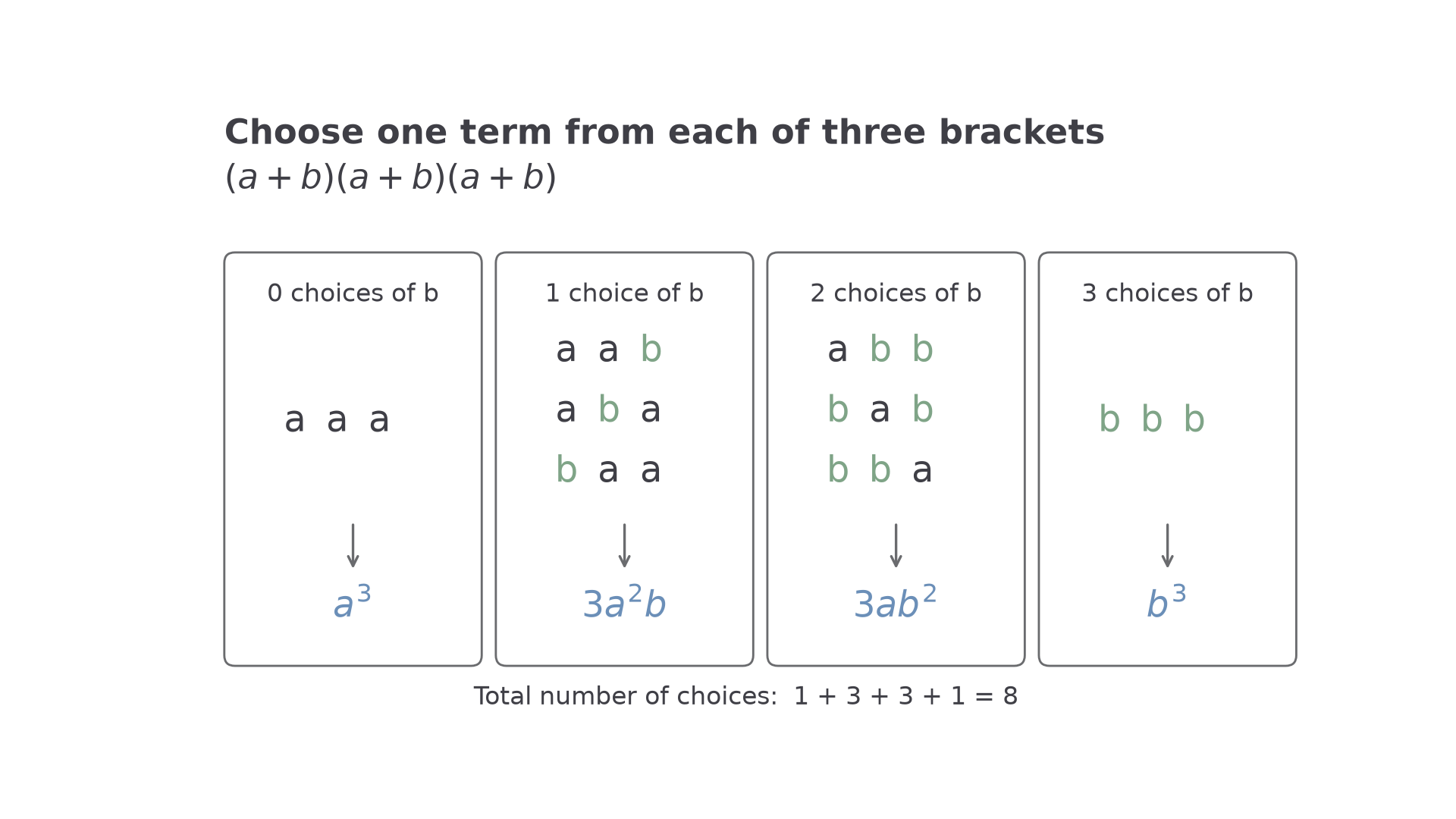
This gives . For , choose the brackets supplying ; all other brackets supply . There are choices. This explains the coefficient rather than asking you to remember a triangle of numbers.
Binomial expansion
A binomial has two terms. Its binomial expansion, for a positive integer power, is the result of multiplying the repeated brackets and collecting like terms. For example, . The expression has three terms inside its bracket, so the binomial formula does not apply directly.
Here is a useful surprise: the coefficients of add to . Substituting shows why: the whole expression becomes . So is no coincidence. This coefficient-sum check is a consequence of the expansion, not a separate result on the formulae sheet.
Key idea
The coefficient counts which brackets supply the second term; each resulting product contains first terms and second terms.
Use that meaning to diagnose the coefficient in the next question before calculating anything.
Expanding positive integer powers
The counting argument gives a compact formula for the whole expansion; your job is to keep the two terms, including their signs, intact.
Binomial expansion
Here is a positive integer and . Also . There are terms before any special values cause terms to vanish.
On the formulae sheet.
In every term the two exponents add to . To write an expansion in ascending powers of , start with the constant term, then , , and so on. Treat a term such as as one complete choice, so its power is .
Worked example 1: an expansion in ascending powers
Question. Expand in ascending powers of .
Plan. Use , and the coefficients , then simplify each power.
Why these powers? Choosing from brackets contributes , so the number must be raised to the power too.
Answer. .
Check. At , the bracket gives , and the coefficients add to .
The next example changes just the sign of the second term. Odd powers now make negative terms; even powers stay positive.
Worked example 2: a negative second term
Question. Expand in ascending powers of .
Plan. Use the same coefficients, but substitute before evaluating the powers.
Why put the minus inside the power? , whereas . They are different expressions.
Answer. .
Check. At , , and .
Both the numerical factor and the sign belong inside the powered bracket.
Watch out
Wrong: . The cube applies to the as well as to . Right: .
Now change the first term as well: its powers also need to appear, even though they contain no .
Finding a requested coefficient
When only one coefficient is requested, write only the term that can contain that power; a full expansion creates more opportunities for a slip.
Continue this lesson.
You’re previewing NovaLearn without an account. Create a free account to read the rest.
Create free account