NM4, NM5 - Estimating gradients with chords
A table of points may describe a curve without giving you a formula to differentiate. NM4 uses a chord to estimate the gradient of a tangent; NM5 improves the estimate by choosing points more carefully. This gives a practical bridge between a measured change and an instantaneous rate.
A chord as a tangent estimate
How can two positions from a moving object's journey tell you how fast it is moving at one instant? A chord gives the average rate between two readings. If the readings are close enough to the instant we care about, that average can estimate the tangent's gradient there.
You already know
The tangent gradient is at a point. For two distinct points on a straight line, gradient is change in divided by change in . A displacement-time gradient represents velocity.
A chord joins two points on a curve. It is a straight line, so its gradient can be calculated even when the curve's formula is unknown. The chord and tangent generally have different gradients: an estimate is not an exact derivative merely because the arithmetic is exact.
Chord estimate
Here is the point of interest and is a nearby point on the same curve, with . This is a one-sided estimate; nearby points on both sides can give a better estimate.
Not on the formulae sheet: learn it.
Keep the subtractions in the same order. Reversing both is fine; reversing just one changes the sign.
Worked example 1: a forward chord
Question. A curve passes through and . Use the chord to estimate the tangent gradient at .
Plan. Divide the change in height by the corresponding change in horizontal position.
Why subtract from ? We used the movement from to in the denominator, so the numerator must describe the same movement.
Answer. The tangent gradient at is approximately .
Check. Both changes are positive, so a positive gradient makes sense. The chord rises about in a horizontal distance of , so a gradient near is plausible.
The next example changes only the second point: it is closer to , allowing the chord to follow the curve more locally.
Worked example 2: a closer forward chord
Question. A second point on the curve is . Use to estimate the tangent gradient at .
Plan. Repeat the chord calculation using the closer point.
Why is this a more local estimate? It averages the gradient over a shorter piece of curve, so changes farther from have less influence.
Answer. The tangent gradient is approximately , using the closer chord.
Check. The new estimate differs from ; the earlier answer was a chord gradient, not an exact tangent gradient.
Writing the fraction before evaluating it makes both the point choice and the sign visible.
Watch out
Wrong: . Only the denominator was reversed. Right: use , or reverse both subtractions.
The next question keeps the same calculation but moves the point of interest.
Using points on both sides
When readings are available on both sides of the point, a chord centred on that point usually gives a better estimate than a chord reaching only one way.
For an estimate at , use points at and , where . The horizontal gap is , not . The chord joins these two curve points; it does not have to pass through the curve point at .
[DIAGRAM: asset_name: Chords approaching a tangent; asset_slug: nm4-closer-chords; caption: A chord centred at x equals 2 approaches the tangent as its endpoints move closer; description: The cubic curve y equals x cubed, its tangent at (2, 8) of gradient 12, a wide chord from (1, 1) to (3, 27) of gradient 13, and a closer chord from (1.8, 5.832) to (2.2, 10.648) of gradient 12.04]
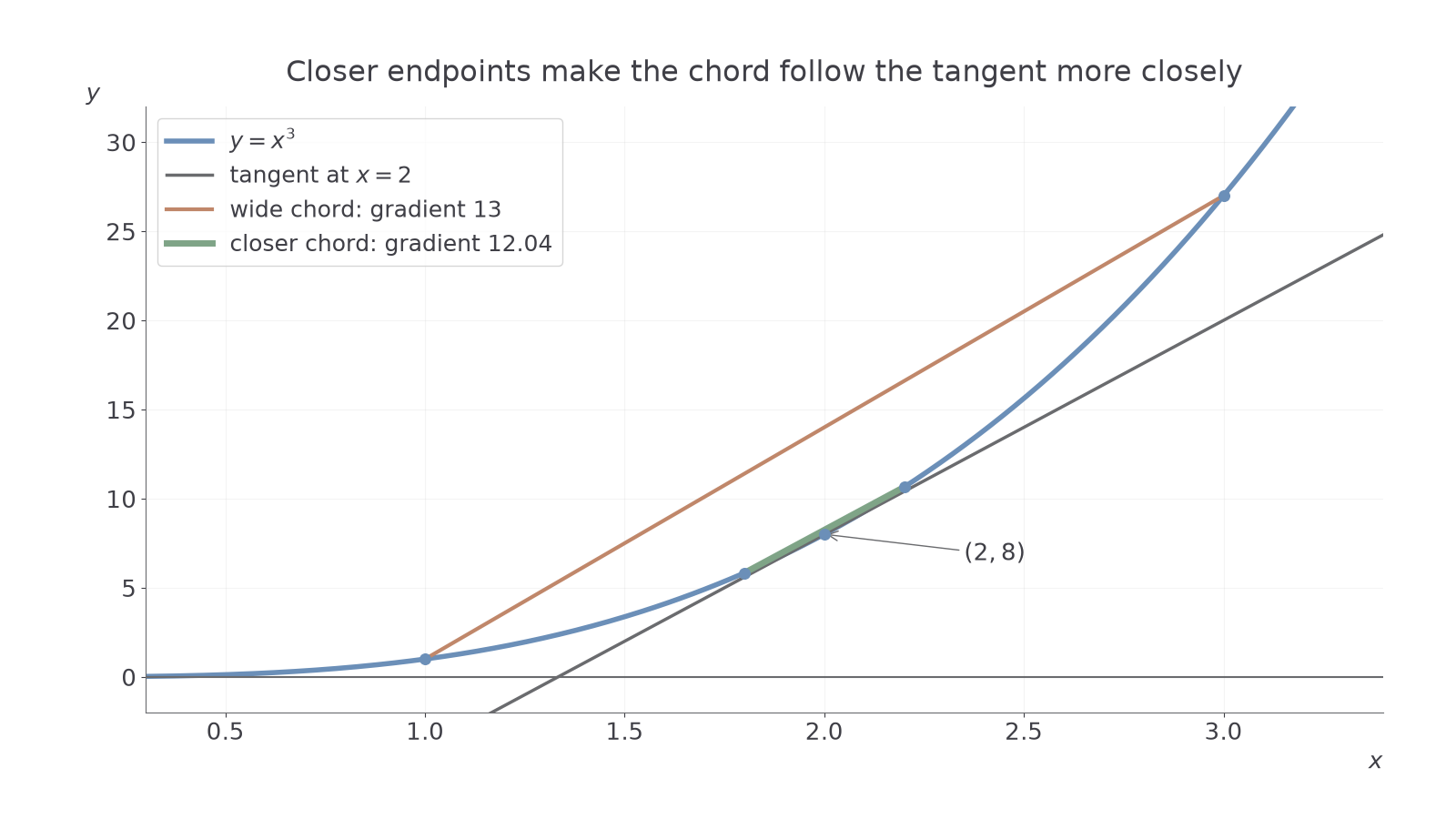
The two-sided calculation is often called a central estimate.
Central estimate of a gradient
Use two points equally spaced either side of , with small positive , on a smooth curve. The denominator is the whole distance between the two points.
Not on the formulae sheet: learn it.
With a table, choose the nearest available points that straddle the requested value. If equally spaced points are available, use them rather than a wider or one-sided chord.
Continue this lesson.
You’re previewing NovaLearn without an account. Create a free account to read the rest.
Create free account