AL6 - Simultaneous equations in two unknowns
Find pairs of values that satisfy two equations at the same time. You will choose a sensible elimination or substitution, keep both answers when a quadratic appears, and turn a word problem into a complete pair of equations. A graph will explain what the algebra says about intersections.
Solving two linear equations
Can a straight line meet a parabola twice, once or not at all, just by sliding up and down? Keep that question in mind. First, we need to be clear about what it means to solve two equations together.
The equation allows many pairs: , and , for example. Adding the condition leaves just . Each equation is a filter; a simultaneous solution must pass both.
Simultaneous solution
A simultaneous solution is a pair satisfying both equations. For example, solves and . The pair satisfies the first equation but not the second, so it is not a simultaneous solution.
At GCSE you met elimination: add or subtract suitable multiples of equations so that one unknown disappears. Substitution does the same job by expressing one unknown in terms of the other. These methods are not on the formulae sheet: learn them. Choose the route that keeps the algebra small.
Worked example 1: elimination by addition
Question. Solve and .
Plan. Add the equations to eliminate , then substitute to find .
Why add? The coefficients of are opposites, so addition removes without any preliminary multiplication.
Answer. , .
Check. and : both original equations hold.
The second example changes one feature: the coefficients do not cancel immediately. Multiply a whole equation, including its right-hand side.
Worked example 2: making matching coefficients
Question. Solve and .
Plan. Multiply the first equation by and the second by , then add to eliminate .
Why these multipliers? They turn the coefficients of into and . Eliminating instead would be equally valid.
Answer. .
Check. and .
A useful check is to use the equation you did not use for substitution; it can catch a copied sign.
Watch out
Wrong: multiplying by gives . The two sides must stay equal. Right: .
Now change the signs again and arrange your own cancellation.
A linear equation and a quadratic equation
Substitution usually makes a linear and quadratic pair manageable: use the line to replace one unknown, then solve the resulting quadratic.
You already know
Factorise a quadratic when its factors are easy to see. Otherwise complete the square or use the quadratic formula, which is on the formulae sheet. A quadratic can have two real roots, one repeated real root or no real roots.
If a line already says , substitute for . Making the subject instead may introduce fractions for no benefit. Once you have found each , return to the line for its matching .
Worked example 3: two intersections with integer coordinates
Question. In this question you must show detailed reasoning. Solve and .
Plan. Equate the two expressions for , solve for , then pair each value with its own .
Why use the line for the last step? It gives with one short calculation, reducing the chance of a squaring error.
Answer. or .
Check. and . Both pairs also satisfy .
The next example changes one feature: the quadratic has both and , so substitute the whole expression for , in brackets.
Worked example 4: substituting into a squared term
Question. Solve and .
Plan. Replace by , expand and solve.
Why the brackets? Squaring means squaring all of . Writing would lose the middle term .
Answer. or .
Check. and ; in each pair .
The answer is a list of pairs, not two unconnected lists of numbers.
Watch out
Wrong: from Worked example 4, . This mixes values from different solutions. Right: substitute each separately and keep and together.
A detailed reasoning question needs the substituted equation and the quadratic-solving steps on the page, even if you check with a calculator.
Two, one or no intersections
The number of real simultaneous solutions tells you how many points the graphs share.
Take and slide a line of gradient vertically. Equating the expressions for , then completing the square, gives the three cases below.
| Line | Equation after substitution | Intersections |
|---|---|---|
| Two: , | ||
| One: | ||
| None in real coordinates |
[DIAGRAM: asset_name: Sliding a line past a parabola; asset_slug: simultaneous-intersections; caption: A vertical shift changes two intersections into a tangency, then no intersections; description: Three coordinate panels show the parabola y equals x squared and parallel lines y equals 4x minus 3, y equals 4x minus 4 and y equals 4x minus 5. The first panel labels intersections 1 comma 1 and 3 comma 9. The second labels the single tangent point 2 comma 4. The third shows no shared points.]
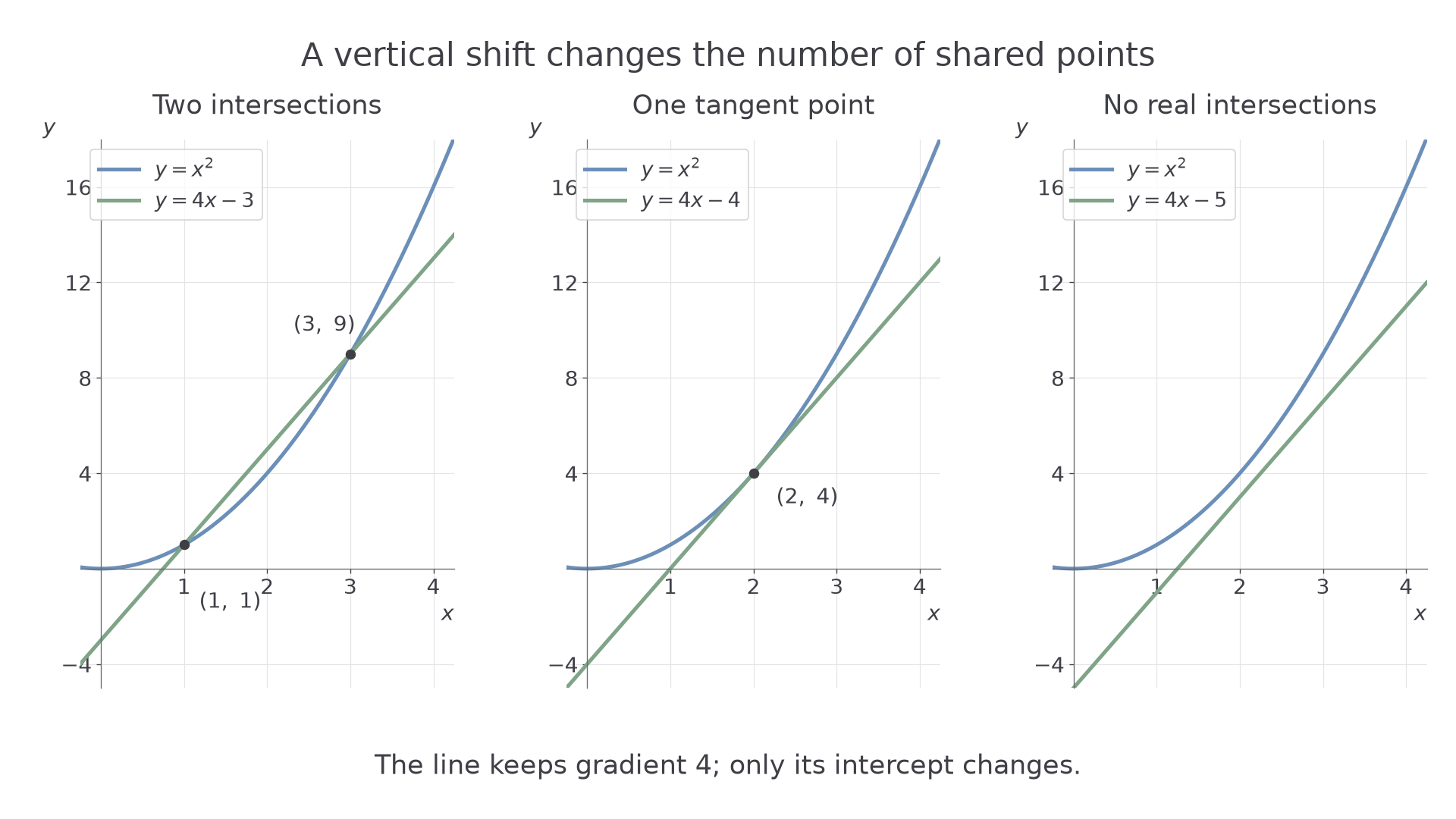
The middle line touches the parabola without crossing it. This is a tangent. Its repeated root gives one point, not two different points with identical coordinates. You can identify this tangency from substitution alone; no differentiation is needed.
Tangent to a parabola
A straight line is tangent to a parabola when it touches it at a point and substitution gives a repeated root. For example, is tangent to at .
This answers the opening question, and gives a useful surprise: the same slope can produce all three intersection counts. The intercept controls whether the line crosses, just touches or misses the parabola. This conclusion is derived from the quadratic; it is not on the formulae sheet.
Key idea
Two distinct real roots mean two intersections; a repeated root means a tangent; no real roots mean no real intersections for a line and a parabola.
Do not generalise “one intersection means tangent” to every pair of graphs. Two non-parallel straight lines have one crossing point. Here it is the repeated root from the line–parabola substitution that identifies tangency.
Building equations from a problem
A word problem supplies relationships; define the unknowns carefully, then translate each independent relationship into an equation.
Use units in the definitions. If is a price in pounds, it is not also the number of tickets. A physical context may rule out an algebraically correct pair, but only after you have found and considered it.
Worked example 5: totals and prices
Question. Three adult tickets and two child tickets cost £34. Two adult tickets and five child tickets cost £41. Find both ticket prices.
Plan. Let and be the adult and child prices in pounds, then eliminate .
Why define prices first? The coefficients count tickets, so each term is a cost and the equations have consistent units.
Answer. An adult ticket costs £8 and a child ticket costs £5.
Check. and .
Now change one feature: one relationship is a product, so substitution produces a quadratic. The final interpretation must respect a length's positivity.
Worked example 6: a rectangle's length and width
Question. A rectangle has area . Its length is greater than its width. Find its dimensions.
Plan. Let the width be and length be ; substitute into .
Why reject ? It would give . That pair satisfies the algebra but cannot describe physical dimensions.
Answer. Width , length .
Check. and .
Context decides whether a solution is usable, not whether it exists algebraically. Equally, a negative coordinate in a graph problem is often perfectly valid.
Watch out
Wrong: discard every negative solution of simultaneous equations. Right: reject a value only when it conflicts with a stated condition, such as a length being positive. In Worked example 4 the negative coordinate pair is valid.
Use the same two-relationship plan in this rectangle problem, changing the product to a sum of squares.
Quick Recap
- A simultaneous solution satisfies both equations; keep matching values together as a pair.
- Eliminate an unknown from two linear equations, or substitute the simplest expression from a line into a quadratic.
- A line and parabola can have two intersections, one tangent point or no real intersections; the substituted quadratic reveals which.
- Define unknowns and build two independent equations in context, then check whether each algebraic solution is physically possible.
The opening puzzle has all three answers: sliding from through to changes two intersections into one tangent point, then none.