4.1.4.05 - The biological approach to explaining and treating OCD
OCD can be investigated through inherited vulnerability, neural systems and the effects of medication, but no single gene or brain circuit explains every case. You will examine candidate genes, polygenic risk, serotonin and brain areas linked to worry and habit, then evaluate selective serotonin reuptake inhibitors as treatment. Twin evidence, drug effectiveness and alternative explanations will support a balanced judgement about biological reductionism.
The Biological Logic
The AQA requirement is focused: explain OCD using genetic explanations and neural explanations, then explain drug therapy as a biological treatment. You do not need a full clinical diagnosis lesson here, but you do need to link biology to the symptoms already taught: obsessions, compulsions, anxiety and disruption to everyday functioning.
Biological approach
The biological approach explains behaviour and mental disorders in terms of physical processes, including genes, brain structures and neurochemistry.
OCD
Obsessive-compulsive disorder is a mental health disorder involving obsessions, compulsions, or both, which are distressing, time-consuming and/or impair normal functioning.
AO1: the core claim
The biological approach argues that some people are more vulnerable to OCD because of inherited genetic differences and differences in brain systems involved in threat detection, habit, inhibition and mood regulation. Drug therapy follows the same logic: if OCD is partly linked to neurochemical functioning, then altering neurotransmitter activity may reduce symptoms.
AO2: applied example
Amira repeatedly checks that the hob is off before leaving for college. A biological explanation would not say that she "chooses" to do this. It would look for vulnerability factors such as a family history of OCD, altered serotonin functioning, and overactivity in brain circuits that keep signalling that something may be unsafe.
AO3: exam warning
Biological explanations are useful, but AQA answers should avoid biological determinism. Genes and neural circuits increase vulnerability; they do not guarantee that a person will develop OCD. Psychological learning, stress, family responses and cognitive interpretations may also matter.
Genetic Explanations
Genetic explanation
A genetic explanation argues that inherited DNA variations increase a person's vulnerability to OCD.
AO1: genes as vulnerability, not destiny
The most exam-safe wording is that OCD has a genetic component. Family and twin studies show that OCD tends to run in families, and that identical twins are more similar for OCD symptoms than non-identical twins. This suggests that genetic similarity contributes to risk.
However, OCD is not caused by a single "OCD gene". It is better described as polygenic: many genetic variations may each add a small amount of risk. Candidate genes have been investigated in serotonin, dopamine and glutamate systems, including genes linked to serotonin transport and receptors, COMT, and the glutamate transporter gene SLC1A1. The research picture is still incomplete, so avoid claiming that one named gene has been proven to cause OCD.
Polygenic
A polygenic explanation says that a trait or disorder is influenced by many genes, each with a small effect.
Candidate gene
A candidate gene is a gene researchers investigate because there is a plausible reason to think it may be linked to a disorder or behaviour.
Research support
Browne, Gair, Scharf and Grice (2014) reviewed genetic evidence for OCD and related disorders. They reported that twin and family studies support a significant genetic contribution. Heritability estimates across studies vary, with some estimates around 50%, and first degree relatives of people with OCD show higher rates of OCD than the general population.
AO3: limitations
Family resemblance is not pure genetic evidence. Relatives often share environments, such as parental modelling, stress patterns and family accommodation of rituals. Twin studies improve the evidence, but even identical twins may be treated more similarly than non-identical twins. Also, the incomplete and mixed candidate-gene evidence means the genetic explanation is stronger as a general vulnerability account than as a precise map of exactly which genes cause OCD.
Neural Explanations
Neural explanation
A neural explanation explains OCD through brain structures, neural circuits and neurotransmitters.
AO1: serotonin and neurochemistry
The classic AQA-level neural explanation focuses on serotonin. Serotonin is a neurotransmitter involved in mood regulation and flexible control of behaviour. A simplified account says that low or abnormal serotonin functioning may make it harder for a person to regulate anxiety and intrusive thoughts.
The more careful contemporary version is this: the serotonin system is clearly implicated in OCD because serotonin reuptake inhibitors can reduce symptoms, but the exact causal mechanism is not fully settled. Dopamine and glutamate may also be involved, so a high-quality answer should avoid treating serotonin as the whole story.
Neurotransmitter
A neurotransmitter is a chemical messenger that carries signals between neurons across a synapse.
Serotonin
Serotonin is a neurotransmitter involved in mood, anxiety and behavioural control. In OCD it is important because several effective drug treatments target serotonin reuptake.
AO1: the CSTC circuit
Many modern neural accounts focus on the cortico-striato-thalamo-cortical circuit, often shortened to CSTC. A revision-friendly version is:
- The orbitofrontal cortex (OFC) is involved in evaluating possible threat or error, such as "the door may not be locked".
- The caudate nucleus, part of the striatum, helps regulate or filter signals from the OFC.
- The thalamus relays signals back to cortical areas.
- If this loop becomes overactive or poorly filtered, threat/error signals may keep returning, making intrusive worries feel urgent and hard to dismiss.
In the checking example, the person may check the lock, feel temporary relief, but the "not safe yet" signal returns. The compulsion is then repeated.
[DIAGRAM: asset_name: Biological pathway for OCD; asset_slug: 4_1_4_05_the_biological_approach_to_explaining_and_treating_ocd__diagram_01; recommended_method: image_gen; description: A four-stage NovaLearn-style pathway diagram linking genetic vulnerability, neural circuits, OCD symptoms and SSRI drug therapy.]
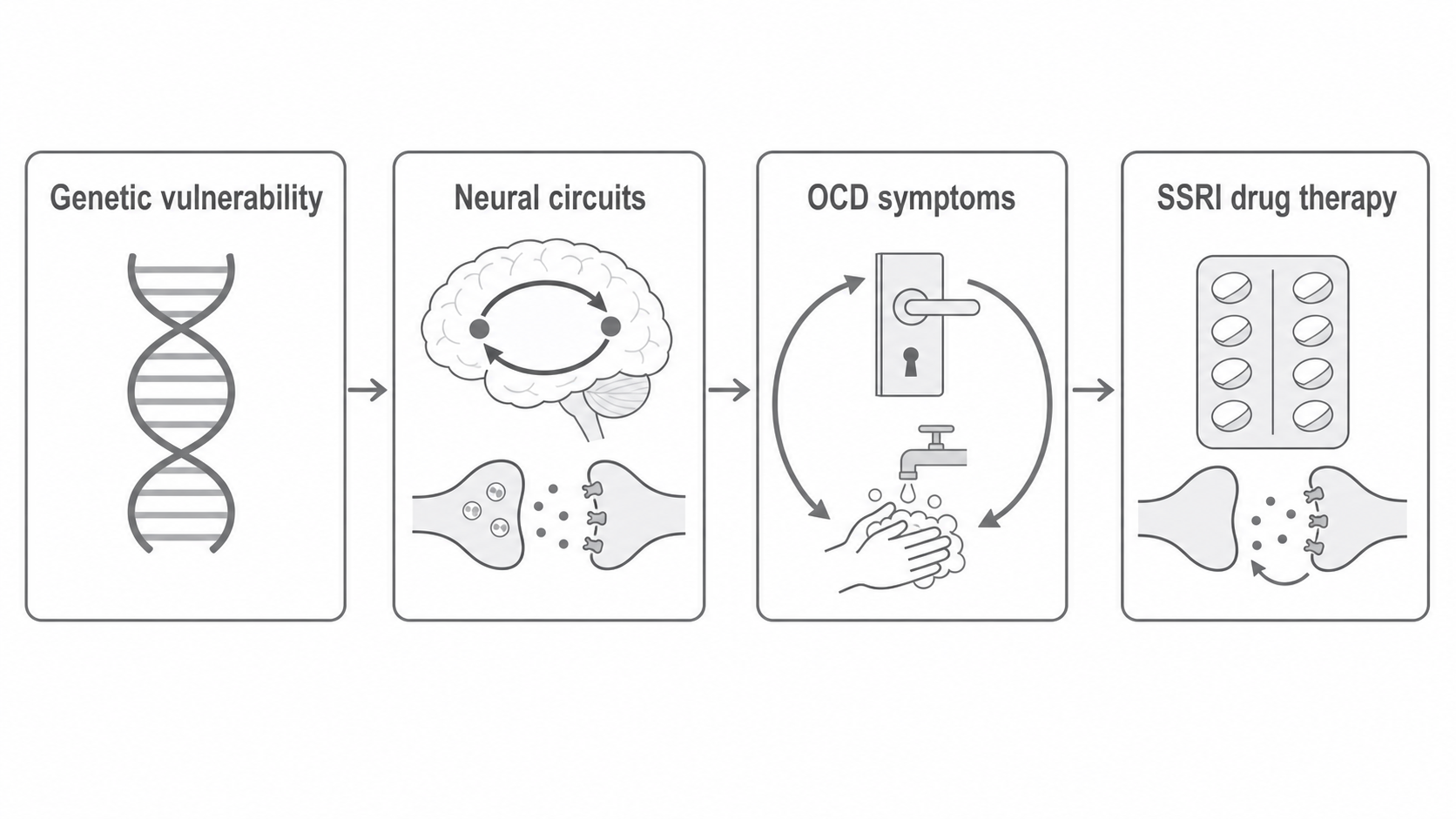
AO3: cause and effect problem
Brain scans can show differences in people with OCD, including altered activity in CSTC regions such as the OFC, striatum and caudate. This supports the neural explanation, but it does not prove direction of causality. Repeated compulsions and anxiety could change brain activity, brain differences could increase symptoms, or both could be affected by a third factor such as genetic vulnerability or stress.
Drug Therapy
Drug therapy
Drug therapy is the use of medication to reduce symptoms. In OCD, biological treatment usually targets neurotransmitter functioning, especially serotonin.
AO1: SSRIs
The main biological treatment for OCD is the use of selective serotonin reuptake inhibitors, or SSRIs. Examples used in clinical guidance include fluoxetine, fluvoxamine, paroxetine, sertraline and citalopram.
SSRI
An SSRI is a selective serotonin reuptake inhibitor: a drug that blocks the reuptake of serotonin into the presynaptic neuron, leaving more serotonin available in the synapse.
At a synapse, serotonin is released from the presynaptic neuron and binds to receptors on the postsynaptic neuron. Normally, some serotonin is reabsorbed by the presynaptic neuron. SSRIs block this reuptake process. Over time, this can increase serotonin availability and may reduce anxiety and intrusive obsessive thoughts, making compulsions easier to resist.
AO1: other biological drug options
If SSRIs do not help enough, clinical guidance may consider alternatives such as another SSRI or clomipramine, a tricyclic drug with strong serotonin reuptake effects. Antipsychotic augmentation may be used in specialist treatment for some treatment-resistant cases, but for this AQA bullet the core treatment is drug therapy through serotonin reuptake inhibition.
AO2: treatment in context
If Amira has moderate OCD and chooses medication, an SSRI might be prescribed and monitored. The treatment would not remove all stress instantly: NHS and NICE information note that benefit can take up to about 12 weeks. If symptoms are severe, guidance may recommend combined treatment, such as an SSRI plus CBT with exposure and response prevention.
AO3: effectiveness and appropriateness
Soomro et al. (2008) reviewed 17 randomised studies with 3097 adult participants and found SSRIs more effective than placebo in reducing OCD symptoms in the short term. This is strong practical support because it uses randomised controlled trials rather than only case reports.
There are still limitations. Some people do not respond, benefits may take weeks, and side effects such as nausea, insomnia, headaches or agitation can reduce adherence. Medication may also reduce symptoms without directly teaching the person new ways to respond to obsessive thoughts, so combined psychological and biological treatment can be more appropriate for some people.
Evaluating The Biological Approach
AO3: strength - research support from several methods
The biological approach is supported by converging evidence. Twin and family studies suggest genetic vulnerability. Brain-imaging and review evidence links OCD to CSTC circuits and serotonin systems. Drug trials show SSRIs can reduce symptoms better than placebo. This triangulation makes the biological approach more credible than a single-study explanation.
AO3: limitation - reductionism
The biological approach can be reductionist if it explains OCD only through genes and neurotransmitters. OCD also involves meanings, fears, avoidance and reinforcement. For example, handwashing may be maintained because it reduces anxiety in the short term, and intrusive thoughts may be made worse by catastrophic interpretations. A stronger account is interactionist: biological vulnerability may make symptoms more likely, while psychological processes shape the content and maintenance of symptoms.
AO3: limitation - determinism and ethics
A purely biological account risks making OCD sound inevitable. This may reduce blame, which is helpful, but it may also encourage pessimism if students write as if people are controlled by their genes or brain circuits. In reality, treatment can help, and people can learn strategies to manage symptoms. Good exam answers describe biological vulnerability without removing agency or ignoring treatment choice.
AO3: treatment evaluation
Drug therapy is often accessible, can be combined with CBT, and is useful when symptoms are severe enough to prevent engagement with therapy. It also has economic advantages because medication may require fewer therapist hours than intensive psychological treatment. However, drug therapy can have side effects, may not work for everyone, and may be less acceptable to people who prefer psychological approaches. NICE guidance reflects this by recommending treatment choices based on impairment, preference and response.
Exam Synthesis
The cleanest AQA answer usually separates explanation from treatment, then joins them evaluatively.
AO1 checklist
- Genetic explanations: OCD has inherited vulnerability; evidence comes from family and twin studies; the genetic influence is polygenic rather than a single OCD gene.
- Neural explanations: serotonin and CSTC circuits are implicated; OFC, caudate/striatum and thalamus help explain persistent threat/error signals and compulsive behaviour.
- Drug therapy: SSRIs block serotonin reuptake; examples include fluoxetine, fluvoxamine, paroxetine and sertraline; clomipramine may be considered after SSRI problems.
AO2 checklist
In a scenario, always name the person's symptom and connect it to the biological point. For example: "Because Ella keeps checking the front door, an overactive OFC-thalamus loop could explain why the feeling of threat returns even after checking."
AO3 checklist
Evaluate with precision:
- Genetic evidence supports vulnerability but cannot fully separate genes from shared environment.
- Neural evidence supports circuit involvement but often faces a cause-and-effect problem.
- SSRIs have RCT support and are practical, but side effects, delay and non-response limit appropriateness.
- An interactionist account is usually more convincing than a purely biological one.