4.1.4.03 - The behavioural approach to explaining and treating phobias
Behavioural psychologists explain phobias as fears that can be learned and maintained, which also suggests routes for treatment. You will use classical conditioning to explain acquisition and operant conditioning to explain avoidance, then compare systematic desensitisation with flooding. Evidence about effectiveness, ethics and suitability will help you judge when counterconditioning or direct exposure is useful and what the two-process account leaves unexplained.
The Behavioural View Of Phobias
The behavioural approach explains phobias as learned responses. It focuses on observable behaviour: what the person avoids, what triggers fear, and what consequences keep the avoidance going.
In AQA terms, this lesson has two jobs:
- AO1: Know the two-process model, systematic desensitisation and flooding.
- AO2: Apply those ideas to a phobia scenario.
- AO3: Evaluate whether behavioural explanations and treatments are convincing.
Phobia
A phobia is an intense, persistent and irrational fear of an object, activity or situation that leads to avoidance or serious distress.
A behavioural explanation does not begin by asking what a person believes about the object. It begins with what the person has learned to do in response to it.
Behavioural approach
The behavioural approach explains behaviour as learned through experience, especially through classical conditioning, operant conditioning and reinforcement.
The key idea is simple but powerful: a person may learn to fear something, then learn to avoid it. Avoidance feels better in the short term, so the behaviour is repeated. That is why a phobia can last even when the person knows, rationally, that the feared object is unlikely to harm them.
AO2 Example: Nia once got trapped in a lift during a power cut. Months later, she avoids lifts and takes stairs even in tall buildings. A behavioural psychologist would look at how the lift became associated with fear and how stair-taking is reinforced because it quickly reduces her anxiety.
Classical Conditioning: Learning The Fear
The first process explains how a phobia may be acquired.
Classical conditioning
Classical conditioning is learning by association. A neutral stimulus becomes able to trigger a response because it has been paired with an unconditioned stimulus that naturally triggers that response.
In phobias, the pattern is:
- Before conditioning, the feared object is a neutral stimulus because it does not yet cause fear.
- A frightening or painful event is an unconditioned stimulus because it naturally produces fear.
- The fear is an unconditioned response.
- After association, the once-neutral object becomes a conditioned stimulus.
- The fear response to that object becomes a conditioned response.
AO2 Example: A dog is neutral to Leo. Then a dog jumps at him and bites him. Pain and shock naturally produce fear. After this pairing, the sight of dogs alone may trigger fear. The dog has become a conditioned stimulus.
Watson and Rayner's (1920) Little Albert study is the classic example. They paired a white rat with a loud frightening noise, and Albert later showed fear towards the rat and some similar furry objects. This supports the possibility that fear can be conditioned, although it is only a single case study and would be considered highly unethical today because distress was deliberately produced in an infant.
AO3 Link: Classical conditioning explains acquisition clearly, but it does not explain why the phobia continues for years after the original event. That is why AQA requires the two-process model rather than classical conditioning alone.
Operant Conditioning: Maintaining The Fear
The second process explains why a phobia is maintained.
Operant conditioning
Operant conditioning is learning through consequences. Behaviour is more likely to be repeated if it is reinforced.
For phobias, the important consequence is usually relief.
Negative reinforcement
Negative reinforcement occurs when a behaviour is strengthened because it removes or reduces something unpleasant.
Avoidance is the crucial behaviour. When a person avoids the phobic stimulus, their anxiety drops. That relief is pleasant compared with the fear, so the avoidance is negatively reinforced.
[DIAGRAM: asset_name: Two-process model of phobias; asset_slug: 4_1_4_03_the_behavioural_approach_to_explaining_and_treating_phobias__diagram_01; recommended_method: image_gen; description: Monochrome NovaLearn infographic showing classical conditioning as fear acquisition and operant conditioning as avoidance maintained by relief and negative reinforcement.]
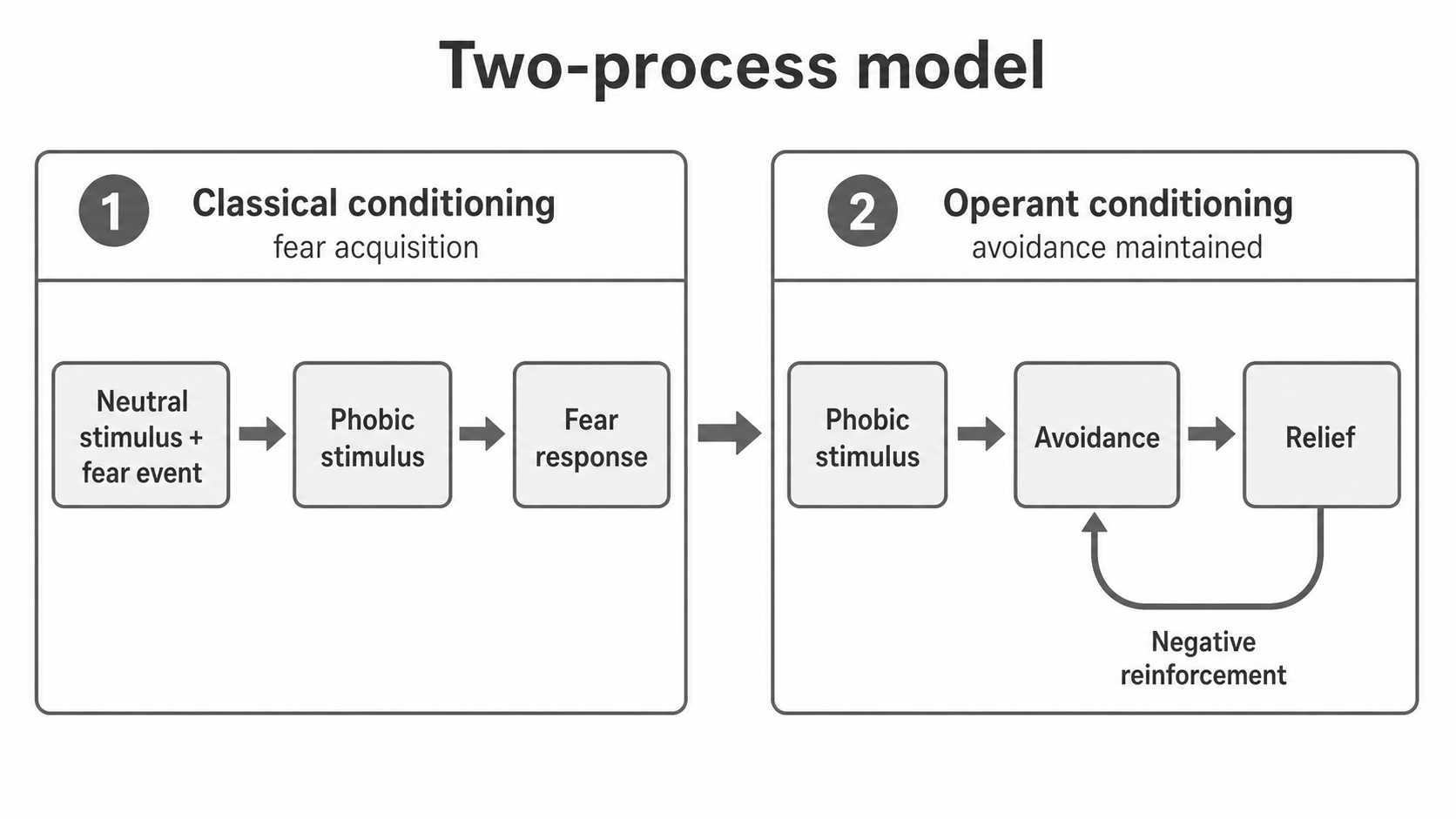
AO2 Example: If Leo crosses the road whenever he sees a dog, his anxiety immediately falls. The fall in anxiety reinforces road-crossing. Next time, he is even more likely to avoid dogs, so he misses the chance to learn that most dogs are harmless.
This is the two-process model, associated with Mowrer's two-factor account of avoidance learning:
- Process 1: classical conditioning creates the phobic fear.
- Process 2: operant conditioning maintains the avoidance through negative reinforcement.
AO3 Link: The model has strong explanatory power because it explains both the origin and persistence of phobias. It also links directly to treatment: if avoidance is prevented in a controlled way, the phobic response can weaken.
Systematic Desensitisation
Systematic desensitisation is a behavioural therapy based on counterconditioning. It aims to replace fear with relaxation.
Systematic desensitisation
Systematic desensitisation is a behavioural treatment for phobias in which a person learns relaxation and is gradually exposed to feared stimuli through an anxiety hierarchy.
The hierarchy is the treatment map.
Anxiety hierarchy
An anxiety hierarchy is a ranked list of phobic situations, from least frightening to most frightening.
The procedure has three core features:
- Relaxation: the client learns a response such as deep breathing, progressive muscle relaxation or guided imagery.
- Hierarchy: the client and therapist build a list of feared situations ranked from least to most anxiety-provoking.
- Gradual exposure: the client works up the hierarchy while using relaxation, moving on only when each step becomes manageable.
The logic is reciprocal inhibition: it is difficult to be deeply relaxed and highly anxious at the same time. Over repeated sessions, the phobic stimulus becomes associated with calm rather than panic.
AO2 Example: For a spider phobia, the hierarchy might begin with saying the word "spider", then looking at a cartoon spider, then viewing a photograph, then standing near a spider in a sealed container, and eventually being close to a real spider. The student must be able to build a hierarchy from a scenario, not just define the term.
Cover Jones' (1924) case of Peter is an early behavioural example. Peter's fear of rabbits was reduced by gradually bringing a rabbit closer while Peter experienced positive, calming situations. As evidence, it is historically important, but it was still a small case study, so it cannot show that the method works equally well for all phobias.
AO3 Link: Systematic desensitisation is often seen as ethically acceptable because it is gradual and gives the client control. A limitation is that it can take time, and it may work best when the phobic stimulus can be arranged safely and repeatedly.
Flooding
Flooding is also a behavioural exposure treatment, but it removes the gradual build-up.
Flooding
Flooding is a behavioural treatment for phobias in which the client is exposed immediately to a highly feared stimulus or situation, without moving gradually through a hierarchy.
In flooding, the client stays with the phobic stimulus until the fear response naturally decreases. Avoidance is prevented, so the person cannot gain the usual relief from escape. Over time, the phobic stimulus is no longer paired with danger, and the fear response may undergo extinction.
[DIAGRAM: asset_name: Behavioural treatments comparison; asset_slug: 4_1_4_03_the_behavioural_approach_to_explaining_and_treating_phobias__diagram_02; recommended_method: image_gen; description: Monochrome NovaLearn infographic comparing systematic desensitisation as relaxation plus hierarchy plus gradual exposure with flooding as immediate exposure leading to extinction.]
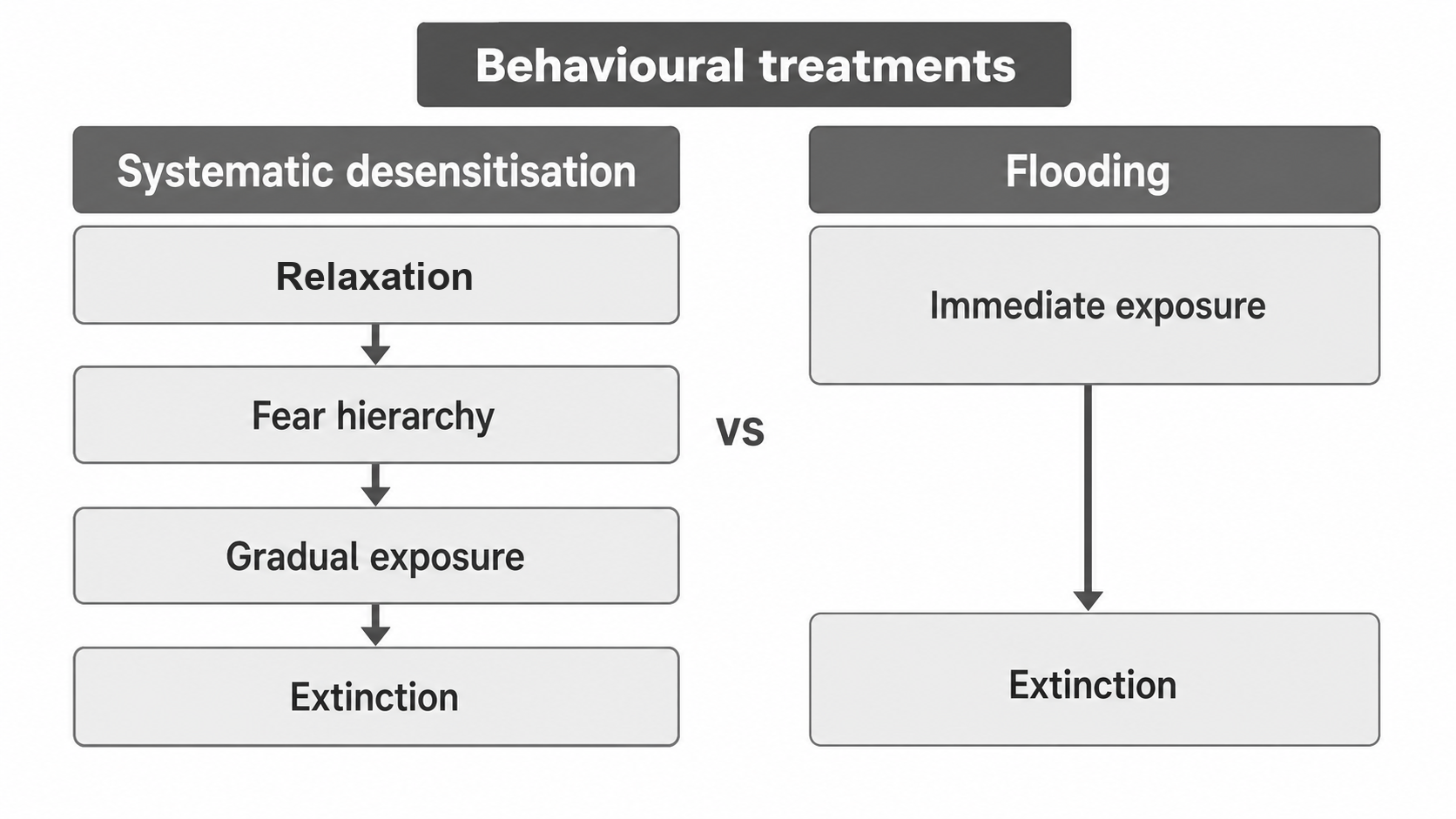
AO2 Example: A person with a lift phobia might, after informed consent and preparation, enter a lift with a therapist and remain there until anxiety peaks and starts to fall. The treatment depends on staying in the situation long enough for anxiety to reduce. If the person escapes early, avoidance may be reinforced instead.
Flooding can be quicker than systematic desensitisation, so it may be cost-effective. But it is also more distressing. It requires informed consent, careful preparation and appropriate clinical judgement. It may be unsuitable for some clients or for situations where high-intensity exposure cannot be made safe.
Evaluation And Exam Use
AO3 Strength: treatment effectiveness supports behavioural principles. Exposure-based treatments are well supported. Wolitzky-Taylor et al. (2008) meta-analysed 33 randomised treatment studies and found that exposure-based treatments produced large effects compared with no treatment, and outperformed placebo and alternative active psychotherapies. This supports the behavioural claim that reducing avoidance and creating new learning can reduce phobic fear.
AO3 Strength: the model has practical application. The two-process model leads directly to treatment. If avoidance maintains fear, then controlled exposure should weaken the phobia. This is a strong practical value point because the explanation has generated useful therapies rather than remaining only descriptive.
AO3 Limitation: not all phobias start with direct conditioning. Some people cannot identify a traumatic pairing with the phobic object. Others may acquire fear through observing someone else, hearing frightening information, or having a biological preparedness to learn certain fears more easily. This means the two-process model may be incomplete as a full explanation of every phobia.
AO3 Limitation: the behavioural approach can be reductionist. It explains phobias mainly in terms of stimulus-response learning and reinforcement. That gives a clear, testable account, but it may underplay cognitive factors such as catastrophic thoughts, attention to threat and beliefs about danger.
AO3 Treatment comparison: Systematic desensitisation is usually less distressing and gives the client a sense of control, but it can take longer. Flooding may work more quickly, but it is more aversive and depends on the client remaining in the feared situation long enough for extinction to occur.
For AQA answers, keep the three assessment objectives visible:
- AO1: Define the key term and describe the sequence.
- AO2: Map the sequence onto the person in the scenario.
- AO3: Make a precise judgement about evidence, ethics, effectiveness or explanatory limits.