1.2.4 Forgetting: Interference and Retrieval Failure
Why do we forget? It is not simply that memories fade over time — psychologists have identified specific mechanisms that prevent us from accessing stored information. This lesson covers two major explanations for forgetting from long-term memory (LTM) required by the AQA specification: interference (both proactive and retroactive) and retrieval failure due to absence of cues. You will learn how each explanation works, examine the key research evidence (AO1), apply these ideas to real-world scenarios (AO2), and critically evaluate the strengths and limitations of each theory (AO3). Both explanations share a crucial assumption: the information has not disappeared from LTM — it is still available but has become inaccessible.
Interference Theory
Interference
Forgetting that occurs when one memory disrupts the recall of another, causing one or both memories to be distorted or forgotten. Interference is proposed as an explanation for forgetting in long-term memory, where stored information becomes inaccessible rather than lost.
Interference theory proposes that forgetting occurs not because memories decay, but because other memories get in the way. When two or more pieces of information stored in LTM are similar, they compete with each other at the point of recall, making it harder to retrieve the target memory. The information is still present in LTM — it has simply become difficult to locate because another memory is blocking access to it.
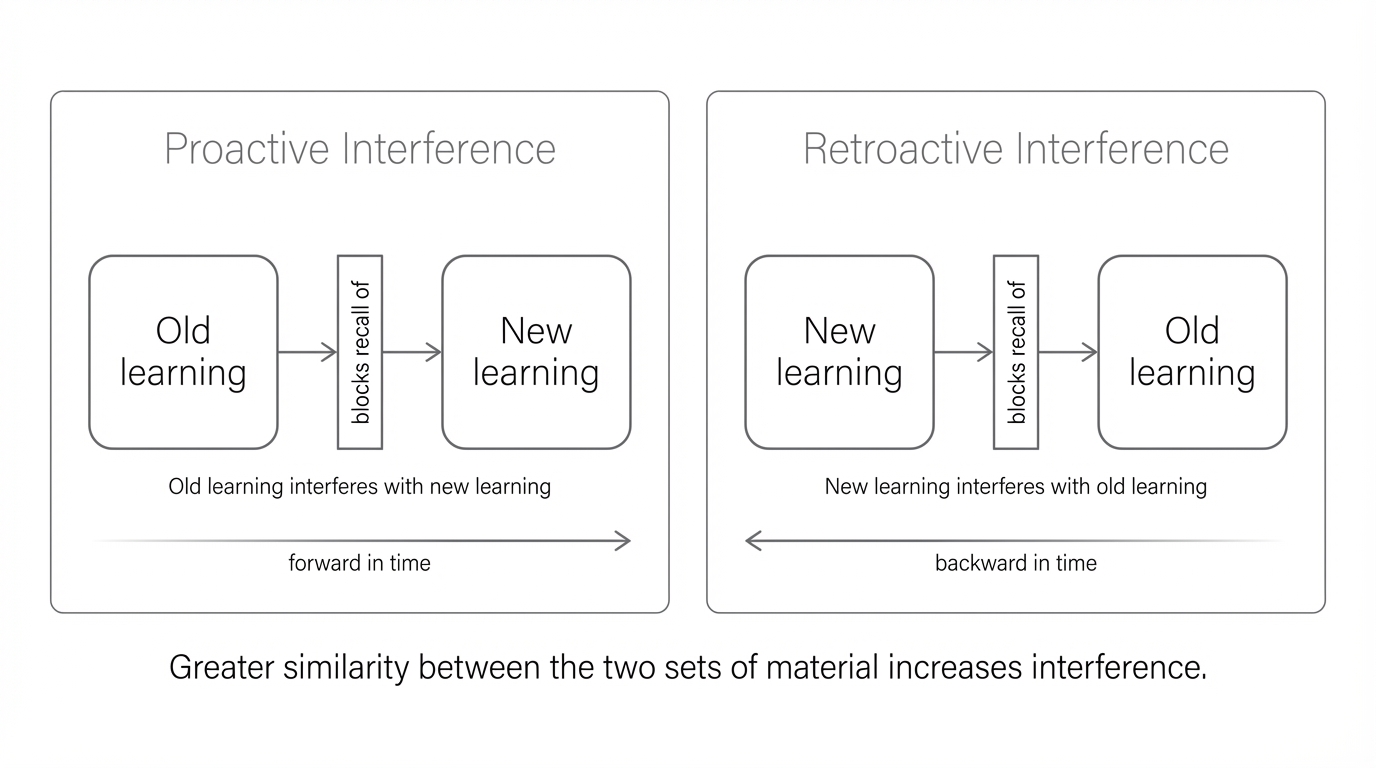
Psychologists distinguish two types of interference based on the direction of disruption:
Proactive Interference
Forgetting that occurs when older, previously learned information disrupts the recall of newer information. The degree of forgetting is greater when the two sets of information are similar. ('Pro' means forward — old learning interferes forwards in time with new learning.)
Retroactive Interference
Forgetting that occurs when newer information disrupts the recall of older, previously learned information. The degree of forgetting is again greater when the two sets of information are similar. ('Retro' means backward — new learning interferes backwards in time with old learning.)
A helpful way to distinguish the two types: imagine a teacher who has taught for twenty years. She struggles to remember the names of her current class because all the names she has learned in previous years interfere with her new learning — this is proactive interference (old disrupting new). Conversely, she also struggles to remember the names of last year's students because all the new names she has learned this year interfere with those older memories — this is retroactive interference (new disrupting old).
A critical feature of both types is that interference is worse when the competing memories are similar. Two very different pieces of information are less likely to disrupt each other than two closely related ones.
Key Research on Interference (AO1/AO3)
The most important laboratory study of interference was conducted by McGeoch and McDonald, who demonstrated that the degree of similarity between competing materials determines the extent of forgetting.
McGeoch and McDonald (1931) — In this laboratory experiment investigating retroactive interference, participants first learned a list of ten words until they could recall them with 100% accuracy. They were then divided into six groups, each of which learned different types of new material: (1) synonyms of the original words, (2) antonyms, (3) unrelated words, (4) consonant syllables, (5) three-digit numbers, or (6) no new list (rest — control group). When participants were then asked to recall the original word list, those who had learned synonyms (the most similar material) showed the worst recall, while the control group who rested performed best. The synonym condition produced an average of 3.1 fewer correct items recalled than the control condition. This laboratory experiment demonstrated that retroactive interference is strongest when competing memories are highly similar, supporting the core prediction of interference theory.
This study is important because it isolates the variable of similarity as the key factor driving interference. However, it uses artificial stimuli (word lists) with no personal meaning to participants, which raises questions about whether these findings generalise to real-world forgetting (see evaluation below).
Priya is a GCSE student revising for her exams. She revises French vocabulary for two hours, then immediately switches to revising Spanish vocabulary for another two hours. When she tries to recall the French words the next day, she finds that Spanish translations keep coming to mind instead. The more similar the French and Spanish words are, the harder she finds it to remember the correct French translations. This illustrates retroactive interference — the newer Spanish learning is disrupting recall of the older French learning, and the effect is strongest where the two languages are most similar.
While laboratory evidence is extensive, a significant strength of interference theory comes from research conducted in more naturalistic settings.
Baddeley and Hitch (1977) — In this field study / quasi-experiment with real-world application, rugby players from the same team were asked to recall the names of teams they had played against over the course of a season. Crucially, while all players had been part of the team for the same time period, some had missed matches due to injury and therefore played fewer games. Players who had played the most games (and therefore had the most intervening memories of other matches) showed the poorest recall of earlier teams. The number of games played since a particular match was a stronger predictor of forgetting than the sheer amount of time that had passed. This supports retroactive interference as an explanation — the more intervening events (newer games), the greater the interference with recall of older games. This field-based study used naturally occurring variables and meaningful real-life memories, increasing the ecological validity of interference as an explanation for forgetting.
Retrieval Failure Due to Absence of Cues
Retrieval Failure
A form of forgetting that occurs when the cues (triggers) that were present at the time of encoding are not available at the time of recall. The memory is still available in LTM but is not accessible without the appropriate cue.
Cue
A trigger that allows us to access a memory. Cues may be meaningful (e.g. a category name that helps you recall items in that category) or indirectly linked by being encoded at the time of learning. Indirect cues can be external (environmental context) or internal (emotional or physiological state).
Retrieval failure is widely regarded as one of the most important explanations for everyday forgetting. The theory proposes that when we encode a memory, we also encode information about the context in which the learning took place — both the external environment and our internal physiological or emotional state. These contextual features become cues that are associated with the memory. If these cues are absent or different at the point of recall, the memory becomes inaccessible — not because it has been lost, but because we lack the right trigger to retrieve it.
This principle was formalised by Endel Tulving (1983) as the encoding specificity principle (ESP). The ESP states that a cue can only aid recall if it was present at the time of encoding and is also present at the time of retrieval. If there is a mismatch between the cues available at encoding and those available at recall — or if relevant cues are entirely absent at recall — then forgetting will occur.
Encoding Specificity Principle
Tulving's principle stating that a cue will only help retrieve a memory if the same cue was present at the time the memory was encoded. A mismatch between encoding cues and retrieval cues leads to forgetting.
Two main types of cue-dependent forgetting have been identified:
Context-dependent forgetting occurs when the external environment at recall does not match the external environment at encoding. For example, you might struggle to recall information learned in one room when tested in a different room, because the environmental cues (sights, sounds, smells) are different.
State-dependent forgetting occurs when the internal physiological or psychological state at recall does not match the state at encoding. For example, information learned while in a calm state may be harder to recall when you are anxious, because the internal cues are mismatched.
Retrieval failure suggests that forgetting is not about losing memories — it is about losing access to them. The memory is still stored in LTM but cannot be reached without the right cue. This is the difference between availability (the memory exists) and accessibility (you can get to it).
Key Research on Retrieval Failure (AO1/AO3)
Two landmark studies demonstrate context-dependent and state-dependent forgetting respectively.
Godden and Baddeley (1975) — In this experiment investigating context-dependent forgetting, deep-sea divers learned a list of words in one of two environments: underwater or on land. They were then asked to recall the words in either the same or different environment, creating four conditions: (1) learn on land — recall on land, (2) learn on land — recall underwater, (3) learn underwater — recall on land, (4) learn underwater — recall underwater. Accurate recall was approximately 40% lower in the non-matching conditions (where the learning and recall environments differed) compared to the matching conditions. Godden and Baddeley concluded that external environmental cues encoded alongside the word list at learning aided retrieval when the same environment was present at recall. When these contextual cues were absent (mismatched conditions), retrieval failure occurred. This study provides strong evidence for context-dependent forgetting, as the experimental design allowed the researchers to isolate environmental context as the variable affecting forgetting.
Carter and Cassaday (1998) — In this laboratory experiment investigating state-dependent forgetting, participants were given antihistamine drugs, which produce a mild sedative effect creating a different internal physiological state from normal alertness. Participants learned lists of words and passages of prose, then recalled the material, creating four conditions analogous to Godden and Baddeley's design: (1) learn on drug — recall on drug, (2) learn on drug — recall off drug, (3) learn off drug — recall on drug, (4) learn off drug — recall off drug. Performance on memory tests was significantly worse in the mismatched conditions. Carter and Cassaday concluded that the internal physiological cues present at encoding (drowsy vs. alert) needed to match those at retrieval for successful recall. This study extends the retrieval failure explanation beyond external context to internal states, demonstrating that state-dependent forgetting follows the same pattern predicted by the encoding specificity principle.
Tom revised extensively for his psychology exam at home, sitting at his desk with a cup of coffee, feeling relaxed and alert. On the day of the exam, he sat in an unfamiliar sports hall under bright fluorescent lights, feeling anxious and tired. Despite having revised thoroughly, Tom found it difficult to recall many of the facts he had learned. This illustrates retrieval failure — both Tom's external context (unfamiliar exam hall versus his desk at home) and his internal state (anxious and tired versus relaxed and alert) differed from those present during encoding, meaning the cues associated with his learning were absent at the point of recall.
An additional study supporting retrieval failure demonstrates that cues can restore apparently 'lost' memories, which has important implications for the relationship between interference and retrieval failure.
Tulving and Psotka (1971) — In this laboratory experiment, participants were given lists of words organised into categories (though they were not told what the categories were) and asked to learn them one list at a time. Recall averaged approximately 70% for the first list but became progressively worse as more lists were learned — consistent with retroactive interference. However, when participants were then given a cued recall test (told the category names), recall rose back to approximately 70% for all lists. This demonstrates that the words had not actually been lost from LTM — they were still available but had become temporarily inaccessible due to interference. Providing appropriate cues restored access, suggesting that what appears to be interference-based forgetting may actually be retrieval failure that can be overcome with the right cues.
Evaluation Bank (AO3)
Strength: A key strength of interference theory is that it is supported by research with high ecological validity, not just artificial laboratory studies. Baddeley and Hitch (1977) demonstrated interference effects using real-world memories when rugby players who had played the most games (and thus accumulated the most potentially interfering memories) showed the poorest recall of earlier opponents — even though all players had been part of the team for the same duration. This matters because it shows interference operates with meaningful, personally relevant memories and not only with artificial word lists, increasing our confidence that interference is a genuine cause of forgetting in everyday life. Furthermore, the finding that the number of intervening events (games played) was more important than the passage of time strengthens the theoretical claim that interference, rather than simple decay, drives forgetting. However, the conditions needed for interference to occur — two similar sets of memories competing with each other — may be relatively uncommon in everyday life compared to laboratory settings, suggesting that interference may account for only a limited proportion of real-world forgetting.
Limitation: A significant limitation of interference theory is that interference effects may be temporary and can be overcome by providing appropriate retrieval cues, which suggests the theory does not fully explain how forgetting works. Tulving and Psotka (1971) demonstrated this by showing that recall of word lists dropped as more lists were learned (apparent interference), but when participants were given category names as cues, recall returned to the original level of approximately 70%. This indicates that the memories were not genuinely lost or permanently blocked by interference — they were still available in LTM and simply required the right cue to be retrieved. If interference truly caused forgetting, we would expect the memories to remain inaccessible regardless of additional cues. This finding suggests that what appears to be interference may actually be better explained by retrieval failure due to absence of cues, undermining the status of interference as an independent explanation for forgetting. This relates to the broader reductionist debate — interference theory reduces forgetting to a single mechanism (competition between similar memories) when in reality, forgetting likely involves multiple interacting processes including cue-dependency, which a more holistic explanation would account for.
Strength: Retrieval failure is supported by an impressive range of research evidence, and some psychologists consider it the most important explanation for everyday forgetting. Both Godden and Baddeley (1975) and Carter and Cassaday (1998) demonstrated that a mismatch between encoding and retrieval contexts — whether external (underwater vs. land) or internal (drugged vs. alert) — leads to significantly poorer recall, with Godden and Baddeley finding a 40% drop in accuracy in non-matching conditions. Eysenck and Keane (2010) have argued that retrieval failure is perhaps the main reason for forgetting from LTM, because in everyday life we constantly move between different contexts and states, meaning cue mismatches are extremely common. This gives the theory considerable explanatory power. However, Godden and Baddeley (1980) found that when they repeated their underwater study using a recognition test rather than a recall test, there was no context-dependent effect — performance was the same across all four conditions. This suggests retrieval failure may only explain forgetting when memory is tested through recall rather than recognition, limiting its status as a universal explanation and raising the question of whether different types of memory retrieval involve fundamentally different processes.