2.1.2 The Behaviourist Approach
The behaviourist approach is one of the most influential perspectives in the history of psychology. It argues that all behaviour is learned from the environment through conditioning, and that psychology should focus exclusively on what can be observed and measured. In this lesson you will learn the two key mechanisms by which behaviourists explain learning — classical conditioning and operant conditioning — along with the landmark research of Pavlov and Skinner that demonstrated each process. You will also practise evaluating the approach, a skill that is essential for 16-mark essays on this topic.
Assumptions of the Behaviourist Approach
Behaviourist Approach
A way of explaining behaviour in terms of what is observable and measurable, proposing that all behaviour is learned from the environment through the processes of classical and operant conditioning.
The behaviourist approach emerged in the early twentieth century as a reaction against the introspective methods pioneered by Wilhelm Wundt. Early behaviourists — most notably John B. Watson (1913) — argued that concepts such as thoughts, feelings, and conscious experience were too subjective and vague to form the basis of a scientific psychology. Instead, behaviourists insisted that only directly observable behaviour should be studied, and that laboratory experiments were the best method for doing so because they allowed precise control over variables.
A central assumption of behaviourism is that behaviour is shaped entirely by the environment. Behaviourists describe the mind of a newborn infant as a tabula rasa — a blank slate — upon which experience writes. This means that behaviourists take a strong nurture position in the nature–nurture debate: genetic inheritance is considered far less important than learning history.
Following Darwin's work on evolutionary continuity, behaviourists also assumed that the fundamental laws of learning are the same across all species. Because of this, non-human animals — particularly rats and pigeons — were routinely used as experimental subjects on the basis that findings could be generalised to human learning. Behaviourists identified two core forms of learning: classical conditioning (learning through association) and operant conditioning (learning through consequences).
Classical Conditioning and Pavlov's Research
Classical Conditioning
A form of learning in which a neutral stimulus is repeatedly paired with an unconditioned stimulus until the neutral stimulus alone is able to produce the same response. The result is a new learned (conditioned) association between the stimulus and the response.
Classical conditioning is learning through association. It was first systematically demonstrated by the Russian physiologist Ivan Pavlov (1927), who was originally studying the digestive processes of dogs when he noticed that the animals began salivating not only when food was placed in their mouths but also in response to stimuli that were associated with food — such as the sight of the food bowl or the sound of the laboratory assistant's footsteps.
To investigate this further, Pavlov designed a controlled procedure using a bell as a neutral stimulus. The process had three stages:
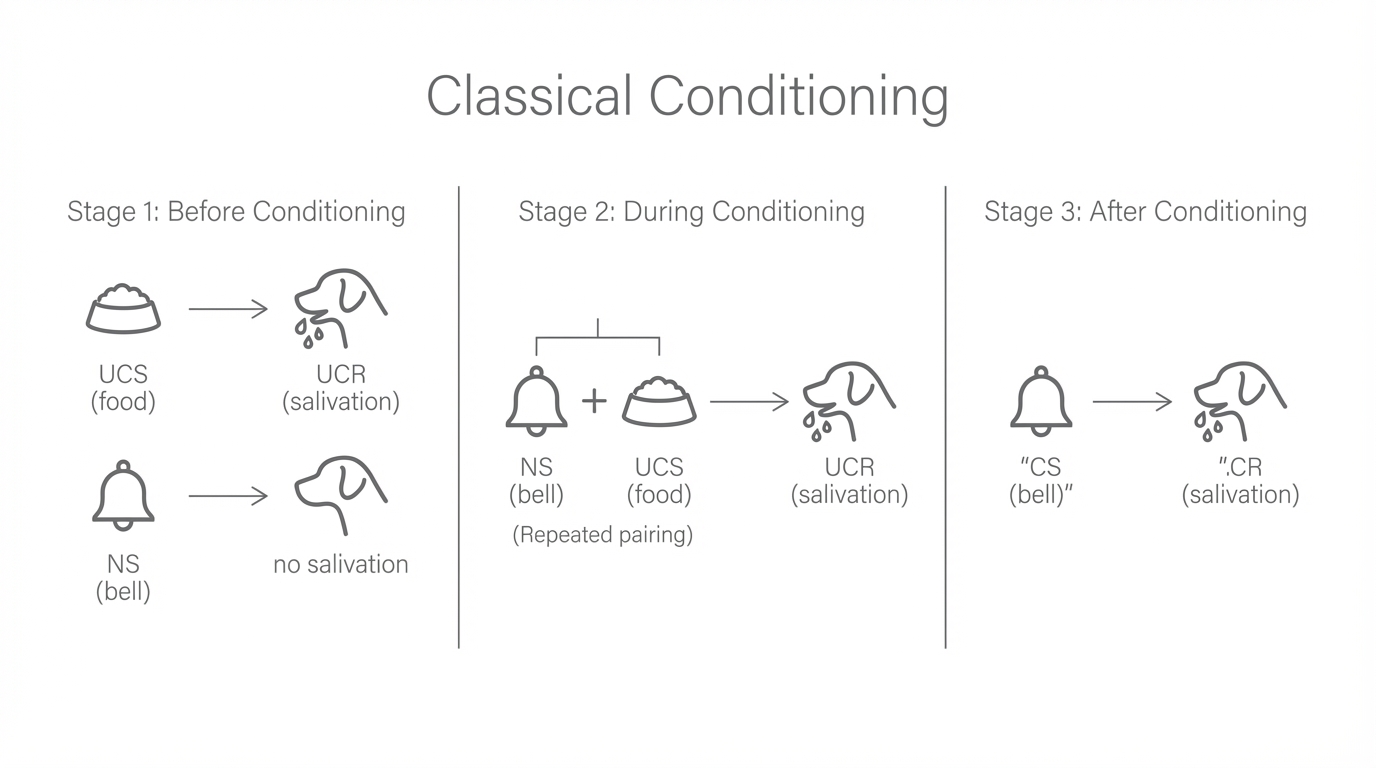
Pavlov (1927) — In a laboratory experiment, Pavlov repeatedly presented a bell (neutral stimulus) at the same time as food (unconditioned stimulus) to dogs. Before conditioning, the food alone naturally produced salivation (an unconditioned response), while the bell produced no salivation. During conditioning, the bell and food were presented together on multiple trials, each time producing salivation. After conditioning, the bell alone was sufficient to produce salivation — the bell had become a conditioned stimulus and the salivation in response to the bell alone was now a conditioned response. Pavlov concluded that a new stimulus–response association had been learned through repeated pairing, demonstrating that reflexive behaviours could be triggered by previously neutral stimuli.
To understand classical conditioning fully, you need to know the following key terms:
Unconditioned Stimulus (UCS)
A stimulus that naturally and automatically produces a response without any prior learning — for example, food producing salivation.
Unconditioned Response (UCR)
An unlearned, naturally occurring response to an unconditioned stimulus — for example, salivation in response to food.
Conditioned Stimulus (CS)
A previously neutral stimulus that, after being repeatedly paired with an unconditioned stimulus, now produces a conditioned response on its own — for example, a bell that triggers salivation after repeated pairing with food.
Conditioned Response (CR)
A learned response to a previously neutral stimulus that has become a conditioned stimulus through association — for example, salivation in response to a bell alone.
Pavlov also identified several additional phenomena that arise from classical conditioning. Generalisation occurs when stimuli that are similar to the conditioned stimulus also produce the conditioned response — for instance, Pavlov's dogs salivated to bells of slightly different pitches. Extinction occurs when the conditioned stimulus is repeatedly presented without the unconditioned stimulus, and the conditioned response gradually disappears. Spontaneous recovery refers to the reappearance of a previously extinguished conditioned response after a period of time has passed.
Priya used to enjoy eating sushi at her favourite restaurant. On one occasion she ate sushi and then experienced severe food poisoning, causing nausea and vomiting. Now, whenever Priya sees sushi — or even smells it — she feels nauseous, even though the food at different restaurants is perfectly safe. This is an example of classical conditioning: the sushi (originally a neutral stimulus) was paired with the food poisoning (unconditioned stimulus), and after this association was formed, the sushi alone (now a conditioned stimulus) produces nausea (a conditioned response).
Operant Conditioning, Types of Reinforcement, and Skinner's Research
Operant Conditioning
A form of learning in which behaviour is shaped and maintained by its consequences. Behaviour that is reinforced (rewarded) is more likely to be repeated, while behaviour that is punished is less likely to be repeated.
While classical conditioning involves learning passive, reflexive responses through association, operant conditioning involves learning active, voluntary behaviours through their consequences. The concept was developed by B.F. Skinner (1953), who argued that learning is an active process in which organisms "operate" on their environment and the consequences of their actions determine whether those actions are repeated.
Skinner identified three types of consequence that shape behaviour:
Positive Reinforcement
A consequence in which a behaviour is followed by the addition of a pleasant stimulus, increasing the likelihood that the behaviour will be repeated — for example, receiving praise after answering a question correctly.
Negative Reinforcement
A consequence in which a behaviour is followed by the removal or avoidance of an unpleasant stimulus, increasing the likelihood that the behaviour will be repeated — for example, fastening a seatbelt to stop an annoying alarm.
Punishment
An unpleasant consequence of a behaviour that decreases the likelihood of that behaviour being repeated — for example, receiving a detention for talking in class.
It is essential to understand that both positive and negative reinforcement increase the likelihood of a behaviour being repeated, whereas punishment decreases it. A common exam error is to confuse negative reinforcement with punishment. Negative reinforcement is not something unpleasant happening — it is the avoidance or removal of something unpleasant, which makes the experience rewarding.
Skinner (1953) — Using a specially designed apparatus known as a Skinner box, Skinner conducted laboratory experiments with rats and pigeons to demonstrate the principles of operant conditioning. To demonstrate positive reinforcement, a hungry rat was placed in the box; when the rat accidentally pressed a lever, a food pellet was dispensed. Over successive trials, the rat learned to press the lever deliberately and repeatedly in order to obtain food — the food pellet acted as a positive reinforcer. To demonstrate negative reinforcement, an electric current was passed through the floor of the box, causing discomfort; the rat learned that pressing the lever switched off the electric current, and subsequently pressed the lever more frequently to avoid the unpleasant stimulus. Skinner concluded that behaviour is shaped by its consequences — reinforced behaviour is strengthened, while behaviour that produces no reinforcement (or punishment) is weakened. This is a laboratory experiment, giving Skinner a high degree of control over extraneous variables and allowing him to establish clear cause-and-effect relationships between reinforcement and behaviour.
Skinner also discovered that the schedule on which reinforcement is delivered affects how quickly a behaviour is learned and how resistant it is to extinction. A continuous reinforcement schedule (reinforcing every response) produces rapid learning but the behaviour extinguishes quickly once reinforcement stops. A variable ratio schedule (reinforcing after an unpredictable number of responses) produces the highest response rates and the greatest resistance to extinction. This principle has been used to explain behaviours such as gambling addiction, where wins occur at unpredictable intervals, keeping the person engaged despite frequent losses.
Tom is a Year 7 student who has recently started secondary school. His form tutor uses a reward chart system where students receive a sticker each time they complete their homework on time. After collecting ten stickers, Tom can exchange them for extra break time. Tom now consistently completes his homework on time. This is an example of positive reinforcement: Tom's homework behaviour is being strengthened because it is followed by a pleasant consequence (stickers leading to extra break time). The stickers function as secondary reinforcers that can be exchanged for a primary reinforcer (the enjoyable experience of extra break time), mirroring the logic of a token economy.
Classical Conditioning vs Operant Conditioning
Although both classical and operant conditioning are forms of learning, they differ in important ways that AQA examiners expect you to understand.
In classical conditioning, the learner is passive — the response is an involuntary reflex (such as salivation or fear) that is triggered automatically by the pairing of stimuli. The learning occurs before the behaviour, through the repeated association of a neutral stimulus with an unconditioned stimulus. The learner does not choose to respond; the response is elicited.
In operant conditioning, the learner is active — they voluntarily operate on their environment, and the consequences of their behaviour determine whether it is repeated. The learning occurs after the behaviour, through reinforcement or punishment. The learner's behaviour is emitted rather than elicited.
A useful way to remember the distinction: classical conditioning is about what happens before the behaviour (stimulus associations), while operant conditioning is about what happens after the behaviour (consequences).
Evaluation Bank (AO3)
The following evaluation paragraphs are written in PEEL structure and can be used directly in 16-mark essay responses on the behaviourist approach.
Strength: The behaviourist approach can be credited with bringing scientific rigour to psychology. By insisting that only observable behaviour should be studied and by relying on highly controlled laboratory experiments, behaviourists such as Pavlov and Skinner were able to establish clear cause-and-effect relationships. For instance, Skinner's use of the Skinner box allowed him to precisely manipulate reinforcement schedules and measure their effects on behaviour while controlling for extraneous variables. The high internal validity of these studies means that findings are replicable — Pavlov's conditioning procedure, for example, has been successfully replicated many times across different species and laboratories. This emphasis on objectivity and measurement played a key role in establishing psychology as a credible scientific discipline, distinguishing it from the earlier introspective tradition that behaviourists such as Watson rejected as unscientific.
Limitation: A significant weakness of the behaviourist approach is that it is environmentally deterministic. Behaviourists argue that all behaviour is the product of past conditioning — Skinner himself stated that free will is merely an illusion and that every action is determined by an individual's reinforcement history. This is problematic because it ignores the role of conscious thought, decision-making, and personal agency in shaping behaviour. The cognitive approach, for example, has demonstrated that mental processes such as attention, memory, and expectation play a significant role in learning — something that behaviourism cannot account for because it refuses to study unobservable processes. Furthermore, by treating human behaviour as no different from animal behaviour, behaviourism may be overly reductionist, breaking complex human experiences down to simple stimulus–response units and ignoring emotional, social, and cognitive dimensions. This connects to the free will versus determinism debate: behaviourism's hard deterministic stance may be more appropriate for explaining simple animal behaviours but is arguably an incomplete account of the complex, goal-directed behaviour that characterises human beings.
Strength: The behaviourist approach has generated valuable real-world applications that have improved people's lives. The principles of operant conditioning underpin token economy programmes used in institutions such as prisons and psychiatric hospitals, where individuals receive tokens (secondary reinforcers) for displaying desirable behaviours — such as following rules or engaging in therapeutic activities — and can exchange these for privileges (primary reinforcers) such as extra recreation time. Similarly, the principles of classical conditioning have been applied to the treatment of phobias through systematic desensitisation, which works by gradually pairing a feared stimulus with a state of relaxation until the fear response is extinguished and replaced by a new, calm association. The fact that behaviourist principles have been successfully applied to address real-world problems — from managing behaviour in institutions to treating clinical anxiety disorders — demonstrates that the approach has practical utility and is not merely a theoretical exercise. This practical impact strengthens the behaviourist approach because it shows that the underlying principles of conditioning have genuine explanatory and therapeutic value.
The behaviourist approach explains all behaviour as learned through classical conditioning (association of stimuli) or operant conditioning (consequences of behaviour). While this brought scientific credibility to psychology and produced powerful real-world applications, it is criticised for being environmentally deterministic and for ignoring the role of mental processes in human learning.