2.2.4 The Fight or Flight Response
When our ancestors encountered a predator on the savanna, their bodies needed to react instantly — preparing them either to confront the threat or to run from it. This ancient survival mechanism, known as the fight or flight response, is still hard-wired into our biology today. In this lesson you will learn how the brain detects a threat and coordinates an immediate physiological response through the combined action of the autonomic nervous system (ANS) and the endocrine system, with a particular focus on the hormone adrenaline. You will also evaluate the strengths and limitations of this explanation as an account of the human stress response.
Part 1 — What is the Fight or Flight Response?
Fight or Flight Response
An acute, automatic physiological response to a perceived threat in which the body becomes aroused in readiness either to confront the stressor (fight) or to escape from it (flight). It is coordinated by the sympathetic branch of the autonomic nervous system and the endocrine system.
The fight or flight response was first described by the American physiologist Walter Cannon (1932), who observed that animals react to threats with a general discharge of the sympathetic nervous system. Cannon argued that this response had evolved because it provided a survival advantage — organisms that could rapidly mobilise energy to deal with danger were more likely to survive and reproduce. From an evolutionary perspective, the fight or flight response is therefore an adaptive behaviour that has been naturally selected over millions of years.
Crucially, the response is automatic and immediate. It does not require conscious thought — as soon as a threat is detected, the body begins preparing itself for action. This speed is essential because, in the environment of evolutionary adaptedness (EEA), threats such as predators required a split-second reaction. Even a momentary delay could be fatal.
Tom is walking home alone at night when he hears footsteps rapidly approaching behind him. Before he has time to think, his heart begins to pound, his muscles tense, and he feels a surge of energy. Without making a conscious decision, Tom breaks into a sprint towards a well-lit street. His body's fight or flight response has been activated automatically, preparing him to flee from the perceived threat before his conscious mind has fully processed the situation.
Part 2 — The Physiological Pathway
Understanding the fight or flight response requires knowing the sequence of events that occurs between detecting a threat and the body being ready for action. This pathway involves both the nervous system and the endocrine system working together.
Hypothalamus
A small structure in the brain that acts as the main control centre for the autonomic nervous system and the endocrine system. It coordinates the body's stress response by activating the sympathetic branch of the ANS and triggering hormone release.
Adrenaline
A hormone produced by the adrenal medulla (part of the adrenal glands, located above the kidneys) as part of the body's immediate stress response. Adrenaline has powerful effects on the cardiovascular system — it increases heart rate, constricts blood vessels, and dilates air passages, preparing the body for vigorous physical activity.
The pathway operates as follows:
-
A stressor is perceived — sensory receptors in the peripheral nervous system (PNS) detect a threat in the environment (e.g. the sound of an aggressive animal, or the sight of an oncoming vehicle). This sensory information is relayed to the brain via sensory neurones.
-
The hypothalamus is activated — the hypothalamus recognises the threat and triggers increased activity in the sympathetic branch of the autonomic nervous system.
-
Adrenaline is released — the sympathetic nervous system stimulates the adrenal medulla (the inner part of the adrenal glands, situated above the kidneys) to release the hormone adrenaline into the bloodstream. Adrenaline is transported through the blood to target organs throughout the body via the endocrine system.
-
Physiological arousal occurs — adrenaline triggers a range of bodily changes that prepare the organism for fight or flight. These changes are rapid and powerful.
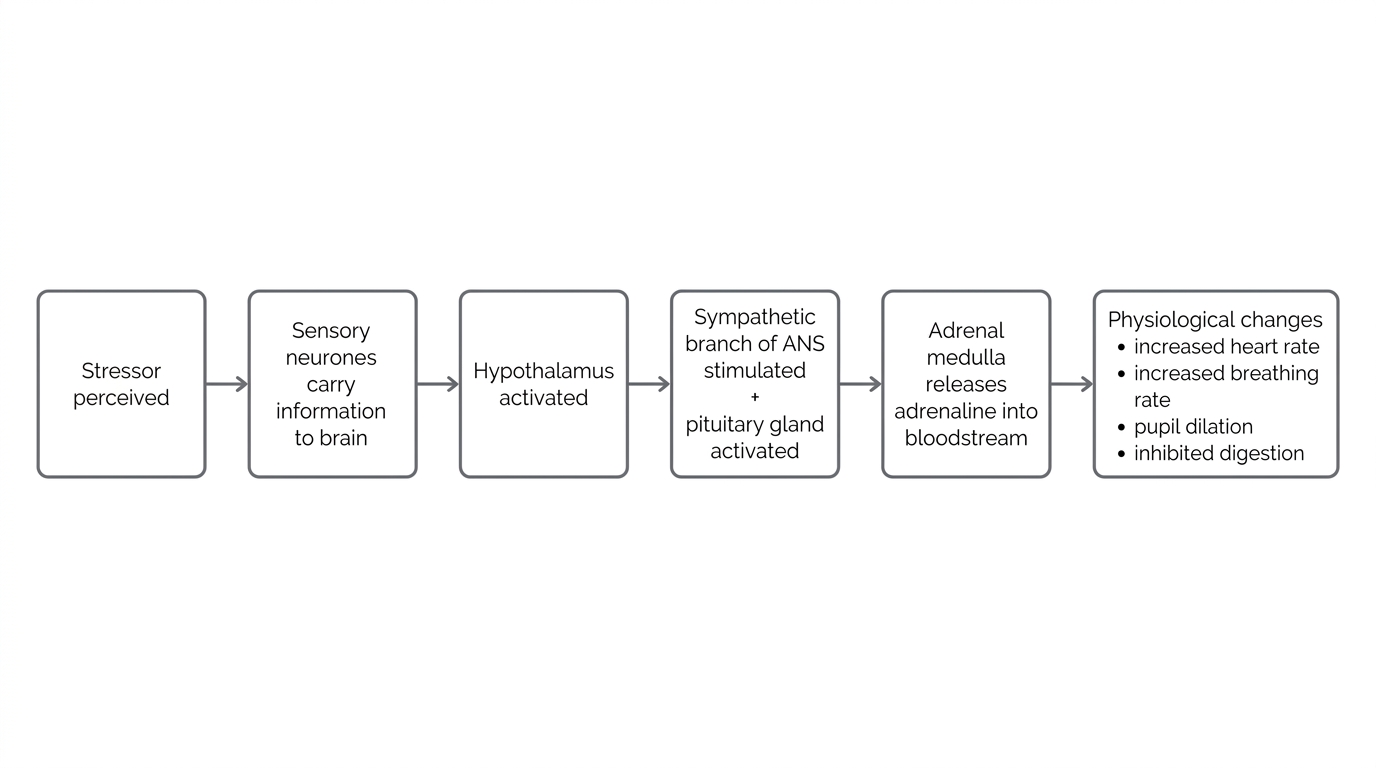
The key physiological changes produced by sympathetic arousal and adrenaline include:
| Sympathetic State (Fight or Flight) | Parasympathetic State (Rest and Digest) |
|---|---|
| Increases heart rate | Decreases heart rate |
| Increases breathing rate | Decreases breathing rate |
| Dilates pupils | Constricts pupils |
| Inhibits digestion | Stimulates digestion |
| Inhibits saliva production | Stimulates saliva production |
| Contracts rectum | Relaxes rectum |
Each of these changes serves an adaptive function. Increased heart rate and breathing rate deliver more oxygen and glucose to the muscles, providing the energy needed for vigorous physical action. Pupil dilation improves visual awareness of the environment. Digestion is inhibited because it is not needed during an emergency — the body diverts blood away from the gut and towards the skeletal muscles instead. This is why stress and anxiety are often experienced as a "sick" feeling or "butterflies" in the stomach.
Part 3 — The Parasympathetic Response
The fight or flight response cannot continue indefinitely — it uses a great deal of energy and would damage the body if sustained for too long. Once the threat has passed, the body must return to its normal resting state.
Parasympathetic Nervous System
The branch of the autonomic nervous system that calms the body after a stress response. It acts in opposition to the sympathetic branch, reducing heart rate, stimulating digestion, and returning the body to a resting state. This is sometimes called the "rest and digest" response.
The sympathetic and parasympathetic branches of the ANS function as an antagonistic pair — they have opposing effects on the same target organs. When the hypothalamus detects that the stressor is no longer present, it reduces activity in the sympathetic branch and increases activity in the parasympathetic branch. The parasympathetic system acts as a "brake", reversing the changes that were produced by sympathetic arousal. Heart rate decreases, breathing slows, digestion resumes, and pupils constrict. This is known as the rest and digest response.
This antagonistic relationship is essential for maintaining homeostasis — the body's stable internal equilibrium. Without the parasympathetic system to counterbalance sympathetic arousal, the body would remain in a state of heightened physiological activation long after the threat had disappeared.
The fight or flight response is a coordinated action of the sympathetic nervous system and the endocrine system (via adrenaline). The parasympathetic system then reverses the response once the threat has passed, restoring the body to its resting state.
Evaluation Bank (AO3)
Strength: The fight or flight response has clear survival value, which provides strong support from an evolutionary perspective. Organisms that could rapidly mobilise energy to deal with threats — whether by confronting a predator or fleeing from it — were more likely to survive and pass on their genes. The universality of the response across mammalian species supports this evolutionary argument; the same basic sympathetic-adrenal mechanism is observed in humans, primates, and other mammals, suggesting it has been conserved through natural selection because of its adaptive value. This means the biological explanation of the fight or flight response has high face validity as an account of acute stress reactions, particularly in situations involving immediate physical danger.
Limitation: A significant criticism of the fight or flight model is that it may be gender-biased (an example of beta bias — assuming that male and female stress responses are the same when they may differ). Taylor et al. (2000) reviewed research on stress responses and argued that the fight or flight model was developed primarily from studies on male animals and male human participants. Taylor proposed an alternative "tend-and-befriend" response that is more characteristic of females under stress: rather than fighting or fleeing, females are more likely to protect offspring (tending) and seek social support from others (befriending). Taylor linked this to the hormone oxytocin, which is released in greater quantities in females during stress and promotes caregiving and social bonding. If Taylor is correct, the traditional fight or flight model provides an incomplete account of the human stress response because it overlooks a distinctly female pattern of behaviour. This connects to the wider issue of gender bias in psychological research — theories based predominantly on male participants risk being applied universally when they may only describe male behaviour (androcentrism).
Limitation: The fight or flight response can also be criticised as a reductionist explanation of stress because it reduces a complex psychological experience to a simple physiological mechanism. While the sympathetic-adrenal pathway accurately describes what happens in the body during acute physical threat, modern stressors are often psychological and chronic rather than physical and acute — for example, work pressure, financial worry, or exam stress. The fight or flight response evolved to deal with immediate physical danger in the EEA, but in contemporary life, the same physiological arousal is triggered by situations where neither fighting nor fleeing is an appropriate response. Prolonged activation of the sympathetic nervous system in response to chronic stress has been linked to health problems including cardiovascular disease and immune suppression. This means the fight or flight model, while biologically accurate, provides an incomplete picture of the human stress response because it does not account for the cognitive appraisal of stressors or the damaging effects of chronic activation. A more holistic approach — incorporating cognitive and social factors alongside the biological mechanism — would offer a fuller explanation.