2.1.3 Social Learning Theory
Social learning theory (SLT) occupies a pivotal position in the AQA Approaches specification because it bridges the gap between traditional behaviourism and the cognitive approach. While behaviourists like Skinner argued that all learning could be explained through direct reinforcement, Albert Bandura demonstrated that people — especially children — also learn by watching others. This lesson covers the core concepts of SLT (imitation, identification, modelling, vicarious reinforcement), the mediational processes that determine whether observed behaviour is reproduced, and Bandura's key research studies. By the end, you should be able to describe and evaluate SLT, and apply it to novel scenarios — skills tested across all three AQA papers.
What Is Social Learning Theory?
Social Learning Theory
A way of explaining behaviour that includes both direct and indirect reinforcement, combining learning theory with the role of cognitive factors. It proposes that people learn by observing and imitating others, not solely through personal experience of rewards and punishments.
Albert Bandura agreed with behaviourists that behaviour is learned from experience, but he argued that classical and operant conditioning alone could not account for all human learning. His social learning theory, developed from the late 1950s onwards, proposed that people also learn indirectly — by observing the behaviour of others and noting the consequences of that behaviour. This means that a child does not need to touch a hot stove to learn that it burns; they can learn this by watching another child touch it and cry. SLT therefore adds a social and cognitive dimension to the behaviourist learning approach.
There are several key concepts that underpin SLT, and each appears in the specification wording. AQA expects you to define and explain all of them.
Imitation
Copying the behaviour of others. In SLT, imitation is most likely to occur when the observer identifies with the model and when the model's behaviour has been vicariously reinforced.
Modelling
From the observer's perspective, modelling refers to imitating the behaviour of a role model. From the role model's perspective, it refers to the precise demonstration of a specific behaviour that may be imitated by an observer.
Identification
The process by which an observer associates themselves with a role model and wants to be like that role model. Identification is more likely when the model is perceived as attractive, of high status, or similar to the observer (e.g. same gender or age).
Vicarious Reinforcement
A type of indirect reinforcement that occurs when an observer sees a role model being rewarded for a behaviour. The observer becomes motivated to imitate that behaviour in order to receive the same reward. This is a key factor in determining whether imitation occurs.
The process works as follows. First, the observer identifies with a role model — someone they perceive as similar to themselves, attractive, or of high status. The role model then displays (or models) a particular behaviour. The observer watches both the behaviour and its consequences. If the model is seen to be rewarded (vicariously reinforced), the observer is motivated to imitate that behaviour. If the model is punished, the observer is less likely to reproduce it. Crucially, the role model does not need to be physically present — they can be seen on television, in social media, or in film. This has significant implications for understanding media influence on behaviour.
Priya, aged 8, watches her favourite YouTuber unbox and review toys every afternoon. The YouTuber is enthusiastic, has millions of followers, and often receives free products from companies. Priya begins copying the YouTuber's catchphrases at school and asks her parents for a camera so she can make her own review videos. According to SLT, Priya has identified with the YouTuber as a role model (similar age group, attractive and high status) and is imitating the modelled behaviour because she has observed it being vicariously reinforced through popularity and free gifts.
It is important to note that SLT does not reject classical and operant conditioning — it incorporates them. Bandura accepted that people learn through direct reinforcement as well. SLT simply adds the idea that learning can also occur indirectly, through observation, without the learner being directly reinforced themselves.
The Role of Mediational Processes
Mediational Processes
Cognitive factors that intervene between observing a behaviour (stimulus) and deciding whether to reproduce it (response). Bandura identified four mediational processes: attention, retention, motor reproduction, and motivation.
SLT is often described as the "bridge" between the behaviourist approach and the cognitive approach because it places mental processes at the centre of learning. Bandura argued that there are important cognitive steps between observing a behaviour and choosing to reproduce it. These steps are called mediational processes, and they explain why not everyone who observes the same behaviour will go on to imitate it.
Bandura identified four mediational processes:
-
Attention — The extent to which the observer notices the model's behaviour. If the observer is not paying attention (perhaps distracted or uninterested), the behaviour will not be learned. Factors that increase attention include the model's attractiveness, status, and similarity to the observer.
-
Retention — How well the observed behaviour is remembered. The observer must be able to store a mental representation of the behaviour in memory so that it can be recalled later. If the behaviour is forgotten, it cannot be reproduced.
-
Motor reproduction — Whether the observer has the physical or intellectual ability to actually perform the behaviour. A young child might observe and remember an adult performing a complex gymnastics routine, but lack the physical capability to reproduce it.
-
Motivation — The perceived rewards or punishments associated with the behaviour. This is where vicarious reinforcement plays its role — the observer must believe that reproducing the behaviour will lead to a desirable outcome. If the model was punished, motivation to imitate is low.
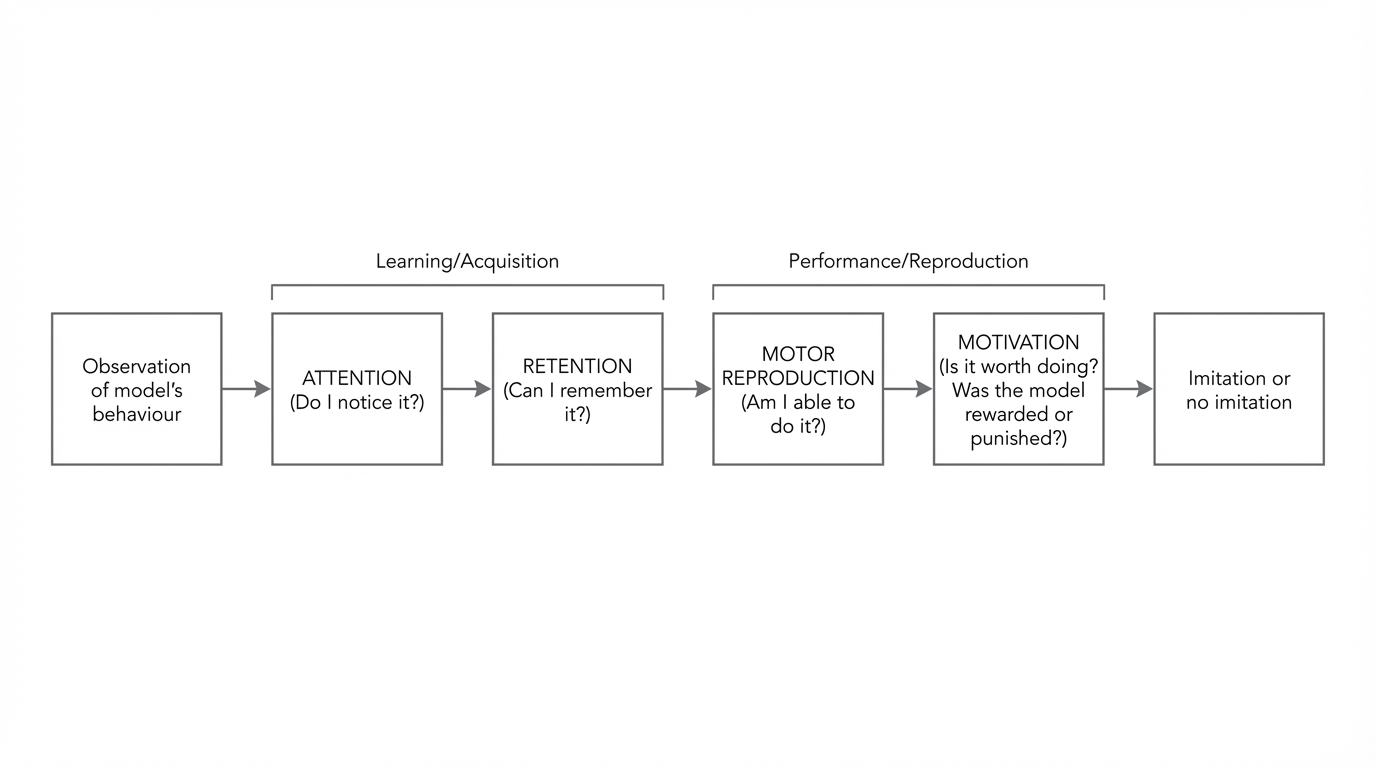
A critical feature of these mediational processes is that they separate the learning of behaviour from the performance of behaviour. The first two processes (attention and retention) relate to whether the behaviour is learned and stored in memory. The last two (motor reproduction and motivation) relate to whether the stored behaviour is actually performed. This means that a person can learn a behaviour through observation but choose not to reproduce it until a later time — or perhaps never. Traditional behaviourism, by contrast, assumed that learning and performance happened simultaneously through reinforcement.
Bandura's Research
The AQA specification explicitly names Bandura's research, so you must be able to describe his key studies in detail. Two studies are particularly important: the original Bobo doll experiment (1961) and the vicarious reinforcement study (1965).
The Original Bobo Doll Study
Bandura, Ross & Ross (1961) — This was a laboratory experiment investigating whether children would imitate aggressive behaviour they had observed in an adult model. The sample consisted of 72 children (36 boys and 36 girls), aged between 3 and 6 years, from Stanford University nursery school. Children were divided into three conditions: one group observed an adult model behaving aggressively towards a Bobo doll (punching it, hitting it with a mallet, and shouting aggressive phrases such as "POW!"); a second group observed a non-aggressive adult model who played quietly with other toys and ignored the Bobo doll; and a third group served as a control with no model present.
After observation, each child was taken to a room containing attractive toys, which were then taken away to induce mild frustration (this was called "aggression arousal"). The child was then moved to a room containing a Bobo doll and other toys. Their behaviour was observed through a one-way mirror.
The key findings were that children who had observed the aggressive model showed significantly more imitative aggression towards the Bobo doll than children in the non-aggressive or control groups. Children also reproduced specific acts and phrases they had seen the model perform, demonstrating that they had learned these through observation rather than through direct reinforcement. Additionally, boys showed significantly more physical aggression than girls overall, though both sexes were equally likely to imitate verbal aggression.
Bandura concluded that children can acquire new aggressive behaviours simply by observing an adult model, even without being directly reinforced — supporting the core principle of SLT.
The Vicarious Reinforcement Study
Bandura (1965) — This study extended the original research to investigate the role of vicarious reinforcement. Children watched a film of an adult model behaving aggressively towards a Bobo doll. However, the children were divided into three groups that saw different endings: in the first condition, the model was rewarded (praised and given sweets); in the second condition, the model was punished (told off and smacked); and in the third condition, there were no consequences for the model.
When later given access to a Bobo doll, children who had seen the model rewarded displayed the most aggression, followed by the no-consequence group, with the punished group showing the least aggression. This demonstrated the role of vicarious reinforcement — observing the model being rewarded increased imitation, while observing punishment decreased it.
Importantly, when all children were later offered direct rewards (stickers and juice) to reproduce the aggressive acts, children in all three groups demonstrated similar levels of aggression. This distinction is crucial: it showed that children in the punishment condition had still learned the aggressive behaviour (attention and retention had occurred) but had chosen not to perform it (low motivation). This finding powerfully illustrates the SLT distinction between learning and performance, mediated by the four cognitive processes.
Bandura, Ross & Ross (1963)
Bandura, Ross & Ross (1963) — This study examined whether the medium through which aggression was observed affected imitation. Children watched aggressive behaviour modelled either by a live adult, by an adult on film, or by an aggressive cartoon character. All three conditions produced significantly more imitative aggression than a control group, though the live model produced the strongest effect. This study demonstrated that modelling does not require the physical presence of a role model — behaviour observed through media can also be learned and imitated.
Twelve-year-old Jake watches his older brother, Amir, receive praise and attention from their parents after scoring the winning goal in a football match. Although Jake has never played football competitively, he starts practising in the garden every evening and asks to join a local team. According to SLT, Jake has identified with Amir (a same-gender, older sibling who is admired) and is imitating his football behaviour because he observed it being vicariously reinforced through parental praise and attention.
Evaluation Bank (AO3)
The following evaluation paragraphs are structured using PEEL (Point, Evidence, Explain, Link) and are exam-ready — you could use any of them directly in a 16-mark essay on SLT.
Strength: A key strength of social learning theory is that it recognises the importance of cognitive factors in learning, giving it greater explanatory power than traditional behaviourism. Neither classical nor operant conditioning can fully account for human learning because they ignore the mental processes that occur between stimulus and response. SLT addresses this by identifying four mediational processes (attention, retention, motor reproduction, and motivation) that determine whether an observed behaviour is actually imitated. Bandura's (1965) vicarious reinforcement study demonstrates this directly: children in the punishment condition had clearly learned the aggressive behaviour (they reproduced it when offered rewards) but had initially chosen not to perform it — proving that a cognitive decision about motivation mediated between observation and action. This means SLT provides a more comprehensive and realistic explanation of human learning than behaviourism, which is why it is often described as a "bridge" to the cognitive approach. This relates to the reductionism vs holism debate — SLT is more holistic than behaviourism because it considers both environmental and cognitive influences on behaviour, rather than reducing learning to simple stimulus-response associations.
Limitation: A significant limitation of SLT is that much of its supporting evidence comes from contrived laboratory studies that may lack ecological validity. Bandura's Bobo doll studies were conducted in controlled lab settings where children observed an unfamiliar adult behaving aggressively towards a toy that is specifically designed to be hit and bounces back when struck. Critics have argued that the children may have interpreted the situation as a game or may have been responding to demand characteristics — behaving aggressively because they believed that was what the experimenter expected. If so, the findings tell us more about how children behave in artificial experimental conditions than about how aggressive behaviour is genuinely learned in everyday life. Furthermore, hitting a Bobo doll is not the same as aggressing towards another person, so the studies may lack mundane realism. This means we should be cautious about generalising Bandura's findings to real-world aggression, and the evidence base for SLT may be weaker than it initially appears. However, it should be noted that the controlled nature of Bandura's experiments also gave them high internal validity, as he was able to isolate specific variables (such as whether the model was rewarded or punished) and establish cause-and-effect relationships.
Limitation: Another limitation of social learning theory is that it underestimates the role of biological factors in behaviour. A consistent finding across Bandura's Bobo doll studies was that boys displayed significantly more physical aggression than girls, despite both sexes observing the same models. SLT struggles to explain this difference because, according to the theory, children who observe the same model and the same consequences should show similar levels of imitation. A more plausible explanation for the gender difference is biological: males have higher levels of testosterone, a hormone that has been consistently linked to increased aggression in both animal and human research. This suggests that SLT adopts a position of environmental determinism — assuming that behaviour is shaped primarily by observational learning while neglecting innate biological influences. This connects to the nature-nurture debate: SLT sits firmly on the nurture side, emphasising learning from the social environment, but the evidence suggests that a complete explanation of behaviour (particularly aggression) must also account for nature in the form of biological predispositions. More recently, the discovery of mirror neurons — brain cells that fire both when performing and when observing an action — suggests that observational learning itself may have a biological basis, further highlighting what SLT overlooks.
Quick Recap
Social learning theory explains that behaviour is learned not only through direct reinforcement but also indirectly, through observing and imitating role models — especially when those models are vicariously reinforced. The four mediational processes (attention, retention, motor reproduction, and motivation) determine whether observed behaviour is actually reproduced, meaning that learning and performance are separate processes.