4.1.2.02 - The working memory model
Holding a phone number, following spoken directions and imagining a route do not place identical demands on short-term memory. This lesson uses the working memory model to separate the central executive, phonological loop, visuospatial sketchpad and episodic buffer. You will use dual-task evidence and neuropsychological cases to judge whether these components explain divided mental work more convincingly than a single short-term store.
Why working memory is a model, not a store
The working memory model (WMM) explains what happens when you are mentally holding information and using it at the same time. It was proposed by Baddeley and Hitch (1974) as a more detailed account of short-term memory than the older idea of one simple short-term store.
Working memory model
The working memory model is a cognitive model of short-term, active memory. It argues that working memory is made of several limited-capacity components, each with a different role, rather than one single store.
Think about calculating 27 x 6 in your head. You may hold the sound of the numbers, picture intermediate steps, keep track of the rule you are using, and stop yourself losing your place. The WMM says these are not all done by one passive box called "STM". They are handled by a small system of specialised components.
AQA names four components:
- The central executive directs attention and coordinates the system.
- The phonological loop deals with speech-based and sound-based information.
- The visuo-spatial sketchpad deals with visual and spatial information.
- The episodic buffer binds information together and links working memory with long-term memory.
The 2025 AQA wording asks for the features of the model in terms of coding and capacity. Duration belongs much more directly to the multi-store model topic, so do not make "duration of working memory" the centre of this lesson.
Coding
Coding means the form in which information is held, such as acoustic, visual, spatial or multimodal coding.
Capacity
Capacity means how much information a memory component can hold or process at one time.
[DIAGRAM: asset_name: Working memory model component map; asset_slug: 4_1_2_02_the_working_memory_model__diagram_01; recommended_method: image_gen; description: Clean NovaLearn-style labelled component diagram showing the central executive above the phonological loop, visuo-spatial sketchpad and episodic buffer, with long-term memory linked to the episodic buffer; monochrome grey on white with spacious labels.]
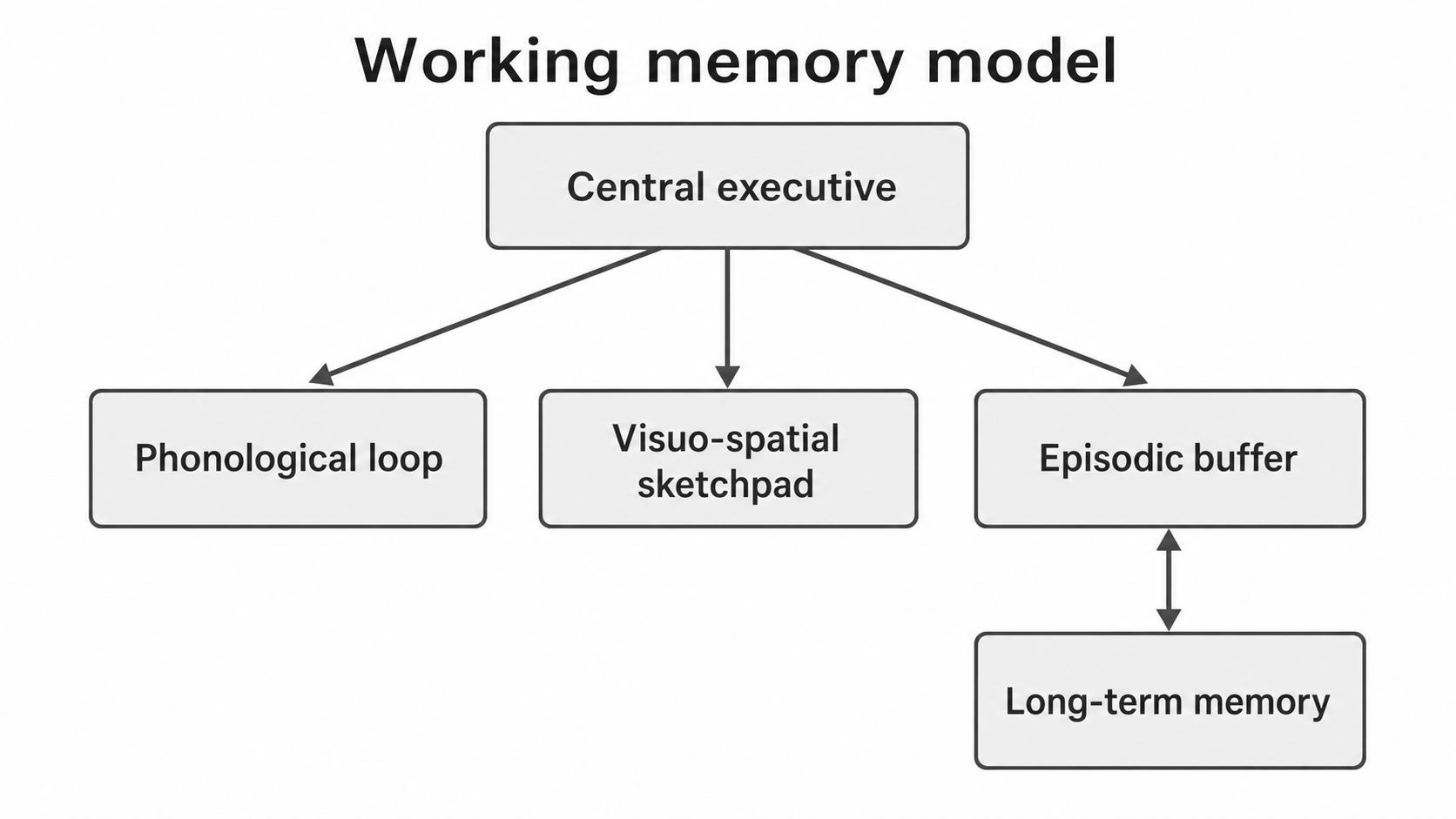
This model is useful because it turns a vague phrase like "short-term memory" into testable claims. For example, if two tasks both need the phonological loop, they should interfere with one another more than two tasks using different components.
AQA usefulness
- AO1: name and describe the four components accurately.
- AO2: decide which component is being used in a scenario.
- AO3: evaluate whether evidence really supports separate working-memory components.
The central executive
Central executive
The central executive is the attentional control system in the WMM. It directs attention, allocates mental resources and coordinates the other working-memory components.
The central executive is not best thought of as a storage box. It is more like the manager of a very small workspace. It decides what gets attention, switches attention between tasks, and coordinates the phonological loop, visuo-spatial sketchpad and episodic buffer.
If you are doing mental arithmetic, the central executive helps you keep the goal in mind, decide which operation to do next, and stop irrelevant information taking over. If you are listening to a teacher while checking a diagram, the central executive helps you divide attention between verbal and visual material.
For coding, the central executive is not tied to one sensory code. It can work with verbal, visual and spatial information because its main job is control rather than storage. That means an exam answer should not say the central executive "stores sounds" or "stores images"; those claims belong to the phonological loop and visuo-spatial sketchpad.
For capacity, the central executive is limited. When two tasks both require heavy attention or decision-making, performance usually suffers. The model therefore predicts that a person can combine some simple tasks, but not unlimited demanding tasks.
AO2 example: Theo can walk to class while rehearsing a definition because walking a familiar route takes little central-executive control. He finds it much harder to rehearse that same definition while solving a new algebra problem, because both tasks demand attention and monitoring.
AQA usefulness
- AO1: the central executive is a limited-capacity attentional controller.
- AO2: use it when a scenario involves coordinating, switching, planning or dividing attention.
- AO3: a common evaluation is that the central executive can be vague because it is described more by what it does than by a precise mechanism.
The phonological loop
Phonological loop
The phonological loop is the working-memory component that temporarily holds and rehearses speech-based information.
The phonological loop is the "sound and speech" part of working memory. It is useful when you repeat a phone number, hold a phrase in mind, learn new vocabulary, or remember the exact wording of a short instruction.
It is usually divided into two subcomponents:
- The phonological store holds speech sounds. This is sometimes called the "inner ear".
- The articulatory control process rehearses information silently or aloud. This is sometimes called the "inner voice".
Phonological store
The phonological store is the part of the phonological loop that briefly holds speech-based information in sound form.
Articulatory control process
The articulatory control process is the rehearsal mechanism that refreshes speech-based information and can convert visually presented words into a sound-based code.
For coding, the phonological loop mainly uses acoustic or phonological coding. This is why a list of similar-sounding letters, such as B, C, D, G, P, T, can be harder to recall than a less similar list. Even if the letters are printed on a screen, many people silently name them, converting the visual input into a sound-based code.
For capacity, the safest exam answer is that the phonological loop is limited and is strongly affected by rehearsal. A classic finding is the word-length effect: people tend to recall more short words than long words in immediate serial recall. Baddeley, Thomson and Buchanan (1975) argued that this fits a time-limited rehearsal system, because shorter words can be rehearsed more quickly.
Word-length effect
The word-length effect is the finding that immediate recall is usually better for lists of short words than lists of long words.
Another useful finding is articulatory suppression. If someone has to repeat an irrelevant sound such as "the, the, the" while trying to remember a word list, their rehearsal process is blocked, so verbal recall is usually worse.
Articulatory suppression
Articulatory suppression is a task in which a person repeats an irrelevant sound or word, blocking silent verbal rehearsal.
AO2 example: If Sara is trying to remember "evaporation, condensation, precipitation" while repeatedly saying "la-la-la", the WMM predicts poorer recall because the articulatory control process is occupied.
AQA usefulness
- AO1: the phonological loop includes the phonological store and articulatory control process.
- AO2: use it for speech, words, numbers, rehearsal and sound-based confusion.
- AO3: word-length and articulatory-suppression findings support the claim that verbal working memory has a specialised, limited system.
The sketchpad and episodic buffer
Visuo-spatial sketchpad
The visuo-spatial sketchpad is the working-memory component that temporarily holds and manipulates visual and spatial information.
The visuo-spatial sketchpad is the "mind's eye" part of the model. It helps you imagine a shape, follow a map, judge where objects are, or picture how a graph should look. Its coding is visual and spatial. "Visual" means appearance, such as colour, shape and pattern. "Spatial" means location, movement and arrangement.
For capacity, the visuo-spatial sketchpad is limited. You may be able to hold a simple route or diagram in mind, but a crowded map, a rotating 3D shape and a moving pointer can overload it quickly. This is why a spatial secondary task, such as tapping a pattern, can disrupt a visual-spatial memory task more than a simple verbal task does.
The fourth component, the episodic buffer, was added by Baddeley in 2000 because the original model did not fully explain how verbal, visual and long-term memory information are bound together into one conscious episode.
Episodic buffer
The episodic buffer is a limited-capacity component that temporarily integrates information from the phonological loop, the visuo-spatial sketchpad and long-term memory into a combined episode.
For coding, the episodic buffer is multimodal. It can combine different forms of information, such as a sentence you hear, a face you see and a memory of where you met the person before.
For capacity, the episodic buffer is limited. Do not treat it as a huge store or as long-term memory itself. A safe AQA answer is that it has a limited capacity for integrated episodes or chunks, and that it acts as a temporary link between working memory and long-term memory.
AO2 example: Imran is revising a labelled brain diagram. The written label "hippocampus" uses the phonological loop, the shape and position use the visuo-spatial sketchpad, and his stored knowledge about memory uses long-term memory. The episodic buffer helps bind these into one meaningful study episode.
AQA usefulness
- AO1: distinguish the sketchpad from the episodic buffer.
- AO2: use the sketchpad for maps, images and spatial layout; use the episodic buffer when a scenario combines information into a meaningful episode.
- AO3: the episodic buffer improved the model by explaining integration, but it was also added later, so some students use this as an evaluation point about the model changing to fit new evidence.
Evidence for separate components
Dual-task technique
The dual-task technique tests working memory by asking participants to do two tasks at the same time, often to see whether the tasks compete for the same component.
A key prediction of the WMM is selective interference. Two tasks using the same component should interfere with one another more than two tasks using different components. This is why dual-task evidence is so important for AO3.
Baddeley and Hitch (1974) used concurrent memory-load tasks while participants carried out reasoning, comprehension and free-recall tasks. Their evidence suggested a trade-off between storage and processing: larger memory loads, especially around memory span, could slow or disrupt reasoning. This supported the idea of a limited-capacity working space rather than a passive short-term store.
The phonological loop is supported by word-length and articulatory-suppression evidence. If verbal recall depends on quick rehearsal, then short words should be easier than long words and irrelevant speech should disrupt rehearsal. Baddeley, Thomson and Buchanan (1975) found a clear short-word advantage in memory span tasks, which fits this prediction.
The visuo-spatial sketchpad is supported by studies where spatial interference disrupts visual-spatial tasks more than verbal interference does. Robbins et al. (1996) tested working memory in chess. Participants remembered or solved chess positions while completing secondary tasks intended to block different WMM components. Blocking the visuo-spatial sketchpad and central executive disrupted chess performance more than blocking the articulatory loop, which makes sense because chess positions are strongly visual-spatial and strategic.
Neuropsychological evidence also matters. Patient KF, reported in Warrington and Shallice's work, had severely impaired auditory-verbal short-term memory but did not show a general collapse of all learning, comprehension or long-term memory. This kind of dissociation challenges a single-store view and supports the idea that verbal short-term memory can be selectively impaired.
However, AO3 needs balance. Dual-task findings support the WMM, but they do not prove that the exact four-part diagram is the only possible model. Case studies such as KF are rich but based on unusual brain damage, so they may not represent normal memory in all people. The strongest exam answer treats evidence as support for the model's usefulness, not as final proof that every component is perfectly understood.
AQA usefulness
- AO1: know the evidence as evidence for components, not as random study names.
- AO2: apply selective interference to new tasks in scenarios.
- AO3: explain why evidence supports the WMM and then add a specific limitation.
Evaluating the model in exam answers
The working memory model is exam-useful because it gives a more active and detailed account of short-term memory than a single short-term store. It explains why you can sometimes do two things at once, why verbal and visual tasks can interfere differently, and why some patients can have a specific short-term memory impairment without all memory being damaged.
A strong AO3 point is that the WMM has research support. Dual-task studies, word-length research and neuropsychological cases all fit the claim that working memory contains specialised components. This makes the model more precise than simply saying "STM has limited capacity".
A second strength is application. The model helps explain everyday multitasking and learning. A teacher might reduce working-memory overload by not asking students to copy a complex diagram while also listening to dense verbal instructions. That is not just a memory fact; it is a practical implication of different coding systems and limited capacity.
There are also limitations. The central executive is less clearly specified than the phonological loop. It is often described as the component that allocates attention, switches tasks and coordinates other systems, but these are broad functions. This makes it harder to test exactly than the phonological loop, where predictions about word length and articulatory suppression are more precise.
The episodic buffer can also be evaluated. It made the model better at explaining how information is integrated with long-term memory, but because it was added after the original model, it can look like a patch for things the earlier model could not explain. A balanced answer should say this is a weakness only if the addition is vague or hard to test; scientific models are allowed to develop when new evidence appears.
Finally, the WMM is a cognitive and partly reductionist model. It breaks memory into components and uses controlled laboratory tasks to test them. That is useful for precision, but it may simplify messy real-life memory, where emotion, motivation, expertise and long-term knowledge also shape performance.
Common mistakes to avoid:
- Do not call the phonological loop "the part that stores all sounds"; it is mainly speech-based/verbal information.
- Do not say the episodic buffer is long-term memory. It links with long-term memory.
- Do not make duration a main WMM feature for this AQA bullet. The named features are coding and capacity.
- Do not evaluate with empty phrases such as "low validity" unless you explain exactly why.
AQA usefulness
- AO1: build answers around component, coding and capacity.
- AO2: identify which component a person is using or overloading.
- AO3: use evidence, practical application and limitations of the central executive/episodic buffer.