4.1.3.01 - Animal studies of attachment
Animal studies let psychologists separate feeding from comfort and observe early bonding under controlled conditions, but their meaning depends on the species and procedure. You will compare Lorenz's work on imprinting with Harlow's studies of contact comfort and later social development. The lesson focuses on what these findings suggest about attachment, how far they generalise to humans, and the ethical costs of producing lasting deprivation.
Why animal studies matter
AQA's updated 2025 requirement for this lesson is deliberately focused: Animal studies of attachment: Lorenz and Harlow. These studies are not here because geese and monkeys are the same as human babies. They are here because they let psychologists ask questions about early bonding that would be impossible or unethical to manipulate directly in humans.
Attachment
An attachment is a close, enduring emotional bond between two individuals, usually shown through behaviours such as proximity-seeking, distress at separation and comfort when reunited.
Animal study
An animal study is research using non-human animals to investigate behaviour. In attachment, animal studies can show whether some bonding behaviours are biologically prepared, learned from experience or linked to particular forms of caregiving.
Lorenz studied imprinting in greylag geese. Harlow studied contact comfort in infant rhesus monkeys. Together, they challenge the simple idea that attachment forms only because a caregiver provides food.
Imprinting
Imprinting is a rapid form of early learning in which some young animals attach to, and follow, the first suitable moving object they encounter during a limited early period.
Contact comfort
Contact comfort is physical comfort from a soft, warm or tactile object. Harlow used this idea to test whether attachment depends more on comfort than on feeding.
For AQA, keep three exam uses in mind:
| Skill | What this lesson gives you |
|---|---|
| AO1 | Accurate descriptions of Lorenz's goslings and Harlow's rhesus monkeys. |
| AO2 | The ability to apply imprinting and contact comfort to unfamiliar examples, such as animal care or a scenario about feeding versus comfort. |
| AO3 | Evaluation of animal research: control, real-world usefulness, ethics, and the problem of generalising from animals to humans. |
The safe exam route is not "animals prove human attachment works like this." It is more precise: animal studies provide evidence about basic attachment-related processes, but any application to humans needs careful evaluation.
Lorenz and imprinting
Konrad Lorenz (1935) investigated imprinting in greylag geese. Goslings are useful for studying early attachment-like behaviour because they can walk soon after hatching and naturally follow a parent, which keeps them close to food, warmth and protection.
Aim: Lorenz wanted to observe how goslings form an attachment-like bond after hatching, and whether the object they first encounter determines whom they follow.
Procedure: Lorenz took a clutch of goose eggs and divided them into two groups. One group hatched naturally with the mother goose. The other group hatched in an incubator, and Lorenz arranged for himself to be the first moving object the goslings saw. He then marked the goslings so the groups could be distinguished and placed them together with both Lorenz and the natural mother available.
Findings: The naturally hatched goslings followed the mother goose. The incubator-hatched goslings followed Lorenz. The goslings did not simply switch to the biological mother when she was available; they stayed with the object they had imprinted on.
Conclusion: Lorenz concluded that imprinting is a biologically prepared process that happens during a limited early period. It supports the idea that some attachment-related behaviours are innate and adaptive because following a caregiver helps survival.
Critical period
A critical period is a limited early time window in which a behaviour or bond must develop if it is to develop normally. For imprinting in birds, later research refined the timing to the first hours after hatching, with strong responses often around 12-17 hours and weaker responses after about 32 hours.
Lorenz also suggested that imprinting could have long-term consequences, including sexual imprinting, where an animal's later mate preference is influenced by the object or species it imprinted on early in life. This is useful AO3 material, but use it carefully: later research suggests imprinting may be more flexible than Lorenz first implied.
AO1 usefulness: describe the split between naturally hatched and incubator-hatched goslings, the first moving object, and the follow-up choice test.
AO2 usefulness: if a scenario says ducklings follow a farmer, a moving boot or a model train immediately after hatching, apply imprinting rather than ordinary reward learning.
AO3 usefulness: Lorenz supports a nature-side explanation because the young birds seem biologically prepared to attach rapidly. However, geese are very different from human infants, so the finding is strongest for bird behaviour and only indirectly useful for human attachment.
Harlow and contact comfort
Harry Harlow's work is usually dated in A-level resources as Harlow (1958) or Harlow and Zimmermann (1959). His classic surrogate-mother research used infant rhesus monkeys to test whether attachment depends mainly on food or on comfort.
Surrogate mother
A surrogate mother in Harlow's study was an artificial mother figure used in place of the monkey's biological mother.
Aim: Harlow wanted to find out whether infant monkeys would attach to the object that provided milk or to the object that provided soft physical comfort.
Procedure: Eight newborn rhesus monkeys were separated from their biological mothers and raised with two artificial mothers. One was made from wire and could provide milk through a bottle. The other was covered in soft cloth. The feeding condition was counterbalanced: for four monkeys the wire mother provided milk; for four monkeys the cloth mother provided milk. Harlow measured how much time the infants spent with each surrogate across many days.
Findings: The monkeys spent most of their time clinging to the cloth mother, regardless of whether she provided milk. When the wire mother provided food, the infants went to it to feed, then returned to the cloth mother. In fear tests and novel environments, monkeys used the cloth mother as a source of security.
Secure base
A secure base is an attachment figure that gives an infant enough comfort and security to explore the environment and return when frightened.
Conclusion: Harlow concluded that contact comfort was more important than feeding in the formation of an affectional bond. This challenged learning-theory explanations that treat food as the primary basis of attachment.
Harlow's broader deprivation work also found long-term social and emotional effects when monkeys were reared without normal early contact. This is important, but do not turn the lesson into "all deprivation research." For this AQA point, the core is the cloth mother versus wire mother study and what it shows about comfort.
AO1 usefulness: know the two surrogate mothers, the food manipulation, and the finding that monkeys preferred the cloth mother.
AO2 usefulness: if a scenario describes an infant animal choosing a soft object over a feeding device, apply contact comfort.
AO3 usefulness: Harlow used strong control and a clear comparison between food and comfort, but the procedure caused distress and would be heavily restricted under modern animal-welfare standards.
Comparison and application
Lorenz and Harlow are easy to confuse because both are animal studies, both involve early experience, and both suggest that feeding alone is not enough to explain attachment. The difference is what each study is really testing.
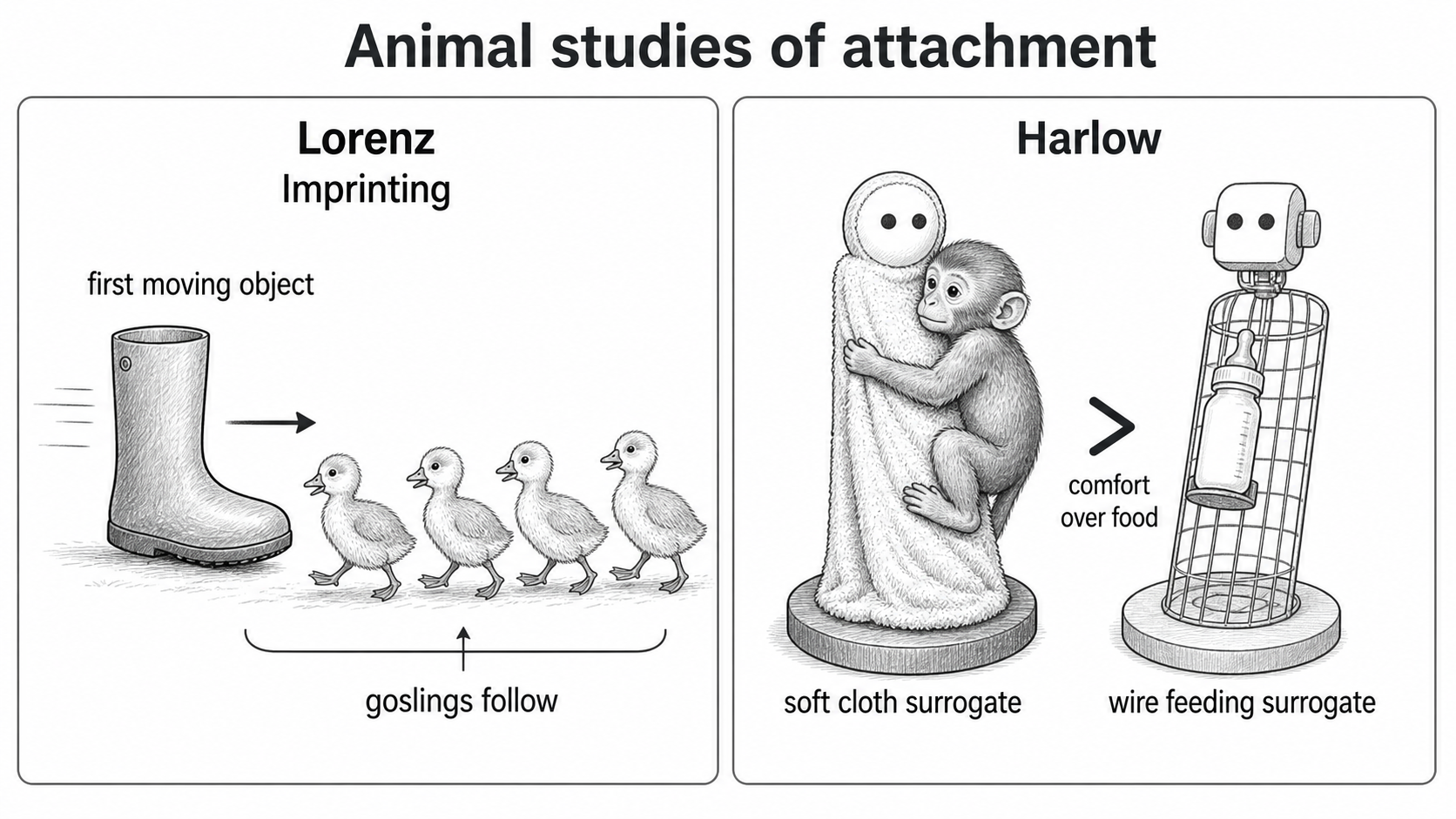
[DIAGRAM: asset_name: Lorenz and Harlow study map; asset_slug: 4_1_3_01_animal_studies_of_attachment__diagram_01; recommended_method: image_gen; description: Side-by-side monochrome NovaLearn diagram comparing Lorenz's goslings imprinting on the first moving object with Harlow's rhesus monkey preferring a soft cloth surrogate over a wire feeding surrogate.]
| Study | Species | Main process | Core finding | Exam conclusion |
|---|---|---|---|---|
| Lorenz | Greylag geese | Imprinting | Goslings followed the first moving object seen after hatching. | Some attachment-like behaviour is biologically prepared and time-limited. |
| Harlow | Rhesus monkeys | Contact comfort | Infant monkeys preferred the soft cloth mother over the wire mother, even when the wire mother fed them. | Comfort and security can matter more than food in attachment. |
AO2 scenario 1: A conservation worker hatches crane chicks and uses a puppet shaped like an adult crane so the chicks do not attach to humans. This applies Lorenz: the worker is managing imprinting during an early sensitive period.
AO2 scenario 2: A zoo has an orphaned infant primate. Staff provide warmth, soft contact and careful social contact rather than only a feeding device. This applies Harlow: contact comfort and social experience matter for development.
AO2 scenario 3: A student says, "Harlow proves babies love whoever feeds them." That is the wrong application. Harlow found almost the opposite: feeding alone did not explain the monkeys' preference.
The best comparison sentence is:
Lorenz shows that some young animals may be biologically prepared to attach rapidly to the first suitable moving object, whereas Harlow shows that in primates, soft contact and security can be more important than food.
Evaluation and exam route
Strong AO3 does more than say "animals are different from humans." It explains why that matters for the conclusion being drawn.
Strength: control and causal inference. Harlow's study was highly controlled. The two surrogate mothers differed mainly in softness/contact comfort and feeding could be varied. This allowed Harlow to test food against comfort more directly than human research could.
Strength: practical usefulness. Animal studies helped change thinking about early care. Harlow's findings supported the importance of comfort, handling and social contact in primate care. Lorenz's imprinting research has practical relevance for conservation and captive breeding, where handlers may need to prevent animals imprinting on humans.
Limitation: generalising to humans. Lorenz studied birds that can walk soon after hatching and naturally follow a parent. Human infants form more complex, reciprocal attachments over time, involving communication, sensitivity and social interaction. Harlow's monkeys are closer to humans than geese are, but rhesus monkey attachment is still not the same as human caregiver-infant attachment.
Limitation: ethics. Lorenz's work involved manipulating early experience, but Harlow's work raises much stronger ethical concerns because infant monkeys were separated from their mothers and exposed to fear or deprivation. Modern animal research is judged against welfare principles such as the 3Rs: replacing animal use where possible, reducing numbers, and refining procedures to minimise suffering.
Limitation: methodological detail. Lorenz's work is influential, but some exam-level accounts simplify it heavily and the original work is less like a modern standardised laboratory experiment. Harlow's artificial surrogate mothers were also not real caregivers, so the study isolates contact comfort but strips away many features of normal attachment, such as responsiveness and social interaction.
Issues and debates: Lorenz supports the nature side of the nature-nurture debate because imprinting appears biologically prepared. Harlow adds nurture because the monkeys' early experience with comfort, social contact and deprivation affected later behaviour. Both studies can also be called reductionist because they isolate one process - first exposure or contact comfort - from the full complexity of attachment.
For an AQA answer, use this structure:
- Describe Lorenz accurately.
- Describe Harlow accurately.
- Make one comparison or application point.
- Evaluate using species differences, ethics, control and usefulness.
- End with a balanced judgement: animal studies are useful for identifying basic processes, but they cannot fully explain human attachment.