4.1.2.01 - The multi-store model of memory
The multi-store model treats memory as movement through distinct stores rather than as one undivided capacity. You will trace information from sensory registers to short-term and long-term memory, considering coding, capacity and duration at each stage and the role of attention and rehearsal. Evidence from laboratory studies and long-term recall helps test the model, while case research reveals where its simple sequence may need refinement.
What the model claims
The multi-store model of memory, often linked with Atkinson and Shiffrin (1968), is a structural model. It explains memory as a sequence of separate stores, with information moving between stores through attention, rehearsal and retrieval.
Multi-store model
A model of memory that proposes three separate stores: the sensory register, short-term memory and long-term memory.
For each store, AQA expects three features. Coding means the form in which information is held; capacity means how much information can be held; duration means how long information can remain there.
Coding, capacity and duration
Coding is the form of stored information, such as sound or meaning. Capacity is the amount a store can hold. Duration is the length of time information can remain in that store.
The route is simple:
- Environmental information first enters the sensory register.
- If attention is paid, selected information moves into short-term memory (STM).
- If information is rehearsed, it is more likely to be transferred to long-term memory (LTM).
- When stored knowledge is needed, it is retrieved from LTM back into STM so it can be consciously used.
[DIAGRAM: asset_name: Multi-store model pathway; asset_slug: 4_1_2_01_the_multi_store_model_of_memory__diagram_01; recommended_method: image_gen; description: A clean left-to-right NovaLearn diagram of environmental input, sensory register, STM and LTM, with arrows labelled attention, rehearsal and retrieval plus brief coding, capacity and duration notes under each store.]
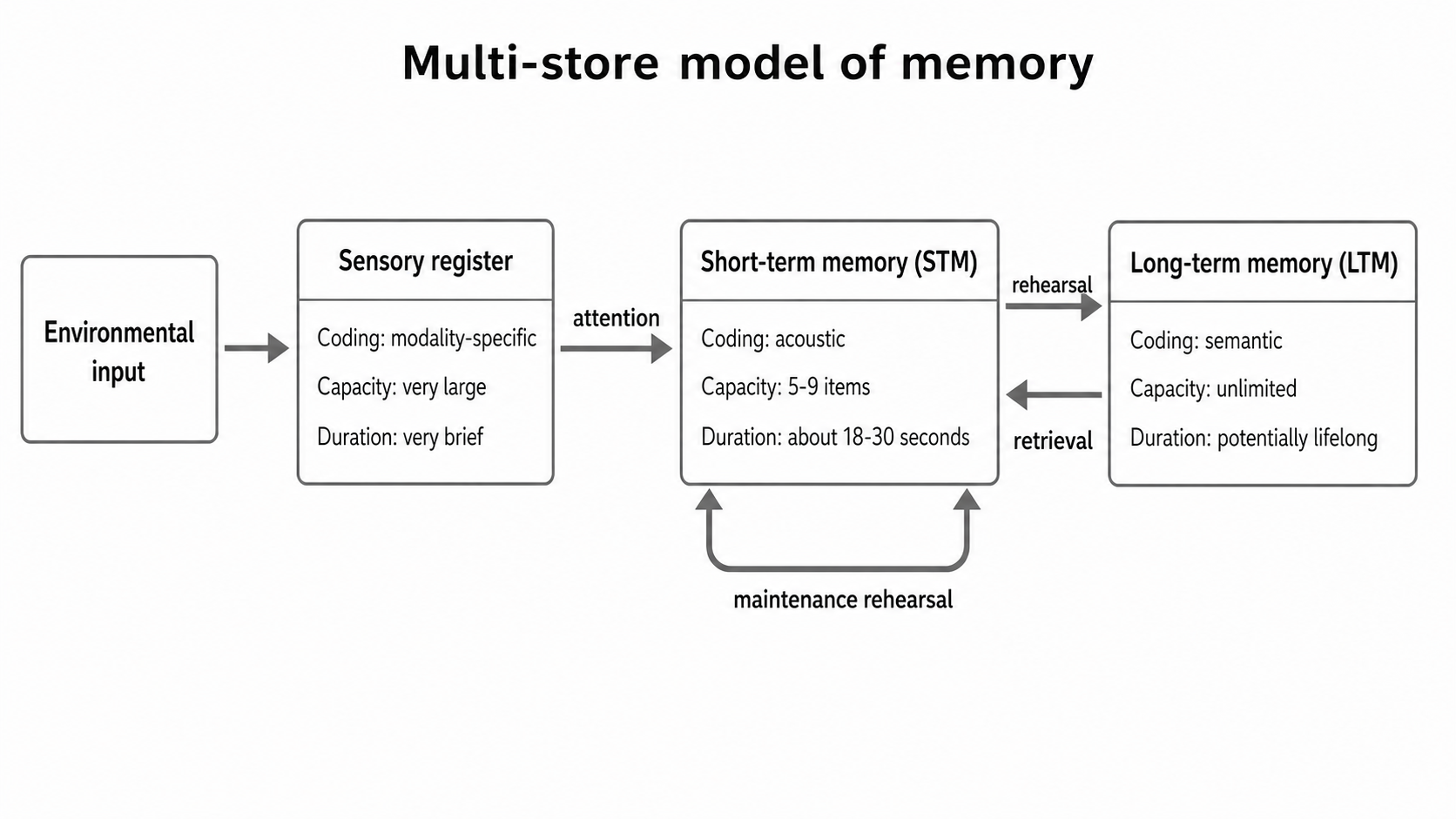
For AQA, the key AO1 is not just naming the three stores. It is being able to describe the features of each store: coding, capacity and duration. AO2 usually asks you to apply the route to a person trying to notice, hold or retrieve information. AO3 asks whether the model is useful, supported by evidence, or too simple.
The sensory register
The sensory register is the brief first store for information arriving from the senses. It is not one single store in the everyday sense. It is better understood as a set of modality-specific registers: visual information is held in iconic memory, auditory information in echoic memory, and so on.
Sensory register
The initial memory store that briefly holds raw sensory information before it is either attended to or lost.
The sensory register has:
- Coding: modality-specific. Information is held in the form in which it arrived, such as visual, auditory, tactile or olfactory information.
- Capacity: very large. Far more information enters the sensory register than we can consciously process.
- Duration: extremely brief. Visual sensory memory is often measured in fractions of a second, while auditory sensory traces may last a little longer.
Sperling's (1960) partial-report research is useful evidence for the sensory register. Participants briefly saw grids of letters. In whole-report trials they could usually report only a few letters, but in partial-report trials a tone told them which row to report just after the display disappeared. Performance was better in the partial-report condition, suggesting that more information had been registered than participants could report before it faded.
AO2 check: if Maya glances at a packed noticeboard, lots of visual information reaches her sensory register. Only the bit she attends to, such as the exam-room number, is likely to move into STM. The rest disappears very quickly.
Short-term memory
Short-term memory is the limited-capacity store for information currently in conscious awareness. In the multi-store model, STM receives selected information from the sensory register and also receives retrieved information from LTM.
Short-term memory
The temporary memory store that holds a limited amount of information for a brief period when it is being consciously used.
The core STM features are:
- Coding: mainly acoustic. Baddeley (1966) found that immediate recall was disrupted more by acoustically similar words than by semantically similar words, supporting the idea that STM often codes verbal material by sound.
- Capacity: limited. Miller (1956) famously estimated around seven plus or minus two chunks, and Jacobs' earlier digit-span work showed immediate span is limited and varies with material and age.
- Duration: brief without rehearsal. Peterson and Peterson (1959) used consonant trigrams and a counting-backwards task to prevent rehearsal; recall fell sharply over short delays, supporting an STM duration of roughly 18 to 30 seconds when rehearsal is blocked.
Maintenance rehearsal
Repeating information to keep it active in STM. In the multi-store model, rehearsal also increases the chance of transfer to LTM.
The word "chunk" matters. A chunk is a meaningful unit. The digits 2, 0, 2 and 7 may be four separate items, but "2027" can become one chunk if a student links it to the first A-level exam year for this specification.
AO2 check: if Aisha silently repeats a six-digit code while walking to a locker, she is using maintenance rehearsal to keep the code in STM. If she is distracted before entering it, the code may disappear because STM is brief and vulnerable.
Long-term memory
Long-term memory is the store for information that has been retained beyond the immediate present. In the multi-store model, information gets into LTM mainly through rehearsal in STM, and it is brought back into STM when we need to use it.
Long-term memory
The relatively permanent memory store with very large capacity and long duration.
The core LTM features are:
- Coding: mainly semantic. Meaning is especially important for long-term retention. Baddeley's work on word similarity is often used to support the contrast between acoustic STM and more semantic LTM.
- Capacity: potentially unlimited. AQA students should avoid claiming that a precise upper limit has been found. The safer phrasing is that no practical capacity limit has been established.
- Duration: potentially lifelong. Bahrick, Bahrick and Wittlinger (1975) tested memory for former classmates using yearbook photos and names across retention intervals of many years, showing that some long-term information can remain accessible for decades.
LTM is not the same as perfect recall. A person may have stored information but fail to retrieve it because the right cue is missing, or because later learning interferes. Those explanations belong in a later lesson, but they help prevent a common mistake: "long-term" does not mean "always easy to remember."
AO2 check: when Tom is asked to define "coding" in class, the definition is retrieved from LTM into STM. He can then hold it consciously long enough to answer.
Using the model in exam answers
The multi-store model is exam-useful because it turns memory into a set of contrasts. When you see a scenario, ask: which store is involved, what is the feature being tested, and what process is moving information?
| Store | Coding | Capacity | Duration | AO2 clue |
|---|---|---|---|---|
| Sensory register | Modality-specific | Very large | Milliseconds to seconds | A person briefly sees, hears or feels more than they can attend to |
| STM | Mainly acoustic for verbal material | Limited, about 5-9 chunks | About 18-30 seconds without rehearsal | A person repeats or holds a small amount of information briefly |
| LTM | Mainly semantic | Potentially unlimited | Potentially lifetime | A person retrieves learned knowledge, meanings, names or facts |
For AO1, define the stores and their features accurately. For AO2, use the person's behaviour in the scenario rather than dropping in a memorised paragraph. For AO3, evaluate how well the model explains memory and where it becomes too simple.
A compact applied answer might look like this:
Leila hears a new password. The sound first enters her auditory sensory register. Because she pays attention, it enters STM, where it is probably coded acoustically. She repeats it several times, which keeps it active in STM and may help transfer it to LTM. Later, when she logs in again, she retrieves the password from LTM back into STM.
Evaluation and usefulness
The multi-store model is useful because it gives a clear, testable account of memory. It separates stores by coding, capacity and duration, which helps explain everyday differences between briefly holding a phone number and remembering a childhood address.
One AO3 strength is evidence for separate STM and LTM. Case studies such as Scoville and Milner's (1957) report of HM suggest that new long-term memory can be severely impaired while immediate memory is relatively preserved. Shallice and Warrington's (1970) patient KF showed the opposite pattern in verbal memory: very poor short-term verbal span with more preserved long-term learning. Double dissociations like this support the idea that STM and LTM are not the same store.
A second strength is that the model generated research. Studies on coding, capacity and duration became easier to organise because researchers could ask which store was being tested. This is why the model remains a useful starting point in AQA memory, even though later models are more detailed.
The main limitation is that the model is too simple. It treats STM and LTM as unitary stores, but later research suggests STM has different components and LTM includes different kinds of memory. This matters because a single-box account cannot fully explain why someone might have poor verbal STM but stronger visual-spatial memory, or remember facts differently from skills.
Another limitation is the model's emphasis on rehearsal. Craik and Lockhart's levels-of-processing approach challenged the idea that repetition is the key route to durable LTM. Deep, meaningful processing often helps long-term recall more than simply repeating information. For revision, this is the difference between repeating "semantic coding" ten times and linking it to the idea of meaning, examples and exam scenarios.
There is also a methodological caution. Much supporting research uses artificial tasks such as recalling trigrams, digits or word lists. These tasks give good control, which is useful for scientific testing, but they may not fully represent richer everyday memory.
Overall, a balanced AO3 conclusion is that the multi-store model is a strong introductory model: it explains basic differences between stores and has research support, but it is reductionist because it compresses complex memory processes into a simple linear pathway.