1.2.5 Eyewitness Testimony: Misleading Information and Anxiety
Eyewitness testimony is one of the most influential forms of evidence in criminal trials, yet decades of psychological research have shown it can be surprisingly unreliable. This lesson examines two major factors that affect the accuracy of eyewitness testimony (EWT): misleading information (including leading questions and post-event discussion) and anxiety. You will learn how memory for events can be distorted after the fact, why witnesses to the same crime can recall different details, and whether the stress of witnessing a crime helps or hinders what we remember. These are core topics for Paper 1 and frequently appear as both short-answer and 16-mark essay questions.
Eyewitness Testimony and Misleading Information
Eyewitness Testimony (EWT)
The ability of people to remember the details of events, such as accidents and crimes, which they themselves have observed. The accuracy of EWT can be affected by factors such as misleading information and anxiety.
In the legal system, juries place great weight on the testimony of eyewitnesses. However, research has consistently demonstrated that what a witness recalls can be altered by information they encounter after the event. This post-event information — which may be incorrect — is referred to as misleading information.
Misleading Information
Incorrect information given to an eyewitness, usually after the event. It can take many forms, including leading questions asked by police and post-event discussion between co-witnesses or with other people.
Misleading information can reach a witness through two main routes: leading questions posed during interviews, and post-event discussion with other witnesses, the media, or anyone else who provides new details about the event. Both routes can alter what the witness genuinely believes they saw.
Leading Questions
Leading Question
A question which, because of the way it is phrased, suggests a certain answer. For example, "Was the knife in his left hand?" leads a person to think there was a knife and that it was in the left hand.
A leading question does not simply ask for information — it subtly directs the witness towards a particular response. This is especially problematic in police interviews, where the phrasing of a single word can shift an eyewitness's entire recollection.
The most influential research on this topic was conducted by Elizabeth Loftus and John Palmer.
Loftus and Palmer (1974) — Experiment 1 — In a laboratory experiment, 45 student participants watched film clips of car accidents and then answered questions about what they had seen. The critical (leading) question was: "About how fast were the cars going when they _____ each other?" Five groups each received a different verb in the blank: contacted, hit, bumped, collided, or smashed. The mean speed estimate for contacted was 31.8 mph, rising through each verb to 40.5 mph for smashed — a difference of 8.7 mph between the lowest and highest estimates. This demonstrated that the wording of a single word in a question could systematically bias eyewitness recall.
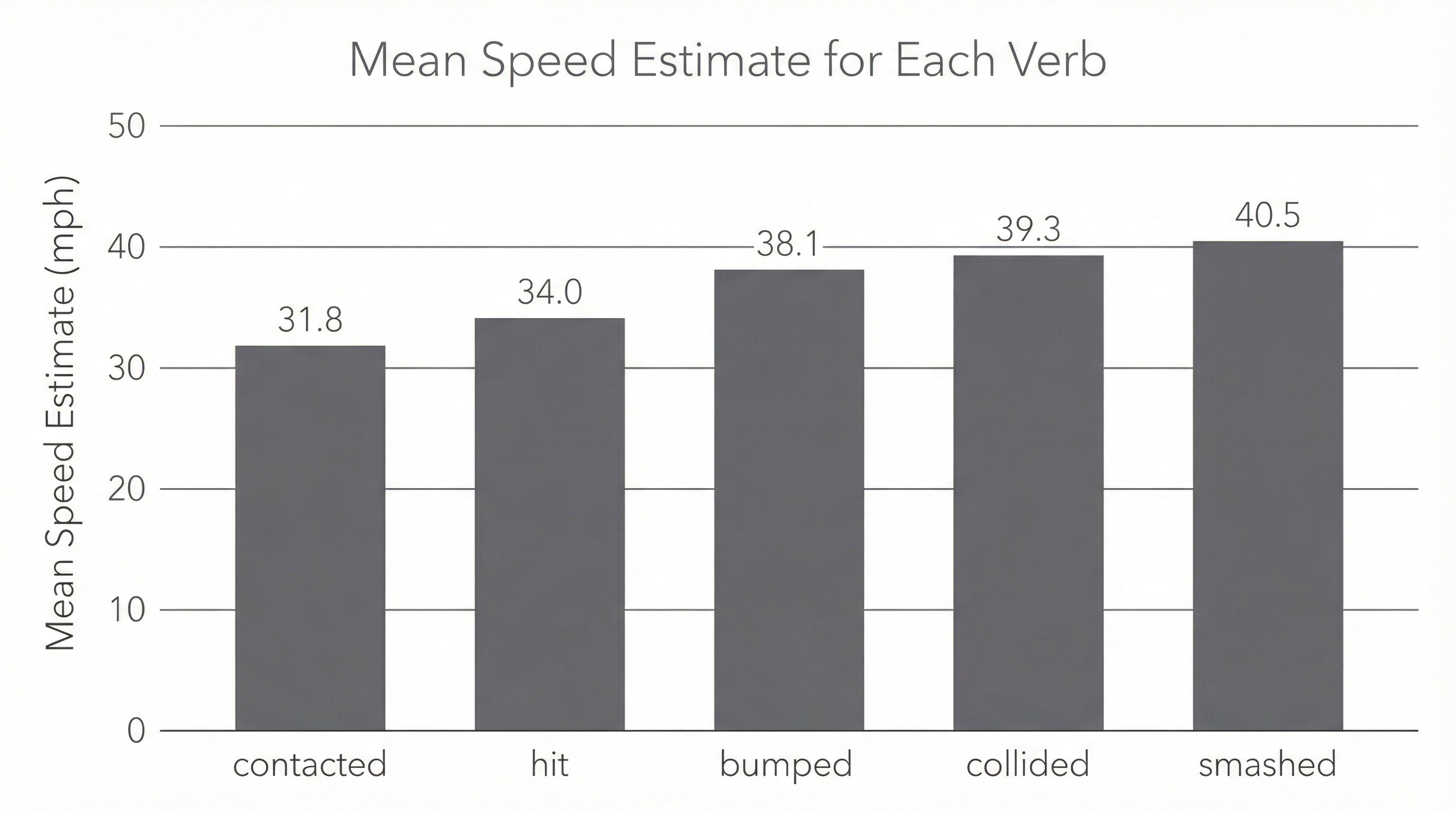
There are two possible explanations for this finding:
- Response-bias explanation — The leading question does not actually change the participant's memory; it simply influences how they choose to answer. The word smashed encourages a higher estimate, but the original memory trace remains intact.
- Substitution explanation — The leading question genuinely alters the witness's stored memory, so the original information is replaced (substituted) with the new, misleading information.
Loftus and Palmer (1974) — Experiment 2 — To test which explanation was correct, Loftus and Palmer conducted a follow-up study. A new group of 150 participants watched a film of a car accident and were then asked speed estimation questions using either smashed, hit, or no verb (the control group received no critical question). One week later, all participants were asked: "Did you see any broken glass?" There was no broken glass in the film. Participants who had heard smashed were significantly more likely to report seeing broken glass than those who had heard hit or who were in the control group. This supported the substitution explanation — the critical verb had not merely influenced how participants answered at the time, but had actually altered their stored memory of the event, causing them to "remember" details that never existed.
Tom witnessed a minor collision in a car park. When a police officer later asks him, "How fast was the car going when it smashed into the other vehicle?", Tom estimates the speed at 35 mph. However, CCTV footage later shows the car was travelling at approximately 15 mph. The leading question, with its use of the verb smashed, appears to have inflated Tom's speed estimate and may have altered his memory of the severity of the impact.
Post-Event Discussion
Post-Event Discussion (PED)
Occurs when there is more than one witness to an event and the witnesses discuss what they have seen with co-witnesses or with other people. This discussion may introduce misleading information and influence the accuracy of each witness's recall.
Leading questions are not the only source of misleading information. When co-witnesses talk to each other — or are exposed to media reports — after an event, the details they share can contaminate each other's memories. This is known as post-event discussion.
Gabbert et al. (2003) — In a laboratory experiment using a matched-pairs design, participants watched a video of a crime filmed from two different angles, so each member of a pair could see certain details that the other could not (for example, only one participant could see the title of a book being carried). The pairs then discussed what they had seen before each participant individually completed a recall test. The researchers found that 71% of participants mistakenly recalled details they had not seen in their own video but had picked up from their partner during discussion. In a control group, where participants had no discussion, the corresponding error rate was 0%. This provided strong evidence that post-event discussion can introduce significant inaccuracies into eyewitness memory.
Gabbert et al. identified two possible explanations for this effect:
- Memory contamination — Co-witnesses combine misinformation from the discussion with their own memories, so the original memory trace becomes genuinely distorted.
- Memory conformity — Witnesses go along with what others report, either to gain social approval or because they believe the other witness is more reliable. In this case, the underlying memory may remain unchanged — the witness simply reports what they think is expected.
Further research has helped to disentangle these two explanations. Skagerberg and Wright (2008) showed participants different versions of a film clip (for example, one version showed a mugger with dark brown hair, the other with light brown hair). After discussion, participants often reported a "blend" of the two — such as "medium brown" hair — rather than reporting what they had personally seen or what their co-witness had told them. This blending effect supports the memory contamination explanation, because the original memory was altered rather than simply overridden by conformity.
Post-event discussion can distort eyewitness memory. Gabbert et al. (2003) found that 71% of participants recalled details they never saw but picked up in discussion with a co-witness, compared to 0% in a no-discussion control group.
The Effects of Anxiety on EWT
Anxiety
A state of emotional and physical arousal. The emotions include worried thoughts and feelings of tension. Physical changes include an increased heart rate and sweatiness. Anxiety is a normal reaction to stressful situations, but it can affect the accuracy and detail of eyewitness testimony.
Witnessing a crime or accident is typically a stressful experience. The anxiety this creates produces physiological changes — increased heart rate, heightened alertness, narrowed attention — that might reasonably be expected to affect what a witness can later recall. However, research findings are contradictory: some studies suggest anxiety reduces the accuracy of EWT, while others suggest it enhances it.
Anxiety has a negative effect on recall — the weapon focus effect
One of the most well-known demonstrations that anxiety impairs EWT comes from research on the weapon focus effect: when a weapon is present, witnesses tend to focus their attention on it at the expense of other details (such as the perpetrator's face).
Johnson and Scott (1976) — In a laboratory experiment, participants sat in a waiting room believing they were about to take part in a study. In the low-anxiety condition, they overheard a casual conversation in the next room, and then a man walked past carrying a pen with grease on his hands. In the high-anxiety condition, participants overheard a heated argument accompanied by the sound of breaking glass, and a man emerged holding a knife covered in blood. All participants were later asked to identify the man from a set of 50 photographs. In the low-anxiety condition, 49% correctly identified the man; in the high-anxiety condition, only 33% did so. This supports the tunnel theory of memory, which proposes that anxiety narrows a witness's attention onto the most threatening stimulus (the weapon), reducing their ability to encode and recall other details of the scene.
Priya is walking home when she witnesses a mugging. The attacker pulls out a large knife and threatens the victim. When police later ask Priya to describe the attacker's face and clothing, she finds she can recall very little — but she can describe the knife in vivid detail. Priya's experience is consistent with the weapon focus effect, where anxiety caused by the presence of the weapon narrowed her attention onto it, reducing her recall for other details.
Anxiety has a positive effect on recall
Not all research paints such a negative picture. Studies of real-life crimes suggest that high anxiety may actually improve the accuracy of recall.
Yuille and Cutshall (1986) — In a study of a real-life shooting at a gun shop in Vancouver, Canada, the shop owner had shot dead a thief. Of the 21 original witnesses, 13 agreed to be re-interviewed four to five months after the incident. Their later accounts were compared with the original police interviews conducted at the time. Accuracy was determined by the number of correct details reported, and witnesses also rated their stress levels at the time of the event using a 7-point scale. The witnesses remained highly accurate even after five months, though there were small inaccuracies in peripheral details such as colour of items and height/weight estimates. Crucially, those who reported the highest levels of stress were the most accurate (approximately 88% accuracy, compared to 75% for the less-stressed group). This suggests that in real-world, high-stakes situations, anxiety may enhance rather than impair eyewitness memory — possibly because the fight-or-flight response increases alertness and attention to environmental cues.
Further support comes from Christianson and Hubinette (1993), who interviewed 58 witnesses to actual bank robberies in Sweden. Witnesses who were directly involved (such as bank tellers who were threatened) — and therefore presumably more anxious — showed even greater recall accuracy than bystanders who witnessed the event from a distance.
Explaining the Contradictory Findings — The Yerkes-Dodson Law
The research reviewed above appears contradictory: Johnson and Scott found that anxiety reduces accuracy, while Yuille and Cutshall found that it improves it. The Yerkes-Dodson Law offers a way to reconcile these findings.
Yerkes and Dodson (1908) proposed that the relationship between physiological arousal and performance follows an inverted-U curve. At low levels of arousal, performance is poor because the individual is not sufficiently alert. Performance improves as arousal increases, reaching an optimal point at moderate levels. Beyond this point, further increases in arousal cause performance to decline sharply.
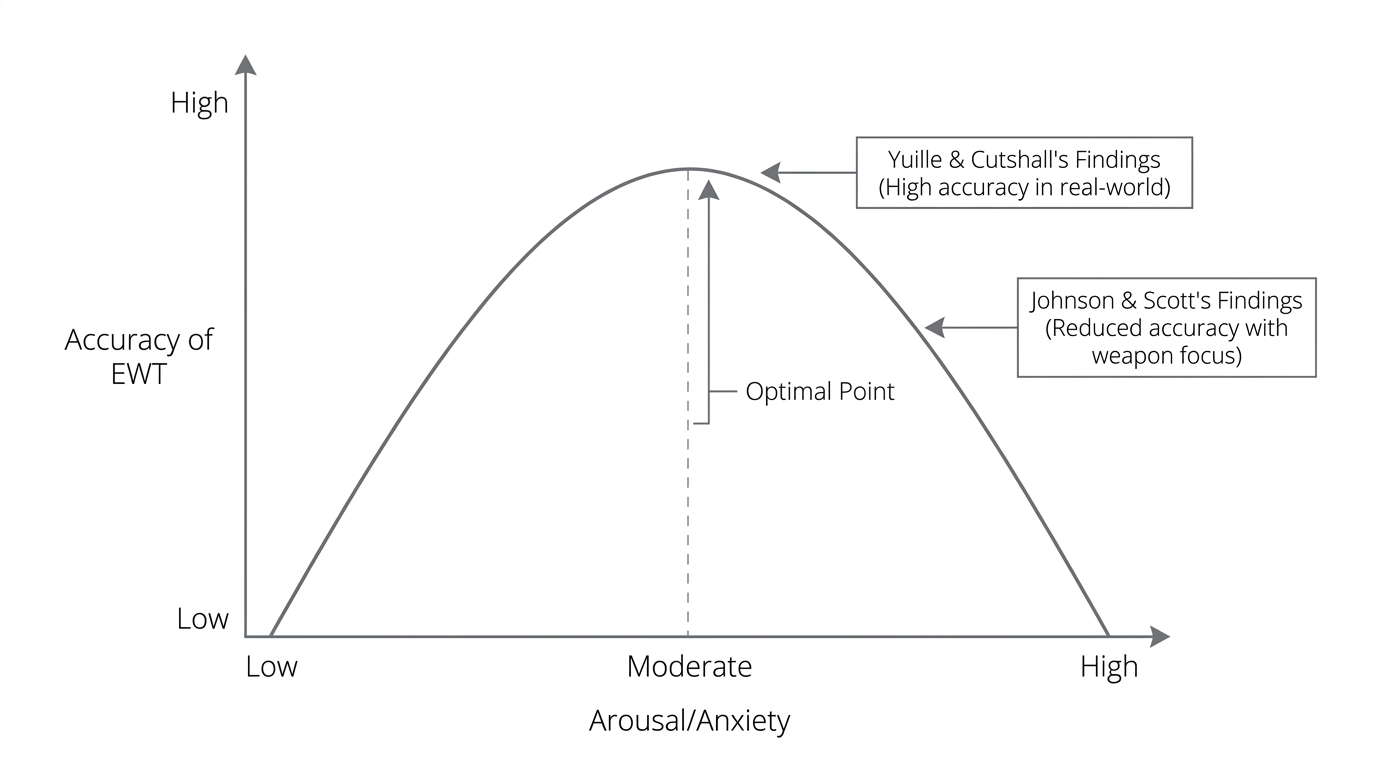
Deffenbacher (1983) reviewed 21 studies of anxiety and EWT and argued that the Yerkes-Dodson Law could explain the contradictory findings. Studies where witnesses experienced moderate-to-high anxiety in real-world situations (such as Yuille and Cutshall) may have been at or near the optimal point on the curve, producing high accuracy. In contrast, extreme or sudden anxiety — such as the unexpected appearance of a bloody knife in Johnson and Scott's study — may push witnesses past the optimal point, causing a sharp decline in recall.
However, the inverted-U theory has been criticised as an oversimplification. Anxiety is a complex state with cognitive, behavioural, emotional, and physical components. The Yerkes-Dodson Law focuses primarily on physical arousal and assumes this is the only dimension that matters, but the way a person thinks about a stressful situation (the cognitive element) may be just as important for memory.
Evaluation Bank (AO3)
Strength: Research into misleading information has significant real-world application in the criminal justice system, which strengthens the value of this area of study. Loftus and Palmer's findings have directly influenced how police interviews are conducted — officers are now trained to avoid leading questions, and the Cognitive Interview (Fisher and Geiselman, 1992) was developed partly in response to EWT research, using open-ended questions and context reinstatement to reduce the effects of misleading information. Furthermore, psychologists are sometimes called as expert witnesses to explain the limitations of EWT to juries, helping to protect innocent people from wrongful conviction. The Innocence Project in the United States has found that mistaken eyewitness identification was a factor in approximately 69% of wrongful convictions later overturned by DNA evidence. This demonstrates that EWT research has made a meaningful contribution to improving the accuracy and fairness of legal proceedings, giving it strong external validity and practical significance.
Limitation: A major limitation of research into both leading questions and the weapon focus effect is that much of it was conducted under artificial laboratory conditions, which reduces its ecological validity. Loftus and Palmer's participants watched film clips of car accidents rather than witnessing real collisions, and Johnson and Scott's participants encountered a staged scenario in a waiting room rather than a genuine crime. Foster et al. (1994) argued that the consequences of eyewitness responses in real life (where testimony can determine whether someone goes to prison) are far more serious than in a laboratory, meaning real witnesses are likely more motivated to be accurate. Supporting this, Yuille and Cutshall's real-world study found that witnesses to an actual shooting remained highly accurate even after five months and were resistant to misleading questions. This suggests that researchers such as Loftus may be too pessimistic about the unreliability of EWT — eyewitness memory may be more robust in real-life, high-stakes situations than lab studies imply. This relates to the broader debate in psychology about whether findings from controlled laboratory experiments can be generalised to real-world behaviour (the tension between internal and ecological validity).
Limitation: The weapon focus effect may not actually measure the effects of anxiety on EWT, but instead reflect the effects of surprise or unusualness. Pickel (1998) tested this by showing participants a video set in a hairdressing salon in which a person held either scissors (high threat, low unusualness), a handgun (high threat, high unusualness), a wallet (low threat, low unusualness), or a raw chicken (low threat, high unusualness). Eyewitness accuracy was poorest in the high unusualness conditions (handgun and chicken), not the high threat conditions. If anxiety were the key factor, scissors in a hairdressing salon should not have produced better recall than a handgun — yet they did, because scissors are not unusual in that context. This suggests that the weapon focus effect identified by Johnson and Scott is better explained by the unexpected nature of the stimulus than by the anxiety it creates, which undermines the conclusion that anxiety itself is responsible for reduced EWT accuracy. This has implications for the broader debate about reductionism — reducing the complex emotional experience of witnessing a crime to a single variable (anxiety or arousal) may oversimplify the cognitive processes involved.