1.4.4 The Cognitive Approach to Depression
Depression is one of the most common mental health conditions, yet people with very similar life circumstances can differ dramatically in whether they develop it. The cognitive approach argues that the key lies not in what happens to us, but in how we think about what happens to us. In this lesson you will learn two cognitive explanations for depression — Beck's negative triad and Ellis's ABC model — and then examine how these theories translate into cognitive behaviour therapy (CBT), the most widely used psychological treatment for depression in the NHS. Understanding both the explanations and the treatment is essential, as AQA names all of them in the specification.
Beck's Cognitive Theory of Depression (AO1)
Depression
A mood disorder characterised by persistent feelings of sadness, hopelessness, and loss of interest in activities. It may include cognitive symptoms (negative thinking, poor concentration), emotional symptoms (low mood, worthlessness), behavioural symptoms (withdrawal, reduced activity), and physical symptoms (changes in sleep, appetite, and energy levels).
Aaron Beck (1967), an American psychiatrist, proposed that some individuals possess a cognitive vulnerability to depression. Rather than depression arising purely from life events or biology, Beck argued that certain patterns of thinking make a person more likely to become depressed. He identified three components of this cognitive vulnerability.
Faulty Information Processing
Depressed individuals process information in a biased way. They selectively attend to negative aspects of a situation while ignoring positives, and they tend to engage in "black and white" (all-or-nothing) thinking where outcomes are seen as entirely good or entirely bad. For example, a student who receives nine positive comments and one piece of criticism on an essay might fixate entirely on the criticism and conclude the essay was a disaster.
Negative Self-Schemas
Schema
A mental framework of beliefs and expectations developed through experience that influences how we interpret new information. A negative self-schema means a person consistently interprets information about themselves in a negative way.
A schema is a cognitive framework built from past experience that shapes how we interpret the world. A self-schema is the package of beliefs a person holds about themselves. If a person has developed a negative self-schema — perhaps through critical parenting or early experiences of failure — they will interpret all self-relevant information negatively, reinforcing feelings of worthlessness and inadequacy.
The Negative Triad
Beck proposed that depressed individuals experience three types of automatic negative thoughts, which together form the negative triad:
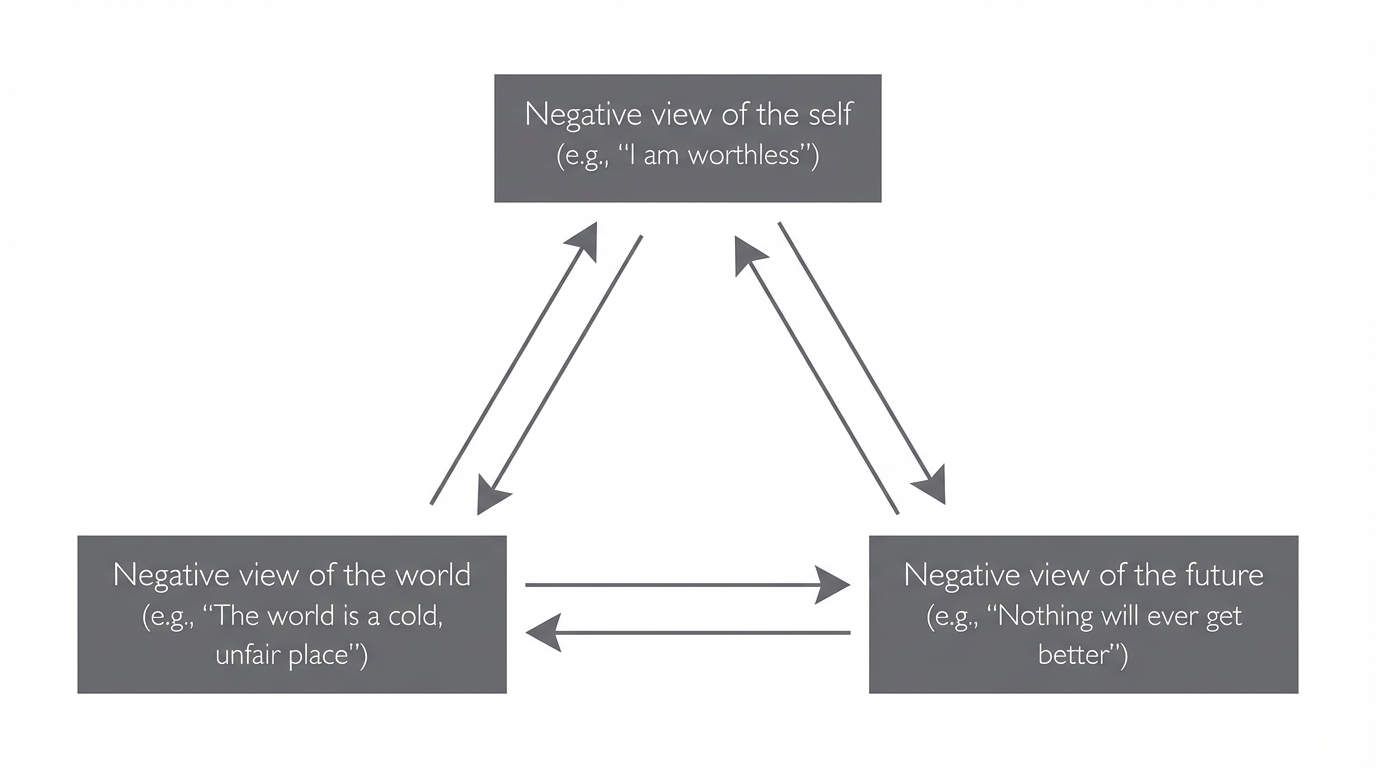
- Negative view of the self — "I am a failure" or "I am worthless." These thoughts erode self-esteem and confirm existing feelings of inadequacy.
- Negative view of the world — "The world is a cold, hard place" or "Nobody cares about me." This creates the impression that there is no source of comfort or support.
- Negative view of the future — "Things will never improve" or "There is no point trying." This removes hope, making the person feel trapped in their current state.
These three components feed into each other. A person who believes they are worthless (self) is more likely to interpret the world as hostile (world) and to see no prospect of change (future), which in turn deepens their sense of worthlessness.
Beck's theory argues that depression is maintained by a self-reinforcing cycle of negative thinking — not simply by negative life events. The negative triad (self, world, future), combined with faulty information processing and negative self-schemas, creates a cognitive vulnerability that makes some people more prone to depression than others.
Ellis's ABC Model (AO1)
Albert Ellis (1962), another American psychologist, offered a different cognitive explanation for depression. While Beck focused on self-sustaining patterns of negative thought, Ellis emphasised the role of irrational beliefs triggered by specific events. Ellis defined irrational thoughts not simply as illogical ideas, but as any thoughts that interfere with a person's ability to be happy and free from pain.
ABC Model
Ellis's explanation of how depression and other emotional disorders develop. An activating event (A) triggers an irrational belief (B), which leads to emotional and behavioural consequences (C) such as depression. The model proposes that it is the belief, not the event itself, that causes the emotional response.
Ellis used the ABC model to explain how irrational beliefs lead to depression:
- A — Activating event: A negative life event occurs, such as failing an exam, losing a job, or the end of a relationship.
- B — Belief: The event triggers an irrational belief. Ellis identified several types of irrational thinking, including musturbation (the rigid belief that certain things must be true for one to be happy, e.g. "I must always succeed"), I-can't-stand-it-itis (the belief that it is a catastrophe whenever something goes wrong), and utopianism (the belief that life must always be fair).
- C — Consequence: The irrational belief produces emotional and behavioural consequences, such as depression, anxiety, or withdrawal.
The crucial insight of the ABC model is that the same activating event can lead to very different outcomes depending on the person's beliefs. Two people may both fail the same exam, but only the one who holds the irrational belief "I must always succeed or I am worthless" will become depressed. The other person, who holds the rational belief "Failing is disappointing but I can try again," will feel upset but not develop depression.
Priya has recently been turned down for a promotion at work. Since then, she has become increasingly withdrawn and tearful. She tells her friend, "If I can't even get a promotion after five years, I must be completely useless. I'll never achieve anything." Priya's reaction illustrates Ellis's ABC model: the activating event (A) is being rejected for promotion, her irrational belief (B) is that this single setback means she is "completely useless" and will "never achieve anything" (an example of musturbation and overgeneralisation), and the consequence (C) is her depressed mood and social withdrawal.
Cognitive Behaviour Therapy (AO1)
Cognitive Behaviour Therapy (CBT)
A psychological treatment that combines cognitive techniques (identifying and challenging irrational or negative thoughts) with behavioural techniques (changing maladaptive behaviours, such as avoidance and inactivity). CBT is the most commonly used psychological treatment for depression in the NHS.
The cognitive explanations of depression proposed by Beck and Ellis both lead naturally to a treatment approach: if depression is caused by faulty thinking, then changing that thinking should alleviate the depression. Cognitive behaviour therapy (CBT) is the umbrella term for therapies that combine cognitive techniques (targeting thoughts) with behavioural techniques (targeting actions). CBT is the first-line psychological treatment for depression in the National Health Service.
Beck's Cognitive Therapy
Beck's version of CBT is a direct application of his cognitive theory. The therapist works collaboratively with the client to:
- Identify automatic negative thoughts — The therapist helps the client recognise the negative triad in their own thinking: negative views of themselves, the world, and the future.
- Challenge these thoughts — Once identified, the therapist questions whether the negative thoughts are supported by evidence. For example, if a client says "Nobody likes me," the therapist might ask them to consider specific recent occasions when someone showed them kindness.
- Test beliefs against reality ("client as scientist") — Clients may be given homework tasks, such as keeping a diary recording positive events, occasions when people were kind, or activities they enjoyed. In subsequent sessions, if the client insists that "nothing good ever happens," the therapist can use the diary as concrete counter-evidence. This approach treats the client like a scientist testing hypotheses about the world, rather than simply accepting negative beliefs as facts.
Ellis's Rational Emotive Behaviour Therapy (REBT)
Rational Emotive Behaviour Therapy (REBT)
A form of CBT developed by Albert Ellis that extends the ABC model to ABCDE. The therapist disputes (D) the client's irrational beliefs through vigorous argument, with the intended effect (E) of replacing irrational beliefs with rational ones and alleviating depression.
Ellis extended his ABC model into an ABCDE model, where D stands for dispute and E for effect. The central technique of REBT is to identify and vigorously challenge the client's irrational beliefs. Unlike Beck's more collaborative, Socratic approach, REBT is characterised by direct, vigorous argument between the therapist and client.
Ellis identified different methods of disputing irrational beliefs:
- Logical disputing — Does the belief logically follow from the facts? (e.g. "Does failing one exam logically mean you are a complete failure?")
- Empirical disputing — Is there actual evidence to support the belief? (e.g. "Where is the evidence that everyone dislikes you?")
- Pragmatic disputing — Is the belief helpful or practical? (e.g. "Is believing you will never succeed helping you to feel better or take action?")
Behavioural Activation
Both forms of CBT include a behavioural component. As people become depressed, they tend to withdraw from activities and become increasingly isolated, which maintains and worsens their symptoms. Behavioural activation involves gradually re-engaging the client in enjoyable and meaningful activities — such as exercising, socialising, or pursuing hobbies — to break the cycle of avoidance and provide evidence that counters their negative beliefs. If a client believes "I never enjoy anything," successfully engaging in a pleasant activity provides direct counter-evidence.
Evidence and Research Support (AO1/AO3)
Several key studies provide evidence for the cognitive approach to depression and the effectiveness of CBT.
Clark and Beck (1999) — Conducted a review of research into cognitive vulnerability and depression. They concluded that cognitive vulnerabilities (faulty information processing, negative self-schemas, and the negative triad) were not only more common in depressed people but actually preceded the depression, supporting Beck's claim that negative thinking is a cause rather than simply a symptom of depression.
Cohen et al. (2019) — Carried out a prospective longitudinal study tracking the development of 473 adolescents, regularly measuring their cognitive vulnerability. They found that showing cognitive vulnerability at earlier time points predicted later depression. This is important because prospective designs are stronger evidence for causation than cross-sectional studies — the cognitive vulnerability was measured before the depression developed, making it unlikely that the depression caused the negative thinking.
March et al. (2007) — Compared three treatment conditions in a sample of 327 depressed adolescents over 36 weeks: CBT alone, antidepressant drugs alone, and CBT combined with antidepressants. The improvement rates were 81% for CBT alone, 81% for antidepressants alone, and 86% for the combination. This demonstrated that CBT is as effective as medication and that the combination of both treatments produces the best outcomes.
Ali et al. (2017) — Assessed depression in 439 clients every month for 12 months following a course of CBT. They found that 42% relapsed within six months and 53% relapsed within a year, raising concerns about the long-term effectiveness of CBT.
James has been feeling low for several months. His therapist asks him to keep a "positive events diary" for the next week, recording any time someone is kind to him or he enjoys something. When James returns saying "nobody cares about me," his therapist shows him the diary, which lists three occasions when colleagues invited him to lunch and one evening when he enjoyed playing football. This illustrates Beck's cognitive therapy technique of treating the "client as scientist" — using real-world evidence to challenge and disprove the client's negative automatic thoughts.
Evaluation Bank (AO3)
Strength: Beck's cognitive theory is supported by strong research evidence demonstrating that cognitive vulnerability precedes depression, rather than merely accompanying it. Cohen et al. (2019) used a prospective longitudinal design to track 473 adolescents over time, measuring cognitive vulnerability at regular intervals. They found that higher cognitive vulnerability at earlier time points predicted the later development of depression. Because this was a prospective study — cognitive vulnerability was measured before the depression emerged — it provides stronger evidence for a causal relationship than cross-sectional research, which can only show correlation. This supports Beck's claim that negative thinking patterns are a genuine cause of depression, not simply a symptom of it, increasing the validity of the cognitive explanation. Furthermore, Clark and Beck (1999) confirmed in a review that cognitive vulnerabilities are more common in depressed individuals and precede the onset of depression, meaning the theory has both explanatory and predictive value in clinical practice.
Limitation: Ellis's ABC model can only explain reactive depression (depression triggered by identifiable life events) and struggles to account for endogenous depression (depression that arises without an obvious external cause). The ABC model requires an activating event (A) to trigger the irrational belief (B), but many individuals develop depression without any clear precipitating event. Additionally, some symptoms of depression — such as extreme anger, hallucinations, and delusions — are not easily explained by cognitive distortions alone. This suggests that the cognitive approach provides only a partial explanation for depression and that biological factors (such as neurotransmitter imbalances) or other psychological mechanisms may also play a significant role. This links to the reductionism vs holism debate: the cognitive approach may be criticised as reductionist because it reduces a complex disorder to faulty thinking patterns, potentially overlooking biological, social, and emotional dimensions of the condition.
Limitation: Although CBT is effective in the short term, there are concerns about its long-term effectiveness and high relapse rates. Ali et al. (2017) found that 53% of 439 clients relapsed into depression within 12 months of completing CBT. This suggests that while CBT successfully addresses the symptoms of depression by challenging negative thoughts, it may not resolve the underlying vulnerability to depression. This is a practical concern because it means that many clients will need repeated courses of treatment, increasing costs to healthcare services and raising questions about whether CBT produces lasting cognitive change or merely temporary symptom relief. This links to the broader debate about free will vs determinism: while CBT is built on the assumption that clients can learn to choose rational thoughts over irrational ones (supporting free will), the high relapse rate might suggest that depressive thinking patterns are more deeply rooted — perhaps in biology or early experience — than the cognitive approach assumes, limiting the individual's ability to simply "think their way out" of depression.