1.1.4 Resistance to Social Influence
Not everyone yields to social pressure. In Milgram's baseline obedience study, 35% of participants refused to deliver the maximum shock. In Asch's line-judging experiments, the most common response on any given trial was not to conform. So what allows some individuals to stand firm while others give in? This lesson examines two explanations for resistance to social influence: social support (a situational factor — whether someone else is also resisting) and locus of control (a dispositional factor — a personality dimension that affects how people respond to pressure). You need to understand both explanations, the research evidence behind each, and their respective strengths and limitations.
Social Support — Resisting Conformity (AO1)
Social support
The presence of people who resist pressures to conform or obey. These individuals act as models of independent behaviour, demonstrating that resistance to social influence is possible and freeing others to follow their own conscience.
Social support is a situational factor — whether a person resists depends not on their personality but on whether another person in the situation is already resisting. When someone else breaks away from the majority, they provide support for anyone who privately disagrees but feels unable to speak up on their own.
Asch's research demonstrated this clearly. In his original line-judging study (a laboratory experiment), conformity was roughly 33% across critical trials. However, when one confederate gave the correct answer instead of going along with the incorrect majority, conformity among genuine participants dropped to approximately one quarter of its original level. Crucially, the dissenter did not even need to give the right answer — simply breaking the unanimity of the group was sufficient to free the participant.
Two psychological mechanisms explain why social support reduces conformity:
- Informational social influence (ISI): The dissenter provides an alternative source of information, increasing the participant's confidence that their own perception is correct.
- Normative social influence (NSI): The dissenter demonstrates that disagreeing with the majority is socially acceptable, reducing the participant's fear of rejection or ridicule.
In both cases, the dissenting person acts as a model of independent behaviour. Their presence signals that dissent is possible, which is often all a person needs to trust their own judgement.
Social Support — Resisting Obedience (AO1)
Social support does not only help people resist conformity — it also helps them resist pressure from authority figures. In one of Milgram's variations (a laboratory experiment), the genuine participant was joined by two confederates who refused to continue administering shocks. The obedience rate dropped dramatically from 65% to just 10%. The disobedient confederates served as models of defiance, making it psychologically easier for the genuine participant to refuse.
The disobedient models work by:
- Breaking the authority figure's power — demonstrating that disobedience is possible without immediate punishment.
- Creating a social norm of defiance — the participant no longer feels they are the only one who wants to stop.
- Freeing the participant's moral judgement — rather than deferring to the experimenter, the participant can act on their own conscience.
Gamson, Fireman and Rytina (1982) — Asked participants, working in groups, to produce evidence that would help an oil company run a smear campaign against a former employee. Because participants were in groups, they were able to discuss what they were being asked to do and support one another in refusing. 29 out of 33 groups (88%) rebelled against their instructions. This was a far higher rate of resistance than Milgram found with isolated individuals, demonstrating that social support within a group setting makes disobedience significantly more likely. This study used a field experiment design, increasing its ecological validity compared with laboratory obedience studies.
Marcus has just started working at a café. His manager regularly instructs the staff to overcharge tourists by adding items to their bills. Marcus feels deeply uncomfortable about this but notices that every other employee seems to comply without question. One afternoon, a colleague named Leah openly tells the manager she will not add false charges because it is dishonest. After witnessing Leah's refusal, Marcus also decides to tell the manager he will not overcharge customers.
Leah's behaviour in this scenario illustrates how social support operates: her open refusal acted as a model of independent behaviour, breaking the unanimity of the group's compliance and giving Marcus the confidence to act on his own moral judgement.
Locus of Control (AO1)
Locus of control (LOC)
A concept proposed by Julian Rotter (1966) referring to a person's sense of what directs events in their lives. It exists on a continuum from high internal LOC (believing you are responsible for your own outcomes through effort and decisions) to high external LOC (believing outcomes are controlled by luck, fate, or powerful others).
While social support is a situational explanation, locus of control (LOC) is a dispositional factor — it relates to a relatively stable aspect of personality that influences how people respond to social pressure.
Rotter (1966) proposed that individuals differ in the extent to which they believe they have personal control over what happens to them. Those with a high internal LOC believe their own decisions and effort determine outcomes. Those with a high external LOC believe that luck, fate, or outside forces are primarily responsible.
| Internal LOC | External LOC |
|---|---|
| "I did well because I worked hard." | "I did well because I was lucky." |
| "I failed because I didn't prepare enough." | "I failed because the questions were unfair." |
| Takes personal responsibility for outcomes | Attributes outcomes to forces beyond their control |
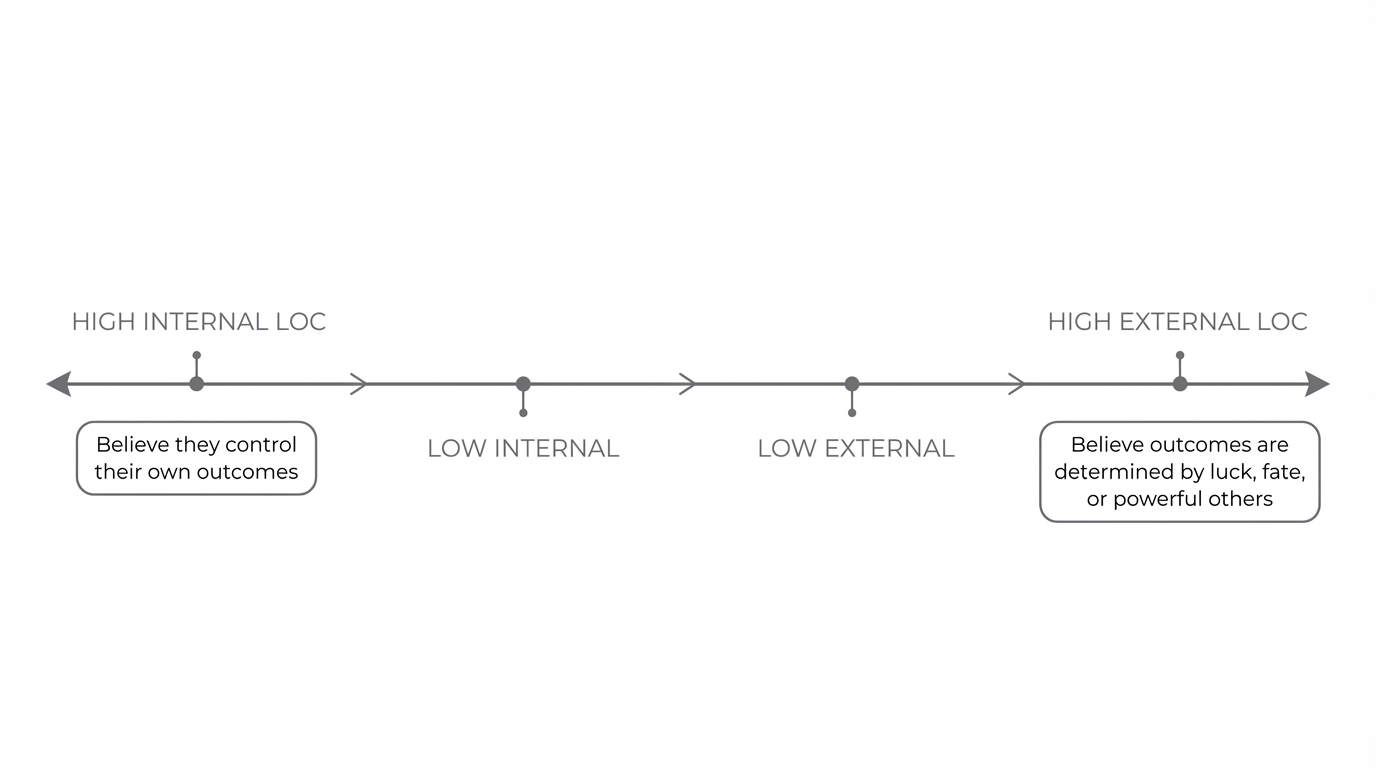
LOC is a continuum, not an either/or category. People are not simply "internals" or "externals" — they fall somewhere along the scale. Most people sit between the two extremes.
Why internals are more resistant to social influence:
- They take personal responsibility for their actions, so they tend to base decisions on their own beliefs and moral code rather than relying on others.
- Research in this area suggests they tend to be more self-confident and achievement-oriented, traits associated with independent thinking.
- They have less need for social approval, making them less susceptible to normative social influence.
- They are more likely to be leaders rather than followers.
By contrast, people with a high external LOC believe events are largely beyond their control. This makes them more willing to defer to others, to act on behalf of authority figures, and to shift responsibility onto external agents. They are therefore more susceptible to both conformity and obedience pressures.
Research Evidence (AO1/AO3)
Evidence for social support
Allen and Levine (1971) — Replicated Asch's line-judging task in a laboratory experiment with a key manipulation: the dissenting confederate either appeared to have good eyesight or wore very thick glasses (implying poor vision and therefore low credibility on a visual task). When the dissenter appeared to have good eyesight, 64% of genuine participants resisted conformity. When there was no supporter at all, only 3% resisted. Even when the dissenter wore thick glasses, resistance was still 36% — lower than with a credible supporter, but far higher than with no support at all. This demonstrates that social support is effective, but its impact partly depends on the perceived credibility of the supporter.
Albrecht et al. (2006) — Evaluated "Teen Fresh Start USA," an eight-week programme designed to help pregnant adolescents aged 14–19 resist peer pressure to smoke, using a quasi-experiment with a treatment group and a control group. Social support was provided by a slightly older mentor or "buddy." At the end of the programme, adolescents who had a buddy were significantly less likely to smoke than a control group without one. This demonstrates that social support can be effective in real-world interventions, not just laboratory studies, providing evidence for its ecological validity.
Evidence for locus of control
Holland (1967) — Repeated Milgram's baseline obedience study in a laboratory experiment and measured participants' locus of control. Found that 37% of internals did not continue to the highest shock level (i.e. they showed resistance), compared with only 23% of externals. This supports the claim that having an internal LOC is associated with greater resistance to authority.
Avtgis (1998) — Conducted a meta-analysis of studies examining the relationship between LOC and conformity. Found that participants who scored highest on external LOC were more easily persuaded and more likely to conform. Because a meta-analysis synthesises findings from multiple studies, this provides broad and reliable support for the link between LOC and susceptibility to social influence.
Oliner and Oliner (1988) — Interviewed non-Jewish people who had lived through the Holocaust in a retrospective interview study: 406 who had rescued Jews from the Nazis and 126 who had not. The rescuers scored significantly higher on measures of internal LOC and on measures of social responsibility. This provides powerful real-world evidence linking internal LOC to resistance against an oppressive authority. However, the finding that rescuers also scored higher on social responsibility raises an important question: does LOC alone explain resistance, or is a sense of moral duty equally or more important?
Evaluation Bank (AO3)
The following evaluation paragraphs are structured using the PEEL format (Point–Evidence–Explain–Link) that AQA examiners reward. Each paragraph is exam-ready and can be used directly in a 16-mark essay.
Strength: There is substantial research support for social support as an explanation of resistance to social influence. Allen and Levine (1971) found that having a dissenter in an Asch-type task increased resistance from just 3% to 64%, and Milgram's variation with two disobedient confederates saw obedience fall from 65% to 10%. These findings are further supported by real-world evidence: Gamson, Fireman and Rytina (1982) found that 88% of participant groups resisted orders to produce a smear campaign when they could discuss with peers, and Albrecht et al. (2006) showed that mentor-based social support helped young people resist peer pressure to smoke. This range of evidence — from controlled laboratory experiments to real-world interventions — demonstrates that social support is a well-evidenced and ecologically valid explanation for resistance. The convergence of findings across different research methods strengthens the overall validity of social support as an explanation, suggesting it is not merely a laboratory artefact.
Limitation: Although Holland (1967) found that internals showed greater resistance in a Milgram-type study (37% versus 23% of externals), Twenge et al. (2004) found evidence that contradicts the LOC theory. They analysed American LOC data over a 40-year period (1960–2002) and found that people had become more external over time, yet simultaneously more resistant to obedience. If the LOC theory were correct, we would expect increasing externality to be accompanied by less resistance, not more. This contradictory pattern suggests that LOC may not be a valid or complete explanation for resistance. Broader cultural and historical changes — such as growing awareness of individual rights or increasing distrust of authority — may be more important than personality in determining whether people resist. This links to the nature versus nurture debate: if cultural shifts can override dispositional tendencies, then nurture (environmental and cultural factors) may play a larger role in resistance than the dispositional LOC explanation implies.
Limitation: Rotter (1982) himself argued that locus of control is most influential when a person encounters a new or unfamiliar situation. When someone has previous experience of a specific context — for example, having conformed or obeyed in that setting before — their past behaviour is a stronger predictor of what they will do than their LOC score. An internal who has previously obeyed in a particular workplace setting is likely to obey again in that setting, regardless of their general LOC position. This significantly limits the explanatory power of LOC because many real-life instances of conformity and obedience involve familiar, repeated situations such as the workplace, school, or family dynamics. This connects to the free will versus determinism debate: if past behaviour determines future behaviour regardless of personality, this suggests a more deterministic view of human action and implies that dispositional factors like LOC are less consistent across situations than the theory claims.
The evaluation bank above provides one strength and two limitations. When writing a 16-mark essay on this topic, you could use the strength to evaluate social support and the limitations to evaluate LOC, giving your essay a balanced and critical structure.
To consolidate these two explanations, remember that resistance to social influence involves both the situation a person is in and the kind of person they are. Social support shows that context matters — even someone who would normally conform can resist when given a model of independent behaviour. Locus of control shows that personality matters too — but only up to a point, because previous experience in a specific situation can override dispositional tendencies.
Resistance to social influence is explained by two factors: social support (a situational factor — the presence of dissenters who model independent behaviour, reducing conformity and obedience) and locus of control (a dispositional factor — internals resist more because they take personal responsibility). Both have research support, but each has limitations: the effectiveness of social support depends on the credibility of the supporter, and LOC is most influential in novel situations rather than familiar ones.