1.3.1 Caregiver-Infant Interactions
Attachment does not appear overnight. Before a baby forms a lasting emotional bond with a caregiver, weeks of subtle back-and-forth interaction lay the groundwork. In this lesson you will learn how psychologists describe these early interactions (reciprocity and interactional synchrony), how Schaffer and Emerson mapped the stages through which attachments develop, and what research tells us about multiple attachments and the distinctive role of the father. Understanding these processes is essential for the 16-mark essay on attachment formation and for scenario questions that ask you to explain a baby's behaviour at a particular age.
Part 1 — What Is Attachment?
Attachment
A close two-way emotional bond between two individuals in which each individual sees the other as essential for their own emotional security. In infancy, attachment is characterised by proximity-seeking, separation distress, and secure-base behaviour.
Psychologists identify an attachment by looking for three observable behaviours. First, proximity-seeking — the baby tries to stay physically close to its attachment figure. Second, separation distress — the baby shows visible anxiety (crying, distress) when the attachment figure leaves. Third, secure-base behaviour — even when exploring independently, the baby periodically returns to or checks in with the attachment figure. These behaviours emerge gradually over the first year of life, as the interactions described below become more frequent and more sophisticated.
Part 2 — Reciprocity and Interactional Synchrony (AO1)
Before a specific attachment forms, babies and caregivers engage in two important types of interaction that psychologists believe provide the foundations for later emotional bonds.
Reciprocity
Reciprocity
A form of interaction between caregiver and infant in which both partners respond to each other's signals and each elicits a response from the other, creating a pattern of turn-taking similar to a conversation.
From birth, babies and their caregivers spend time in intense, pleasurable interaction. When one partner acts, the other responds, and that response in turn prompts a further action — much like a conversation in which people take turns. Brazelton et al. (1975) described this mutual responsiveness as a "dance" in which each partner adjusts their movements to match the other.
Babies are not passive recipients of care. They have periodic alert phases — short windows in which they signal readiness for interaction, for example by making eye contact. Research by Feldman and Eidelman (2007) shows that skilled mothers pick up on and respond to these alert phases approximately two-thirds of the time, although this rate varies with the mother's experience and with external stressors such as financial pressure or lack of social support (Finegood et al. 2016). From around three months, reciprocal interactions become more frequent as both caregiver and baby pay closer attention to each other's facial expressions and vocal signals (Feldman 2007).
Reciprocity matters because it teaches the baby the basic structure of communication — that social interaction involves responding to another person's cues. It also enables caregivers to detect the baby's needs more quickly and respond to them more effectively.
Interactional synchrony
Interactional Synchrony
A form of caregiver-infant interaction in which the caregiver and baby coordinate their actions and emotions so that they mirror each other simultaneously, reflecting what Feldman (2007) called "the temporal co-ordination of micro-level social behaviour."
Where reciprocity involves turn-taking, interactional synchrony involves doing the same thing at the same time. Caregiver and baby mirror each other's facial expressions, gestures, and emotional states in a coordinated way.
Meltzoff and Moore (1977) — In a controlled observation, an adult displayed one of three facial expressions or one of three distinctive hand gestures to babies as young as two weeks old. Each baby's response was filmed and independently coded by observers who did not know which expression or gesture the adult had shown. The babies were significantly more likely to produce the matching expression or gesture than would be expected by chance alone. This laboratory experiment provided early evidence that interactional synchrony begins in the first weeks of life.
Isabella et al. (1989) — Observed 30 mother-infant pairs and assessed both the degree of interactional synchrony and the quality of the attachment that later developed. Mothers and babies who achieved higher levels of synchrony went on to develop better-quality attachments, characterised by greater emotional intensity. This correlational finding suggests that synchrony is not just a curious behaviour but plays a functional role in the formation of secure attachments.
When Priya's 3-month-old daughter Amara enters an alert phase and makes eye contact, Priya instinctively leans in, smiles, and speaks softly. Amara responds by smiling back and waving her arms. This back-and-forth exchange — where each partner's action triggers a response from the other — is an example of reciprocity. The moments when Priya and Amara simultaneously smile at each other represent interactional synchrony.
It is worth noting that most research on reciprocity and interactional synchrony uses controlled observations, often filmed in laboratory settings. This is a methodological strength because filming allows researchers to replay and analyse interactions in fine detail, and multiple observers can independently code the same footage to establish inter-rater reliability. Furthermore, babies are generally unaware that they are being observed, so their behaviour is unlikely to be affected by the presence of a camera.
Part 3 — Schaffer's Stages of Attachment (AO1)
Understanding when and how attachments form is central to this topic. The most important study here is the longitudinal investigation by Rudolf Schaffer and Peggy Emerson, which produced a four-stage model of attachment development.
Schaffer and Emerson (1964) — Studied 60 babies (31 boys, 29 girls) from predominantly skilled working-class families in Glasgow. This was a longitudinal study: researchers visited babies and their mothers in their own homes every month for the first year and again at 18 months. At each visit, mothers were interviewed about the kind of protest their baby showed in seven everyday separation situations (e.g. the adult leaving the room), which served as a measure of separation anxiety. The researchers also directly assessed stranger anxiety — the baby's distress response to an unfamiliar person. From their data, Schaffer and Emerson identified four distinct stages through which all babies appeared to progress.
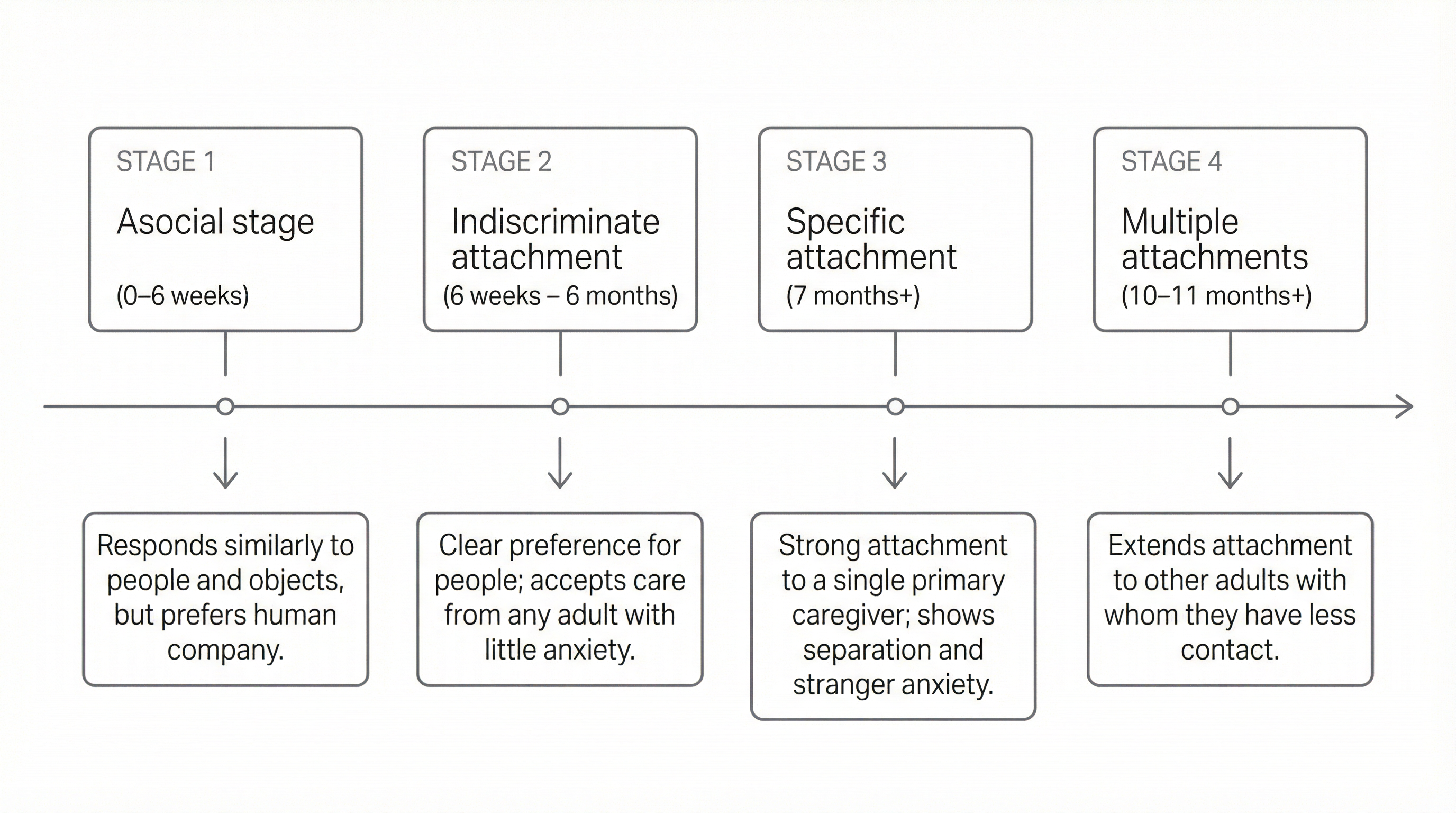
Stage 1 — Asocial stage (birth to approximately 6 weeks)
The baby responds to objects and people in a broadly similar way, though it does show some preference for faces and eyes. Even at this stage babies prefer the company of people to being alone, and they are more easily soothed by familiar individuals. The term "asocial" does not mean the baby is antisocial — it means that clear social preferences are not yet reliably observable.
Stage 2 — Indiscriminate attachment (approximately 6 weeks to 7 months)
The baby now shows a clear preference for human company over inanimate objects and can distinguish familiar from unfamiliar people. However, it does not yet show anxiety when separated from a specific caregiver, nor does it display distress in the presence of strangers. It can be comforted by anyone — hence the term "indiscriminate."
Stage 3 — Specific attachment (from approximately 7 months)
The baby begins to show the classic signs of attachment — separation anxiety when the primary attachment figure leaves and stranger anxiety when an unfamiliar person is present, especially if the attachment figure is absent. The person to whom this first specific attachment is directed is called the primary attachment figure. Schaffer and Emerson found that this figure was the mother in about 65% of cases. Crucially, the primary attachment figure is not necessarily the person who spends the most time with the baby, but the person who is most sensitively responsive — who reads and responds to the baby's signals most skilfully and who engages in the most interaction.
Stage 4 — Multiple attachments (from approximately 10–11 months)
Shortly after forming a specific attachment, most babies extend attachment behaviours to other people with whom they spend regular time. These are called secondary attachments. Schaffer and Emerson found that 29% of babies formed a secondary attachment within one month of forming their primary attachment, and by 18 months the majority of babies had developed multiple attachments — to fathers, siblings, grandparents, and other regular caregivers. These secondary attachments varied considerably in strength.
Multiple Attachments
Attachments to two or more people. Most babies develop multiple attachments once they have formed one initial specific (primary) attachment, typically extending attachment behaviours to fathers, grandparents, siblings, and other regular caregivers.
A key finding from Schaffer and Emerson was that the person the baby attached to most strongly was not always the person who spent the most time with them. Instead, the quality of the interaction mattered more than the quantity. A caregiver who played with, talked to, and responded sensitively to the baby was more likely to become the primary attachment figure than one who simply fed and changed them.
Attachment is not simply about who feeds the baby. Schaffer and Emerson found that sensitive responsiveness — the quality of interaction — predicted attachment strength more strongly than the quantity of time spent together.
Now that you understand Schaffer's stages, try applying them to a realistic scenario — this is exactly the kind of question that appears in AQA exams.
Part 4 — The Role of the Father (AO1/AO3)
In attachment research, "the father" refers to the main male caregiver — not necessarily the biological father. Research into the father's role addresses several overlapping questions: Do babies attach to their fathers? Is this attachment different from the one they form with mothers? Can fathers serve as primary attachment figures?
Do babies attach to fathers?
Schaffer and Emerson (1964) found that in only 3% of cases was the father the sole first attachment figure. In 27% of cases the father was a joint first attachment figure alongside the mother. However, by 18 months 75% of babies had formed an attachment to their father, evidenced by separation anxiety when the father left. The father is therefore very likely to become an important attachment figure, but rarely the first one.
A distinctive role: play and stimulation
Grossmann et al. (2002) — Conducted a longitudinal study following babies into their teenage years. They examined the relationship between the quality of early attachment to each parent and the quality of the child's later adolescent attachments. The quality of attachment to the mother (but not the father) predicted the quality of teenage attachments. However, the quality of the father's play with the baby was significantly related to the quality of adolescent attachments. Grossmann et al. concluded that fathers have a different role from mothers — one centred on play and stimulation rather than emotional nurturing.
Fathers as primary attachment figures
Field (1978) — Filmed 4-month-old babies in face-to-face interactions with three groups: primary caregiver mothers, secondary caregiver fathers, and primary caregiver fathers. The primary caregiver fathers behaved more like the primary caregiver mothers than like the secondary caregiver fathers — they spent more time smiling at, imitating, and holding their babies. These are exactly the behaviours associated with reciprocity and interactional synchrony. Field concluded that fathers can adopt the sensitive, emotionally responsive caregiving style usually associated with mothers, but they tend to do so only when placed in the primary caregiver role.
Evidence from diverse family structures
MacCallum and Golombok (2004) — Studied children growing up in single-mother and lesbian-parent families and compared them with children in two-parent heterosexual families. They found no significant differences in the children's social or emotional development. If the father played an essential and irreplaceable role in attachment, we would expect children without a father figure to show developmental differences — the absence of such differences suggests that families can adapt to fill the role fathers typically play.
Tom is a stay-at-home father who has been the primary caregiver for his 5-month-old son, Leo, since birth. Tom's partner, Sarah, works full-time but makes time to play energetically with Leo each evening. Field's research suggests that Tom, as the primary caregiver, is likely to display the sensitive, emotionally responsive behaviours typically associated with mothers — such as imitating Leo's expressions and responding to his signals. Meanwhile, Sarah may naturally adopt the more play-oriented role that Grossmann's research associates with the secondary attachment figure.
The research on fathers highlights an important distinction: the role a parent plays in attachment may depend less on their gender and more on whether they occupy the primary or secondary caregiver position. This challenges traditional assumptions about parenting roles.
Evaluation Bank (AO3)
Strength: Research into caregiver-infant interactions benefits from strong methodology because studies typically use controlled observations filmed in laboratory settings. Meltzoff and Moore (1977), for example, filmed babies' responses and had them independently coded by observers who were unaware of which adult expression had been displayed, reducing the risk of observer bias. Filmed observations allow footage to be replayed, fine-grained behaviours to be analysed in detail, and inter-rater reliability to be established by comparing independent coders' judgements. Furthermore, very young babies are unaware they are being filmed, so their behaviour is unlikely to be affected by the observation process — a problem that typically undermines overt observational studies with older participants. This means we can be relatively confident that the patterns of reciprocity and interactional synchrony identified in this research are genuine, reliable phenomena rather than artefacts of the research process.
Limitation: A significant weakness of Schaffer and Emerson's (1964) study is its limited generalisability. All 60 babies were from one district of Glasgow and predominantly from skilled working-class families during the 1960s. Child-rearing practices have changed considerably since then — for example, fathers now take a more active caregiving role than was typical in the 1960s, partly influenced by attachment research itself. Additionally, the stages may not apply universally across cultures: in collectivist cultures where extended family members share caregiving from birth, multiple attachments may form much earlier than Schaffer's model predicts (van IJzendoorn 1993). The study also relied on mothers as the primary data collectors, asking them to keep diaries of their baby's separation protests. Mothers may have been subject to social desirability bias — underreporting negative interactions or overreporting attachment behaviours they perceived as desirable — and their busy routines may have led to incomplete or inaccurate records. This means the stages should be treated as a useful framework rather than a definitive, universal account of attachment development. This limitation connects to the broader debate about whether psychological research conducted in specific cultural and historical contexts can be generalised to all populations (cultural bias and ethnocentrism).
Limitation: Research into the role of the father produces contradictory conclusions partly because researchers are asking fundamentally different questions. Some studies investigate whether fathers as secondary attachment figures play a distinctive role (Grossmann et al. 2002 concluded they contribute through play and stimulation), while others examine whether fathers can serve as primary attachment figures (Field 1978 showed they can adopt a sensitive caregiving style). If fathers truly had an essential, irreplaceable role, we would expect children in single-mother or lesbian-parent families to develop differently — yet MacCallum and Golombok (2004) found no such differences. One resolution is that fathers do adopt a distinctive role when present, but families without a father can adapt to compensate. However, a deeper problem is that this entire area of research risks gender bias: cultural stereotypes about fathers being "playful" rather than "nurturing" may produce observer bias, leading researchers to see and record behaviours that confirm expectations rather than recording objectively. This means that conclusions about the father's role should be interpreted cautiously, and future research should use blind coding procedures to minimise the influence of gender stereotypes on observational data. This connects to the wider nature versus nurture debate — it remains unclear whether differences in mothers' and fathers' caregiving styles reflect biological predispositions (e.g. hormonal differences such as higher oestrogen levels in women) or socially constructed gender roles.