1.3.6 Influence of Early Attachment on Relationships
Bowlby's theory of attachment does not end at infancy. One of its most significant claims is that the bond formed between a baby and their primary caregiver casts a long shadow over every relationship that follows — from playground friendships to adult romance and even the way a person parents their own children. In this lesson you will learn how the internal working model acts as a mental blueprint for relationships, examine the research evidence linking early attachment type to the quality of later relationships, and evaluate whether this continuity is as inevitable as Bowlby suggested.
Part 1 — The Internal Working Model
Internal Working Model
A mental representation or schema of the relationship between a baby and their primary attachment figure, which acts as a template for what to expect from future relationships. It contains a model of the self (am I lovable?) and a model of others (are other people trustworthy and reliable?).
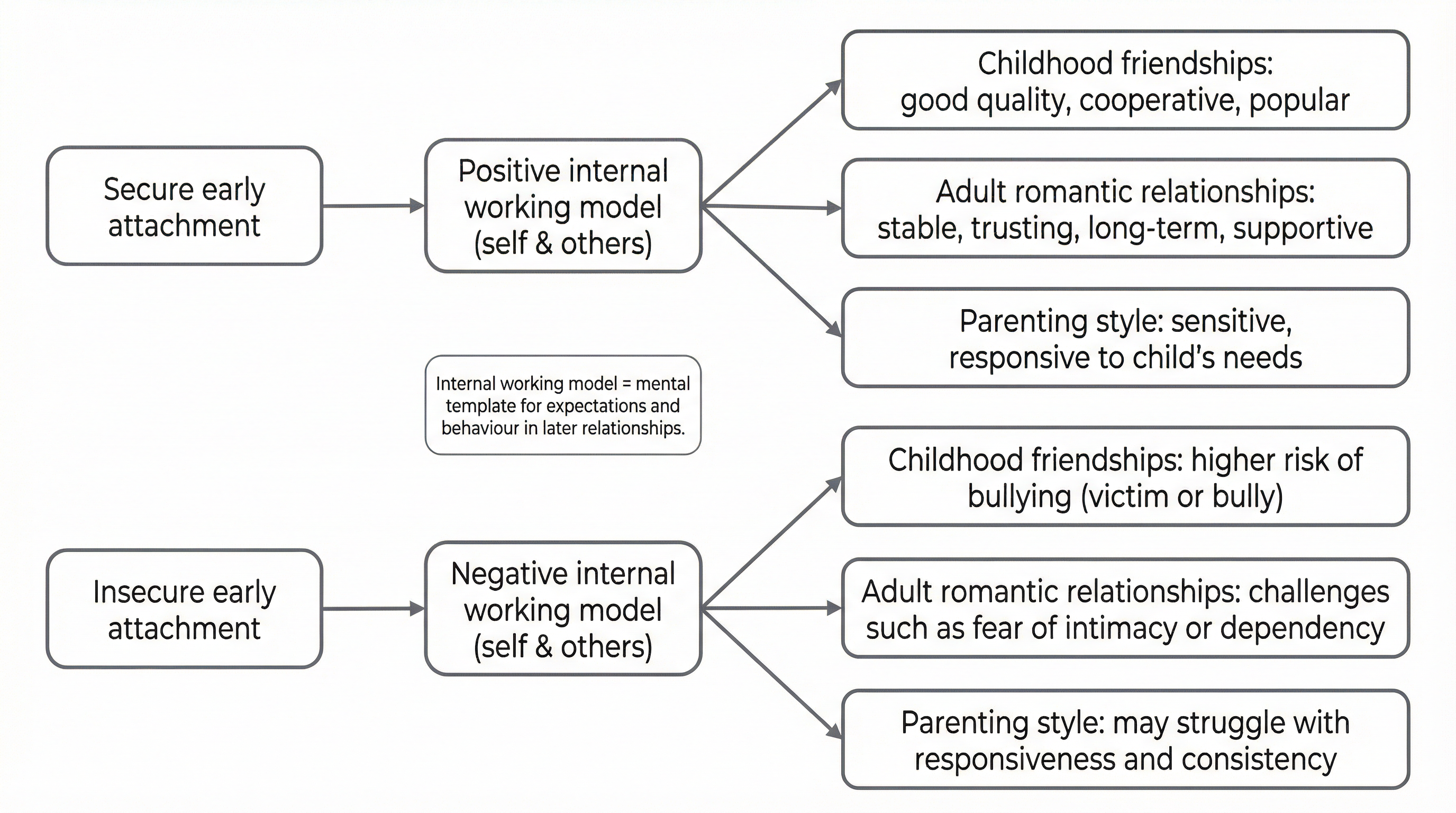
John Bowlby (1969) proposed that a baby's first attachment relationship creates an internal working model (IWM) — a cognitive framework that shapes expectations about how relationships work. This model has two components: a model of the self (whether the child sees themselves as worthy of love) and a model of others (whether other people are seen as trustworthy, responsive, and reliable). A securely attached baby, whose caregiver has been consistently warm and responsive, develops a positive internal working model — they come to see themselves as lovable and others as dependable. An insecurely attached baby, by contrast, may develop a negative model of the self, of others, or of both.
The internal working model is not simply a passive memory of early experiences. It actively guides behaviour in new relationships by shaping expectations. A child who has learned that their caregiver responds when they are distressed will approach new social situations with confidence and trust. A child whose early experiences taught them that others are unreliable or rejecting will carry that expectation forward, approaching relationships with anxiety, avoidance, or both.
Continuity Hypothesis
The idea proposed by Bowlby that there is a consistent link between early attachment type and the quality of later childhood and adult relationships, because the internal working model created in infancy carries forward throughout life.
Bowlby termed this the continuity hypothesis — the prediction that the type of attachment formed in infancy will be reflected in the quality and style of relationships throughout the lifespan. This is one of the most influential and debated claims in developmental psychology, because it implies that experiences in the first year or two of life set the trajectory for all future social and emotional development.
Part 2 — Influence on Childhood Relationships
The internal working model begins to exert its influence well before adulthood. Research has shown that attachment type in infancy predicts the quality of peer relationships in childhood, including friendships and involvement in bullying.
Kerns (1994) found that securely attached babies tended to go on to form the best-quality childhood friendships, whereas insecurely attached babies experienced greater difficulty in peer relationships. This is consistent with the continuity hypothesis: a child whose internal working model includes a positive view of the self and trust in others is better equipped to navigate the reciprocal give-and-take that friendship demands.
The link between attachment and childhood relationships extends to bullying behaviour. Myron-Wilson and Smith (1998) used standard questionnaires to assess attachment type and bullying involvement in 196 children aged 7–11 from London schools. They found that securely attached children were very unlikely to be involved in bullying in any role. Insecure-avoidant children were the most likely to be victims of bullying, while insecure-resistant children were the most likely to be bullies. This pattern makes psychological sense when understood through the lens of internal working models: insecure-avoidant children, whose model of the self is negative ("I am not worthy of care"), may be less assertive and more vulnerable to victimisation. Insecure-resistant children, whose model of others is negative ("Others cannot be trusted to meet my needs"), may use aggression and control as strategies for managing social relationships — precisely the pattern associated with bullying.
Leah is seven years old and has recently started at a new school. Her teachers notice that she finds it very difficult to make friends — she tends to hover on the edge of groups at playtime rather than joining in, and she becomes very distressed if another child is unkind to her. Leah's mother mentions at a parents' evening that Leah was "always a clingy baby" and that she herself found the early years exhausting and sometimes struggled to be emotionally available. A psychologist might suggest that Leah's early insecure attachment led to an internal working model in which she sees herself as unworthy of care and others as potentially rejecting, making it difficult for her to confidently initiate and maintain friendships.
Part 3 — Influence on Adult Romantic Relationships
The continuity hypothesis predicts that early attachment type should be reflected in the quality of romantic relationships in adulthood. This is one of the most heavily researched areas in attachment theory, and several key studies provide evidence for this link.
Hazan and Shaver (1987) conducted a landmark study of the relationship between attachment type and adult romantic experiences. They published a "Love Quiz" in a local American newspaper and analysed 620 responses. The quiz assessed respondents' current or most significant romantic relationship, their general love experiences (including the number of partners), and their attachment type — determined by asking respondents to choose which of three descriptions best matched their feelings about close relationships. This was a self-report study using a questionnaire method. The findings revealed that 56% of respondents were classified as securely attached, 25% as insecure-avoidant, and 19% as insecure-resistant. Securely attached respondents reported the happiest, most trusting, and longest-lasting romantic relationships. Insecure-avoidant respondents were characterised by a fear of intimacy. Insecure-resistant respondents reported jealousy, intense emotional highs and lows, and a preoccupation with their partner. Hazan and Shaver concluded that patterns of attachment established in infancy are reflected in the style and quality of adult romantic relationships, supporting Bowlby's continuity hypothesis.
McCarthy (1999) took a different approach by studying 40 adult women who had been assessed for attachment type as babies. Those who had been classified as securely attached in infancy had the best-quality adult friendships and romantic relationships. Women who had been classified as insecure-resistant as babies had particular problems maintaining friendships, while those classified as insecure-avoidant struggled specifically with intimacy in romantic relationships. Because attachment was assessed in infancy rather than retrospectively, this study avoids some of the methodological problems that affect Hazan and Shaver's work.
Simpson et al. (2007) conducted a longitudinal study as part of the Minnesota Longitudinal Study of Risk and Adaptation, following participants at four key developmental points: infancy, early childhood, adolescence, and adulthood. Attachment types and the quality of romantic relationships were assessed at different stages. They found that individuals who had been securely attached as infants were rated as more socially competent in childhood, were closer to their friends in adolescence, and were more expressive and emotionally connected in their adult romantic relationships. This longitudinal design provides some of the strongest evidence for the continuity hypothesis because it tracks the same individuals across their lifespan, demonstrating that the quality of emotional expression in adult romantic relationships can be traced back to early attachment experiences.
Part 4 — Influence on Parenting and Intergenerational Transmission
The internal working model does not only shape friendships and romantic partnerships — it also affects how a person parents their own children, creating an intergenerational pattern of attachment. Because the IWM contains a template of what a "normal" caregiving relationship looks like, adults tend to unconsciously reproduce the parenting style they themselves experienced. A parent who was raised by a warm, sensitive caregiver is likely to be warm and sensitive in return; a parent whose own attachment figure was neglectful or inconsistent may struggle to provide the responsiveness that fosters secure attachment in their baby.
Bailey et al. (2007) investigated this intergenerational transmission directly. They assessed the attachments of 99 mothers in two directions: to their own babies (using the Strange Situation) and to their own mothers (using the Adult Attachment Interview, a structured clinical interview that assesses a person's state of mind with respect to attachment). The majority of women had the same attachment classification in both relationships — that is, the attachment style they had with their own mother was mirrored in the attachment they formed with their baby. This provides strong evidence for the continuity hypothesis and for the idea that the internal working model is transmitted across generations. It suggests that attachment quality is self-perpetuating: securely attached mothers tend to raise securely attached children, while insecurely attached mothers are more likely to have insecurely attached children.
The internal working model created in the first attachment relationship does not just affect the individual — it can be passed down across generations, because parents unconsciously base their caregiving style on their own early experiences of being cared for.
Evaluation Bank (AO3)
Strength: There is substantial research support for the link between early attachment and the quality of later relationships. Hazan and Shaver (1987) found that securely attached adults had the happiest and longest-lasting romantic relationships, McCarthy (1999) demonstrated that attachment type assessed in infancy predicted the quality of adult friendships and romantic relationships, and Simpson et al. (2007) tracked individuals from infancy to adulthood and found that secure attachment predicted greater emotional expressiveness in adult romance. Fearon and Roisman (2017) reviewed the accumulated evidence and concluded that early attachment consistently predicts later attachment quality, emotional well-being, and attachment to one's own children. This convergence of evidence from cross-sectional, retrospective, and longitudinal designs strengthens confidence in Bowlby's continuity hypothesis because the same pattern emerges regardless of the method used. This is important because it suggests that early intervention to promote secure attachment could have lasting positive effects on an individual's social and emotional development across the lifespan.
Limitation: A major methodological weakness of much research in this area is that early attachment is often assessed retrospectively rather than measured directly in infancy. In studies such as Hazan and Shaver (1987), adult participants classified their current attachment style from brief self-report descriptions, so infant attachment was not measured directly. This raises two validity problems. First, adults may not accurately recall or honestly report their early attachment experiences, making the data unreliable. Second, it becomes difficult to determine whether the study is actually measuring early attachment or simply current attachment style — if someone is currently unhappy in relationships, they may interpret their childhood more negatively. The Regensburg longitudinal study (Becker-Stoll et al., 2008) followed 43 individuals from age one and found no evidence of continuity between infant attachment type and attachment assessed at age 16 using the Adult Attachment Interview. This suggests that when early attachment is measured properly in infancy and followed up longitudinally, the continuity predicted by Bowlby may not always hold, meaning that retrospective studies may overestimate the strength of the link. This relates to the broader methodological debate in psychology about the validity of self-report data versus observational measurement.
Limitation: The continuity hypothesis is criticised for being overly deterministic, as it implies that a baby who forms an insecure attachment is destined to experience poor-quality relationships throughout their life. This leaves little room for free will or the possibility of change. Clarke and Clarke (1998) argued that the influence of early attachment is probabilistic rather than deterministic — insecure attachment increases the risk of later relationship difficulties but does not guarantee them. Many insecurely attached children grow up to have happy, fulfilling relationships, suggesting that other factors — such as later positive experiences, personal resilience, or therapeutic intervention — can override the influence of the internal working model. Furthermore, Kagan's temperament hypothesis offers an alternative explanation, proposing that innate, biologically determined personality traits (rather than early attachment experiences) are the primary influence on relationship quality. If temperament is the key factor, then the correlation between early attachment and later relationships may be spurious — both could be driven by the child's innate temperament rather than one causing the other. This debate connects directly to the nature-nurture issue and the question of whether early experience (nurture) or biological disposition (nature) has the greater influence on social development, as well as the free will-determinism debate about whether individuals can overcome early disadvantage.