2.1.4 The Cognitive Approach
The cognitive approach represents a fundamental shift in how psychologists study the mind. Emerging in the 1950s as a direct challenge to behaviourism — which dismissed internal mental processes as unscientific — cognitive psychologists argued that what goes on inside the mind not only matters, but can be studied objectively. In this lesson you will learn how cognitive psychologists study internal mental processes through inference, how schemas shape our thinking, how theoretical and computer models provide frameworks for understanding the mind, and how the emergence of cognitive neuroscience has given us the tools to observe brain activity directly. This is one of the core approaches you need to know for Paper 2, and it underpins many topics across the specification, including memory, psychopathology, and forensic psychology.
Part 1 — Internal Mental Processes and the Role of Inference
Cognitive Approach
An approach in psychology focused on how internal mental processes — such as perception, memory, thinking, and attention — affect behaviour. It assumes these processes can be studied scientifically.
The central assumption of the cognitive approach is that internal mental processes can and should be studied scientifically. This placed it in direct opposition to the behaviourist approach, which argued that only directly observable behaviour was worthy of investigation. Cognitive psychologists study areas that behaviourists ignored entirely — memory, perception, attention, and language — and insist that understanding these processes is essential for explaining human behaviour.
Internal Mental Processes
Private cognitive operations — such as perception, attention, and memory — that mediate between a stimulus and a response. They cannot be directly observed but can be studied indirectly.
The difficulty, of course, is that internal mental processes are private. Nobody can directly observe what happens inside another person's mind. Cognitive psychologists therefore rely on inference — drawing conclusions about how mental processes work on the basis of observable behaviour. For example, if a participant recalls more words from the beginning and end of a list than from the middle (the serial position effect), cognitive psychologists infer that different memory stores must be operating. The behaviour is observed directly; the underlying mental processes are inferred from it.
Inference
The process by which cognitive psychologists draw conclusions about how internal mental processes operate, based on patterns in observable behaviour rather than direct observation of the processes themselves.
This reliance on inference means that much of cognitive psychology involves the indirect measurement of cognition. The approach treats mental processes as information-processing operations that are conceptually distinct from the physical brain — that is, cognitive psychologists are interested in what the mind does (its functions and processes) rather than solely in the biological structures that support it. This distinction becomes important when we consider cognitive neuroscience later in the lesson.
Part 2 — The Role of Schema
Schema
A mental framework of beliefs, ideas, and expectations developed through experience that influences cognitive processing. Schemas act as mental shortcuts, enabling rapid interpretation of incoming information.
One of the most important concepts in cognitive psychology is the schema. Schemas are packages of ideas, knowledge, and expectations about particular objects, people, events, or situations, built up through experience. They act as mental frameworks that shape how we interpret new information. For example, you have a schema for "restaurant" — you expect to be shown to a table, given a menu, asked to order, served food, and presented with a bill. This schema allows you to navigate the situation quickly without having to work out what to do from scratch each time.
Schemas begin forming from birth. Babies are born with simple motor schemas for innate behaviours such as sucking and grasping. The grasping schema, for instance, involves coordinating hand movement towards an object, shaping the hand around it, and using visual input to guide the action. As children grow older and accumulate more experience, their schemas become increasingly detailed and sophisticated. An adult possesses complex schemas for everything from social situations to abstract concepts like "justice" or "psychology."
Schemas serve a crucial adaptive function: they enable us to process large volumes of information quickly and efficiently, acting as mental shortcuts that prevent cognitive overload. Without schemas, every new experience would require processing from scratch, which would be overwhelmingly slow.
However, schemas also have a significant drawback. Because they represent pre-existing expectations, they can distort our interpretation of new information, leading to perceptual errors. We may see what we expect to see rather than what is actually there. A classic demonstration of this was provided by Bugelski and Alampay (1962), who showed participants a sequence of either faces or animals before presenting them with an ambiguous figure known as the "rat-man." Participants who had previously viewed faces were more likely to perceive the figure as a man, while those who had viewed animals were more likely to see it as a rat. Their prior experience had activated different schemas, which then distorted their perception of an identical stimulus.
Priya is walking home at night and sees a dark shape on the pavement ahead. She immediately feels frightened and crosses the road because she perceives the shape as a crouching figure. When she looks back from the other side, she realises it is just a bin bag. Priya's existing schema for "threat" — developed through warnings about walking alone at night — caused her to misinterpret an ambiguous stimulus, demonstrating how schemas can lead to perceptual errors.
This tendency for schemas to produce perceptual distortions has been studied in media psychology as well. Potter et al. (2002) found that although television viewers may share the same basic schema for a story, they make different judgements about specific elements within it. For instance, viewers' judgements about the level of violence in a programme varied depending on the individual expectations and beliefs they brought to the viewing experience. This illustrates that schemas are not only shaped by experience but that they actively filter and distort the information we take in.
Part 3 — Theoretical and Computer Models
Cognitive psychologists use two types of model to explain and make inferences about mental processes: theoretical models and computer models. Although there is overlap between the two, they serve different functions.
Theoretical models are abstract representations of how cognitive processes operate. They describe the flow of information through the cognitive system using diagrams and concepts. One important theoretical model is the information processing approach, which suggests that information moves through the mind in a sequence of stages — input, storage (or processing), and retrieval (or output). The Multi-Store Model of Memory (Atkinson and Shiffrin, 1968) is a well-known example: it proposes that information passes from a sensory register to short-term memory and then to long-term memory, with different encoding, capacity, and duration at each stage. The Working Memory Model (Baddeley and Hitch, 1974) is another theoretical model, representing short-term memory as a multi-component system with a central executive, phonological loop, visuo-spatial sketchpad, and episodic buffer.
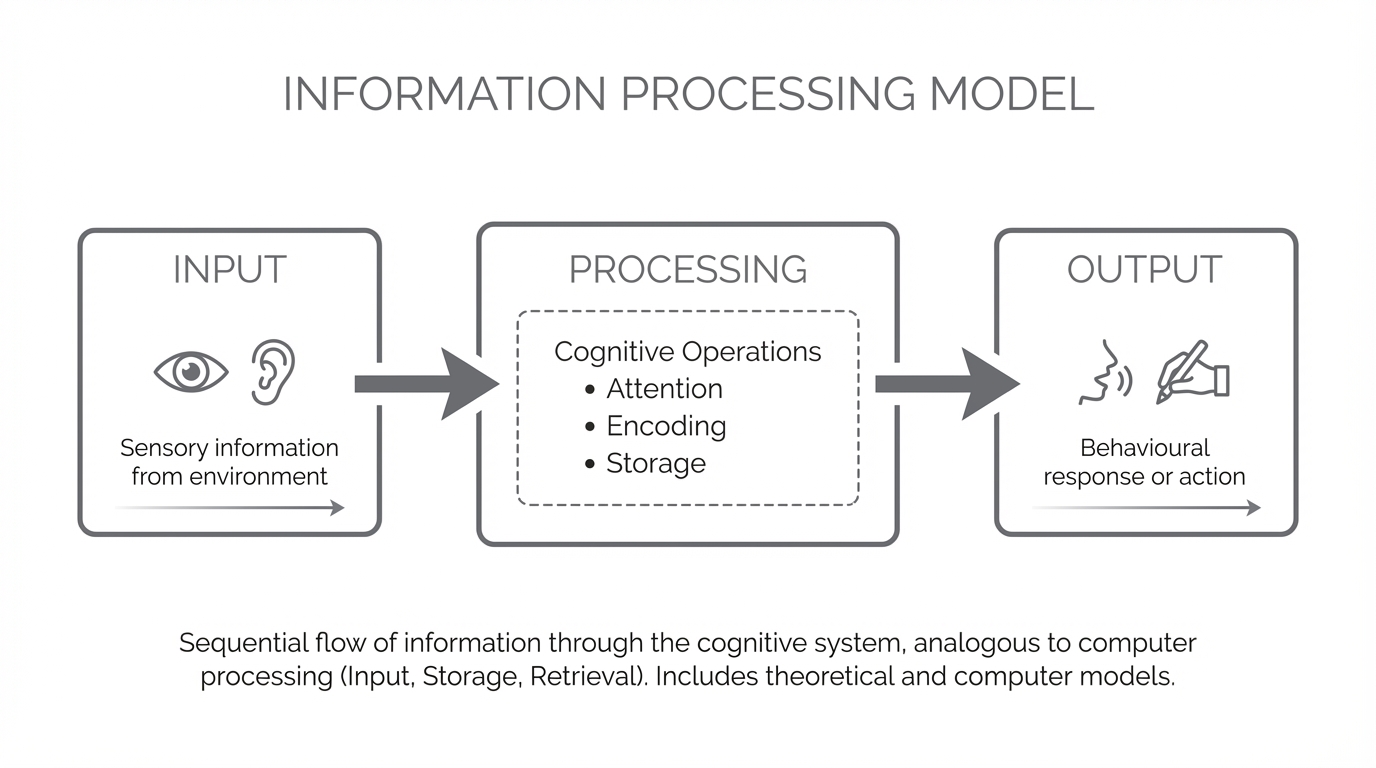
Computer models take this further by creating actual computational simulations of cognitive processes. The development of computers from the 1940s onwards was pivotal for cognitive psychology because it provided a powerful analogy for the mind. Both computers and human minds appear to involve input (receiving information from the environment or a keyboard), processing (the brain or central processing unit manipulates and stores the information), and output (producing a response such as speech or a display on screen). A computer model involves programming a computer to perform a cognitive task and then comparing its output with human performance. If the computer produces similar results, this suggests that analogous processes may be operating in the human mind. This approach has contributed to the development of artificial intelligence (AI) — machines designed to simulate human cognitive abilities, such as holding a conversation or solving problems.
Daniel is a software engineer developing a chatbot that can answer customer queries. He programs the system to receive input (the customer's typed question), process it by matching key words against stored information, and generate an output (a relevant answer). Daniel notices that the chatbot sometimes misinterprets ambiguous questions — much like how humans can misunderstand communication when they lack the relevant schema. His work illustrates the use of computer models as a way of testing whether computational processes can simulate aspects of human cognition.
It is important to recognise that the computer analogy has limitations. While it highlights structural similarities between minds and machines, it ignores distinctly human factors such as emotion, motivation, and consciousness — all of which influence cognitive processing in ways that computers do not experience. This point forms a key evaluation issue, known as machine reductionism, which we will return to in the evaluation bank.
Part 4 — The Emergence of Cognitive Neuroscience
Cognitive Neuroscience
The scientific study of the biological structures and neural processes that underpin cognitive functions such as memory, perception, language, and decision-making.
Cognitive neuroscience represents the merging of cognitive psychology with neuroscience — combining the study of mental processes with the study of brain structures. Where traditional cognitive psychologists relied on inference to understand the mind, cognitive neuroscientists can directly observe brain activity using modern imaging technology, linking specific cognitive functions to identifiable brain regions.
The roots of this field stretch back to the 1860s. Paul Broca studied patients who had suffered damage to a particular region of the left frontal lobe and found that they had lost the ability to produce speech, even though they could still understand language. This region became known as Broca's area and provided early evidence for brain localisation — the idea that specific areas of the brain are responsible for specific cognitive functions. Shortly after, in the 1870s, Carl Wernicke studied patients with damage to a different region (now known as Wernicke's area, located in the left temporal lobe, corresponding to Brodmann's area 22) and found that these patients could produce fluent speech but could not comprehend language. Together, these case studies established the principle that different cognitive functions are localised in different brain regions.
However, early research relied on case studies of brain-damaged patients, which limited what could be concluded about the healthy brain. The real transformation came with advances in brain imaging technology from the 1970s onwards. Techniques such as PET scans (positron emission tomography) and later fMRI (functional magnetic resonance imaging) allowed researchers to observe brain activity in healthy, living participants while they performed cognitive tasks.
Petersen et al. (1988) used PET scanning to demonstrate that Wernicke's area was activated during a listening task and Broca's area was activated during a reading task — providing objective, in-vivo evidence for the localisation of language functions that Broca and Wernicke had originally proposed through case studies over a century earlier. Buckner and Petersen (1996) used similar techniques to show that episodic and semantic memory may be associated with different sides of the prefrontal cortex, while Braver et al. (1997) provided evidence that the central executive component of working memory may reside in a similar prefrontal region.
More recently, cognitive neuroscience has expanded its scope considerably. Researchers now investigate the neural basis of conditions such as obsessive-compulsive disorder (OCD), where the parahippocampal gyrus appears to play a role in processing unpleasant emotions. The field has also embraced computer-generated models designed to interpret brain activity, leading to techniques such as brain fingerprinting — the analysis of brainwave patterns that may, in the future, be used in forensic settings to determine whether eyewitnesses are telling the truth.
Cognitive neuroscience has transformed psychology by providing objective, biological evidence for mental processes that were previously studied only through inference — bridging the gap between the cognitive and biological approaches.
Evaluation Bank (AO3)
Strength: The cognitive approach uses objective, scientific methods, and the emergence of cognitive neuroscience has significantly enhanced its credibility. Cognitive psychologists employ highly controlled laboratory studies that produce reliable, replicable data — for example, standardised memory experiments that can be repeated to verify findings. More importantly, the development of brain imaging techniques such as PET and fMRI scans has allowed researchers to move beyond inference and directly observe neural activity during cognitive tasks. Petersen et al. (1988) provided objective, biological evidence for the localisation of language functions that had previously been proposed solely on the basis of case studies. This means that cognitive psychology now has a credible, empirical foundation, bringing it closer in rigour to the natural sciences such as biology and physics. This relates to the wider debate about whether psychology can be considered a true science — the cognitive approach, particularly through cognitive neuroscience, provides one of the strongest cases that it can.
Limitation: A significant weakness of the cognitive approach is that it relies on machine reductionism — the comparison of human cognitive processing to the operations of a computer. While the computer analogy has been useful in modelling the stages of information processing (input, processing, output), it ignores factors that are uniquely human, such as emotion, motivation, and consciousness. Research consistently shows that these factors influence cognition: for example, anxiety can impair eyewitness memory (Deffenbacher et al., 2004), and emotional significance can enhance encoding (the "flashbulb memory" effect). A computer processes information identically regardless of emotional context, but a human mind does not. This means that the cognitive approach, by reducing the mind to a machine-like system, may oversimplify human cognition and overlook the complexity of real mental life. This links to the reductionism versus holism debate — while reductionism allows for controlled, scientific study, it may sacrifice the validity of explanations by ignoring the interplay between cognition and emotion.
Strength: The cognitive approach adopts a position of soft determinism, which provides a more realistic and balanced account of human behaviour than the hard determinism of behaviourism. While the cognitive approach acknowledges that our thinking is constrained by our cognitive system — for example, the capacity limits of working memory, or the influence of pre-existing schemas — it also recognises that humans can actively reason, plan, and make conscious decisions within those constraints. This contrasts with the behaviourist view, which sees behaviour as entirely determined by environmental conditioning, leaving no role for thought or choice. Soft determinism is generally considered a more credible philosophical position because it captures something genuinely distinctive about human cognition: we are influenced by our mental frameworks, but we are not entirely controlled by them. This means the cognitive approach can account for the complexity and flexibility of human behaviour in a way that mechanistic or purely deterministic approaches cannot, linking to the broader free will versus determinism debate.