1.1.5 Minority Influence
If conformity (majority influence) were the only social pressure, society would never change — new ideas would never gain traction and reform would be impossible. Minority influence explains how a small number of people, sometimes even a single individual, can shift the beliefs and behaviour of the majority. Serge Moscovici pioneered this area of research, arguing that minorities bring about innovation and social change through three key behavioural processes: consistency, commitment, and flexibility. This lesson covers all three processes, the key research evidence behind them, and how the conversion process leads to lasting attitude change.
What Is Minority Influence?
Minority Influence
A form of social influence in which a small group of people — or even a single individual — persuades others to adopt their beliefs, attitudes, or behaviours. Unlike conformity (majority influence), minority influence typically leads to internalisation (conversion), meaning that private attitudes are genuinely changed, not just public behaviour.
It is important to distinguish minority influence from conformity. In conformity, the majority pressures individuals to change. The result is often compliance — public agreement without private acceptance. In minority influence, the direction of influence is reversed: a small, committed group gradually changes how the majority thinks. The outcome is usually internalisation, where people come to genuinely accept the minority viewpoint both publicly and privately. This distinction matters in the exam because it connects minority influence directly to the types of conformity you have already studied.
Consistency
Consistency
The extent to which a minority maintains the same position over time and across all members of the group. Consistency is effective because it draws attention to the minority viewpoint, forcing the majority to consider that the minority may have a valid point.
Moscovici identified consistency as the single most important factor in minority influence. When a minority maintains a clear, unwavering position, it forces the majority to pay attention. A consistent message signals that the minority holds genuine, deeply felt beliefs rather than arbitrary or trivial opinions. Over time, this persistent repetition creates doubt in the minds of majority members, causing them to question whether their own position might be wrong.
There are two forms of consistency that work together:
- Diachronic consistency — the minority maintains the same position over time. They do not waver, backtrack, or change their message from one occasion to the next. This repeated exposure to the same viewpoint gradually erodes the majority's certainty about their own beliefs.
- Synchronic consistency — all members of the minority group agree with each other. When every person in the minority says the same thing, it is harder for the majority to dismiss them as isolated eccentrics.
When both forms of consistency operate together, the effect is powerful: the majority begins to reason that there must be something worth considering if the minority has maintained unity across its members and has held firm over an extended period.
Wood et al. (1994) — Conducted a meta-analysis of almost 100 studies examining minority influence across a range of experimental contexts. The meta-analysis found that minorities perceived as consistent were the most influential in shifting majority opinion, regardless of the specific task or setting. This large-scale review confirms that consistency is a minimum requirement for any minority attempting to influence a majority.
Commitment and the Augmentation Principle
Commitment
The degree to which a minority demonstrates dedication to their position, often through personal sacrifice or risk. Commitment is effective because it shows the majority that the minority is not acting out of self-interest and truly believes in their cause.
Augmentation Principle
The idea that if a minority is willing to suffer for their views — accepting personal risk, hardship, or sacrifice — then the majority is more likely to take their position seriously. The personal cost "augments" (increases) the persuasive impact of the minority's message.
Commitment takes minority influence beyond mere repetition. When members of a minority make personal sacrifices or take risks for their position, the majority pays closer attention. The reasoning is straightforward: if someone is willing to endure hardship for a belief, that belief must be deeply held and possibly valid. Moscovici described this as the augmentation principle — the willingness to accept personal costs increases (augments) the persuasive power of the minority's argument.
Consider real-world examples: civil rights activists who faced imprisonment, environmental campaigners who risked arrest, or suffragettes who went on hunger strikes. In each case, personal sacrifice demonstrated conviction so powerful that majority members felt compelled to reconsider their own views. The augmentation principle explains why extreme commitment is often more persuasive than quiet persistence alone.
Priya is a student council member at her school who believes the school should switch to a vegetarian menu to reduce its carbon footprint. Despite being the only person on the council who holds this view, she organises a petition, gives up her lunchtimes to research the environmental impact, and volunteers to eat only the vegetarian options herself for a full term — even though she previously enjoyed meat dishes. Several council members who initially dismissed the idea begin to take her seriously and agree to trial a meat-free Monday.
Flexibility
Flexibility
The willingness of a minority to adapt their position and consider reasonable counter-arguments, rather than rigidly repeating the same message. Flexibility prevents the minority from appearing dogmatic and increases their persuasive influence.
Charlan Nemeth (1986) argued that consistency alone is not sufficient for minority influence, and can even be counterproductive. A minority that simply repeats the same arguments without ever acknowledging opposing views may appear rigid, dogmatic, and unreasonable. Rather than persuading the majority, this kind of relentless inflexibility can alienate them.
The key is to strike a balance between consistency and flexibility. The minority must maintain its core position (consistency) while demonstrating a willingness to listen to counter-arguments and make reasonable compromises (flexibility). This combination makes the minority appear rational and cooperative rather than extreme, which increases the likelihood that the majority will engage with their ideas.
Nemeth and Brilmayer (1987) — In a simulated jury task, participants discussed the amount of compensation to be awarded in a personal injury case. A confederate minority member who consistently argued for a low amount but showed flexibility by shifting their position slightly in response to new arguments was significantly more influential than a confederate who simply maintained the same position rigidly without any willingness to negotiate. This demonstrated that flexibility enhances the persuasiveness of a consistent minority, supporting Nemeth's argument that an effective minority must combine both qualities.
Key Study: Moscovici et al. (1969) — The Blue-Green Slides
Moscovici et al. (1969) — This laboratory experiment investigated whether a consistent minority could influence the majority's judgements. Groups of six participants were shown a set of 36 blue-coloured slides that varied in intensity, and each person was asked to state aloud whether each slide was blue or green. In each group, two of the six members were confederates (the minority) and four were genuine participants (the majority). In the consistent condition, the confederates called every slide "green" on all 36 trials. In the inconsistent condition, the confederates said "green" on 24 trials and "blue" on 12 trials. A control group had no confederates — all six members were genuine participants who simply identified the colour of each slide. In the consistent condition, genuine participants agreed with the minority and called the slides "green" on 8.42% of trials. In the inconsistent condition, agreement dropped to just 1.25%. In the control group, wrong answers occurred on only 0.25% of trials. Moscovici concluded that a consistent minority can influence the majority to change their judgements, whereas an inconsistent minority has very little effect.
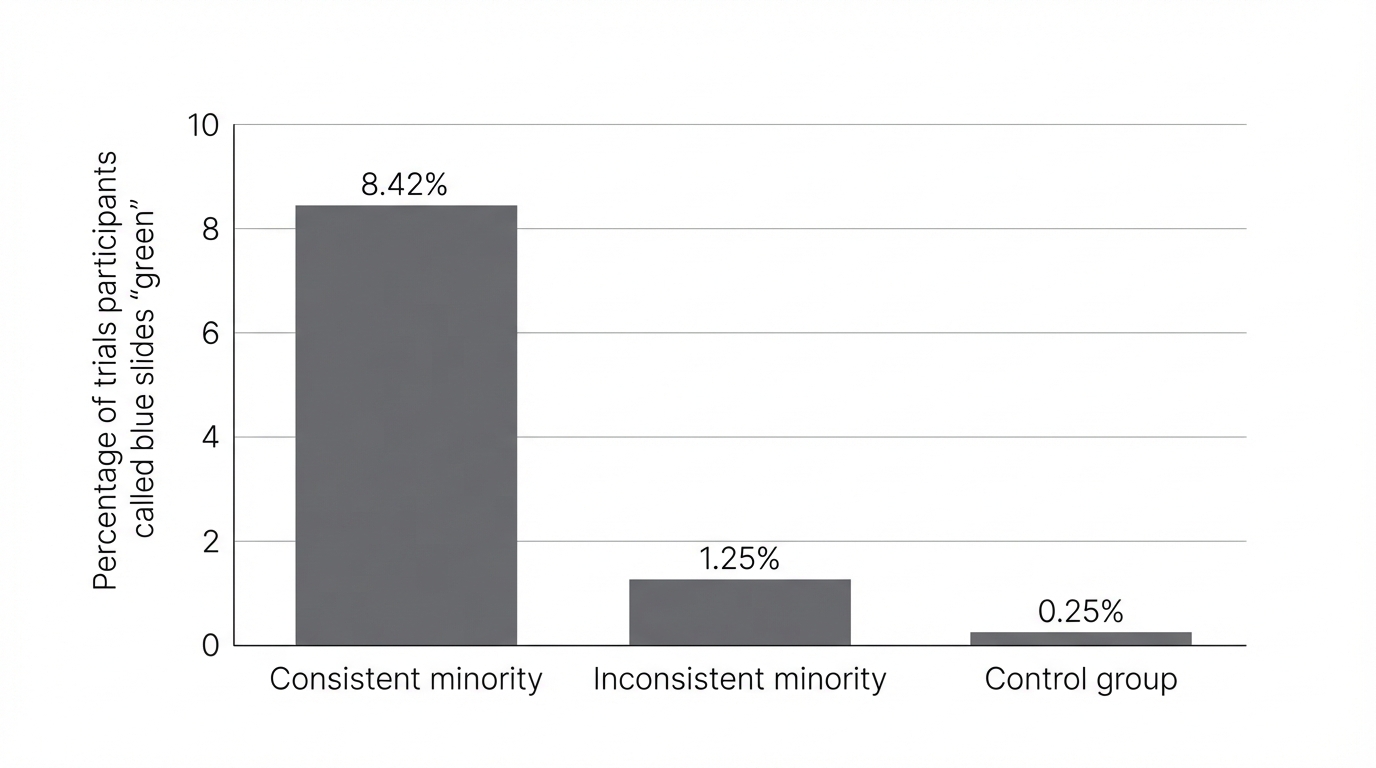
This study is significant because it was the first to demonstrate experimentally that influence can flow from a minority to a majority, not just the other way around. The dramatic difference between the consistent and inconsistent conditions directly supports the role of consistency as the primary driver of minority influence. The study used a laboratory experiment, which means it had high internal control — the number of confederates, the slides shown, and the consistency of responses were all carefully standardised. However, the artificial nature of the task raises questions about ecological validity (see Evaluation Bank below).
It is worth noting that when Moscovici asked participants to write down their answers privately rather than stating them aloud, agreement with the minority was higher. This "tip of the iceberg" finding suggests that minority influence may produce more private conversion than is visible in public responses — exactly the internalisation process that distinguishes minority influence from compliance.
The Process of Conversion and the Snowball Effect
Conversion
A gradual change in privately held attitudes and beliefs resulting from deeper cognitive processing of a minority's arguments. Unlike compliance, conversion involves genuine internalisation — the person comes to truly accept the minority viewpoint.
The three factors covered above — consistency, commitment, and flexibility — all work by prompting the majority to think more carefully about the minority's position. Hearing a viewpoint you already agree with rarely triggers deep thought, but encountering a persistent, committed, and flexible alternative forces you to engage with the arguments more carefully. This deeper processing is what leads to conversion: a genuine shift in private attitudes, not just a superficial change in public behaviour.
Martin et al. (2003) — Participants were first presented with a message supporting a particular viewpoint and their level of agreement was measured. One group was then told that a minority endorsed the message, while another group was told that a majority endorsed it. Both groups were subsequently exposed to a conflicting counter-message, and their attitudes were measured again. Participants who believed the original message came from a minority were significantly less willing to change their position after hearing the counter-message than those who believed it came from a majority. Martin et al. concluded that minority-endorsed messages are processed more deeply and produce more durable attitude change than majority-endorsed messages.
This finding has important implications: it suggests that although minorities influence fewer people, the influence they do have is more profound and longer-lasting. This is the distinction between conversion (deep, permanent change) and compliance (surface-level, temporary change).
Over time, as more individuals privately convert to the minority position, the minority gradually grows. As the minority expands, conversion accelerates because the growing number of converts makes the position seem increasingly credible. Moscovici described this as the snowball effect — just as a snowball rolling downhill gathers more snow and grows larger, a minority viewpoint gathers more supporters and eventually becomes the new majority position. This process explains how social change occurs: ideas that once seemed radical — such as recycling, women's suffrage, or the abolition of slavery — began as minority positions but, through consistent and committed advocacy, eventually became widely accepted majority norms.
Marcus is the only employee in his department who believes the company should adopt a four-day working week. He raises the idea at every team meeting, presenting new research on productivity each time, and volunteers to trial a compressed schedule himself — working longer hours over four days. Although his manager is initially dismissive, two colleagues begin to privately agree with Marcus. Over the following months, those two colleagues also start advocating for the change, and within a year the department votes to pilot a four-day week.
The snowball effect is visible in Marcus's scenario: his consistent advocacy led to two converts, whose additional support then accelerated the shift until the minority position became the majority decision. This mirrors how major social movements have historically progressed — from a committed few to widespread acceptance.
Evaluation Bank
Strength: There is strong research support for the role of consistency in minority influence. Moscovici et al. (1969) demonstrated that a consistent minority (8.42% agreement) was far more influential than an inconsistent minority (1.25%) in shifting majority judgements about the colour of slides. Wood et al. (1994) reinforced this through a meta-analysis of almost 100 studies, finding that minorities perceived as consistent were the most influential across a wide range of experimental contexts. This convergence of evidence from both individual experiments and large-scale meta-analytic reviews means we can be confident that consistency is a genuine and robust mechanism through which minorities exert influence, rather than an artefact of a single study. This supports the validity of Moscovici's theory and suggests that consistency is a minimum requirement for minority influence to occur.
Strength: Martin et al. (2003) provide evidence that minority influence involves deeper processing than majority influence, which supports the claim that minority influence leads to genuine conversion rather than superficial compliance. Participants who believed a message came from a minority were significantly less willing to change their opinion when later exposed to a conflicting viewpoint, compared to those who believed the same message came from a majority. This suggests that minority messages are processed more thoughtfully, producing more durable and lasting attitude change. The finding is important because it explains why minority influence, although affecting fewer people, can be more powerful in the long run — it changes what people genuinely think, not just what they say publicly. However, a counterpoint is that Martin et al.'s study, like much minority influence research, made a simplified distinction between majority and minority that may not reflect real life. In real-world social influence situations, majorities typically hold greater power, status, and resources, and minorities face hostile opposition — features that are absent from controlled laboratory studies. This limits the ecological validity of the findings and how far they can be generalised to real-world minority influence processes.
Limitation: A significant criticism of research into minority influence is that it relies heavily on artificial tasks that lack ecological validity. Moscovici et al.'s task — identifying the colour of a slide — is trivial compared to the real-world situations in which minority influence actually operates, such as jury deliberation, political campaigning, or social reform movements like the suffragette movement or the civil rights movement. In these real contexts, outcomes carry far greater personal and social significance, and minority groups face hostile opposition, power imbalances, and potential personal danger that laboratory studies do not capture. This means that findings from studies like Moscovici's may tell us little about how minority influence genuinely works in meaningful social contexts. This relates to the broader Issue and Debate of ecological validity versus internal validity: the controlled conditions that give Moscovici's study its high internal validity are the very same conditions that strip the situation of the complexity and consequences present in real-world minority influence. Additionally, most research in this area was conducted with Western participants in individualist cultures where expressing dissent may be more socially acceptable. In collectivist cultures, where group harmony is prioritised and publicly opposing the majority carries greater social cost, minority influence may operate very differently. This suggests the research may suffer from cultural bias (ethnocentrism), limiting the generalisability of its conclusions.
Minority influence operates through three key processes — consistency, commitment (augmentation principle), and flexibility. Together, these trigger deeper cognitive processing in the majority, leading to genuine conversion (internalisation) rather than mere compliance. Over time, the snowball effect can transform a minority viewpoint into the new majority position, which is how lasting social change occurs.