2.1.1 Origins of Psychology: Wundt and Introspection
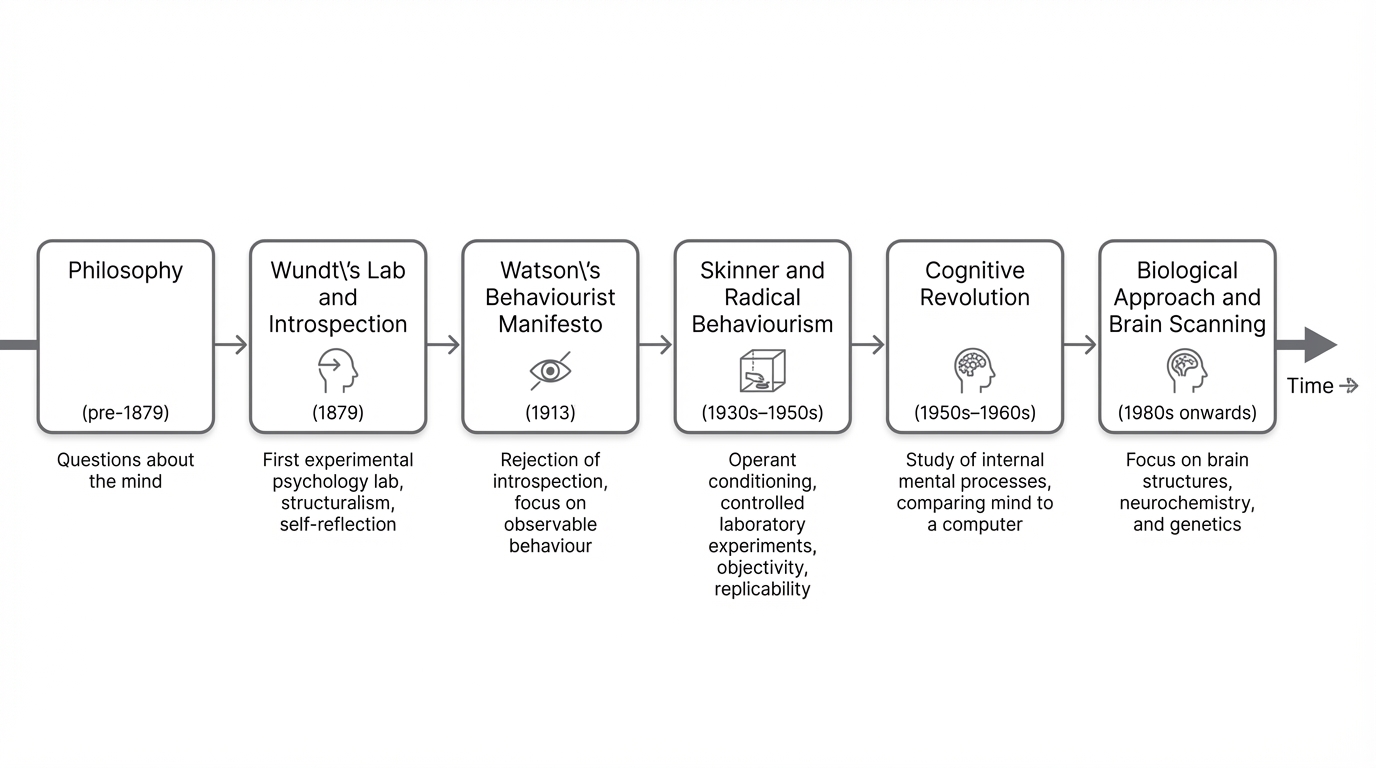
Before psychology existed as a discipline in its own right, questions about the mind belonged to philosophy. For centuries, thinkers such as Descartes debated whether the mind and body were separate entities, but nobody attempted to study mental processes using systematic, scientific methods. This lesson traces how psychology broke away from philosophy — beginning with Wilhelm Wundt's pioneering laboratory work in the 1870s, through the behaviourist revolution of the early 20th century, and into the modern era of cognitive and biological psychology. Understanding this timeline is essential because AQA expects you to explain not just what Wundt did, but why his work matters, and how each subsequent approach moved psychology closer to being a fully scientific discipline.
Part 1 — Wundt and Introspection
Psychology
The scientific study of the mind, behaviour, and experience.
Before 1879, the study of the mind was embedded within philosophy. Philosophers speculated about consciousness, perception, and thought, but they did so through reasoning and debate rather than controlled investigation. This changed when Wilhelm Wundt opened the first laboratory dedicated entirely to psychological research in Leipzig, Germany, in 1879. This event is widely regarded as the formal birth of psychology as a separate discipline, and Wundt is often referred to as the "father of modern psychology."
Introspection
The first systematic experimental attempt to study the mind by breaking up conscious awareness into basic structures of thoughts, images, and sensations.
Wundt's method was introspection — a controlled process in which trained participants were presented with carefully chosen stimuli (such as a ticking metronome, visual objects, or sounds) and asked to report their inner experiences. Participants would divide their observations into three categories: thoughts, images, and sensations. This process of isolating the basic components of conscious experience is known as structuralism — the attempt to identify the fundamental "building blocks" of the mind, much as a chemist might break a compound into its elements.
Structuralism
The approach pioneered by Wundt that aimed to identify the basic elements (structures) of conscious experience by breaking it down into thoughts, images, and sensations through introspection.
Critically, Wundt's introspective procedures were not casual self-reflection. He imposed standardised conditions: the same stimuli were presented in the same order, and the same instructions were given to every participant. Sessions took place in a controlled laboratory environment, which helped to minimise the influence of extraneous variables. This systematic approach distinguished Wundt's work from earlier philosophical speculation and represented a genuine attempt to apply scientific principles to the study of the mind.
However, despite these controls, the data produced by introspection were fundamentally subjective — they relied on participants accurately and honestly reporting their own private mental experiences. Different individuals often described the same stimulus in very different ways, making it extremely difficult to establish general laws of mental functioning. This subjectivity would later become a major point of criticism.
Tom is revising for his psychology exam by trying to describe exactly what goes through his mind when he listens to a particular song — he notes the images it brings up, the emotions he feels, and the specific thoughts that arise. Without realising it, Tom is using a process similar to Wundt's introspection, attempting to break his conscious experience into its component parts: thoughts, images, and sensations.
Wundt also made lasting contributions to the infrastructure of psychology as an academic discipline. He established the first academic journal dedicated to psychological research and wrote the first psychology textbook, helping to create a community of researchers who could share and build upon each other's findings.
Part 2 — The Behaviourist Revolution
Science
A means of acquiring knowledge through systematic and objective investigation. The aim is to discover general laws that can be used to predict and control phenomena.
Although Wundt's laboratory represented an important first step, introspection was increasingly criticised for producing data that were too subjective to qualify as truly scientific. The key features of science include: objectivity (measurements free from personal bias), replicability (the ability to repeat studies and obtain the same results), hypothesis testing, falsifiability (theories must be testable and potentially disprovable), and the discovery of general laws. Introspection struggled on several of these criteria — particularly objectivity and the ability to establish general laws — because each participant's self-report was unique and unverifiable.
In 1913, the American psychologist John B. Watson published a landmark paper, Psychology as the Behaviourist Views It, in which he argued that psychology could only be a true science if it abandoned the study of private mental experiences entirely and focused exclusively on observable, measurable behaviour. Watson's position was clear: if something cannot be seen and objectively recorded, it has no place in scientific psychology.
Behaviourism
An approach in psychology that argues only observable and measurable behaviour should be studied scientifically, rejecting the investigation of internal mental processes.
Watson's ideas were later developed by B.F. Skinner, whose work from the 1930s onwards refined what became known as radical behaviourism. Skinner used highly controlled laboratory experiments — most famously the "Skinner box" — to study how behaviour is shaped by its consequences (reinforcement and punishment). By manipulating independent variables and measuring behavioural responses under standardised conditions, the behaviourist approach achieved a level of objectivity, control, and replicability that Wundt's introspection could not match. Behaviourism dominated scientific psychology for approximately the first half of the 20th century.
The behaviourist approach represented a major turning point because it established that psychology could meet the same methodological standards as the natural sciences. Observable behaviour could be measured, experiments could be replicated, and general laws of learning (such as classical and operant conditioning) could be formulated and tested.
Part 3 — The Cognitive and Biological Revolutions
While behaviourism made psychology more scientific, it did so at a cost — by refusing to study mental processes, it could not explain important aspects of human experience such as memory, attention, language, and problem-solving. Two later developments brought the study of the mind back into scientific psychology, but with far more rigorous methods than Wundt had used.
The Cognitive Approach (1950s onwards)
The digital computer revolution of the 1950s provided psychologists with a powerful new metaphor for understanding the mind. Cognitive psychologists proposed that the mind processes information in a way similar to a computer — receiving input, processing it, storing it, and producing output. This became known as the computer analogy. Unlike introspection, the cognitive approach did not rely on subjective self-reports. Instead, cognitive psychologists used controlled experiments to test predictions about internal mental processes (such as memory capacity or attention span) by measuring observable behavioural outcomes — for example, how many items a person could recall under different conditions.
This approach made the study of mental processes scientifically legitimate once again, but in a far more objective and testable way than Wundt's introspection. Models such as the multi-store model of memory could generate specific, falsifiable hypotheses that could be tested and refined through experimentation.
Social Learning Theory (1960s)
Albert Bandura proposed social learning theory (SLT), which accepted the behaviourist principle that behaviour is learned through experience but argued that learning also occurs through observation and imitation of others in a social context. SLT introduced the role of cognitive (mediational) factors — such as attention, retention, and motivation — into the explanation of learning, effectively bridging the gap between traditional behaviourism and the cognitive approach.
The Biological Approach (1980s onwards)
Advances in technology from the 1980s onwards allowed psychologists to investigate the biological basis of behaviour with unprecedented precision. Sophisticated brain-scanning techniques such as fMRI (functional magnetic resonance imaging) and EEG (electroencephalography) enabled researchers to observe and measure brain activity as it happens, providing objective, quantifiable data. More recently, developments in genetic testing have allowed psychologists to explore the relationship between genes and behaviour. The biological approach has arguably taken scientific psychology to its most rigorous level yet, producing data that meets the strictest criteria of objectivity and replicability.
Dr Patel is a researcher who uses fMRI scans to measure brain activity in participants while they complete memory tasks, comparing brain activation patterns in patients with Alzheimer's disease to those of healthy controls. Her work illustrates the biological approach to psychology — using advanced technology to produce objective, measurable data about the physiological processes underlying behaviour, rather than relying on participants' subjective self-reports.
By the late 20th century, the cognitive and biological approaches began to merge into a new discipline: cognitive neuroscience, which investigates how biological brain structures influence mental processes. This integration represents the most recent stage in psychology's development as a science.
Part 4 — Is Psychology Really a Science?
The question of whether psychology qualifies as a genuine science is an important debate that runs throughout the AQA specification. There are arguments on both sides.
The case for psychology as a science: Modern psychology shares the same core aims as the natural sciences — to describe, understand, predict, and control behaviour. The behaviourist, cognitive, and biological approaches all make extensive use of scientific methods, including laboratory experiments, controlled observation, and hypothesis testing. These approaches produce objective, replicable data and seek to establish general laws. In this sense, psychology has firmly established itself as a scientific discipline over the course of the 20th and 21st centuries.
The case against psychology as a science: Not all approaches within psychology adopt scientific methods. The humanistic approach (developed in the 1950s by Carl Rogers and Abraham Maslow) explicitly rejects the scientific method, arguing that reducing human experience to measurable variables ignores what makes people unique. Humanistic psychologists prefer to study subjective experience and emphasise self-determination and free will. Similarly, the psychodynamic approach (developed by Sigmund Freud from the early 1900s) relies heavily on case studies and concepts such as the unconscious mind that are difficult to test or falsify.
The philosopher Thomas Kuhn argued that for a discipline to qualify as a science, it must have a single shared paradigm — a set of agreed principles, assumptions, and methods. Kuhn suggested that psychology lacks such a paradigm because its different approaches (behaviourist, cognitive, biological, humanistic, psychodynamic) disagree fundamentally about what to study and how to study it. This internal disagreement, Kuhn argued, means psychology is a pre-science rather than a mature science.
Psychology's journey from philosophical speculation to scientific discipline is not a simple linear story. Different approaches have contributed different levels of scientific rigour, and the debate about whether psychology truly qualifies as a science remains unresolved. For the exam, you must be able to explain how each approach contributed to making psychology more (or less) scientific.
Evaluation Bank (AO3)
Strength: A key strength of Wundt's work is that his methods represented the first systematic attempt to study the mind under controlled conditions. He used standardised procedures — the same stimuli were presented in the same order, the same instructions were given to all participants, and all observations were recorded in a controlled laboratory environment. This meant that extraneous variables were minimised and his investigations could, in principle, be replicated. This is significant because it established the foundational principle that the mind could be studied scientifically, paving the way for later, more rigorous approaches. Without Wundt's pioneering decision to move psychology out of philosophy and into the laboratory, the behaviourist, cognitive, and biological approaches that followed might not have developed as they did. His contribution is therefore historically important even though his specific method — introspection — was later superseded.
Limitation: A significant limitation of Wundt's introspective method is that it produced subjective data that could not be independently verified. Participants were asked to report their own private conscious experiences — their thoughts, images, and sensations — but there was no way for an external observer to check whether these reports were accurate or complete. Different participants frequently described the same stimulus in very different ways, and participants may have withheld or distorted aspects of their experience. Watson (1913) argued that this made it impossible to establish the general laws of behaviour that a scientific discipline requires, since scientific knowledge depends on objective, replicable observations. This limitation is directly connected to the broader Issues and Debates theme of the scientific status of psychology — it illustrates why early psychology struggled to establish itself as a credible science and why the shift to behaviourism, with its insistence on observable measurement, was seen as necessary for psychology's progress.
Strength: A further strength is that the emergence of psychology as a science demonstrates a clear pattern of methodological progression, with each new approach building on and improving the methods of its predecessors. Wundt introduced controlled laboratory conditions but relied on subjective self-report; behaviourism eliminated subjectivity by studying only observable behaviour; the cognitive approach reintroduced mental processes but studied them through objective experimental methods rather than introspection; and the biological approach used advanced technology (fMRI, EEG, genetic testing) to produce precise, quantifiable, physiological data. This progression means that modern psychology, particularly within the cognitive and biological approaches, can now claim to meet the core criteria of science — objectivity, replicability, falsifiability, and the establishment of general laws. However, this strength must be qualified by acknowledging that not all approaches share this scientific rigour — the humanistic approach explicitly rejects scientific methods, and Kuhn's argument that psychology lacks a unifying paradigm suggests it may not yet be a fully mature science. This connects to the broader debate about reductionism versus holism: the most scientific approaches tend to be the most reductionist (breaking behaviour into measurable components), which may mean that the richness and complexity of human experience is lost in the pursuit of scientific credibility.