1.2.2 Types of Long-Term Memory
The multi-store model describes long-term memory (LTM) as a single, unitary store — but this is one of its greatest weaknesses. When you think about everything stored in your LTM, from your memory of yesterday's breakfast to the ability to ride a bike to the meaning of the word "psychology," it seems unlikely that all of these are kept in the same way. In this lesson you will learn about Tulving's proposal that LTM consists of three distinct stores — episodic, semantic, and procedural — along with the evidence that supports (and challenges) this distinction. Understanding these types is essential for evaluating the multi-store model and for answering exam questions that ask you to distinguish between different kinds of long-term memory.
Tulving's Classification of Long-Term Memory
Endel Tulving (1985) was one of the first cognitive psychologists to argue that the multi-store model's view of LTM as a single store was too simplistic. Based on extensive research, Tulving proposed that LTM is not one store but three, each holding a fundamentally different type of information. He called these episodic memory, semantic memory, and procedural memory.
Episodic Memory
A long-term memory store for personal events (episodes). It includes memories of when events occurred and the people, objects, places, and behaviours involved. Episodic memories must be recalled consciously and with deliberate effort.
Episodic memory functions like a personal diary. It stores your experiences — your first day at school, a birthday party, a conversation you had last week. These memories have three key features. First, they are time-stamped: you remember not just what happened but when it happened and how events relate to each other in time. Second, they are complex and multi-layered: a single episodic memory weaves together people, places, emotions, and sensory details into one coherent recollection. Third, they require conscious, deliberate retrieval — you must actively search your memory to recall an episode.
Semantic Memory
A long-term memory store for our knowledge of the world, including facts, concepts, and the meanings of words. Semantic memories are not time-stamped and usually need to be recalled deliberately.
Semantic memory is more like an encyclopaedia or dictionary. It holds factual knowledge that is shared and impersonal — the capital of France, what the word "democracy" means, the fact that fire is hot. Unlike episodic memories, semantic memories are generally not time-stamped. You know that Paris is the capital of France, but you probably cannot recall the specific moment you first learned that fact. Tulving argued that semantic memory is less vulnerable to forgetting and distortion than episodic memory, which makes intuitive sense — facts tend to be more stable than personal recollections.
Procedural Memory
A long-term memory store for our knowledge of how to do things, including learned motor skills and actions. Procedural memories are recalled automatically, without conscious effort.
Procedural memory stores learned skills and actions — how to ride a bike, drive a car, tie your shoelaces, or play the piano. The defining feature of procedural memory is that it operates unconsciously and automatically. Once a skill has been practised enough, you perform it without thinking. In fact, trying to consciously describe what you are doing (such as explaining how you change gear while driving) can actually make the task harder.
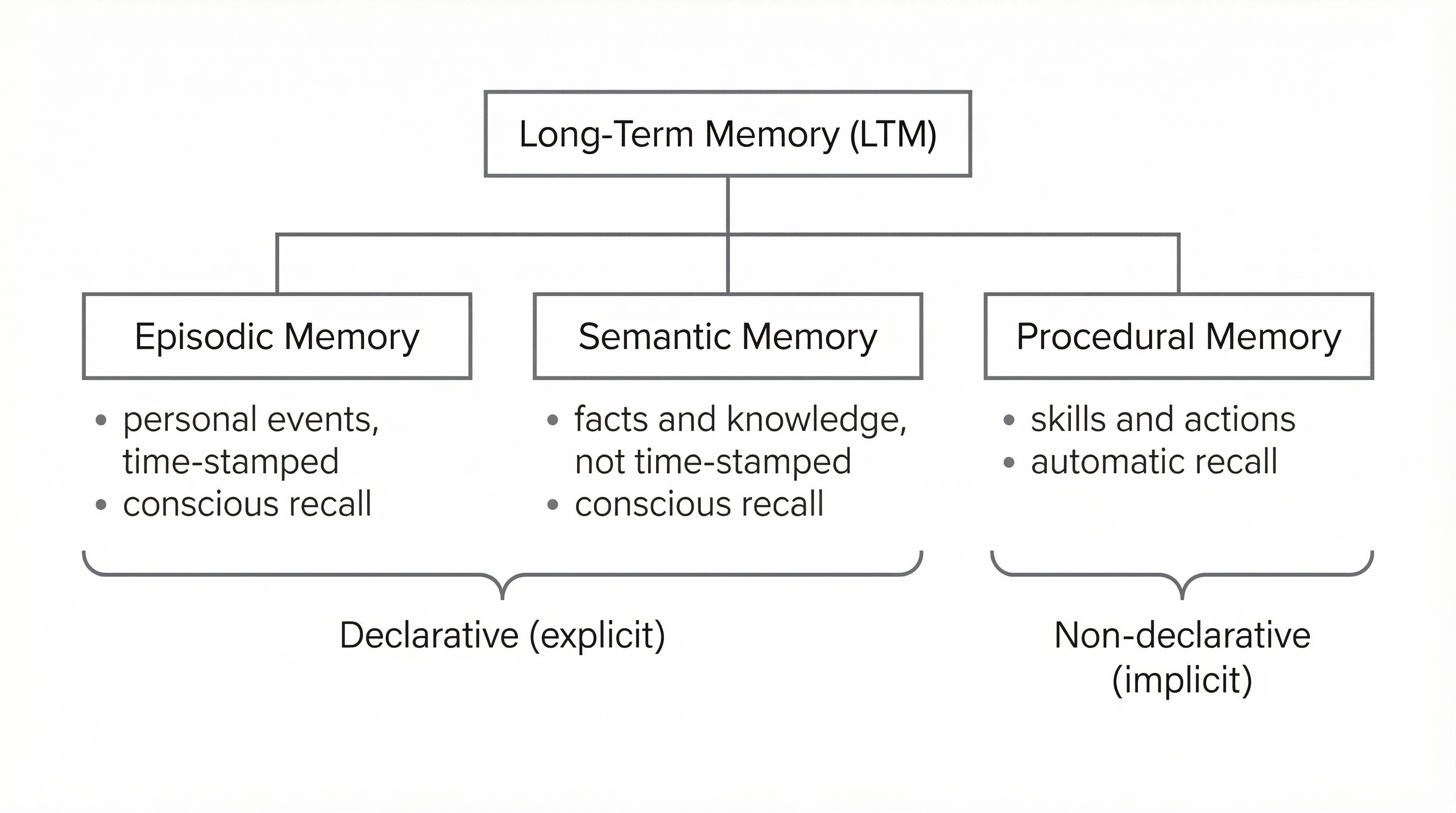
An important distinction introduced by Cohen and Squire (1980) separates LTM into declarative and non-declarative memory. Declarative (explicit) memories are those that must be recalled consciously — this includes both episodic and semantic memory. Non-declarative (implicit) memories are recalled automatically without conscious effort — this is procedural memory. This classification highlights a fundamental divide: episodic and semantic memories share the property of requiring deliberate retrieval, while procedural memories do not.
Tom is revising for his psychology exam. He can remember sitting in last Friday's lesson and his teacher explaining the working memory model (the room, the time, and what the teacher was wearing). He also knows the definition of the central executive and can explain its role. When he picks up his pen to write practice answers, he does not have to think about how to form letters — his hand moves automatically across the page.
Tom's memory of sitting in the lesson is an episodic memory (a personal event, time-stamped, with contextual details). His knowledge of what the central executive does is a semantic memory (factual knowledge, not tied to a specific moment). His ability to write without thinking is a procedural memory (an automatic, learned motor skill).
Evidence from Case Studies: HM and Clive Wearing
Some of the most compelling evidence for the distinction between types of LTM comes from clinical case studies of individuals with brain damage. If LTM were truly a single store, then damage to it should impair all types of long-term memory equally. The fact that brain damage can selectively impair one type while leaving others intact provides strong support for Tulving's classification.
Henry Molaison (HM) is one of the most studied cases in the history of memory research. Following surgery to treat severe epilepsy, which removed large portions of his hippocampus and surrounding structures, HM lost the ability to form new episodic memories. He could not recall events that happened after his operation. However, his semantic memory remained relatively intact — he still understood language and the meanings of words. Crucially, his procedural memory was also preserved: HM was able to learn new motor skills (such as mirror drawing) and improve with practice, even though he had no episodic memory of having practised the task before. This dissociation — impaired episodic memory but intact procedural and semantic memory — provides direct evidence that these are separate stores.
Clive Wearing, a professional musician, suffered severe amnesia following a viral infection (herpes simplex encephalitis) that damaged his hippocampus and associated brain areas. Like HM, Clive's episodic memory was devastated — he could not remember events from more than a few seconds ago. He would greet his wife Deborah with great joy each time she entered the room, believing he had not seen her in years, even if she had only left minutes earlier. Despite this, Clive retained his procedural memories: he could still play the piano brilliantly, conduct a choir, and read music. His semantic memory was also partially preserved — he understood language and could recognise objects. This case powerfully demonstrates that one type of LTM can be severely impaired while the others remain largely functional, confirming that they rely on different brain systems.
The cases of HM and Clive Wearing show that episodic memory can be severely impaired while procedural and semantic memory remain intact, providing strong evidence that LTM is not a single store but consists of separate systems.
Neuroimaging Evidence
Beyond case studies, brain-scanning technology has provided further evidence that different types of LTM involve different brain regions. If episodic, semantic, and procedural memories are genuinely separate stores, we would expect them to be associated with activity in different parts of the brain.
Buckner and Petersen (1996) reviewed neuroimaging evidence regarding the location of semantic and episodic memory in the brain. They concluded that semantic memory is primarily associated with activity in the left prefrontal cortex, while episodic memory retrieval is associated with the right prefrontal cortex. The fact that recalling a fact about the world activates a different brain region from recalling a personal experience supports the idea that these are distinct memory systems with separate neural bases.
However, the neuroimaging picture is not entirely straightforward. Tulving et al. (1994) used PET scanning to study brain activity during memory tasks and found a more complex pattern. Their research linked the left prefrontal cortex with the encoding of episodic memories, while the right prefrontal cortex was linked to episodic memory retrieval. This creates a conflict with Buckner and Petersen's conclusion that the left prefrontal cortex is the location of semantic memory — if the same region is also involved in encoding episodic memories, the picture is less clear-cut than a simple left-semantic, right-episodic division.
This conflicting evidence is worth noting: while neuroimaging broadly supports the idea that different types of LTM involve different brain areas, researchers have not reached full agreement on exactly which brain regions correspond to which type of memory. This limits the strength of neuroimaging as evidence for Tulving's classification.
The Relationship Between Episodic and Semantic Memory
While Tulving originally proposed episodic and semantic memory as entirely separate stores, later research — including his own — has suggested that the relationship between them may be more complex than first thought.
Tulving (2002) revised his position and proposed that episodic memory may be a specialised subcategory of semantic memory rather than a completely separate store. His reasoning was based on findings from amnesia research: some individuals with amnesia retain functioning semantic memory alongside damaged episodic memory, but it does not appear possible to have functioning episodic memory with damaged semantic memory. This asymmetry suggests that episodic memory may depend on semantic memory in some way — perhaps you need a framework of factual knowledge before you can meaningfully encode personal experiences.
However, this revised view was challenged by Hodges and Patterson (2007), who studied patients with Alzheimer's disease and found that some could form new episodic memories but not new semantic memories. Irish et al. (2011) found the opposite pattern. These conflicting findings suggest that the two stores can operate independently of each other, which challenges Tulving's later proposal that episodic memory is merely a subcategory of semantic memory.
Grandma Rose, aged 78, has recently been diagnosed with mild cognitive impairment. Her family have noticed that she struggles to remember recent events — she cannot recall that her granddaughter visited last weekend or what she had for dinner yesterday. However, she can still discuss history and politics knowledgeably, and she has no trouble baking her famous Victoria sponge, a recipe she has made for decades.
Rose's difficulty with recent events reflects impaired episodic memory, which research by Belleville et al. (2006) confirms is often the type of LTM most affected by age-related cognitive decline. Her retained factual knowledge (history, politics) demonstrates intact semantic memory, while her ability to bake without difficulty shows preserved procedural memory. This pattern is consistent with Tulving's view that these are separate stores.
Evaluation Bank (AO3)
Strength: The clinical case studies of HM and Clive Wearing provide strong evidence for the distinction between types of LTM. Both individuals suffered damage to brain structures involved in episodic memory (particularly the hippocampus), resulting in severe impairment of episodic memory while their procedural and semantic memories remained largely intact. HM could learn new motor skills without remembering practising them, and Clive Wearing could still play the piano brilliantly despite being unable to remember events from seconds earlier. The fact that one type of LTM can be selectively damaged while others continue to function normally is difficult to explain if LTM is a single, unitary store. This supports Tulving's view that episodic, semantic, and procedural memory are genuinely separate systems with different neural substrates, increasing the validity of the three-store distinction. However, a limitation of relying on case study evidence is that clinical cases lack control of variables — the brain injuries were unexpected, researchers have no knowledge of the individual's memory before the damage, and each case involves unique patterns of damage, making it difficult to draw general conclusions.
Limitation: The neuroimaging evidence for types of LTM is inconsistent, which weakens the biological support for Tulving's classification. Buckner and Petersen (1996) concluded that semantic memory is associated with the left prefrontal cortex and episodic memory retrieval with the right prefrontal cortex, seemingly confirming that the two stores have different neural bases. However, Tulving et al. (1994) found that the left prefrontal cortex was also involved in the encoding of episodic memories, not just semantic memory. This poor agreement on where each type of memory is located means that neuroimaging cannot yet provide clear-cut support for the distinction between stores. If researchers cannot agree on the biological basis of different memory types, this undermines the claim that Tulving's classification maps neatly onto separate brain systems. This relates to the broader issue of reductionism — attempting to reduce complex memory processes to specific brain locations may oversimplify how memory actually works, as different types of LTM may involve overlapping and distributed neural networks rather than discrete regions.
Strength: Tulving's classification of LTM into three types has valuable real-world applications, particularly in the treatment of memory disorders. Belleville et al. (2006) used knowledge of the distinction between types of LTM to develop a targeted intervention for older people with mild cognitive impairment, which typically affects episodic memory more than other types. Participants who received training specifically designed to improve episodic memory performed significantly better on episodic memory tests than a control group. This demonstrates that understanding the different types of LTM is not merely a theoretical exercise — it enables clinicians to identify which specific type of memory is impaired and to develop treatments that target that type directly, rather than applying a one-size-fits-all approach. The practical utility of this classification supports the view that Tulving's distinction between episodic, semantic, and procedural memory is a meaningful and useful way of understanding how LTM operates, giving the theory face validity and real-world relevance.