1.4.1 Definitions of Abnormality
Psychopathology is the study of psychological disorders — their causes, symptoms, and treatment. Before we can diagnose or treat any mental disorder, we need a way of deciding what counts as "abnormal" in the first place. This is more difficult than it sounds. AQA requires you to know four definitions of abnormality: statistical infrequency, deviation from social norms, failure to function adequately, and deviation from ideal mental health. Each takes a different approach to drawing the line between normal and abnormal, and each has strengths and limitations that examiners regularly test. By the end of this lesson you will be able to describe all four definitions (AO1), apply them to scenarios (AO2), and evaluate them using specific evidence and issues (AO3).
Part 1 — Statistical Infrequency
Statistical Infrequency
A definition of abnormality whereby a behaviour or characteristic is considered abnormal if it is statistically rare, occurring in a small percentage of the population according to the normal distribution.
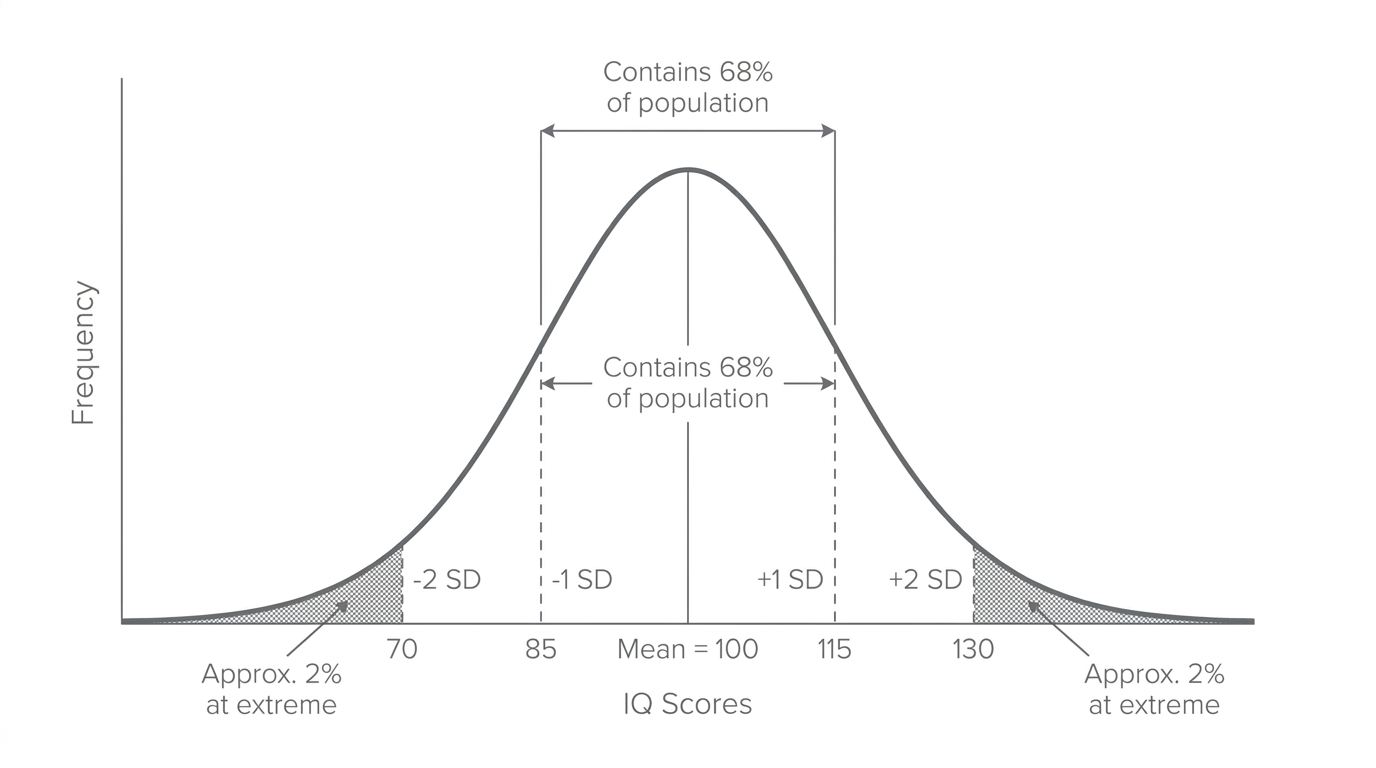
The statistical infrequency approach defines abnormality in terms of how common or uncommon a characteristic is. Any human trait — intelligence, depression, anxiety — can be plotted on a normal distribution (bell curve). Most people's scores cluster around the average, with fewer and fewer people at the extremes. Under this definition, anyone whose score falls beyond two standard deviations from the mean (roughly the top or bottom 2% of the population) is considered statistically abnormal.
Example: Intellectual Disability Disorder
Statistical infrequency is used directly in clinical diagnosis. Intellectual disability disorder (IDD) requires, among other criteria, an IQ score below 70 — placing the individual in the bottom 2% of the population. Similarly, the Beck Depression Inventory (BDI) uses statistical cut-offs: a score of 30 or above (the top 5% of respondents) is widely interpreted as indicating severe depression. In both cases, the statistical rarity of the score is used as evidence that the individual's functioning is abnormal.
However, statistical infrequency applies equally to both ends of the distribution. For every person with an IQ below 70, there is someone with an IQ above 130 — yet we would not consider a genius to be "abnormal" in any clinical sense. Likewise, someone with an extremely low depression score would not be diagnosed with a disorder. This reveals a fundamental limitation: statistical infrequency does not distinguish between desirable and undesirable deviations from the norm. Being rare is not the same as being problematic.
Part 2 — Deviation from Social Norms
Deviation from Social Norms
A definition of abnormality whereby behaviour is considered abnormal if it violates the unwritten rules and expectations about how people should behave within a particular society or culture.
This definition moves away from statistics and towards social judgement. Every society has implicit and explicit rules about acceptable conduct — standards of politeness, dress, personal space, honesty, and so on. When a person's behaviour consistently breaks these expectations in ways that cause discomfort or concern, they may be judged as abnormal. Unlike statistical infrequency, this definition does make a distinction between desirable and undesirable behaviour, because social norms generally exist to encourage prosocial conduct.
Example: Antisocial Personality Disorder
A clear clinical application is antisocial personality disorder (APD). According to the DSM-5, one defining feature of APD is "an absence of prosocial internal standards associated with failure to conform to lawful and culturally normative ethical behaviour." In other words, the diagnosis is partly based on the social judgement that the person's impulsive, aggressive, and deceitful behaviour deviates from moral standards that most cultures share.
The Problem of Cultural and Historical Relativity
Social norms vary dramatically across time, place, and culture, and this makes the definition vulnerable to misuse. Historically, psychiatric diagnoses based on social norms have been used as tools of social control. In nineteenth-century Britain, "nymphomania" was used to label women who showed sexual attraction to working-class men — functioning less as a genuine diagnosis and more as a way to enforce class boundaries and patriarchal values. In the United States, "drapetomania" was a diagnosis applied to enslaved people who attempted to escape — pathologising the desire for freedom. Homosexuality was classified as a mental disorder until 1973 in the DSM, and continues to be criminalised in some countries today.
These examples demonstrate a serious risk: if abnormality is defined by deviation from whatever norms happen to prevail, then non-conformists, minorities, and anyone who challenges the status quo can be labelled as mentally disordered simply for being different.
Priya has recently moved from India to a small town in England. She continues her daily practice of offering food and prayers to a small shrine in her garden, as is customary in her Hindu faith. Some of her neighbours find this behaviour unusual and whisper that it is "strange." However, in her home community this is an entirely normal and respected act of devotion. This illustrates how deviation from social norms varies across cultures — behaviour considered perfectly normal in one cultural context may be viewed as abnormal in another.
Social norms also differ between situations within the same culture. Aggressive and confrontational behaviour at a boxing match is perfectly acceptable, but the same behaviour at a family dinner would be considered deeply abnormal. This situational relativism makes it difficult to apply the definition consistently.
Part 3 — Failure to Function Adequately
Failure to Function Adequately
A definition of abnormality whereby a person is considered abnormal when their mental state prevents them from coping with the ordinary demands of day-to-day living, such as maintaining personal hygiene, holding down a job, or sustaining relationships.
This definition shifts the focus to the practical impact of a person's psychological state on their everyday life. A person crosses the line from "normal" to "abnormal" at the point when they can no longer cope — when they cannot maintain basic nutrition and hygiene, hold down a job, or sustain meaningful relationships.
Rosenhan and Seligman's Indicators
Rosenhan and Seligman (1989) proposed several additional signs that indicate a person is failing to function adequately:
- Violation of interpersonal rules — not maintaining eye contact, invading personal space, or failing to follow basic social conventions of interaction.
- Severe personal distress — the individual experiences significant emotional suffering.
- Irrational or dangerous behaviour — actions that pose a risk to the individual themselves or to others around them.
A key advantage of this definition is that it takes the patient's own perspective into account. The diagnosis combines the individual's subjective experience of distress with the clinician's objective observations, potentially leading to more accurate and sensitive assessment than a purely statistical approach.
Overlap with Other Definitions
Failure to function adequately often overlaps with statistical infrequency in clinical practice. For example, a diagnosis of intellectual disability disorder requires not just a statistically low IQ (below 70), but also evidence that the individual is failing to function adequately in daily life. The statistical criterion alone is insufficient — the person must also be struggling to cope.
Failure to function adequately represents a practical threshold: it identifies the point at which a person's mental state has real consequences for their daily life and at which professional help is most needed.
However, there is a risk of confusing genuine failure to function with unconventional lifestyle choices. A person who chooses to live without a permanent address or regular employment — such as a New Age traveller — might appear to be failing to function, but may in fact be perfectly content and coping well within their chosen way of life. Labelling such individuals as "abnormal" risks discrimination and represents a form of social control rather than genuine clinical assessment. Additionally, most people experience temporary periods of failing to cope — such as following a bereavement — and it may be unfair to apply a diagnostic label to what is essentially a normal human response to distressing circumstances.
Part 4 — Deviation from Ideal Mental Health
Deviation from Ideal Mental Health
A definition of abnormality proposed by Jahoda (1958) that identifies abnormality by focusing on what constitutes psychological well-being, rather than on what is wrong. A person is considered abnormal if they fail to meet a set of criteria for optimal mental health.
Rather than trying to define what makes someone abnormal, Marie Jahoda (1958) took the opposite approach: she asked what it means to be psychologically healthy. If we can define ideal mental health, then anyone who deviates significantly from that ideal can be considered abnormal. Jahoda proposed the following criteria:
- No symptoms of distress — the absence of psychological suffering.
- Rational and accurate self-perception — seeing ourselves as we really are.
- Self-actualisation — striving to fulfil our potential (drawing on humanistic psychology).
- Ability to cope with stress — resilience in the face of everyday pressures.
- Realistic view of the world — perceiving our environment accurately.
- Good self-esteem and freedom from excessive guilt.
- Independence and autonomy — not being overly dependent on others.
- Ability to successfully work, love, and enjoy leisure.
| Jahoda criterion | Brief description |
|---|---|
| No symptoms of distress | Absence of ongoing psychological suffering |
| Rational and accurate self-perception | Seeing yourself as you really are |
| Self-actualisation | Striving to fulfil your potential |
| Ability to cope with stress | Remaining resilient under everyday pressure |
| Realistic view of the world | Perceiving external reality accurately |
| Good self-esteem and freedom from excessive guilt | Having a positive sense of self without persistent self-blame |
| Independence and autonomy | Not being overly dependent on other people |
| Ability to work, love, and enjoy leisure | Functioning effectively in work, relationships, and free time |
A Comprehensive but Demanding Standard
The strength of this approach is its comprehensiveness. Jahoda's criteria cover a wide range of aspects of psychological well-being, from emotional resilience to interpersonal functioning. This means that an individual's mental health can be meaningfully discussed with professionals from different theoretical perspectives — a psychiatrist might focus on symptoms and distress, while a humanistic counsellor might emphasise self-actualisation and personal growth.
However, the criteria set an extraordinarily high standard. Very few people would meet all eight criteria simultaneously, and probably nobody maintains all of them consistently over time. The inability to cope with stress on a bad day, a temporary dip in self-esteem, or failing to reach one's full potential would all technically qualify as deviations from ideal mental health. If taken literally, the vast majority of the population would be classified as abnormal — which rather defeats the purpose of the definition.
Jake is a 22-year-old university student who generally enjoys his course and has a good group of friends. However, during exam season he struggles with stress, sometimes doubts his abilities, and puts off working on his dissertation. According to Jahoda's criteria, Jake could be said to deviate from ideal mental health because he is not coping well with stress, shows reduced self-esteem, and is not fully self-actualising. Yet most people would recognise Jake's experience as entirely ordinary — highlighting how Jahoda's criteria may set unrealistically high standards for "normal" mental health.
Cultural Bias
Like deviation from social norms, this definition is also vulnerable to cultural relativism. Several of Jahoda's criteria reflect Western, individualist values. The concept of self-actualisation — putting personal growth and individual achievement first — may be seen as selfish or inappropriate in collectivist cultures (such as those in China or Japan), where the needs of the group take priority over personal ambition. Similarly, the emphasis on personal independence and autonomy does not translate well to cultures where interdependence within families and communities is the norm. This means that Jahoda's definition may only function as a meaningful standard for abnormality within certain cultural contexts.
Part 5 — Comparing the Definitions
No single definition of abnormality is sufficient on its own. In clinical practice, mental health professionals draw on multiple definitions simultaneously. For instance, diagnosing intellectual disability disorder requires both a statistically infrequent IQ score (statistical infrequency) and evidence that the person is not coping with daily demands (failure to function adequately). Modern diagnostic systems like the DSM-5 tend to combine criteria — classifying paraphilias as disorders only when they cause harm or distress, rather than simply because they deviate from social norms.
| Definition | Basis | Key strength | Key limitation |
|---|---|---|---|
| Statistical infrequency | Rarity of a behaviour or characteristic | Objective and measurable; used in clinical tools like IQ tests and the BDI | Does not distinguish between desirable and undesirable deviations |
| Deviation from social norms | Violation of society's expectations | Distinguishes between desirable and undesirable behaviour; used in diagnosing APD | Culturally and historically relative; open to abuse as social control |
| Failure to function adequately | Inability to cope with daily life | Practical and patient-centred; identifies when help is genuinely needed | May confuse unconventional lifestyles with genuine dysfunction |
| Deviation from ideal mental health | Failure to meet criteria for psychological well-being | Comprehensive; promotes positive approach to mental health | Unrealistically high standards; culturally biased toward Western individualism |
Evaluation Bank (AO3)
Strength: The failure to function adequately definition has strong practical value because it represents a meaningful threshold for when professional intervention is needed. According to the mental health charity Mind, around 25% of people in the UK experience a mental health problem in any given year, yet many continue to manage their daily lives. It is typically at the point when a person ceases to function adequately — when they can no longer work, maintain relationships, or care for themselves — that they either seek help or are referred by others. By combining the patient's subjective experience of distress with the clinician's objective observations, as proposed by Rosenhan and Seligman (1989), this definition ensures that diagnoses are sensitive to the individual's lived experience rather than being imposed purely from the outside. This means that treatment and services can be targeted effectively to those who need them most, making it the most clinically useful of the four definitions. However, its strength is also its weakness: the subjective element means that two clinicians might disagree about whether a person is truly "failing to function" or simply living unconventionally.
Limitation: A significant weakness shared by deviation from social norms and deviation from ideal mental health is cultural bias (ethnocentrism). Both definitions are rooted in Western, individualist assumptions about what constitutes normal or healthy behaviour. Deviation from social norms relies on the standards of a particular society, meaning that behaviour considered perfectly normal in one culture (such as hearing ancestral voices in some African and Asian communities) may be diagnosed as a symptom of schizophrenia in Western psychiatry. Similarly, Jahoda's (1958) emphasis on self-actualisation and personal independence reflects individualist values that may be dismissed as self-indulgent in collectivist cultures, where interdependence and group harmony are prioritised. This means that both definitions risk pathologising people from non-Western or minority cultural backgrounds simply because their behaviour or values differ from those of the dominant culture. This connects to the wider issue of cultural bias in psychology — the tendency for research and theory developed in one cultural context to be inappropriately applied to another, potentially leading to misdiagnosis and discrimination.
Limitation: The deviation from social norms definition carries a serious risk of being used as a tool for social control, which raises important ethical concerns. Historically, psychiatric diagnoses based on perceived violations of social norms have been used to oppress and control marginalised groups rather than to treat genuine mental illness. "Drapetomania" — a supposed disorder causing enslaved people to flee captivity — was invented in the 1850s to pathologise resistance to slavery. "Nymphomania" was used in nineteenth-century Britain to control women's sexual behaviour and reinforce patriarchal class boundaries. Homosexuality remained classified as a mental disorder in the DSM until 1973. These examples demonstrate that when abnormality is defined by conformity to prevailing social norms, the definition becomes a reflection of the power structures within that society rather than an objective assessment of mental health. This relates directly to the free will versus determinism debate: labelling someone as "abnormal" for choosing to deviate from social expectations denies their agency and freedom of choice, treating non-conformity as pathology rather than as a legitimate expression of individual autonomy. Although modern diagnostic systems like the DSM-5 have moved towards combining multiple criteria to reduce this risk, the historical misuse of this definition serves as a cautionary reminder that definitions of abnormality are never value-free.