1.2.6 The Cognitive Interview
Eyewitness testimony is unreliable enough that innocent people have been wrongly convicted on the basis of mistaken identification alone. If memory is so vulnerable to distortion, can anything be done to retrieve more accurate information from witnesses? This lesson examines the cognitive interview (CI) — a set of interview techniques grounded in psychological research on memory — and evaluates how effectively it improves the accuracy of eyewitness recall.
Why a New Interview Technique Was Needed
Research into eyewitness testimony (covered in previous lessons) demonstrated that witness recall can be distorted by leading questions, post-event discussion, and the anxiety experienced during a crime. The standard police interview — the traditional method used by police — typically involved direct, closed questions asked in a fixed order. Officers often interrupted witnesses, asked leading questions, and did not allow witnesses to describe events in their own words. These practices were shown to reduce both the amount and the accuracy of information recalled.
Cognitive Interview
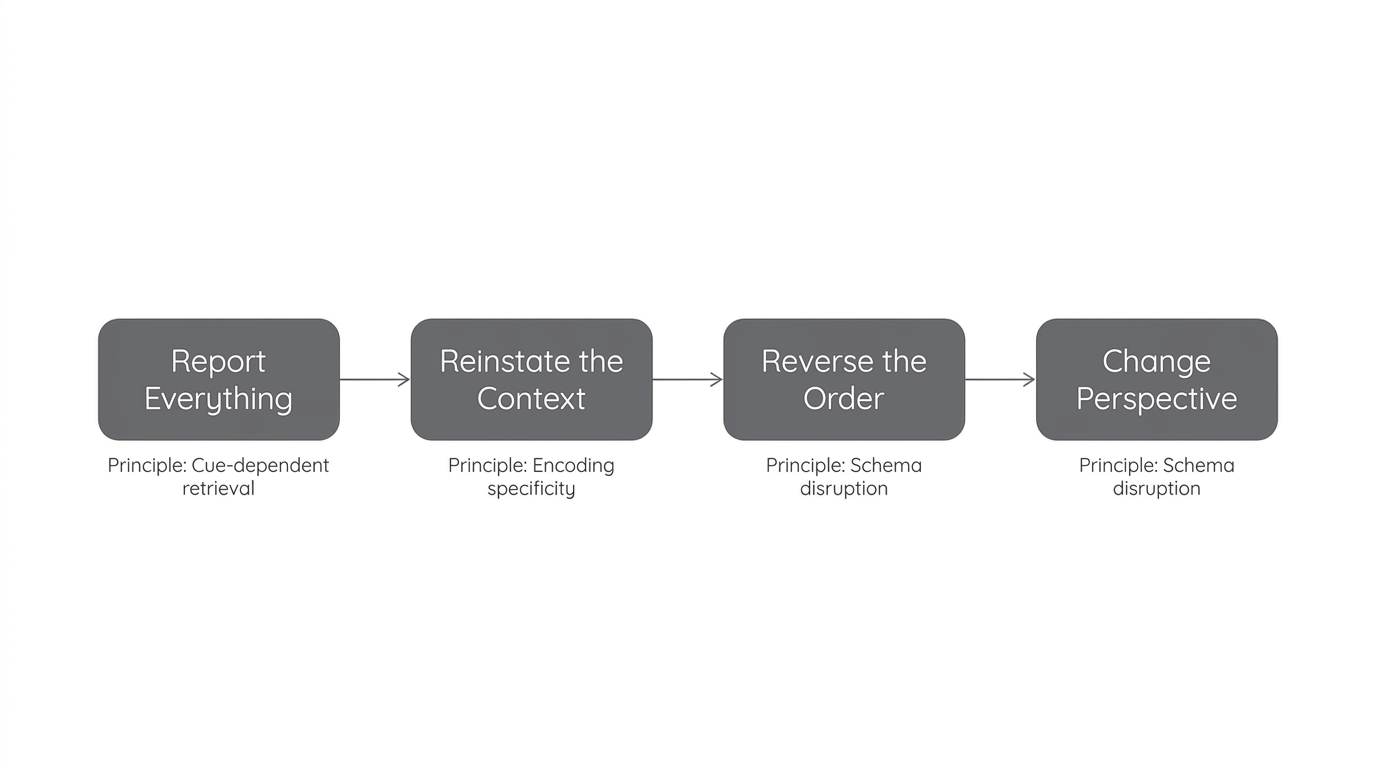
A method of interviewing eyewitnesses designed to improve the accuracy of their recall. It uses four main techniques — report everything, reinstate the context, reverse the order, and change perspective — all based on psychological research into how human memory works.
Ronald Fisher and Edward Geiselman argued that police interview techniques should be based on what psychologists know about how memory works. They developed the cognitive interview to replace the standard approach, drawing on theories such as Tulving's encoding specificity principle (the idea that memory retrieval is most effective when the cues present at recall match those present at encoding) and schema theory (the idea that our pre-existing knowledge structures can distort what we remember).
The Four Techniques of the Cognitive Interview
Fisher and Geiselman (1992) proposed four core techniques that make up the cognitive interview. Each one is rooted in a specific aspect of memory theory.
1. Report everything
The witness is asked to report every detail they can remember, no matter how trivial or irrelevant it may seem. Even small, seemingly unimportant details may act as retrieval cues that trigger the recall of other, more significant memories. This technique is grounded in the principle that memories are interconnected — recalling one detail can unlock access to others through cue-dependent retrieval.
2. Reinstate the context
The witness is encouraged to mentally return to the scene of the crime and reconstruct the environmental context (what the weather was like, what they could see, the time of day) and their emotional state at the time (whether they were happy, anxious, or distracted). This technique draws directly on context-dependent forgetting and Tulving's encoding specificity principle: memory retrieval improves when the cues present at recall match those present at encoding.
3. Reverse the order
Instead of recalling events in chronological order, the witness is asked to describe what happened in a different sequence — for example, starting from the end and working backwards, or beginning in the middle. This serves two purposes. First, it disrupts the influence of schemas — pre-existing expectations about how events typically unfold — which can cause witnesses to fill in gaps with what they think must have happened rather than what actually happened. Second, it makes it more difficult for a dishonest witness to fabricate a false account, because lying in reverse is cognitively demanding.
4. Change perspective
The witness is asked to recall the event from the perspective of another person who was present — for example, from the viewpoint of the victim, a bystander, or even the perpetrator. Like reversing the order, this technique is designed to reduce the distorting influence of schemas and personal expectations on recall. By adopting a different viewpoint, the witness may access details they overlooked from their own perspective.
Priya witnessed a robbery at a petrol station while filling up her car. When interviewed using the cognitive interview, the police officer first asks Priya to close her eyes and picture herself back at the petrol station — to think about the cold evening air, the bright fluorescent lighting, and the uneasy feeling she had when the man in the hoodie walked in. The officer then asks Priya to tell him everything she can remember, no matter how small. Later, the officer asks Priya to describe the events starting from the moment police arrived and working backwards to the start of the robbery.
The cognitive interview is therefore not a single technique but a structured combination of four approaches, each targeting a different barrier to accurate recall.
The Enhanced Cognitive Interview (ECI)
Fisher et al. (1987) recognised that the original CI focused primarily on cognitive techniques for improving memory retrieval but paid insufficient attention to the interpersonal dynamics between the interviewer and the witness. They developed the enhanced cognitive interview (ECI), which added several elements focused on the social and communicative aspects of the interview.
Enhanced Cognitive Interview
An extension of the original cognitive interview that incorporates additional techniques focused on the social dynamics of the interview. These include building rapport with the witness, reducing anxiety, minimising distractions, encouraging the witness to speak slowly, using open-ended questions, and managing non-verbal communication such as eye contact.
The ECI includes techniques such as:
- Building rapport with the witness before questioning begins, to help them feel comfortable and willing to share sensitive or personal information.
- Reducing anxiety — a relaxed witness is more likely to recall accurately than a stressed one.
- Minimising distractions in the interview environment to allow the witness to focus.
- Encouraging slow speech — asking the witness to speak slowly gives them time to retrieve memories carefully rather than rushing.
- Using open-ended questions rather than closed or leading questions — this allows the witness to give a fuller account in their own words.
- Managing eye contact — knowing when to establish and when to break eye contact to keep the witness calm and at ease.
The ECI therefore combines the four cognitive retrieval techniques of the original CI with a psychologically informed approach to the interpersonal aspects of interviewing. In practice, police forces often use a mixture of CI and ECI elements rather than following a single rigid procedure.
Evidence — How Effective Is the Cognitive Interview?
Several studies have investigated whether the CI produces more accurate recall than the standard police interview.
Köhnken et al. (1999) — Conducted a meta-analysis combining data from 55 studies that compared the cognitive interview (and the enhanced cognitive interview) with the standard police interview. The meta-analysis (a research method that statistically combines the results of multiple studies on the same topic) found that the CI produced an average 41% increase in the amount of correct information recalled compared with the standard interview. Only four of the 55 studies found no difference between the CI and the standard interview. However, Köhnken et al. also found that the CI led to an increase in the amount of incorrect information recalled, particularly when the enhanced cognitive interview was used. This suggests that while the CI improves the quantity and overall accuracy of recall, it may also produce more false details alongside the accurate ones.
Milne and Bull (2002) — Investigated which of the four CI techniques are most effective. They found that each of the four techniques used individually produced more information than the standard police interview. However, the combination of report everything and reinstate the context together produced better recall than any other single technique or combination. This finding has practical significance: it suggests that police forces could achieve substantial improvements in witness recall by training officers in just these two techniques, even if time and resources do not allow training in the full CI.
Kebbell and Wagstaff (1997) — Surveyed police officers about their use of the CI in practice. Officers reported that the CI is time-consuming to conduct and that training in its use is both time-consuming and expensive. Many police forces could only provide a few hours of training, which officers felt was insufficient — particularly for the enhanced social skills required by the ECI. This helps explain why, despite evidence of its effectiveness, the CI has not been universally adopted by police forces.
The cognitive interview is supported by substantial evidence showing it improves accurate recall, but it also increases inaccurate recall, takes more time than standard interviews, and requires specialist training that many police forces struggle to provide.
Taken together, the evidence paints a nuanced picture: the CI is a genuine improvement over standard interview methods, but it is not a perfect solution. Understanding the strengths and weaknesses of the research evidence is essential for evaluating the CI effectively in exam answers.
Evaluation Bank (AO3)
Strength: The cognitive interview has strong research support demonstrating its effectiveness. Köhnken et al. (1999) conducted a meta-analysis of 55 studies and found that the CI produced a 41% average increase in correct information recalled compared with the standard police interview, with only four studies showing no difference. Because a meta-analysis combines data from many studies using different participants, settings, and procedures, the finding has high reliability and can be generalised with greater confidence than any single study. This means we can be reasonably certain that the CI genuinely improves witness recall and is not simply an artefact of one particular research design. The strength of this evidence is further supported by the fact that the CI is grounded in well-established psychological principles (such as Tulving's encoding specificity principle), giving it a strong theoretical foundation as well as empirical support.
Limitation: A significant practical limitation of the cognitive interview is that it is time-consuming and requires specialist training that many police forces cannot provide. Kebbell and Wagstaff (1997) found that police officers viewed the CI as impractical because it took longer to conduct than a standard interview and because adequate training was expensive and time-intensive. Many forces could only offer a few hours of training, which officers felt was insufficient — especially for the enhanced social skills required by the ECI. This means that although the CI is effective under controlled research conditions, its real-world applicability is limited by practical constraints. This relates to the broader debate about the gap between psychological research and its application in real-world settings: a technique can be scientifically valid but still fail to achieve its potential if it cannot be realistically implemented.
Limitation: The cognitive interview increases the quantity of information recalled but does not exclusively improve the accuracy of that information. Köhnken et al. (1999) found that as well as increasing correct recall, the CI also increased the amount of incorrect information reported, with the enhanced cognitive interview producing even more false details than the original CI. This is problematic because the primary purpose of the CI was to improve the reliability of eyewitness testimony for use in criminal investigations. If witnesses produce more inaccurate information alongside accurate details, police officers and juries may struggle to distinguish true memories from false ones. This suggests that the CI should be used with caution and that corroborating evidence should always be sought — the CI improves but does not guarantee the accuracy of eyewitness accounts. However, Milne and Bull (2002) offer a partial solution: they found that using just the report everything and reinstate the context techniques together was as effective as the full CI, suggesting that a streamlined version may achieve the benefits while reducing the risk of generating excessive inaccurate information.