2.2.3 The Endocrine System: Glands and Hormones
The nervous system is not the only communication network in your body. Running alongside it is the endocrine system, a slower but more widespread chemical messenger system that releases hormones into the bloodstream. Where the nervous system sends rapid, short-lived electrical signals along specific neural pathways, the endocrine system broadcasts chemical messages that can reach almost every cell in the body, producing powerful and long-lasting effects. Understanding the endocrine system is essential for this specification because it underpins topics you will meet later — the fight-or-flight response, the role of hormones in aggression, and the biological approach to explaining behaviour.
Part 1 — The Endocrine System: An Overview
Endocrine system
One of the body's major information systems, consisting of a network of glands that manufacture and secrete hormones directly into the bloodstream. These hormones are transported to target organs and cells throughout the body, where they regulate physiological processes and behaviour.
The endocrine system works alongside the nervous system to maintain homeostasis — the stable internal conditions the body needs to function. However, the two systems operate very differently. The nervous system communicates via electrical impulses travelling along neurons, producing effects in milliseconds. The endocrine system communicates via hormones — chemical substances released by glands into the blood — which travel more slowly (taking seconds to minutes to reach their targets) but tend to have more widespread and longer-lasting effects.
Hormones
Chemical messengers produced by endocrine glands and secreted directly into the bloodstream. Hormones travel to target organs where they bind to specific receptors on cells, triggering physiological changes. They are produced in large quantities but are broken down relatively quickly, so their effects, while powerful, are not permanent.
Gland
An organ in the body that synthesises and releases chemical substances, such as hormones. Endocrine glands (e.g. the pituitary, thyroid, and adrenal glands) release their products directly into the bloodstream, unlike exocrine glands (e.g. salivary glands) which release substances through ducts.
Hormones only affect cells that carry the correct receptor for that hormone. This is often described as a lock-and-key mechanism: the hormone is the key and the receptor on the target cell is the lock. If the receptor matches, the hormone binds and triggers a response; if it does not, the cell is unaffected. This selectivity means that although hormones travel through the entire bloodstream, they only influence specific target organs.
A crucial point for the exam is the contrast between the nervous system and the endocrine system:
| Feature | Nervous system | Endocrine system |
|---|---|---|
| Type of signal | Electrical impulses (and neurotransmitters at synapses) | Chemical hormones via the bloodstream |
| Speed | Very fast (milliseconds) | Slower (seconds to minutes) |
| Duration of effect | Short-lived | Longer-lasting |
| Precision | Highly targeted (specific neurons and muscles) | Widespread (any cell with the correct receptor) |
| Pathway | Along neurons | Via the bloodstream |
Although they are distinct systems, the nervous and endocrine systems interact constantly. The most important example of this interaction is the relationship between the hypothalamus (a brain structure) and the pituitary gland, which forms the primary link between the nervous system and the endocrine system.
Part 2 — The Major Endocrine Glands
The body contains several endocrine glands, each producing specific hormones with distinct functions. You need to know the key glands and the hormones they produce for the AQA specification.
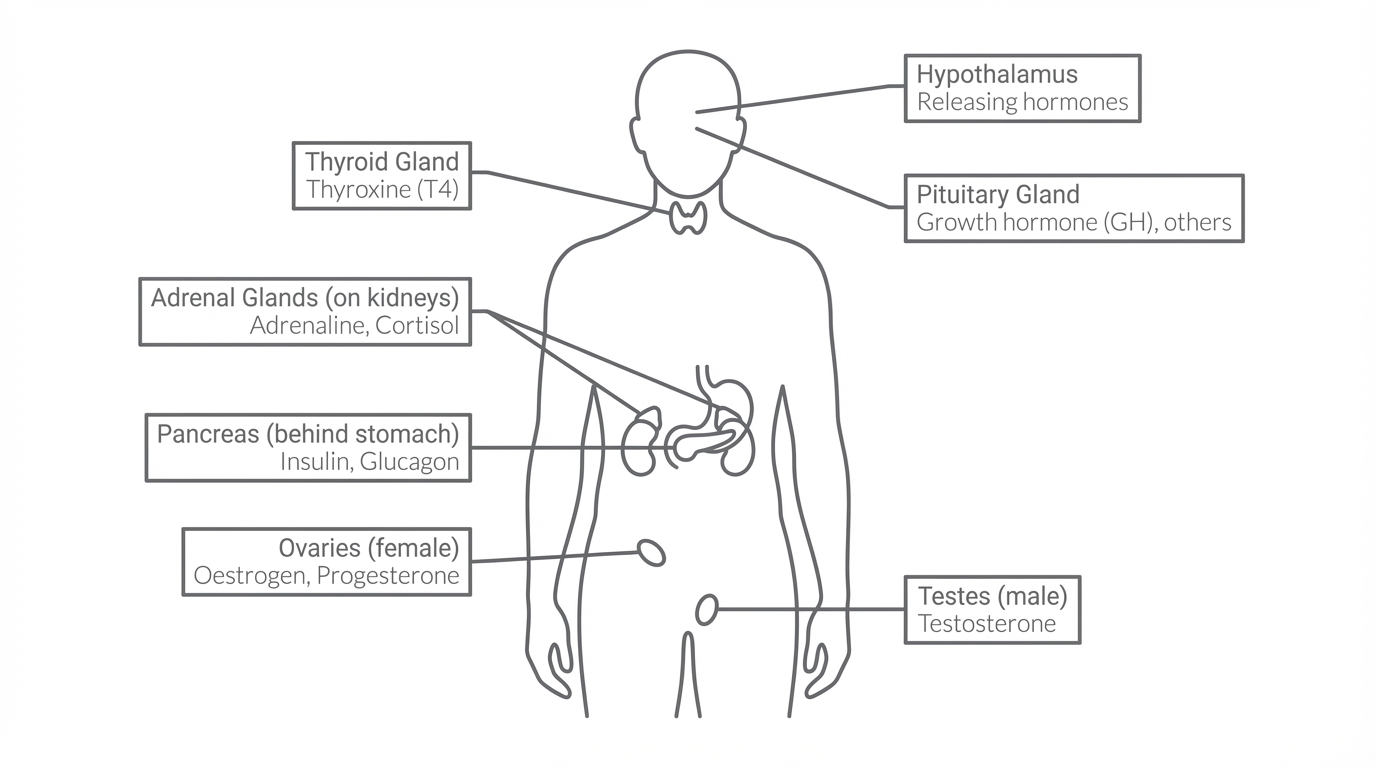
The Pituitary Gland — the "Master Gland"
Pituitary gland
A small, pea-sized endocrine gland located at the base of the brain, just below the hypothalamus. It is often called the 'master gland' because it releases hormones that control the activity of many other endocrine glands in the body.
The pituitary gland is controlled by the hypothalamus, a brain structure that acts as the bridge between the nervous system and the endocrine system. The hypothalamus detects changes in the body (e.g. stress, temperature, blood composition) via the nervous system and instructs the pituitary gland to release — or stop releasing — specific hormones.
The pituitary has two main sections:
- The anterior pituitary produces hormones including ACTH (adrenocorticotropic hormone), which stimulates the adrenal glands to release cortisol; growth hormone, which regulates physical growth; and FSH (follicle-stimulating hormone), which is involved in reproductive function.
- The posterior pituitary stores and releases hormones manufactured by the hypothalamus, including oxytocin (involved in bonding and social attachment) and ADH (antidiuretic hormone, which regulates water balance).
The pituitary gland earns its title of "master gland" because its hormones trigger other glands to release their own hormones. For example, ACTH from the pituitary instructs the adrenal cortex to release cortisol. However, it is worth noting that the pituitary itself is controlled by the hypothalamus — so the hypothalamus could be considered the true controller of the endocrine system.
The Thyroid Gland
The thyroid gland is located in the neck and produces the hormone thyroxine. Thyroxine has wide-ranging effects throughout the body: it regulates the body's metabolic rate (the speed of chemical processes in cells), affects heart rate, and influences growth and development. Higher thyroxine levels increase metabolic rate and energy expenditure; lower levels slow these processes. Abnormalities in thyroxine production can have psychological effects — for example, an underactive thyroid (hypothyroidism) is associated with fatigue, low mood, and cognitive sluggishness.
The Adrenal Glands
The two adrenal glands sit on top of each kidney. Each adrenal gland has two distinct regions:
- The adrenal medulla (inner part) produces adrenaline (also called epinephrine) and noradrenaline (norepinephrine). Adrenaline is the hormone most directly involved in the acute fight-or-flight response: it increases heart rate, dilates air passages, diverts blood to the muscles, and releases glucose for energy. You will study the fight-or-flight response in detail in a separate lesson.
- The adrenal cortex (outer part) produces cortisol, a hormone released during prolonged stress. Cortisol helps the body maintain energy supply by regulating blood sugar levels and suppressing non-essential functions such as the immune response and digestion.
The Ovaries and Testes
The ovaries (in females) produce oestrogen and progesterone, hormones involved in the menstrual cycle, sexual development, and reproductive behaviour. The testes (in males) produce testosterone, a hormone involved in the development of male sex characteristics, muscle mass, and — as you will study later — aggression.
The Pancreas
The pancreas produces insulin and glucagon, which work together to regulate blood glucose levels. Insulin lowers blood sugar when it is too high; glucagon raises it when it is too low.
David has been revising late into the night for his exams and has been sleeping very little. He has noticed that he feels constantly cold, sluggish, and unable to concentrate. His doctor runs a blood test and discovers that David's thyroid gland is underproducing thyroxine. Because thyroxine regulates metabolic rate throughout the body, David's low levels mean his cells are not producing enough energy, explaining his physical and cognitive symptoms. This illustrates how the endocrine system, through the release of a single hormone, can have widespread effects on both the body and psychological functioning.
Part 3 — The Endocrine System and the Nervous System Working Together
Although the nervous system and endocrine system are presented as separate systems, in reality they work in close collaboration. The most important link between them is the hypothalamic-pituitary axis — the connection between the hypothalamus (part of the nervous system) and the pituitary gland (the master gland of the endocrine system).
When the brain detects a threat or stressor via the nervous system, the hypothalamus can activate the endocrine system in two main ways:
-
The rapid pathway (SAM axis): The hypothalamus activates the sympathetic branch of the autonomic nervous system, which stimulates the adrenal medulla to release adrenaline into the bloodstream. This produces the immediate, short-term fight-or-flight response — elevated heart rate, increased breathing, heightened alertness. This response takes effect within seconds.
-
The slower pathway (HPA axis): The hypothalamus releases CRH (corticotropin-releasing hormone), which travels to the anterior pituitary gland and triggers the release of ACTH. ACTH then travels via the bloodstream to the adrenal cortex, which responds by releasing cortisol. Cortisol helps maintain the body's stress response over a longer period — minutes to hours — by regulating blood sugar and suppressing non-essential functions.
This demonstrates that the nervous system and endocrine system are not truly independent — they form an integrated communication network. The nervous system provides rapid, precise responses while the endocrine system sustains and amplifies those responses through hormonal action.
The endocrine system is a chemical messenger system that works alongside the nervous system. Glands release hormones into the bloodstream to regulate bodily processes. The pituitary gland — controlled by the hypothalamus — is the "master gland" that coordinates the activity of other endocrine glands. The nervous system acts fast and precisely; the endocrine system acts more slowly but with widespread, long-lasting effects.
Evaluation Bank (AO3)
Strength: The endocrine system provides a clear biological explanation for many aspects of human behaviour, which is a strength because it gives psychology a scientific, measurable basis for understanding behaviour. For example, researchers can measure hormone levels (such as cortisol or testosterone) in blood samples and correlate these with specific behaviours like aggression or stress responses. This measurability gives the endocrine explanation high scientific credibility and allows hypotheses to be empirically tested. For instance, studies have shown that cortisol levels are reliably elevated in individuals experiencing chronic stress, confirming the role of the HPA axis in the stress response. This means the endocrine explanation meets the criteria for being a scientific account of behaviour, lending it greater validity than purely subjective or introspective approaches.
Limitation: The endocrine explanation can be criticised as biologically reductionist because it reduces complex human experiences and behaviours to the action of hormones on target cells. For example, explaining aggression solely in terms of elevated testosterone levels ignores the role of cognitive factors (such as how a person interprets a situation), social learning (such as observing aggressive role models), and cultural norms that shape whether aggression is expressed. Reductionism oversimplifies behaviour by treating hormones as direct causes when, in reality, the relationship between hormones and behaviour is bidirectional — not only does testosterone influence aggression, but engaging in competitive or aggressive behaviour can itself raise testosterone levels. This means that while the endocrine system provides a partial explanation for behaviour, it is incomplete on its own and needs to be integrated with psychological and social explanations for a full understanding. This relates to the reductionism versus holism debate in psychology.
Limitation: A further issue concerns the degree to which endocrine explanations imply biological determinism — the idea that behaviour is determined by internal biological processes beyond a person's control. If aggression is "caused" by high testosterone or stress is "caused" by elevated cortisol, this leaves little room for free will or personal responsibility. This has significant real-world implications: for example, it could be used to argue that individuals are not responsible for violent behaviour because it was "determined" by their hormones. However, the existence of cognitive behavioural therapies that successfully help people manage stress and anger despite their hormonal profiles demonstrates that humans are not simply controlled by their endocrine system — they can exert conscious control over their responses. This links to the free will versus determinism debate, and suggests that a complete account of behaviour must consider both biological predispositions and the individual's capacity for choice.