1.1.1 Types of Conformity and Explanations
Conformity is one of the most important topics in social influence and forms the foundation for understanding how groups shape individual behaviour. In this lesson, you will learn about the three types of conformity proposed by Kelman, the two explanations for conformity identified by Deutsch and Gerard, and the key situational variables that Asch investigated through his classic line-judging experiments. By the end, you will be able to distinguish between types and explanations, apply them to exam scenarios, and evaluate the research evidence critically.
Types of Conformity
Conformity
A change in a person's behaviour or opinions as a result of real or imagined pressure from a person or group of people.
Not all conformity is the same. Herbert Kelman (1958) proposed three distinct types of conformity, which differ in how deeply the individual accepts the group's position and how long the change lasts.
Internalisation
Internalisation
The deepest type of conformity, where an individual genuinely accepts the group's beliefs or behaviours as their own. The change is both public and private, and it persists even when the group is no longer present because the views have become part of the person's own way of thinking.
Internalisation represents a true conversion of opinion. The person does not merely go along with the group outwardly — they come to believe that the group's position is correct. For example, someone raised in a household that values environmental conservation may genuinely adopt those beliefs as their own, continuing to recycle and reduce waste throughout their life regardless of whether anyone is watching. Because the change has been internalised into the person's own value system, it tends to be permanent. Internalisation is most likely to occur through informational social influence, where the person accepts the group's view because they believe it is accurate.
Identification
Identification
A moderate type of conformity where an individual publicly changes their behaviour or beliefs in order to be accepted by a group they value and wish to belong to. The person does not fully accept the group's views privately, and the change may not persist if the individual leaves the group.
Identification sits between the other two types. The person conforms because membership of the group matters to them — they identify with the group and want to be a part of it. Unlike internalisation, the person has not genuinely adopted the group's beliefs as their own; unlike compliance, there is a degree of engagement with the group's values rather than simple outward agreement. For instance, a new employee might adopt the dress code, communication style, and working habits of their colleagues because they want to fit into the team, even though these do not reflect how they would naturally behave outside of work. If the person leaves the job, these adopted behaviours are likely to fade because they were driven by group membership rather than genuine personal acceptance.
Compliance
Compliance
The shallowest type of conformity, where an individual publicly goes along with the majority view but privately disagrees. The change is temporary and only lasts as long as the group is present or monitoring.
Compliance is essentially "going along with the crowd." The person outwardly agrees with the group to gain approval or avoid disapproval, but their private opinion remains unchanged. A classic everyday example would be laughing at a joke you do not find funny because everyone else in the group is laughing. As soon as the social pressure is removed, the behaviour stops. Compliance is most commonly driven by normative social influence — the desire to be liked rather than any genuine belief that the group is correct.
| Type | Depth | Public response | Private response | Key feature |
|---|---|---|---|---|
| Internalisation | Deepest | Public agreement | Private agreement | Permanent change and genuine acceptance |
| Identification | Moderate | Public change | Private views not fully changed | Group-dependent and driven by valuing group membership |
| Compliance | Shallowest | Public agreement only | Private disagreement | Temporary and lasts only while group pressure is present |
Explanations for Conformity
Having established the types of conformity, we now turn to the reasons why people conform. Morton Deutsch and Harold Gerard (1955) proposed a two-process theory, arguing that conformity stems from two fundamental human needs: the need to be right and the need to be liked.
Informational Social Influence (ISI)
Informational Social Influence (ISI)
An explanation for conformity based on the desire to be correct. When individuals are uncertain about the right course of action, they look to others for guidance and accept the majority position because they believe it is accurate. ISI is a cognitive process that typically leads to internalisation.
ISI is about who has the better information — you or the rest of the group. When we lack knowledge, face an ambiguous situation, or need to make a rapid decision in a crisis, we assume that other people probably have better information than we do. We therefore adopt their position because we genuinely believe they are right, not because we want to be liked. Because the person truly accepts the group's answer as correct, ISI typically leads to internalisation — a lasting change in both public behaviour and private belief.
ISI is most likely to occur in situations that are new to a person (so they do not know what is right), where there is genuine ambiguity (so it is not clear what is right), or in crisis situations where decisions must be made quickly. For example, if you are unsure which exit to use during a fire alarm in an unfamiliar building, you are likely to follow the crowd because you assume they know the way out.
Lucas et al. (2006) — Conducted a laboratory experiment in which participants were asked to solve easy and hard maths problems while being shown answers supposedly from other students (who were not real). Participants conformed more frequently to incorrect answers when the problems were difficult, and especially when they rated their own mathematical ability as low. This demonstrates that people turn to others for information when they lack the knowledge to judge for themselves — exactly what ISI predicts.
Normative Social Influence (NSI)
Normative Social Influence (NSI)
An explanation for conformity based on the desire to be accepted and liked by a group. Individuals go along with the majority to gain social approval or to avoid rejection. NSI is an emotional process that typically leads to compliance.
NSI is about norms — what is "normal" or typical behaviour for a social group. People do not want to appear foolish and prefer to gain social approval rather than be rejected. NSI is therefore an emotional process rather than a cognitive one. Because the person's private opinion has not actually changed, NSI typically leads to compliance — a temporary, surface-level change.
NSI is particularly likely in situations involving strangers (where first impressions matter and the fear of rejection is high), among friends (whose approval we especially value), and in stressful situations (where the need for social support is heightened).
Evidence for NSI comes from Asch's own research. Asch (1951) — When participants in Asch's line-judging laboratory experiment were interviewed afterwards, several reported that they conformed because they felt self-conscious giving the correct answer and feared disapproval from the group. Furthermore, when Asch modified the procedure so that participants wrote their answers down privately instead of stating them aloud, conformity dropped to 12.5%. This strongly suggests that normative pressure — the desire to avoid public disagreement — was a significant driver of conformity. Removing the public element removed the normative pressure, and conformity fell dramatically.
Priya has just started at a new school and is desperate to make friends. During lunch, her new group of friends all express enthusiasm for a television show that Priya finds boring. She tells the group she loves the show too and makes a point of discussing it every day, even though she has no genuine interest in watching it. Priya's behaviour demonstrates compliance driven by normative social influence: she is publicly agreeing with the group to gain their approval and avoid the risk of being excluded as the newcomer, but her private opinion has not changed.
It is important to note that NSI and ISI are not always easy to separate in practice. Deutsch and Gerard (1955) originally presented them as two distinct processes, but they often operate together. For instance, when a dissenting confederate breaks the unanimity in Asch's study, this could reduce conformity by providing social support (reducing NSI) or by offering an alternative source of information that validates the participant's own judgement (reducing ISI). Both interpretations are plausible, and in many real-world situations the two influences complement each other rather than acting in isolation.
Asch's Line-Judging Study
The most influential research on conformity was conducted by Solomon Asch (1951, 1955). Asch designed a laboratory experiment to test whether people would conform to a clearly incorrect majority, even when the correct answer was obvious. As a laboratory experiment, this was a controlled research method in which the key variables (such as group size, unanimity, and task difficulty) were systematically manipulated while extraneous variables were kept constant.
Procedure
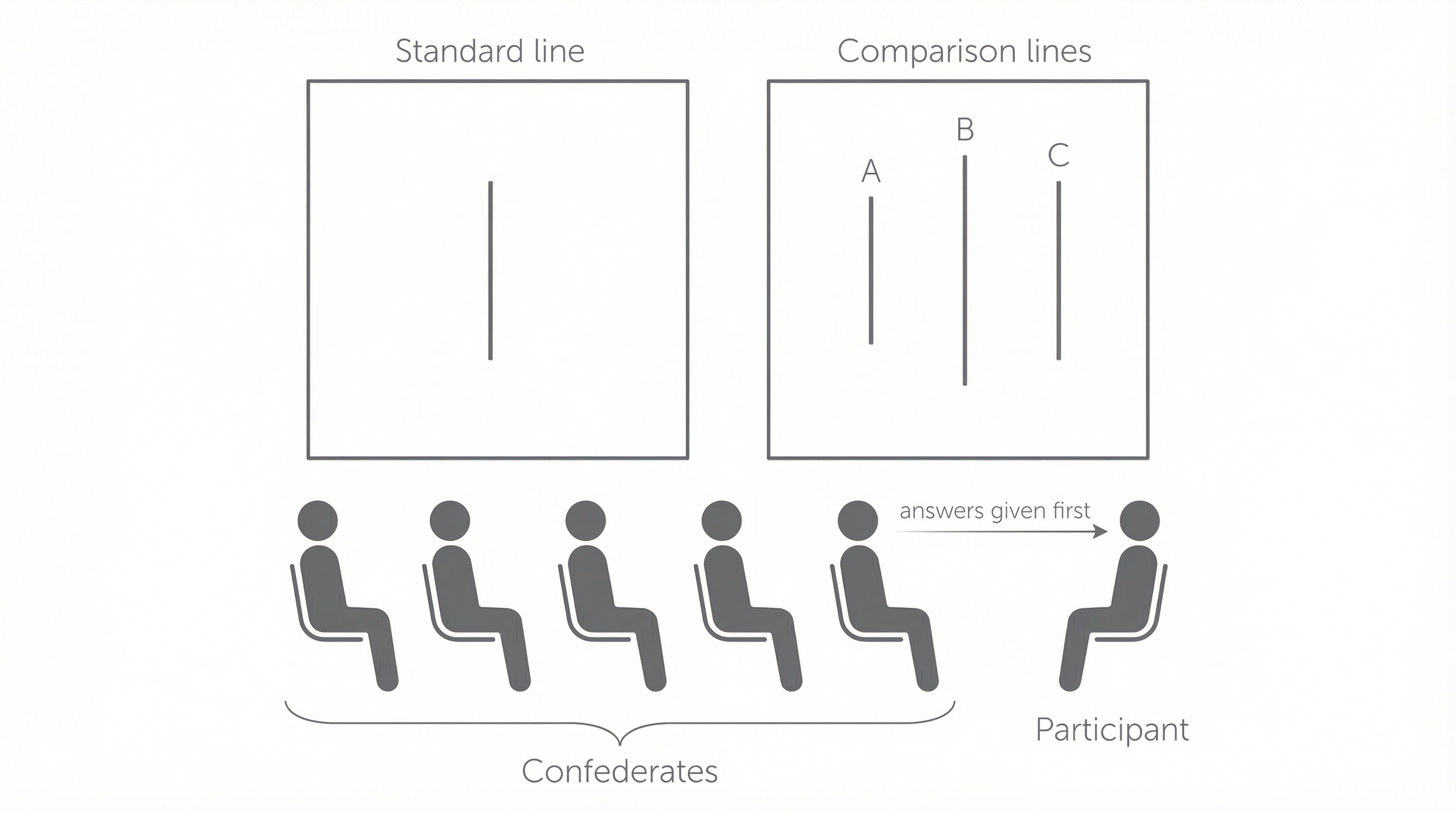
Asch tested 123 American male undergraduates, each placed in a group of six to eight people. Only one person in each group was a genuine (naive) participant — all the others were confederates who had been instructed to give predetermined answers. The group was shown two cards: one displaying a single standard line and the other displaying three comparison lines of different lengths. The task was straightforward — state out loud which comparison line matched the standard line in length.
The genuine participant was always seated last or second to last, so they heard the confederates' answers before giving their own. On 12 out of 18 trials (called "critical trials"), all confederates deliberately gave the same incorrect answer. Asch observed whether the naive participant would conform to this obviously wrong majority or give the correct answer independently.
Findings
The results were striking. On the critical trials, participants conformed to the incorrect majority 36.8% of the time on average. Looking at individual differences, 75% of participants conformed at least once, while 25% never conformed at all. In a control condition where there were no confederates, fewer than 1% of responses were incorrect. This confirmed that the task was genuinely easy and that the errors in the experimental condition were caused by social influence rather than perceptual difficulty.
Variables Affecting Conformity
Asch (1955) extended his baseline study by systematically varying different aspects of the situation to identify the factors that increase or decrease conformity. He investigated three key variables: group size, unanimity, and task difficulty.
Group Size
Asch varied the number of confederates from one to fifteen to determine whether larger majorities produce more conformity. He found a curvilinear relationship: conformity increased as the group grew, but only up to a point. With just one confederate, there was very little conformity. With two confederates, conformity was still relatively low. However, with three confederates, conformity rose sharply to approximately 31.8%. Beyond a group of three or four confederates, conformity levelled off — adding more people to the majority made little additional difference.
This finding suggests that people are sensitive to the views of others and that even a small majority of three is sufficient to exert significant pressure. However, an overwhelming majority is not necessary to produce conformity.
Unanimity
Asch investigated the effect of breaking the unanimity of the majority by introducing a dissenting confederate — one who gave a different answer from the rest of the group. In one variation, the dissenter gave the correct answer; in another, they gave a different incorrect answer.
The results were dramatic. When the majority was unanimous, conformity stood at approximately 32%. When one confederate gave the correct answer, conformity dropped to just 5.5%. Even when the dissenter gave a different wrong answer, conformity still fell to around 9%. The presence of any form of dissent — regardless of whether the dissenter was actually correct — appeared to free the naive participant to respond more independently.
This demonstrates that unanimity is crucial for majority influence. Even a single crack in the group's consensus significantly weakens the pressure to conform, because it gives the participant confidence to trust their own judgement.
Task Difficulty
Asch also manipulated the difficulty of the line-judging task by making the comparison lines more similar in length to the standard line. This made it harder for participants to identify the correct answer with certainty.
Under these conditions, conformity increased. When the task was more ambiguous, participants were less sure of their own answer and therefore more likely to rely on the group's judgement. This variable connects directly to informational social influence — in uncertain situations, people look to others for information about what is correct.
A group of Year 12 students are revising together for their psychology exam. One student, Callum, is unsure about the answer to a practice question on research methods. All four of his friends confidently give the same answer — one that Callum suspects may be wrong. However, when another student, Aisha, arrives and says she thinks a different answer is correct, Callum feels more confident in disagreeing with the group and gives his own answer. This illustrates how unanimity and task difficulty interact: the task was difficult for Callum (increasing conformity via ISI), but the break in unanimity provided by Aisha's dissent freed him to think independently.
The key insight from Asch's research into variables is that conformity is not simply a personality trait — it is powerfully shaped by situational factors. Group size, unanimity, and task difficulty all systematically influence whether a person conforms, with unanimity emerging as the single most important factor.
Asch demonstrated that conformity depends on the situation, not just the person. A unanimous majority of just three people is enough to produce significant conformity, but even one dissenter can dramatically reduce it.
The findings from Asch's variations provide strong evidence for both ISI and NSI. The task difficulty variable supports ISI (people conform more when they are uncertain), while the unanimity variable supports NSI (a unanimous group creates stronger normative pressure). The group size variable likely operates through both processes — a larger majority is both a more compelling source of information and a more powerful source of social pressure.
Evaluation Bank (AO3)
The following evaluation paragraphs are structured using the PEEL format (Point, Evidence, Explain, Link) that AQA examiners reward in 16-mark essays. Each paragraph can be used directly in an essay on conformity.
Strength: A key strength of Asch's research is its high internal validity due to the strict control of extraneous variables within the laboratory experiment. The standardised procedure — including the controlled timing, predetermined confederate responses, and identical line-judging task — meant that Asch could confidently attribute changes in conformity to the manipulated variables (group size, unanimity, task difficulty) rather than to confounding factors. The inclusion of a control condition, in which fewer than 1% of responses were incorrect, confirmed that participants could easily identify the correct line when not subjected to group pressure, ruling out perceptual difficulty as an alternative explanation. This means we can be confident that the conformity observed in the experimental conditions was genuinely caused by social influence, not by the task itself. The laboratory setting also allowed for successful replication, increasing the reliability of the findings and making them a robust foundation for understanding situational factors in conformity.
Limitation: A significant limitation of Asch's research concerns its population validity and the potential for cultural bias and gender bias. The sample consisted entirely of American male undergraduates, which limits how far the findings can be generalised. Neto (1995) found evidence suggesting that women may conform more than men, possibly because they are more concerned with maintaining social relationships and gaining acceptance. Furthermore, Bond and Smith (1996) conducted a meta-analysis of conformity studies across different cultures and found that conformity rates were significantly higher in collectivist cultures (such as China, where group harmony is prioritised) compared to individualist cultures like the United States. Asch's findings may therefore underestimate the true extent of conformity in many populations worldwide. Additionally, Perrin and Spencer (1980) replicated Asch's procedure with British engineering students and found conformity on only one out of 396 critical trials, suggesting that Asch's original conformity rate may not generalise across time and social groups. A separate temporal-validity criticism is that Asch tested participants in 1950s America, a period of strong pressure to avoid dissent that is often linked to McCarthyism, which may have made public disagreement feel riskier than it would in other periods. Together, these criticisms suggest that while Asch identified important variables, his specific conformity rates may be a product of the particular sample, culture, and historical period in which the study was conducted, rather than a universal measure of human conformity.
Strength: Another strength is that there is research support for both ISI and NSI as distinct explanations for conformity, demonstrating that the two-process model proposed by Deutsch and Gerard (1955) has predictive value. Lucas et al. (2006) provided support for ISI by showing that conformity increased when maths problems were difficult and participants lacked confidence in their own ability — exactly what ISI predicts about ambiguous situations. Support for NSI comes from Asch's own finding that conformity dropped to 12.5% when participants wrote their answers privately, removing the normative pressure of public disagreement. Furthermore, McGhee and Teevan (1967) found that students high in need for affiliation (nAffiliators — people with a particularly strong desire to relate to others) were more likely to conform, supporting the idea that NSI drives conformity specifically through the emotional need for social approval. These converging lines of evidence from different researchers strengthen the validity of the two-process distinction. However, it should be noted that NSI and ISI often operate together in real-world situations, making them difficult to separate — a dissenting confederate in Asch's study could reduce conformity through either mechanism, suggesting the two-process model may oversimplify a more integrated process.
Bringing It All Together
The topics covered in this lesson — types of conformity, explanations for conformity, and Asch's research into situational variables — are closely interconnected. Types describe what conformity looks like (how deep the change is), while ISI and NSI explain why it happens. Asch's variables then demonstrate when conformity is more or less likely. Being able to link all three elements together in a scenario is a crucial skill for AQA exam questions.
Understanding these concepts is not just about memorising definitions — it is about being able to recognise conformity in real-world situations and explain the psychological processes driving it. In the exam, you will be expected to apply these ideas to novel scenarios and to evaluate the evidence critically using PEEL-structured paragraphs.