1.4.2 Mental Disorders: Phobias, Depression and OCD
The AQA specification requires you to know the behavioural, emotional and cognitive characteristics of three mental disorders: phobias, depression and obsessive-compulsive disorder (OCD). This lesson works through each disorder in turn, explaining how each one affects the way a person acts, feels, and thinks. Being able to distinguish these three types of characteristic — and apply them to unfamiliar scenarios — is essential for exam success, because AQA frequently presents short case studies and asks you to identify which characteristics are being demonstrated. By the end of this lesson you should be able to describe and distinguish the characteristics of all three disorders confidently.
Part 1 — Characteristics of Phobias
Phobia
An irrational fear of an object or situation that is out of all proportion to any actual danger posed by the phobic stimulus. The fear leads to significant anxiety and avoidance behaviour that interferes with everyday functioning.
The DSM-5 recognises three broad categories of phobia: specific phobias (fear of a particular object or situation, such as spiders or flying), social anxiety disorder (fear of social situations, such as public speaking), and agoraphobia (fear of being outside or in public places). Regardless of category, all phobias share a common set of behavioural, emotional and cognitive features.
Behavioural characteristics
The three key behavioural responses to a phobic stimulus are panic, avoidance and endurance.
Panic is the immediate behavioural response to encountering the phobic stimulus. It may involve crying, screaming, running away or freezing. In children, panic can present as clinging to a caregiver or having a tantrum. The underlying mechanism is activation of the sympathetic branch of the autonomic nervous system, triggering the fight-or-flight response.
Avoidance is the most common long-term behavioural pattern. The person goes to considerable effort to prevent contact with the phobic stimulus. This avoidance is maintained through negative reinforcement (an operant conditioning process): escaping or avoiding the stimulus removes the unpleasant anxiety, which reinforces the avoidance behaviour. The consequence is that avoidance can seriously disrupt daily life — for example, someone with a phobia of public toilets may limit the time they spend outside the home.
Endurance is the opposite of avoidance. It occurs when a person remains in the presence of the phobic stimulus despite experiencing high levels of anxiety — for example, someone with arachnophobia choosing to stay in a room with a spider on the ceiling rather than leaving.
Emotional characteristics
The defining emotional feature of phobias is anxiety — an unpleasant state of high arousal that prevents relaxation and makes it very difficult to experience positive emotions. Anxiety in phobias can be persistent and long-lasting.
Closely related but distinct is fear, which is the immediate, intense emotional reaction experienced when encountering or thinking about the phobic stimulus. Fear tends to be more intense but shorter-lived than the broader state of anxiety.
A critical feature is that the emotional response is unreasonable and disproportionate to the actual threat. A person with arachnophobia will experience extreme distress in response to a tiny, harmless spider — a reaction far beyond what the situation warrants.
Cognitive characteristics
Selective attention to the phobic stimulus means that the person finds it extremely difficult to look away from the feared object or situation. While attending to genuine danger can be adaptive, this selective focus becomes problematic when the fear is irrational — for instance, a person with pogonophobia (fear of beards) may be unable to concentrate on their work if someone with a beard is nearby.
Irrational beliefs are unfounded thoughts connected to the phobic stimulus. Someone with a social phobia, for example, might hold beliefs such as "I must always sound intelligent" or "if I blush, people will think I'm weak." These beliefs intensify the pressure to perform in feared situations.
Cognitive distortions mean the person does not perceive the phobic stimulus accurately. Someone with mycophobia (fear of mushrooms) may perceive mushrooms as disgusting, or a person with ophidiophobia (fear of snakes) may see snakes as unnaturally aggressive-looking. These distortions maintain and reinforce the phobia.
| Characteristic type | Key features |
|---|---|
| Behavioural | Panic, avoidance, and endurance |
| Emotional | Anxiety, fear, and an emotional response that is disproportionate to the real threat |
| Cognitive | Selective attention to the phobic stimulus, irrational beliefs, and cognitive distortions |
Part 2 — Characteristics of Depression
Depression
A mood disorder characterised by persistent low mood, reduced energy levels, and a range of behavioural, emotional and cognitive symptoms that significantly impair everyday functioning. The DSM-5 distinguishes major depressive disorder (severe, often short-term) from persistent depressive disorder (long-term or recurring).
Depression belongs to the category of mood disorders and is distinct from the everyday experience of "feeling a bit down." Clinical depression involves symptoms that are prolonged, severe, and pervasive enough to interfere with a person's work, relationships and daily activities.
Behavioural characteristics
Changes in activity levels are a hallmark of depression. Most commonly, people experience reduced energy and lethargy, leading them to withdraw from work, education and social life. In extreme cases, the person may be unable to get out of bed. However, some individuals experience the opposite pattern — psychomotor agitation — where they are unable to relax and may pace restlessly.
Disruption to sleep and eating takes different forms. Sleep disruption may involve insomnia (particularly premature waking) or hypersomnia (excessive sleeping). Similarly, appetite may decrease — leading to significant weight loss — or increase, leading to weight gain. The key point is that these patterns represent a clear change from the person's usual behaviour.
Aggression and self-harm can also feature. People with depression are often irritable and may become verbally or physically aggressive towards others, which can damage relationships or lead to impulsive decisions such as quitting a job. Depression can also lead to aggression directed at the self, including self-harm (such as cutting) and, in severe cases, suicide attempts.
Emotional characteristics
Lowered mood is the defining emotional characteristic, but it goes far beyond ordinary sadness. People with depression often describe feeling "worthless" or "empty," and this lowered mood persists for weeks or months at a time.
Anger is a frequently overlooked emotional feature. People with depression experience intense negative emotions that extend beyond sadness to include anger — sometimes extreme — directed either at themselves or at others.
Lowered self-esteem refers to a reduced sense of self-worth. In severe cases, this can escalate to self-loathing — an intense dislike or hatred of oneself.
Cognitive characteristics
Poor concentration makes it difficult to sustain attention on tasks or to make decisions that would normally be straightforward. This has practical consequences: disrupted performance at work or school, which in turn reinforces feelings of worthlessness.
Selective attention to the negative means the person tends to focus on negative aspects of situations while ignoring positives — seeing the glass as half-empty. There is also a bias towards recalling unhappy memories rather than happy ones, which is the reverse of the pattern seen in people without depression.
Absolutist thinking (also called "black-and-white thinking") means the person interprets situations in extreme, all-or-nothing terms. A minor setback is experienced as a total disaster. For example, a person might think "I forgot to phone my mother today, so I am a complete failure as a daughter."
Tom is a 22-year-old university student who has been struggling since failing an exam two months ago. He has stopped attending lectures and rarely leaves his flat. He sleeps until midday most days, has lost his appetite, and has dropped a considerable amount of weight. When his flatmate asks if he is okay, Tom snaps at him aggressively. Tom tells his flatmate that he is "useless at everything" and that there is "no point" in continuing his course. He cannot concentrate on his revision and keeps thinking about all the other times he has failed in life.
Tom's situation illustrates several characteristics of depression: his withdrawal from university and sleeping until midday are behavioural changes (reduced activity levels and disrupted sleep); his weight loss reflects disrupted eating; his verbal aggression towards his flatmate is a behavioural and emotional feature; his belief that he is "useless at everything" reflects absolutist thinking (cognitive); his focus on past failures demonstrates selective attention to the negative (cognitive); and his feelings of worthlessness reflect lowered self-esteem (emotional).
Part 3 — Characteristics of Obsessive-Compulsive Disorder (OCD)
Obsessive-compulsive disorder (OCD)
A condition characterised by obsessions (recurrent, intrusive and unwanted thoughts, images or urges) and/or compulsions (repetitive behaviours performed to reduce the anxiety caused by obsessions). Most people diagnosed with OCD experience both obsessions and compulsions.
OCD shares features with both phobias (anxiety) and depression (irrational thinking), but it is a distinct disorder. A crucial distinction that examiners test is that obsessions are cognitive (they happen in the mind) while compulsions are behavioural (they are things the person does). Around 90% of people with OCD experience obsessive thoughts, and approximately 70% experience both obsessions and compulsions. About 10% show compulsions alone, and around 20% experience obsessions alone.
Behavioural characteristics
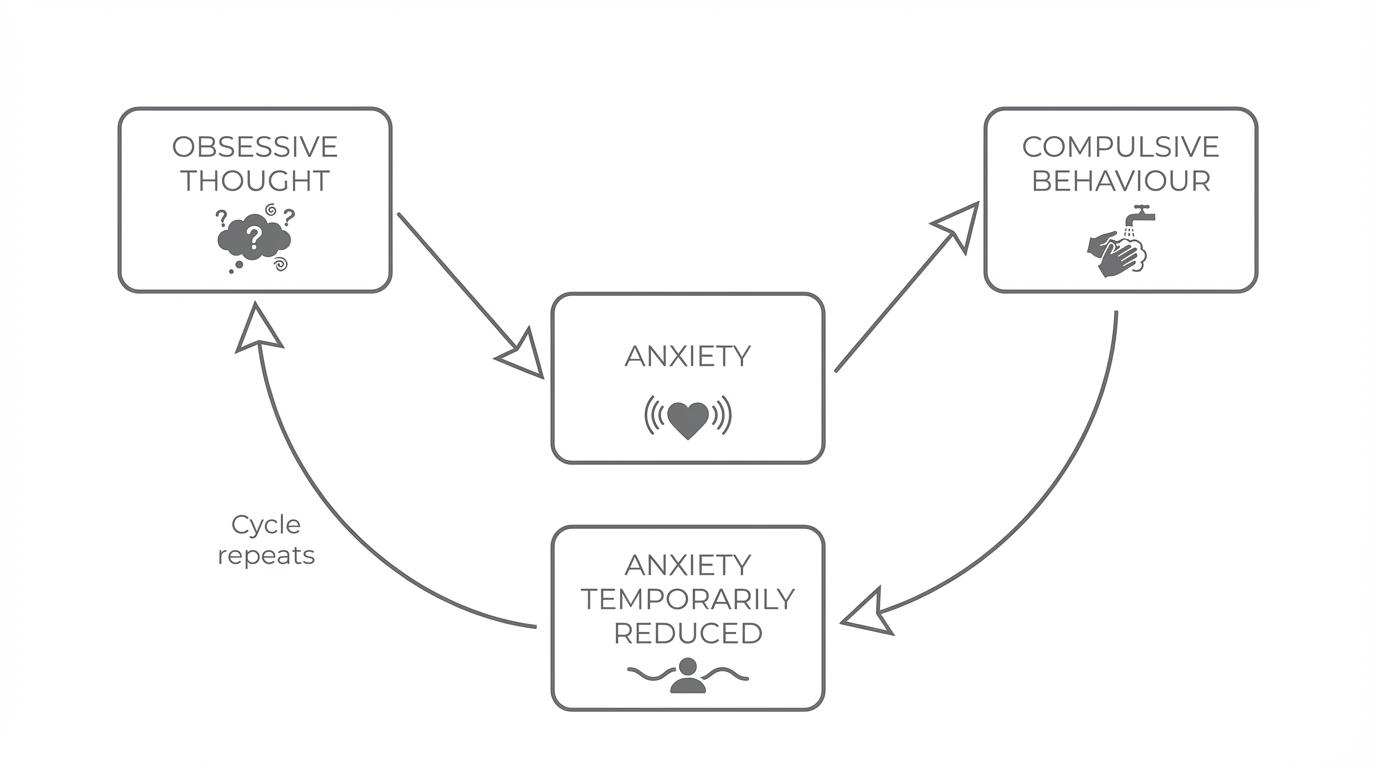
The behavioural component of OCD is compulsive behaviour. Compulsions are repetitive actions that the person feels driven to perform — common examples include handwashing, checking (e.g. that doors are locked or appliances are turned off), counting, praying, and ordering objects. For the majority of people with OCD, these compulsions are carried out in a direct attempt to manage the anxiety produced by obsessive thoughts. For example, compulsive handwashing is performed in response to an obsessive fear of contamination by germs.
Compulsions temporarily reduce anxiety, which is why they are repeated — the relief is real but short-lived, and the cycle of obsession followed by compulsion followed by temporary relief restarts.
Avoidance is also a behavioural feature of OCD. People attempt to reduce anxiety by keeping away from situations that trigger their obsessive thoughts. For instance, someone with contamination fears might avoid emptying rubbish bins or touching door handles. This avoidance can become so extensive that it interferes significantly with everyday life.
Emotional characteristics
Anxiety and distress are central to the OCD experience. Obsessive thoughts are unpleasant and frightening, generating powerful anxiety. The urge to perform compulsive behaviours also creates its own anxiety — the person feels they must carry out the behaviour or something terrible will happen.
Accompanying depression is common. The relentless nature of the obsession-compulsion cycle often leads to low mood and a loss of enjoyment in activities. Compulsive behaviour brings temporary relief, but the overall emotional experience remains negative.
Guilt and disgust are also characteristic emotions. People with OCD may experience irrational guilt — for example, over trivial moral concerns — or feelings of disgust, which may be directed at external triggers (such as dirt) or at themselves.
Cognitive characteristics
Obsessive thoughts are the defining cognitive feature for around 90% of people with OCD. These are recurrent, unwanted and intrusive thoughts, images or impulses that cause significant distress. Common themes include contamination (fear of germs), harm (fear of hurting someone), symmetry (things not being "right"), and doubt (e.g. certainty that a door has been left unlocked). The content varies between individuals but the thoughts are always experienced as unpleasant and difficult to control.
Cognitive coping strategies are methods people with OCD develop to deal with their obsessive thoughts. For example, a person tormented by obsessive guilt may respond by praying or meditating. While these strategies can reduce anxiety in the short term, they may also appear unusual to others and can distract from everyday tasks.
Insight into excessive anxiety is a particularly important cognitive feature and one that often distinguishes OCD from other conditions. People with OCD commonly recognise that their obsessions and compulsions are excessive or irrational, although the level of insight can vary and may sometimes be poor. Despite this insight, they experience catastrophic thinking about worst-case scenarios and tend to be hypervigilant, maintaining constant alertness for potential hazards. This insight — knowing the thoughts are irrational yet feeling unable to stop them — is a source of considerable distress.
The key distinguishing cognitive feature of OCD is insight: the person knows their thoughts are irrational but cannot stop them. This is what separates OCD from disorders involving delusions, where the person genuinely believes their thoughts are based in reality.
Part 4 — Comparing Across All Three Disorders
Now that you have studied each disorder individually, it is worth stepping back to notice the patterns and differences. All three disorders involve anxiety, but the nature and role of that anxiety differs. In phobias, anxiety is triggered by a specific external stimulus. In depression, anxiety may be present but is secondary to the pervading low mood. In OCD, anxiety is generated internally by obsessive thoughts and drives the compulsive behaviours that temporarily relieve it.
| Characteristic type | Phobias | Depression | OCD |
|---|---|---|---|
| Behavioural | Panic, avoidance, endurance | Reduced or agitated activity, disrupted sleep and eating, aggression and self-harm | Compulsions and avoidance |
| Emotional | Anxiety, fear, disproportionate response | Lowered mood, anger, lowered self-esteem | Anxiety and distress, accompanying depression, guilt and disgust |
| Cognitive | Selective attention, irrational beliefs, cognitive distortions | Poor concentration, selective attention to the negative, absolutist thinking | Obsessions, cognitive coping strategies, insight with catastrophic thinking |
Cognitive characteristics also differ meaningfully. In phobias, cognitive distortions involve misperceiving the phobic stimulus. In depression, cognitive patterns include absolutist thinking and selective attention to negative events. In OCD, the person has insight into the irrationality of their own thoughts — a feature not necessarily present in phobias or depression in the same way.
Understanding these distinctions matters because AQA exam questions often present a scenario and ask you to identify which disorder is being described, or to distinguish between the characteristics of two disorders.
Hannah has been experiencing persistent, unwanted thoughts about whether she locked her front door every time she leaves the house. She checks the lock three or four times before she can walk away, and sometimes drives back home from work to check again. Hannah knows this behaviour is irrational and feels embarrassed about it, but she cannot stop the thoughts from recurring. Her partner has noticed that Hannah seems constantly on edge and anxious.
Hannah's experience demonstrates the three types of OCD characteristic: her repetitive checking is a compulsion (behavioural), her recurrent intrusive thoughts about the door being unlocked are obsessions (cognitive), and her constant anxiety and edginess reflect the emotional characteristics of the disorder. Her insight — knowing the behaviour is irrational — is the distinctive cognitive feature that supports an OCD identification rather than another condition.
Evaluation Bank (AO3)
Strength: The classification of mental disorders into behavioural, emotional and cognitive characteristics provides a systematic and comprehensive framework for diagnosis, which improves the reliability of identifying disorders. By requiring clinicians to assess symptoms across all three domains rather than relying on a single feature, the DSM-5 system reduces the likelihood that two clinicians would reach different diagnoses for the same patient. For example, distinguishing OCD from a specific phobia depends on identifying the cognitive feature of insight into irrationality, which is specific to OCD. This structured approach supports the nomothetic goal of psychology — establishing general laws and categories that apply across individuals — and has practical value because reliable diagnosis is a prerequisite for selecting appropriate treatment. This matters because inconsistent diagnosis could lead to ineffective or harmful treatment.
Limitation: A significant limitation of categorising characteristics into behavioural, emotional and cognitive components is that it risks oversimplifying the experience of mental disorders — an issue related to reductionism. In reality, the three types of characteristic do not operate independently: for example, the obsessive thoughts (cognitive) in OCD directly generate anxiety (emotional), which drives compulsive behaviour (behavioural), which temporarily reduces anxiety — a continuous, dynamic cycle. Similarly, in depression, absolutist thinking (cognitive) lowers mood (emotional), which leads to withdrawal from activities (behavioural), which reduces opportunities for positive experiences, reinforcing the low mood further. Breaking this interconnected cycle into separate categories, while useful for description, may give a misleadingly fragmented picture of the disorder. This relates to the broader reductionism versus holism debate: a holistic approach that considers how biological, cognitive, emotional and social factors interact might provide a more complete understanding of mental disorders than listing characteristics in isolation.
Limitation: The behavioural, emotional and cognitive characteristics described in the specification and the DSM represent a nomothetic approach — they describe what is typical across people with a given diagnosis. However, there is considerable individual variation within each disorder. For instance, the textbook notes that depression may involve either insomnia or hypersomnia, and either appetite loss or appetite increase — opposite behavioural patterns that both fall under the same diagnostic label. Similarly, the content of obsessive thoughts in OCD varies enormously from person to person (contamination, harm, symmetry, doubt). This means that two people with the same diagnosis may present very differently, which raises questions about whether broad diagnostic categories capture the true nature of individual suffering. This connects to the idiographic versus nomothetic debate: an idiographic approach, which focuses on the unique experience of each individual, might complement the nomothetic framework by ensuring that treatment is tailored to the specific pattern of characteristics a particular person displays, rather than applying a one-size-fits-all approach based on the diagnostic label.