1.1.3 Obedience
This lesson covers the psychology of obedience -- why people follow direct orders from authority figures, sometimes even when those orders cause harm to others. You will learn about Milgram's landmark baseline study, the situational variables he investigated (proximity, location, and uniform), a closely related variation on social support from disobedient role models, two explanations for why obedience occurs (the agentic state and legitimacy of authority), and finally a dispositional explanation -- Adorno's Authoritarian Personality. Together, these cover the full range of factors AQA expects you to understand: situational explanations for obedience and its variations, plus the personality-based account that offers an alternative perspective.
Milgram's Baseline Study
Obedience
A form of social influence in which an individual follows a direct order from a person who is usually perceived as a figure of authority, and who has the power to punish non-compliance.
Stanley Milgram was motivated by events of the Holocaust, in which millions of people were systematically murdered under the orders of Nazi leaders. He wanted to test whether Germans might be unusually obedient, or whether ordinary people from any culture could be led to harm others simply because an authority figure told them to. To investigate this, he designed a controlled laboratory procedure at Yale University in the United States.
Milgram (1963) -- 40 male American volunteers (aged 20-50), recruited through newspaper adverts and mailshots, were paid $4.50 to participate in what they believed was a study about memory and learning. Each participant was introduced to a confederate called "Mr Wallace" and they drew lots to assign roles of "Teacher" and "Learner." The draw was rigged so the real participant was always the Teacher. The Learner was strapped into a chair and wired with electrodes. A second confederate played the role of the Experimenter and wore a grey lab coat. The Teacher was required to test the Learner on word pairs and administer an electric shock each time an incorrect answer was given, increasing in 15-volt increments from 15V up to 450V. Switches on the shock generator were labelled from "slight shock" through "intense shock" to "danger -- severe shock." The shocks were entirely fake, but the Teacher believed them to be real (having received a small genuine sample shock at 45V beforehand). At 300V, the Learner pounded on the wall and then gave no response to the next question. At 315V, he pounded again and was then silent for the remainder. If the Teacher hesitated or refused, the Experimenter used a standardised sequence of four verbal prods: (1) "Please continue," (2) "The experiment requires that you continue," (3) "It is absolutely essential that you continue," (4) "You have no other choice, you must go on." Milgram found that 100% of participants administered shocks up to 300V, and 65% continued to the full 450V. Only 12.5% stopped at 300V. Participants displayed extreme signs of tension and distress -- sweating, trembling, stuttering, nervous laughter, and in three cases, full-blown seizures. This was a laboratory experiment using a standardised procedure. Milgram concluded that ordinary people are capable of high levels of obedience to a perceived authority figure, even when this involves potentially lethal harm to another person, and that this tendency is not unique to any one culture or nationality.
Before the study, Milgram asked 14 psychology students to predict the results. They estimated that no more than 3% of participants would go to 450V -- dramatically underestimating actual obedience. All participants were debriefed afterwards, assured their behaviour was normal, and were shown that the Learner was unharmed. A follow-up questionnaire revealed that 84% of participants said they were glad to have taken part.
David has recently started working in a busy restaurant kitchen. The head chef is well-known and highly respected in the industry. During a particularly stressful service, the head chef tells David to serve a dish that David suspects has been sitting out too long and may not be safe. Despite his concerns, David plates the dish and sends it out without questioning the instruction. Afterwards, David tells a colleague, "I was just doing what I was told -- the chef is in charge."
Situational Variables: Proximity, Location, and Uniform
Having established his baseline finding, Milgram conducted a series of variations to identify which features of the situation influenced obedience levels. AQA requires you to know about three situational variables: proximity, location, and uniform.
Situational Variables
Features of the immediate physical and social environment that may influence a person's behaviour. In the context of obedience, these include proximity to the victim or authority figure, the location where the order is given, and whether the authority figure wears a uniform.
Proximity
Proximity
The physical closeness or distance between the authority figure and the person receiving the order, or between the person and their victim. Greater physical closeness to the victim tends to reduce obedience, while greater closeness to the authority figure tends to increase it.
Milgram tested several proximity conditions to see how physical closeness affected obedience:
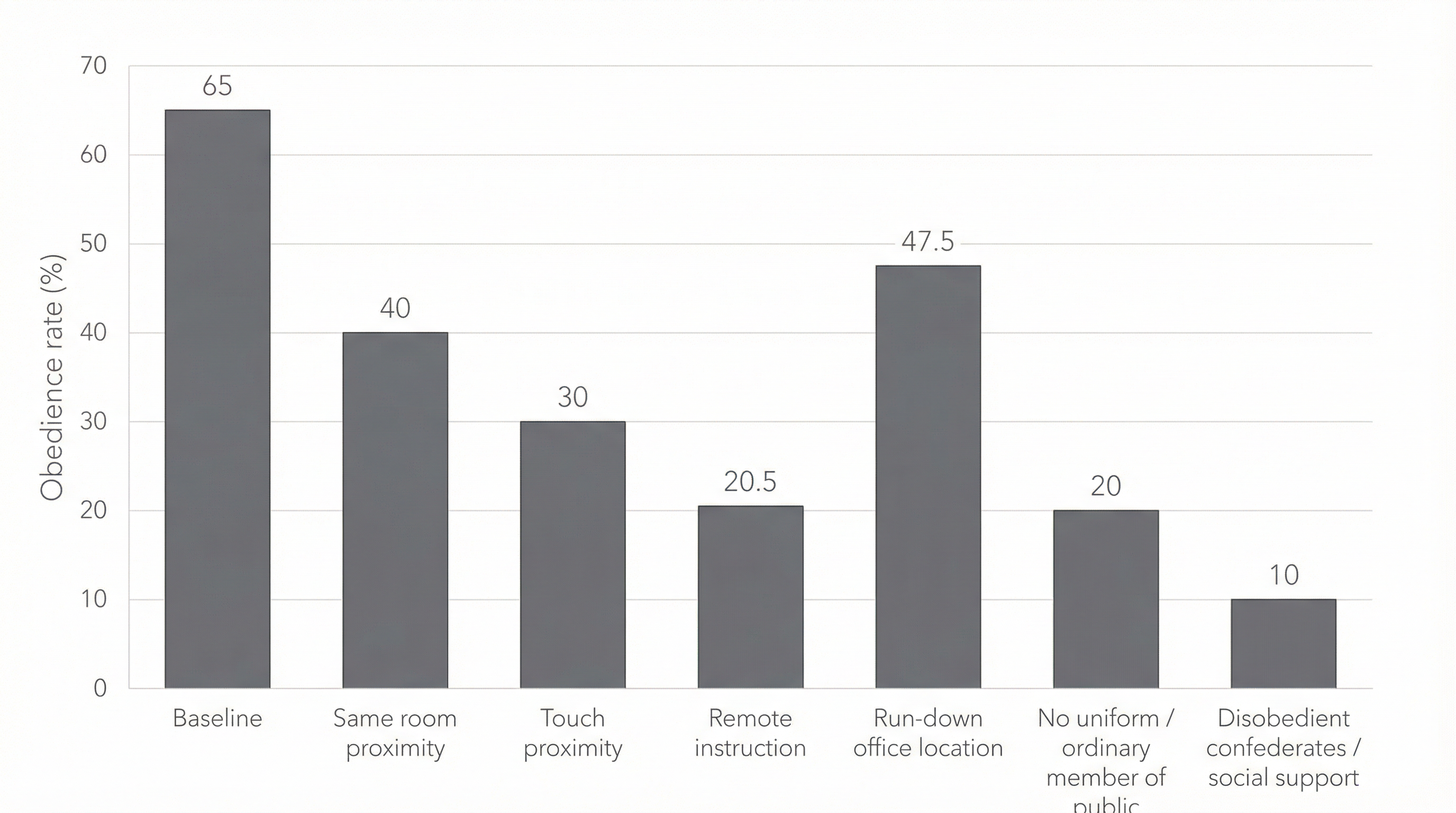
- Baseline (Teacher and Learner in separate rooms, Teacher could hear but not see Learner): 65% obeyed to 450V.
- Proximity variation (Teacher and Learner in the same room): obedience dropped to 40%.
- Touch proximity variation (Teacher had to force the Learner's hand onto an electroshock plate): obedience dropped further to 30%.
- Remote instruction variation (Experimenter left the room and gave orders by telephone): obedience fell to 20.5%. Participants also frequently pretended to give shocks.
The explanation for these findings is that when participants were physically closer to the Learner, they found it harder to psychologically distance themselves from the harm they were causing. Being able to see or touch the victim made the consequences of obedience more immediate and emotionally distressing. Conversely, when the authority figure was physically removed (giving orders by telephone), participants found it easier to defy instructions because the social pressure to obey was weakened.
Location
Milgram repeated his study in a run-down office building rather than the prestigious Yale University campus. In this less prestigious location, obedience dropped to 47.5% (compared with the baseline 65% at Yale).
The prestige of a location can bestow legitimacy on the authority figure. At Yale, participants were more likely to trust that the researchers were competent and that the procedure was safe, which made obedience feel more reasonable. A less distinguished setting reduced participants' trust and the perceived legitimacy of the person giving orders. Notably, obedience was still relatively high even in the office block, suggesting that the "scientific" nature of the procedure itself also carried authority.
Uniform
In the baseline study, the Experimenter wore a grey lab coat -- a symbol of scientific authority. In one variation, the Experimenter was called away at the start and replaced by an "ordinary member of the public" (actually a confederate) wearing everyday clothes rather than a lab coat. Under these conditions, obedience fell to just 20% -- much lower than the baseline rate, though not as low as the social-support variation.
Uniforms function as widely recognised symbols of authority and status. A lab coat signals scientific expertise and the legitimate right to give orders in a research setting. Without this visible marker, participants were far less willing to defer to the person issuing instructions.
Bickman (1974) -- In a field experiment in New York City, three confederates dressed in different outfits (jacket and tie, milkman's uniform, and security guard's uniform) individually stood on the street and asked passers-by to perform tasks such as picking up litter or handing over a coin for a parking meter. People were twice as likely to obey the confederate dressed as a security guard than the one in a jacket and tie. This real-world study supports the view that uniform is a powerful situational variable affecting obedience, independent of a laboratory setting.
Social Support and Disobedient Role Models
Milgram also ran a variation in which the real participant worked alongside two additional "teachers" who were actually confederates. These confederates refused to continue part-way through the procedure, openly disobeying the Experimenter. In this condition, obedience dropped sharply from 65% in the baseline study to 10%.
Seeing other people refuse provides social support for disobedience. It shows that obedience is not inevitable, weakens the pressure from the authority figure, and makes resistance feel more possible. In practice, disobedient role models help a person remain in -- or return to -- the autonomous state, because responsibility feels less tied to the authority figure's wishes and more tied to the individual's own judgement.
Explanations for Obedience: Agentic State and Legitimacy of Authority
The situational variables above describe what affects obedience levels. The agentic state and legitimacy of authority are explanations for why people obey -- the psychological mechanisms behind obedient behaviour.
The Agentic State
Agentic State
A mental state in which a person sees themselves as an agent carrying out the wishes of another person (an authority figure). In this state, the individual feels no personal responsibility for their actions, attributing responsibility to the authority figure instead.
The key change in obedience is the move away from personal responsibility. To see what has changed, it helps to contrast the agentic state with its opposite:
Autonomous State
The opposite of the agentic state. A condition in which a person sees themselves as responsible for their own actions and behaves according to their own principles and conscience.
Milgram proposed that when a person perceives another individual as a legitimate authority figure, they undergo an agentic shift -- a transition from the autonomous state (where they feel responsible for their own actions) to the agentic state (where they see themselves as merely carrying out someone else's wishes). This shift occurs because humans have evolved to function within social hierarchies; from childhood, we learn to defer to those with greater power or status, such as parents and teachers.
In the agentic state, a person does not become an unfeeling puppet. Milgram observed that his participants showed visible signs of distress -- sweating, trembling, and pleading to stop -- yet continued to obey. He described this inner conflict as moral strain: the anxiety and discomfort a person feels when they are required to carry out actions that conflict with their conscience, but feel unable to disobey because they have surrendered responsibility to the authority figure.
Moral Strain
The uncomfortable feeling of anxiety experienced when a person in the agentic state is ordered to do something they believe is wrong. The person wants to stop but feels unable to defy the authority figure.
Milgram also identified binding factors -- aspects of the situation that keep the person locked in the agentic state and prevent them from disobeying. These include strategies such as shifting blame to the victim ("he was foolish to volunteer") or denying the damage they are causing. In Milgram's study, when participants asked "Who is responsible if Mr Wallace is harmed?" and the Experimenter answered "I'm responsible," participants often continued through the procedure rapidly with no further objections. This directly illustrates the agentic shift in action: once the participant believed responsibility had been explicitly taken by the authority figure, they could obey without personal guilt.
Legitimacy of Authority
Legitimacy of Authority
An explanation for obedience which proposes that people are more likely to obey those who they perceive as having justified power over them. This authority is considered legitimate because it is agreed upon by society and is linked to the person's position in a social hierarchy.
Most societies are organised hierarchically, with certain individuals occupying positions that give them authority over others -- parents, teachers, police officers, military commanders, and doctors all hold recognised positions of power. We accept their authority as legitimate because it allows society to function in an orderly way. From childhood, we learn to defer to those in higher positions in these hierarchies.
Legitimacy of authority explains why the specific nature of the authority figure matters. In Milgram's study, participants perceived the Experimenter as a scientist working at a prestigious university, which gave him both expert authority (knowledge and competence) and institutional authority (the backing of Yale University). When the study was moved to a run-down office block and the institution's prestige was removed, obedience fell -- the authority was perceived as less legitimate.
The danger arises when legitimate authority is used for destructive purposes. History provides stark examples: the My Lai massacre of 1968, in which American soldiers killed as many as 504 unarmed Vietnamese civilians under orders from commanding officers. The soldiers' defence -- like Adolf Eichmann's at his trial -- was that they were "just following orders." Kelman and Hamilton (1989) argued that this real-world atrocity can be understood through the power hierarchy of the US Army, in which commanding officers operate within a clearer and more enforceable legitimate hierarchy than, for example, hospital doctors, and possess greater power to punish disobedience.
Dispositional Explanation: The Authoritarian Personality
While Milgram's explanations focus on situational and social-structural factors, not everyone in the same situation behaves identically -- 35% of Milgram's participants disobeyed, despite experiencing the same conditions as those who obeyed. This suggests that individual personality differences also play a role. The most influential dispositional explanation for obedience is Adorno's theory of the Authoritarian Personality.
Authoritarian Personality
A personality type identified by Adorno et al. (1950) that is especially susceptible to obeying authority. Characterised by extreme submissiveness to those of higher status, contempt for those perceived as inferior, rigid "black-and-white" thinking, and adherence to conventional values.
Dispositional Explanation
Any explanation of behaviour that emphasises the role of an individual's personality or internal characteristics (their disposition), as opposed to features of the situation or environment.
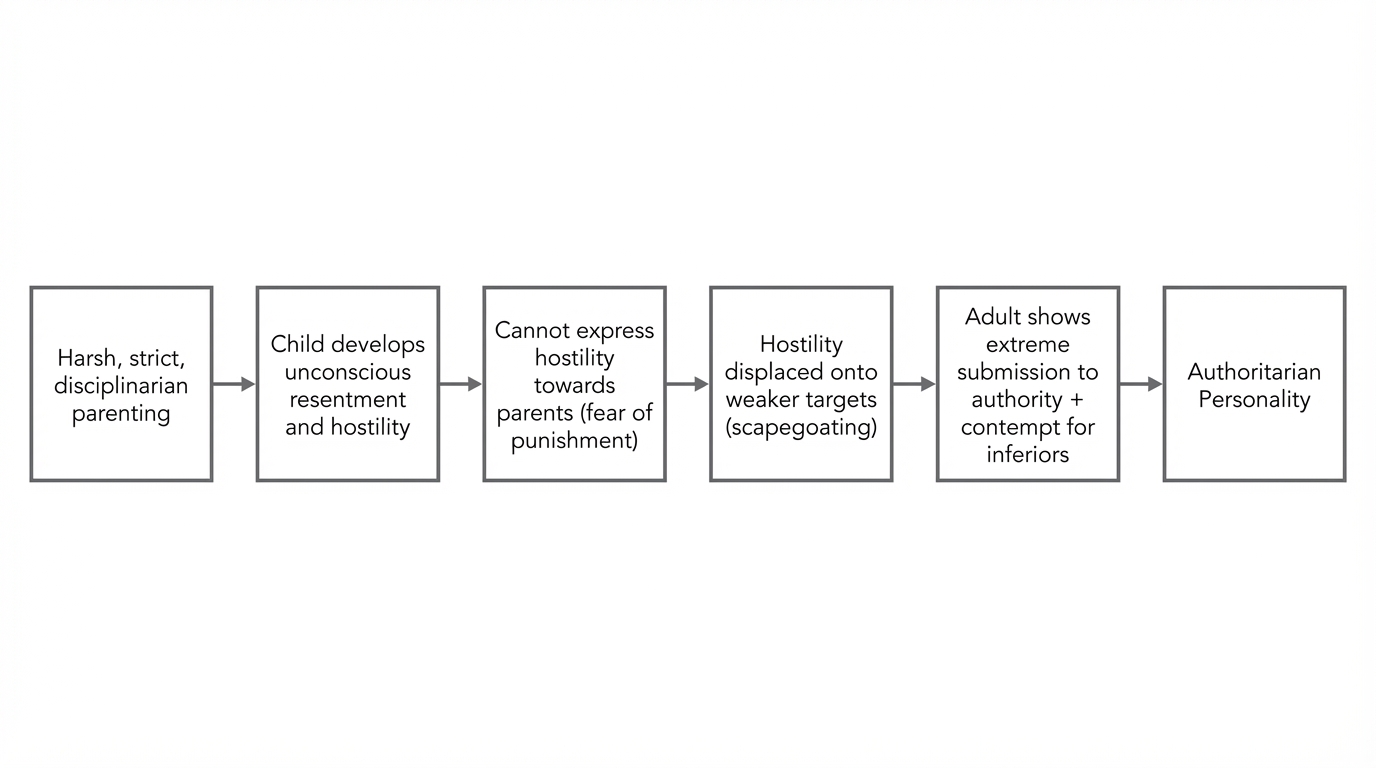
Adorno et al. (1950) -- Like Milgram, Theodor Adorno and his colleagues were motivated by the horrors of the Holocaust, but they reached a very different conclusion. Rather than seeing obedience as a product of the situation, they believed that an unusually high level of obedience was essentially a psychological disorder rooted in personality. They studied over 2,000 middle-class white Americans, assessing their unconscious attitudes towards other ethnic groups using several measurement scales. The most important of these was the F-scale (potential-for-fascism scale), which is still used today to measure authoritarian tendencies. Participants rated their agreement with statements such as "Obedience and respect for authority are the most important virtues for children to learn" on a Likert-style scale. People who scored highly on the F-scale were found to be submissive to those of higher status, contemptuous of those perceived as inferior, highly conscious of social status and rank, and rigid in their thinking -- viewing the world in stark "black-and-white" terms with fixed stereotypes and no tolerance for ambiguity. The research method was a correlation between personality scores and attitudes, combined with self-report questionnaire data.
Origins of the Authoritarian Personality
Adorno adopted a psychodynamic explanation for how this personality type develops. He proposed that children raised by overly strict, harsh, and disciplinarian parents -- who set impossibly high standards, offer only conditional love, and punish failure severely -- develop deep resentment and hostility towards their parents. However, the child cannot express this hostility directly because they fear harsh punishment. Instead, these feelings are displaced onto perceived "weaker" or "inferior" targets through a process called scapegoating. On the surface, the child idolises and respects their parents, but unconsciously they harbour fear and anger. This displaced hostility is directed at people who seem unable to fight back, such as minority groups.
Research Support
Elms and Milgram (1966) -- Interviewed a sample of participants from the original Milgram obedience studies: 20 who had been fully obedient (administering 450V) and 20 who had been disobedient. All participants completed the F-scale. The fully obedient participants scored significantly higher on the F-scale than the disobedient group, supporting Adorno's view that personality is linked to obedient behaviour. However, when the individual subscales of the F-scale were analysed in detail, the obedient participants did not match the full authoritarian profile -- for example, they did not glorify their fathers, did not report unusually harsh punishment in childhood, and did not hold particularly hostile attitudes towards their mothers. This suggests the link between obedience and authoritarianism is more complex than Adorno's theory implies.
Priya notices that her colleague, Tom, always agrees with whatever their line manager says in meetings, even when Tom has previously expressed different views in private. Tom is also dismissive of the junior members of the team, often criticising their ideas harshly. When Priya asks Tom about this, he says, "The managers know best -- that's why they're in charge. The juniors just need to learn their place." Priya remembers Tom mentioning that his parents were very strict and expected perfect behaviour from him as a child.
Evaluation Bank (AO3)
Strength: Milgram's research has strong internal validity because the controlled laboratory procedure allowed him to systematically isolate specific situational variables -- proximity, location, and uniform -- and measure their individual effects on obedience levels. By changing only one variable at a time while keeping all other aspects of the procedure constant, Milgram could be confident that changes in obedience were caused by the variable being tested rather than by extraneous factors. The baseline finding of 65% obedience has also been supported by cross-cultural replications: Meeus and Raaijmakers (1986) found 90% obedience in a Dutch sample using a more realistic procedure, and Beauvois et al. (2012) found 80% obedience in a French reality TV replication. This consistency across cultures and procedures strengthens the reliability of the original findings. Furthermore, Sheridan and King (1972) found that participants administered what they believed were fatal real electric shocks to a puppy (54% of men and 100% of women obeyed), countering concerns that Milgram's participants were merely "play-acting." This body of converging evidence means we can be reasonably confident that obedience to authority is a genuine and robust psychological phenomenon, not merely an artefact of one particular laboratory set-up.
Limitation: A major criticism of Milgram's research concerns its ecological validity and the related issue of demand characteristics. Orne and Holland (1968) argued that participants may not have genuinely believed the shocks were real, meaning they were responding to the perceived expectations of the experimental situation rather than demonstrating true obedience. Gina Perry (2013) provided further evidence for this concern after listening to tapes of Milgram's debriefing sessions: she reported that only about half of participants believed the shocks were genuine, and of those who believed, two-thirds were disobedient. If participants were "going along" with a procedure they suspected was fake, the findings tell us more about how people behave in psychology experiments than how they respond to real authority in everyday life. Additionally, the task itself -- pressing switches on a machine in a laboratory -- lacks mundane realism compared to the kinds of destructive obedience seen in real-world atrocities. However, this limitation must be weighed against the supporting evidence from Hofling et al. (1966), who found that 21 out of 22 real nurses obeyed a doctor's telephone instruction to administer a dangerous drug overdose in a genuine hospital setting, and from Sheridan and King's puppy-shock study where shocks were real. This debate relates to the broader methodological issue in psychology of whether findings from controlled laboratory experiments can be generalised to real-world behaviour -- the trade-off between internal and ecological validity.
Limitation: The Authoritarian Personality offers a limited explanation for obedience because it cannot account for obedient behaviour across entire populations. In pre-war Germany, millions of people displayed obedient, anti-Semitic behaviour despite inevitably possessing a wide variety of personality types -- it is implausible that they all scored highly on the F-scale. Christie and Jahoda (1954) further criticised the theory for political bias, pointing out that the F-scale only measures right-wing (fascist) authoritarianism while ignoring left-wing authoritarianism, such as Soviet Bolshevism or Chinese Maoism. Since both political extremes emphasise absolute obedience to authority, the F-scale fails to capture the full picture. Additionally, the F-scale itself has been criticised as methodologically flawed: Greenstein (1969) described it as "a comedy of methodological errors" because all items are worded in the same direction, making it susceptible to acquiescence bias -- respondents who tend to agree with statements will automatically score as authoritarian regardless of their actual personality. This means the evidence base for the Authoritarian Personality is undermined by measurement problems, and the theory as a whole is too narrow to serve as a comprehensive dispositional explanation for obedience. This relates to the wider debate in psychology between situational and dispositional explanations of behaviour (the person-situation debate), and suggests that obedience is better explained by an interaction of personality and situational factors rather than by either alone.
Quick Recap
Obedience is influenced by situational variables such as proximity, location, uniform, and the presence of disobedient role models, by social-structural explanations such as the agentic state and legitimacy of authority, and by dispositional factors such as the Authoritarian Personality. No single explanation fully accounts for why people obey -- or disobey -- destructive authority figures.