1.4.5 The Biological Approach to OCD
Obsessive-compulsive disorder (OCD) is one of the most clearly biological mental disorders in psychology. Unlike some conditions where psychological and social explanations dominate, OCD has strong links to genetics, brain chemistry, and neural circuitry. In this lesson you will learn how genes create vulnerability to OCD, how abnormalities in neurotransmitters and brain structures contribute to its symptoms, and how drug therapy targets these biological mechanisms. You will also evaluate the strengths and limitations of biological explanations and treatments — a critical skill for the 16-mark essay that commonly appears on this topic.
Genetic Explanations of OCD (AO1)
Obsessive-Compulsive Disorder (OCD)
A mental health condition characterised by obsessions (recurrent, intrusive, and unwanted thoughts, images, or urges that cause anxiety) and compulsions (repetitive behaviours or mental acts performed to reduce the anxiety caused by obsessions).
The biological approach proposes that OCD has its roots in a person's genetic makeup. Rather than being caused by upbringing or learning, this explanation suggests that certain individuals inherit a biological vulnerability that makes them more likely to develop OCD.
Genetic Explanation
The view that psychological characteristics, including mental disorders, are influenced by genes inherited from parents. Genes consist of DNA and code for both physical and psychological features.
Lewis (1936) — Family studies
Early evidence for a genetic component came from Aubrey Lewis (1936), who assessed 50 patients with OCD at the Maudsley Hospital in London. He found that 37% of his OCD patients had parents who also suffered from OCD, and 21% had siblings with the condition. This was a clinical study using case histories and direct assessment. Lewis concluded that OCD appears to run in families, suggesting a possible inherited component. More recent research by Marini and Stebnicki (2012) confirmed this pattern, finding that people with a first-degree relative diagnosed with OCD are approximately four times more likely to develop it themselves.
However, family members share environments as well as genes, so family studies alone cannot prove genetic causation. Twin studies provide stronger evidence.
Nestadt et al. (2010) — Twin studies
Gerald Nestadt et al. (2010) conducted a review of twin studies examining OCD. They found a concordance rate of 68% in monozygotic (identical) twins compared with 31% in dizygotic (non-identical) twins. Since MZ twins share 100% of their genes while DZ twins share approximately 50%, the substantially higher concordance in MZ twins strongly suggests a genetic influence on OCD. This was a meta-analysis, combining data from multiple twin studies to increase the reliability of the findings.
The fact that concordance in MZ twins is not 100% is equally important — it tells us that genes alone do not determine whether someone develops OCD. Environmental factors must also play a role.
Candidate genes and polygenic inheritance
Researchers have identified specific genes that may create vulnerability to OCD — these are called candidate genes. Some of these are involved in regulating the serotonin system. For example, the gene 5HT1-D beta codes for a serotonin receptor involved in serotonergic signalling. Another candidate is the SERT gene, which influences serotonin transport and therefore serotonin levels in the body. Ozaki et al. (2003) identified a mutation of the SERT gene in two unrelated families where several members had OCD, providing direct molecular evidence for a genetic link.
The COMT gene codes for the enzyme catechol-O-methyltransferase, which helps regulate dopamine levels. A particular variation (allele) of this gene that reduces COMT enzyme activity — and therefore leads to higher dopamine levels — is found more frequently in people with OCD.
Polygenic
A characteristic that is influenced by the combined action of many different genes rather than a single gene.
Crucially, OCD is polygenic. Steven Taylor (2013) analysed previous research and found evidence that up to 230 different genes may be involved in OCD. Many of these genes are associated with the functioning of dopamine and serotonin — neurotransmitters believed to regulate mood. Because so many genes are involved, each one contributes only a tiny increase in risk.
Aetiological heterogeneity
OCD is also described as aetiologically heterogeneous, meaning that the causes (aetiology) of OCD differ from one person to another. One combination of genes might produce OCD in one individual, while a completely different set of genetic variations produces it in someone else. There is even evidence that specific types of OCD, such as hoarding disorder, may be linked to particular genetic variations.
The diathesis-stress model
Diathesis-Stress Model
A psychological model proposing that a mental disorder results from the interaction between a biological vulnerability (diathesis, e.g. genetic predisposition) and an environmental trigger (stress, e.g. a traumatic life event).
The genetic explanation is best understood through the diathesis-stress model. Having candidate genes for OCD does not make a person certain to develop the disorder — it creates a vulnerability (the diathesis). An environmental stressor, such as a traumatic life event, may then be needed to trigger the condition. Kiara Cromer et al. (2007) found that over half of OCD patients in their sample had experienced a traumatic event, and that OCD severity increased with the number of traumas experienced. This supports the idea that genes provide a predisposition, but environmental factors determine whether the disorder actually manifests.
Daniel's mother and older brother both have OCD. Daniel has always been a slightly anxious person, but his symptoms were manageable. After starting university and experiencing the stress of living away from home for the first time, Daniel begins developing intrusive thoughts about contamination and starts washing his hands dozens of times a day. His GP suggests that Daniel may have a genetic predisposition to OCD that has been activated by the stress of his new environment.
Now that you understand how genetic vulnerability, candidate genes, and environmental triggers interact to produce OCD, test your understanding of a key concept from this section.
Neural Explanations of OCD (AO1)
While genetic explanations focus on inherited vulnerability, neural explanations examine how abnormalities in brain chemistry and brain structure produce OCD symptoms. In many cases, the genes associated with OCD directly affect neural functioning, so these two types of explanation are closely linked.
Neural Explanation
The view that physical and psychological characteristics are determined by the functioning of the nervous system, including the brain, neural pathways, and individual neurons — particularly the action of neurotransmitters.
The role of serotonin
The most established neural explanation for OCD involves the neurotransmitter serotonin, which plays a key role in regulating mood, sleep, and anxiety. In individuals with OCD, the serotonin system appears to function abnormally — specifically, there is thought to be reduced serotonin activity in certain brain circuits.
When serotonin levels are too low, normal transmission of mood-relevant information between neurons does not take place effectively. This can lead to increased anxiety, repetitive thoughts, and difficulty controlling impulses — all features of OCD. The strongest evidence for serotonin's involvement comes from treatment studies: drugs that specifically increase serotonin levels (SSRIs) are effective at reducing OCD symptoms, which strongly implies that serotonin dysfunction is part of the problem.
The role of dopamine
High levels of dopamine have also been implicated in OCD. Dopamine is a neurotransmitter associated with reward, motivation, and habitual behaviour. Elevated dopamine activity may help explain the compulsive, repetitive behaviours seen in OCD — the brain's reward system may become hijacked, driving the person to repeat certain actions. The link to dopamine is supported by the fact that OCD symptoms sometimes appear in people with conditions known to involve dopamine dysfunction, such as Parkinson's disease.
Brain structures — the worry circuit
Neuroimaging research has identified specific brain structures that function abnormally in people with OCD:
- The orbitofrontal cortex (OFC), located at the front of the brain just above the eye sockets, is involved in decision-making and processing worry. In OCD, the OFC appears to be overactive, sending excessive "worry signals" to the thalamus.
- The caudate nucleus, part of the basal ganglia, normally acts as a filter — it suppresses the worry signals from the OFC before they reach the thalamus. In OCD, the caudate nucleus fails to suppress these signals effectively.
- The thalamus, which processes and relays sensory information, becomes overstimulated by the unsuppressed worry signals, creating a feedback loop of persistent anxiety.
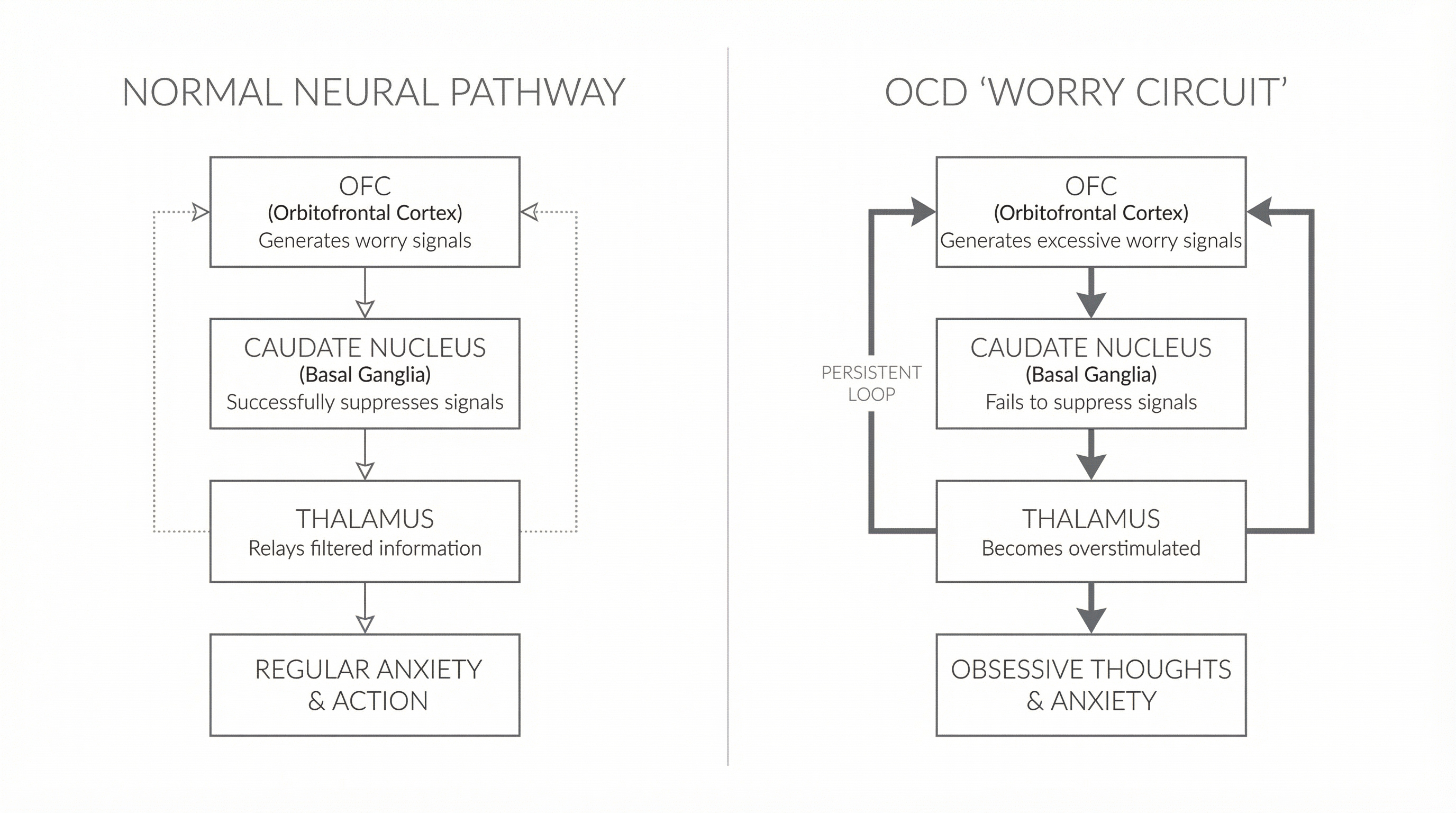
This "worry circuit" model explains why people with OCD experience constant, intrusive anxiety about things that others would dismiss — their neural filtering mechanism is not working properly. Menzies et al. (2007) used MRI scans and found that OCD patients and their close relatives had reduced grey matter in brain regions surrounding the OFC, suggesting there are structural differences in the brains of people vulnerable to OCD.
Additionally, the left parahippocampal gyrus, a brain region associated with processing unpleasant emotions, has been found to function abnormally in people with OCD, which may contribute to the intense emotional distress that accompanies obsessive thoughts.
Impaired decision-making
Some forms of OCD, particularly hoarding disorder, appear to be linked to impaired decision-making. This may be associated with abnormal functioning of the lateral frontal lobes, which are responsible for logical thinking, planning, and making choices. When these areas do not function normally, a person may struggle to decide what to keep and what to discard, or may find it impossible to stop a behaviour even when they recognise it is irrational.
Drug Therapy for OCD (AO1)
Drug Therapy
A biological treatment involving the use of chemical substances (drugs) that alter the functioning of the brain or body. In the case of mental disorders, drugs typically target neurotransmitter levels to reduce symptoms.
The biological explanations of OCD imply that biological treatments should be effective. If OCD involves abnormal serotonin functioning, then drugs that correct serotonin levels should reduce symptoms. This is precisely the rationale behind drug therapy for OCD.
SSRIs — the first-line treatment
SSRIs (Selective Serotonin Reuptake Inhibitors)
A class of antidepressant drugs that increase the level of serotonin in the synapse by preventing its reabsorption (reuptake) into the presynaptic neuron. They are the standard first-line drug treatment for OCD.
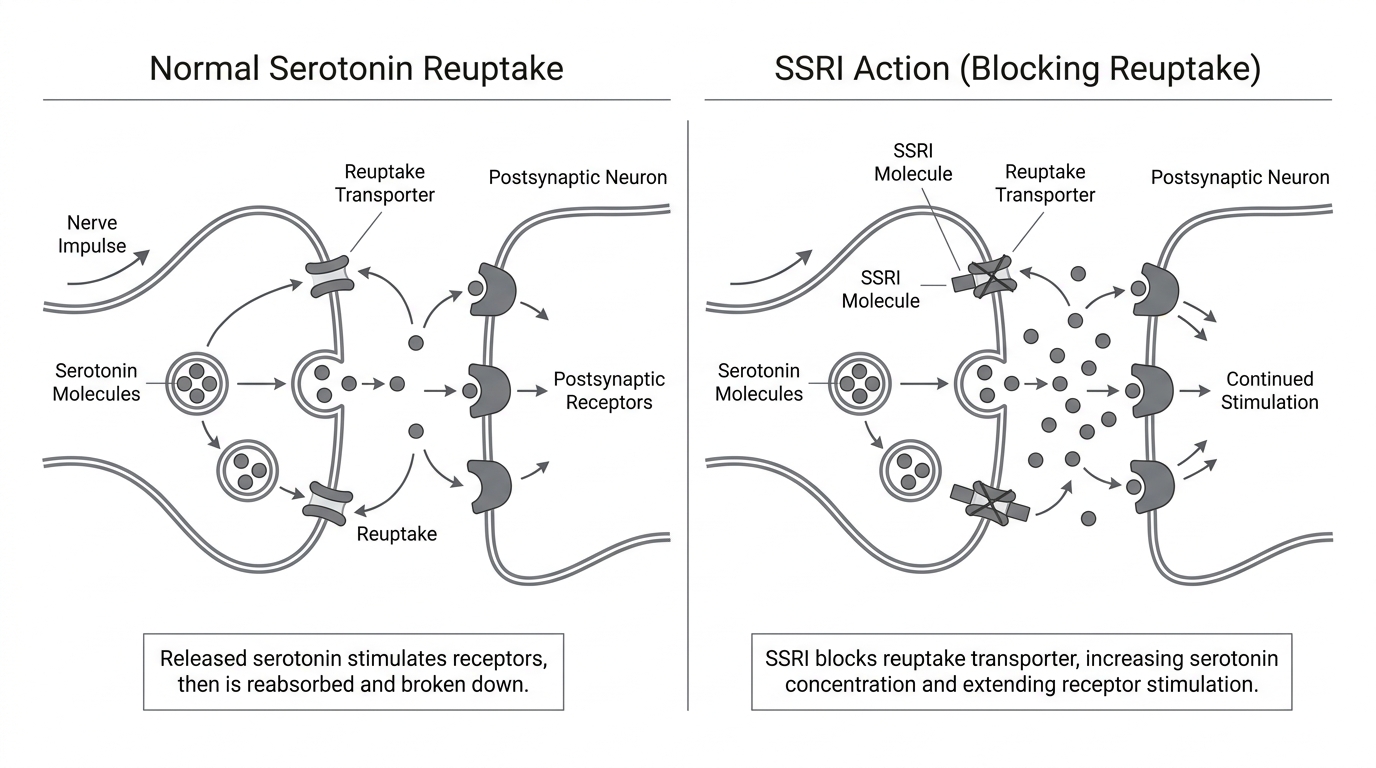
Selective serotonin reuptake inhibitors (SSRIs) are the standard medical treatment for OCD. They work by targeting the serotonin system in the brain. Under normal conditions, serotonin is released from the presynaptic neuron into the synapse, where it stimulates receptors on the postsynaptic neuron. It is then reabsorbed by the presynaptic neuron (reuptake) and broken down for reuse.
SSRIs block this reabsorption process. By preventing reuptake, they increase the concentration of serotonin in the synapse, meaning the postsynaptic neuron continues to be stimulated for longer. Over time, this compensates for the serotonin dysfunction believed to underlie OCD.
A commonly prescribed SSRI is fluoxetine (brand name Prozac). A typical starting dose is 20 mg per day, which can be increased to up to 60 mg if the initial dose is not effective. It is important to note that SSRIs take three to four months of daily use before they have a significant impact on symptoms — patients must persist with treatment even if they do not feel immediate improvement.
Combining SSRIs with psychological therapy
In practice, SSRIs are often used alongside cognitive behaviour therapy (CBT). The drugs reduce emotional symptoms such as anxiety and low mood, which enables the person to engage more effectively with the psychological aspects of CBT. Some patients respond best to CBT alone, while others benefit most from the combination of drugs and therapy.
Alternatives to SSRIs
Not all patients respond to SSRIs. When an SSRI has not been effective after three to four months, clinicians may increase the dose, switch to a different SSRI, or try alternative drug classes:
-
Tricyclics — An older class of antidepressant. Clomipramine is the most commonly used tricyclic for OCD. It works on multiple neurotransmitter systems, including serotonin (where it has the same reuptake-blocking effect as SSRIs) and noradrenaline. However, tricyclics tend to produce more severe side effects than SSRIs, so they are generally reserved as a second-line treatment for patients who do not respond to SSRIs.
-
SNRIs (Serotonin-Noradrenaline Reuptake Inhibitors) — A newer class of antidepressant that increases levels of both serotonin and noradrenaline. Like tricyclics, SNRIs are used as a second-line treatment when SSRIs alone are insufficient.
Priya has been diagnosed with OCD and her psychiatrist prescribes fluoxetine at 20 mg daily. After six weeks, Priya tells her friend she does not feel any different and is thinking of stopping the medication. Her psychiatrist explains that SSRIs typically take three to four months to have a noticeable effect on OCD symptoms and encourages her to continue. After four months, Priya's intrusive thoughts have become less frequent and she feels able to begin CBT sessions alongside her medication.
Understanding how SSRIs work and the practical realities of drug treatment is essential for exam questions on this topic. Check your knowledge of the mechanism.
Evaluating Drug Therapy for OCD (AO3)
The evidence base for drug therapy is substantial, but the treatment has both clear strengths and notable limitations.
Evidence of effectiveness
Soomro et al. (2009) conducted a meta-analysis reviewing 17 studies that compared SSRIs to placebos in the treatment of OCD. All 17 studies showed significantly better outcomes for SSRIs than for placebo conditions. Overall, symptoms are reduced in approximately 70% of people taking SSRIs. For the remaining 30%, most can be helped through alternative drugs, drug combinations, or a combination of drugs and psychological therapy.
For patients who do not respond to SSRIs, other options exist. Bogetto et al. (2000) trialled the drug olanzapine with 23 OCD patients who had not responded to SSRIs. Ten of these patients showed improvement, with mean symptom scores on the Yale-Brown Obsessive Compulsion Scale falling from 26.8 to 18.9.
SSRIs are not always the best option
However, drugs may not always be the most effective treatment available. Skapinakis et al. (2016) carried out a systematic review of outcome studies and concluded that both cognitive therapy and behavioural therapy (such as exposure and response prevention) were more effective than SSRIs alone in the treatment of OCD. This suggests that while SSRIs are helpful, they may not be the optimal treatment for every patient.
Symptom return
A further concern is that drug therapy may not provide a long-term cure. Research suggests that when patients stop taking their medication, OCD symptoms frequently return. This implies that SSRIs manage symptoms rather than addressing the underlying cause of the disorder, and that many patients may need to take medication indefinitely.
Side effects
Although SSRIs are generally well tolerated, some patients experience side effects including indigestion, blurred vision, and loss of sex drive. These are usually temporary, but for a minority they can be long-lasting and distressing. Side effects are more common and more serious with tricyclics. For those taking clomipramine, more than 1 in 10 experience erection problems and weight gain, and approximately 1 in 100 experience increased aggression and heart-related problems. Side effects can reduce quality of life and may lead some patients to stop taking their medication altogether, undermining the treatment's effectiveness.
Evaluation Bank (AO3)
Strength: The genetic explanation for OCD is supported by strong research evidence from multiple methodological approaches. Twin studies by Nestadt et al. (2010) found concordance rates of 68% in monozygotic twins compared with 31% in dizygotic twins, and family studies show that first-degree relatives of OCD sufferers are around four times more likely to develop the condition (Marini and Stebnicki, 2012). At the molecular level, Ozaki et al. (2003) identified a specific mutation of the SERT gene in families with high rates of OCD. The convergence of evidence from twin, family, and molecular genetic studies strengthens our confidence that genetic factors genuinely contribute to OCD, because each method compensates for the limitations of the others — twin studies control for environment, family studies show real-world patterns, and molecular studies identify specific mechanisms. This means the genetic explanation has high scientific credibility as a partial account of OCD's origins.
Limitation: A significant limitation of the genetic explanation is that having candidate genes for OCD is not deterministic — it does not guarantee that a person will develop the disorder. The concordance rate for MZ twins is 68%, not 100%, which means that even with an identical genetic makeup, one twin can develop OCD while the other does not. Furthermore, Cromer et al. (2007) found that over half of OCD patients had experienced a traumatic event, and that symptom severity increased with the number of traumas. This supports the diathesis-stress model, where genes create a vulnerability but environmental triggers are needed to produce the disorder. With up to 230 candidate genes identified (Taylor, 2013), each contributing a tiny effect, the genetic explanation also has limited predictive value — we cannot reliably screen for or predict OCD based on genetic testing alone. This links to the nature-nurture debate: OCD is best understood as an interaction between biological predisposition and environmental experience, rather than being determined solely by genes. A purely genetic account is therefore reductionist, because it overlooks the psychological and social factors — such as trauma, stress, and learned behaviours — that also contribute to OCD's onset and severity.
Limitation: The neural explanation for OCD faces a significant challenge from the problem of co-morbidity and the difficulty of establishing causation. Many people with OCD also suffer from clinical depression, and depression is itself associated with disrupted serotonin activity. This creates a logical problem: the low serotonin observed in OCD patients may actually be caused by their co-morbid depression rather than by OCD itself. If so, serotonin may not be directly relevant to OCD symptoms. More broadly, the neural evidence is largely correlational — neuroimaging studies show that brain structures such as the orbitofrontal cortex and caudate nucleus function differently in people with OCD, but correlation does not establish causation. It is possible that the OCD itself causes the neural abnormalities (rather than the reverse), or that both the neural differences and the OCD are caused by a third factor. This relates to the wider issue of reductionism versus holism: reducing OCD to abnormal serotonin levels or faulty brain circuits may oversimplify a complex condition that also involves cognitive biases, learned behaviours, and emotional responses. Drug treatments based solely on the serotonin hypothesis are effective for only around 70% of patients (Soomro et al., 2009), which further suggests that the neural explanation alone is incomplete.
Quick Recap
To consolidate everything covered in this lesson, keep in mind the following core insight.
OCD has strong biological roots — genetics create vulnerability, abnormal serotonin and brain circuits drive symptoms, and SSRIs help around 70% of patients — but no single biological factor fully explains or cures the disorder. The diathesis-stress model, which combines genetic vulnerability with environmental triggers, provides the most complete biological account.