1.1.6 Social Influence and Social Change
Throughout this chapter on social influence, you have studied how individuals are affected by those around them — through conformity, obedience, and minority influence. This final lesson brings those processes together by asking a bigger question: how do entire societies change their attitudes and behaviours? Social change occurs when widely held norms shift across a whole population, not just in isolated individuals. Understanding how conformity, minority influence, and obedience each contribute to this process is the ultimate practical application of everything you have learned in social influence — and it is a favourite topic for extended-response questions on Paper 1.
Social Change Through Minority Influence
Social Change
A shift in the attitudes, beliefs, and behaviours of an entire society, so that what was previously the accepted norm is replaced by a new norm. Examples include women's suffrage, the civil rights movement, and changing attitudes towards smoking.
Social Influence
The process by which individuals and groups change each other's attitudes and behaviours. It includes conformity, obedience, and minority influence.
Minority influence is considered the primary engine of social change. A small group of committed individuals challenges the existing majority position and, over time, persuades the wider population to adopt a new point of view. The processes you studied in the minority influence lesson — consistency, commitment, and flexibility — are the mechanisms through which this persuasion operates. However, minority influence alone does not explain the full picture; conformity and obedience also play important roles in how social change spreads and becomes embedded in society.
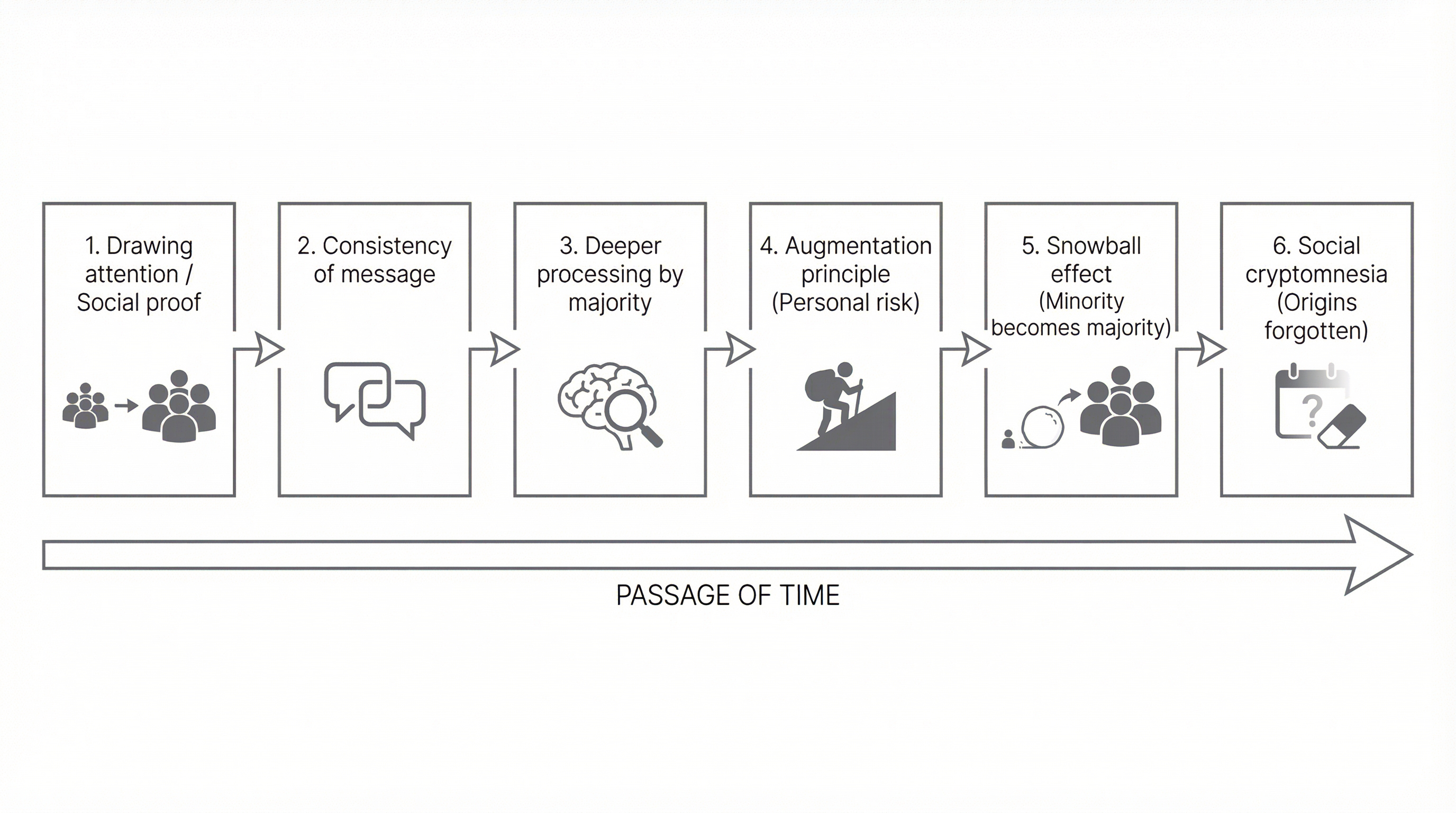
To understand how minority influence leads to social change, psychologists have identified a step-by-step process. A useful way to learn these steps is through a real-world example: the African-American civil rights movement of the 1950s and 1960s.
Step 1 — Drawing attention through social proof. In 1950s America, racial segregation was the norm across schools, restaurants, transport, and neighbourhoods, particularly in the southern states. The civil rights marches drew public attention to this injustice, providing social proof that a problem existed and that people cared about it.
Step 2 — Consistency. Civil rights activists represented a minority of the American population, but they maintained a consistent, non-aggressive message over many years. Millions of people participated in marches, sit-ins, and boycotts, always presenting the same core argument for equality. This consistency made their position difficult to dismiss.
Step 3 — Deeper processing. The sustained activism forced people who had previously accepted the status quo without question to think more carefully about the injustice of segregation. This is the conversion effect — the majority begins to privately re-examine its own views.
Step 4 — The augmentation principle. Many activists placed themselves at significant personal risk. The "freedom riders," for instance, were mixed-ethnicity groups who deliberately boarded segregated buses in the southern states and were often beaten for doing so. This personal sacrifice strengthened and augmented their message — if people are willing to suffer for a cause, it signals the depth and sincerity of their conviction.
Augmentation Principle
The idea that a persuasive argument becomes more convincing when the person advocating it has had to make sacrifices or overcome obstacles to maintain their position. In minority influence, personal risk augments the perceived strength of the minority's message.
Step 5 — The snowball effect. Gradually, more and more members of the majority began to support the minority position. Key figures such as Martin Luther King attracted national and international attention. In 1964, the US Civil Rights Act was passed, prohibiting discrimination — marking the point at which the minority position had become the majority view.
Snowball Effect
The process by which a minority viewpoint gradually gains supporters, building momentum over time until the rate of conversion accelerates and the minority position becomes the new majority norm.
Step 6 — Social cryptomnesia. Over time, society recognises that change has occurred — the American South is a very different place now compared to the 1950s — but many people have no clear memory of how or why that change came about. This phenomenon, where people are aware of social change but forget its origins, is called social cryptomnesia.
Social Cryptomnesia
A phenomenon in which society is aware that social change has occurred but has forgotten the events, processes, and individuals that brought it about.
Social Change Through Conformity and Obedience
While minority influence is the primary driver of social change, conformity and obedience processes also play important roles — both in initiating change and in embedding it once it has begun.
Lessons from conformity research
Asch's research on conformity demonstrated that the presence of a dissenter — a single confederate who broke away from the unanimous majority and gave correct answers — dramatically reduced conformity rates. This finding has a direct implication for social change: dissent breaks the power of the majority and encourages others to follow suit. Even one person standing against the consensus can free others to express their true views.
A different application of conformity to social change involves normative social influence. Environmental and health campaigns have exploited this by informing people about what the majority is actually doing. For instance, campaigns to reduce litter have used normative messages on bins (such as "Bin it — others do"), and anti-smoking campaigns have told young people that most of their peers do not smoke. By drawing attention to the true majority behaviour, these campaigns use normative social influence to encourage individuals to conform to a prosocial norm — one they might not have been aware of.
Priya is the head of a local council trying to encourage residents to recycle more. She designs a new campaign that includes leaflets stating: "85% of households on your street now recycle regularly." When the leaflets are distributed, recycling rates on the targeted streets increase noticeably over the following month. Priya's campaign exploits normative social influence — by telling residents what most of their neighbours are already doing, she creates social pressure to conform to the recycling norm.
Nolan et al. (2008) — Jessica Nolan and colleagues conducted a field experiment in San Diego, California, where messages were hung on the front doors of houses every week for one month. The key normative message told residents that most of their neighbours were trying to reduce their energy usage. A control group received a message simply asking them to save energy, with no reference to other people's behaviour. Residents who received the normative message showed significant decreases in energy usage compared to the control group. This was a field experiment, giving it high ecological validity. Nolan et al. concluded that normative social influence (learning what the majority does) is an effective tool for producing social change in real-world behaviour.
Lessons from obedience research
Milgram's variations demonstrated the power of disobedient role models. In the variation where a confederate teacher refused to continue giving shocks, obedience rates in the genuine participants dropped sharply. This finding shows that seeing someone disobey authority can liberate others to do the same — a process that can contribute to social change when individuals begin to resist unjust authority.
Philip Zimbardo (2007) suggested that obedience processes can also drive social change through gradual commitment. Once a person obeys a small instruction, it becomes psychologically harder to refuse a larger one. People essentially "drift" into a new pattern of behaviour through a series of small, incremental steps. This mechanism can be used positively — for example, campaigns that start with small requests (such as signing a petition) may lead to larger behavioural changes (such as donating money or changing lifestyle habits).
Furthermore, once a minority position has gained enough support to become the majority view, it often becomes enshrined in law. At this point, obedience to authority and legal compliance help to enforce the new norm. People who have not been personally convinced by the minority's arguments may still be compelled to follow the new rules. For example, anti-discrimination legislation means that even those who privately hold prejudiced views are required to act in accordance with equality laws.
Evaluating the Role of Social Influence in Social Change
While the processes described above offer a compelling account of how social change occurs, there are important criticisms and limitations to consider. This section introduces evaluation points that are essential for 16-mark essay responses on this topic.
One significant challenge comes from Charlan Nemeth (1986), who argued that social change through minority influence is a slow process that produces fragile effects. Nemeth suggested that the majority is often not directly confronted with the central issue at stake; instead, they are influenced on more peripheral, related issues. Because the process takes so long, the effects — the actual social changes — are delayed and may not be long-lasting. This casts doubt on whether minority influence alone can be relied upon to produce durable changes in society.
However, in later work, Nemeth (2009) offered a more positive perspective. She argued that when people consider minority arguments, they engage in divergent thinking — a broad, flexible type of thinking in which the individual actively searches for information and weighs up multiple options. Nemeth claimed that this leads to better decisions and more creative solutions to social problems. This suggests that the true value of minority dissent lies not just in converting people to a specific viewpoint, but in opening minds and stimulating new ideas in a way that conforming to a majority simply cannot achieve.
A further challenge comes from Diane Mackie (1987), who questioned whether deeper processing really is triggered by minority influence. Mackie presented evidence that it is actually majority influence that creates deeper processing when you disagree with it. Her reasoning is that people naturally assume others share their views; when they discover a majority believes something different, they are unsettled and forced to think carefully about the majority's arguments. If Mackie is correct, then a central mechanism in the minority influence explanation of social change — that minorities trigger deeper thought — may be flawed.
James has been vegetarian for several years. Most of his friends and family eat meat, and he occasionally receives teasing comments. However, James has noticed that over the past two years, several of his friends have started reducing their meat consumption, and two have become fully vegetarian. One of them mentioned that James's consistent commitment to vegetarianism over the years made them reconsider their own diet. This illustrates minority influence leading to social change — James's consistent and committed position as a minority gradually triggered deeper processing in his social group, leading to a snowball effect as more people adopted his viewpoint.
There are also practical barriers to social change. Bashir et al. (2013) found that people often resist changing their behaviour because of negative stereotypes associated with minority activists. In their study, participants were less likely to engage in environmentally friendly behaviours because they did not want to be associated with stereotypical "environmentalists" — described negatively as "tree-huggers" or extremists. This suggests that even when a minority's message is logical and well-supported, social barriers — such as stigma and stereotyping — can prevent the majority from being influenced. Bashir et al. advised minorities to avoid behaving in stereotypical ways, though this creates a tension with the minority influence explanation, since factors like consistency and the augmentation principle (which involves visible sacrifice and commitment) can themselves reinforce the very stereotypes that put people off.
Finally, the effectiveness of normative approaches is not guaranteed. Foxcroft et al. (2015) conducted a review of 70 studies as part of the Cochrane Collaboration, examining whether social norms interventions could reduce student alcohol consumption. The review found only a small reduction in drinking quantity and no effect on drinking frequency. This suggests that using normative social influence to create social change does not always produce meaningful, long-term results.
How Social Influence Processes Work Together
It is important to recognise that social change rarely results from a single process operating in isolation. In practice, minority influence, conformity, and obedience interact and overlap. A useful way to understand this is to trace the timeline of a social change:
-
Minority influence initiates the change. A committed, consistent minority draws attention to an issue and begins to convert members of the majority through deeper processing and the augmentation principle.
-
The snowball effect shifts the balance. As more people adopt the minority position, it gains momentum. At some tipping point, the minority view becomes the majority view.
-
Conformity embeds the change. Once the new position is held by the majority, normative social influence takes over. People conform to the new norm because they want to be accepted and because they see others behaving in the new way.
-
Obedience enforces the change. The new majority position is often written into law or institutional rules. Those who have not been personally persuaded are still compelled to comply through obedience to legitimate authority.
-
Social cryptomnesia obscures the origins. Over time, the new norm becomes "just the way things are," and the struggle that brought it about fades from collective memory.
This timeline can be applied to many examples: the shift in attitudes towards smoking (from socially acceptable to broadly stigmatised and legally restricted), the extension of voting rights to women, and changing attitudes towards same-sex relationships.
Social change is best understood as a multi-stage process. Minority influence starts the change, conformity spreads and normalises it, obedience enforces it through law, and social cryptomnesia means the origins are eventually forgotten.
Evaluation Bank (AO3)
Strength: Research supports the claim that normative social influence can be an effective tool for producing social change. Nolan et al. (2008) conducted a field experiment in San Diego in which normative messages — telling residents that most of their neighbours were trying to reduce energy usage — were hung on front doors weekly for one month. Residents who received the normative message showed significant reductions in energy usage compared to a control group who were simply asked to save energy. This demonstrates that informing people about majority behaviour can shift their own behaviour in a prosocial direction, supporting the validity of conformity-based explanations of social change. Furthermore, the field experiment design gives the finding high ecological validity, as residents were responding in their real homes rather than in a laboratory setting. This connects to the broader issue of whether social psychological findings can be applied to real-world behaviour — in this case, the evidence suggests they can.
Limitation: A significant limitation of the minority influence explanation of social change is that there are practical barriers that the model does not fully account for. Bashir et al. (2013) found that participants were less likely to adopt environmentally friendly behaviours because they did not want to be associated with negative stereotypes of "environmentalists" (e.g. "tree-huggers"). This means that even when a minority's arguments are logical and well-supported, social stigma can prevent the majority from being influenced. This creates a particular problem for the minority influence model because the very factors it identifies as important — consistency, commitment, and the augmentation principle (involving visible sacrifice) — can themselves reinforce the stereotypes that deter people from joining the cause. This suggests that the six-step model of social change may be overly simplistic, underestimating the role of social identity and stereotype processes in determining whether minority influence succeeds or fails. This relates to the wider debate about reductionism — the model may reduce social change to a set of persuasion techniques while ignoring the complex social and cultural factors that shape how people respond to minority groups.
Limitation: The assumption that minority influence triggers deeper processing — a central mechanism in explaining how minorities bring about social change — has been directly challenged. Mackie (1987) presented evidence that it is actually majority influence, not minority influence, that produces deeper processing. Her argument is that people generally assume others share their views, so when they discover that a majority disagrees with them, they are forced to think carefully about why. If Mackie is correct, the causal mechanism at the heart of the minority influence explanation is flawed: minorities may not change minds through the deeper processing route at all. However, this challenge must be weighed against research by Martin et al. (2003), who found that people who had been exposed to a minority viewpoint were less willing to change their newly adopted position than those exposed to a majority viewpoint. This suggests that the minority message had been processed more deeply and was therefore more resistant to counter-persuasion. The debate between Mackie and Martin et al. remains unresolved, meaning that the role of deeper processing in minority-led social change is still contested. This links to the broader methodological issue of how we measure cognitive processing in social influence research, and whether artificial experimental tasks can capture the complexity of real-world persuasion.