RP Volumetric solution and acid-base titration
This required practical is about making concentration data trustworthy. First you prepare a solution with an accurately known concentration, then you use that solution in a titration to find the concentration of another acid or alkali. To do that confidently, you need more than a recipe: you need to understand why each piece of apparatus is used, how uncertainty enters, and how the colour change links to the chemistry taking place.
Making An Accurate Volumetric Solution
A titration is only as good as the solution you start with. If the concentration of the standard solution is wrong, every later calculation will also be wrong, even if the titration technique is excellent.
Volumetric solution
A solution prepared so that its volume is known accurately, allowing its concentration to be known accurately as well.
The usual sequence is: calculate the mass needed, weigh the solid carefully, dissolve it in water, transfer the whole solution into a volumetric flask, then make the flask up exactly to the calibration mark. The key word is "exactly". At this stage you are not just making a solution that looks about right; you are making one whose concentration is genuinely known.
Making up a standard solution
These equations let you move between concentration, moles, and mass. V must be in dm^3, so 250.0 cm^3 = 0.2500 dm^3.
Worked example: calculate the mass of anhydrous sodium carbonate needed to make 250.0 cm^3 of a 0.100 mol dm^-3 solution.
n = cV = 0.100 x 0.2500 = 0.0250 mol
So 2.65 g of anhydrous Na2CO3(s) is needed.
In practice, you do not try to tip exactly 2.65 g straight into a flask and hope for the best. A more accurate method is to weigh the bottle or boat, transfer some solid, then reweigh it and use the difference.
Weighing by difference
Measuring the mass transferred by subtracting the final mass of the weighing bottle from its initial mass.
This is more reliable because any solid left behind in the weighing bottle is automatically accounted for. After weighing, dissolve the solid in a beaker with deionised water and stir until it has all dissolved. If gentle warming is needed, allow the solution to cool before making up to the mark, because warm liquids occupy a larger volume.
Next, transfer the solution into the volumetric flask through a funnel. Rinse the beaker, glass rod, and funnel with deionised water and add those washings to the flask as well. This is called quantitative transfer: the aim is that all the solute ends up in the flask, not partly left behind on the apparatus.
Then add deionised water until the bottom of the meniscus sits on the calibration line. The last few drops should be added carefully, often with a dropping pipette, because overshooting the mark means the solution is too dilute. Finally, stopper the flask and invert it several times so the concentration is uniform throughout the solution. The diagram below summarises the full preparation sequence from weighing by difference to reading the meniscus at eye level.
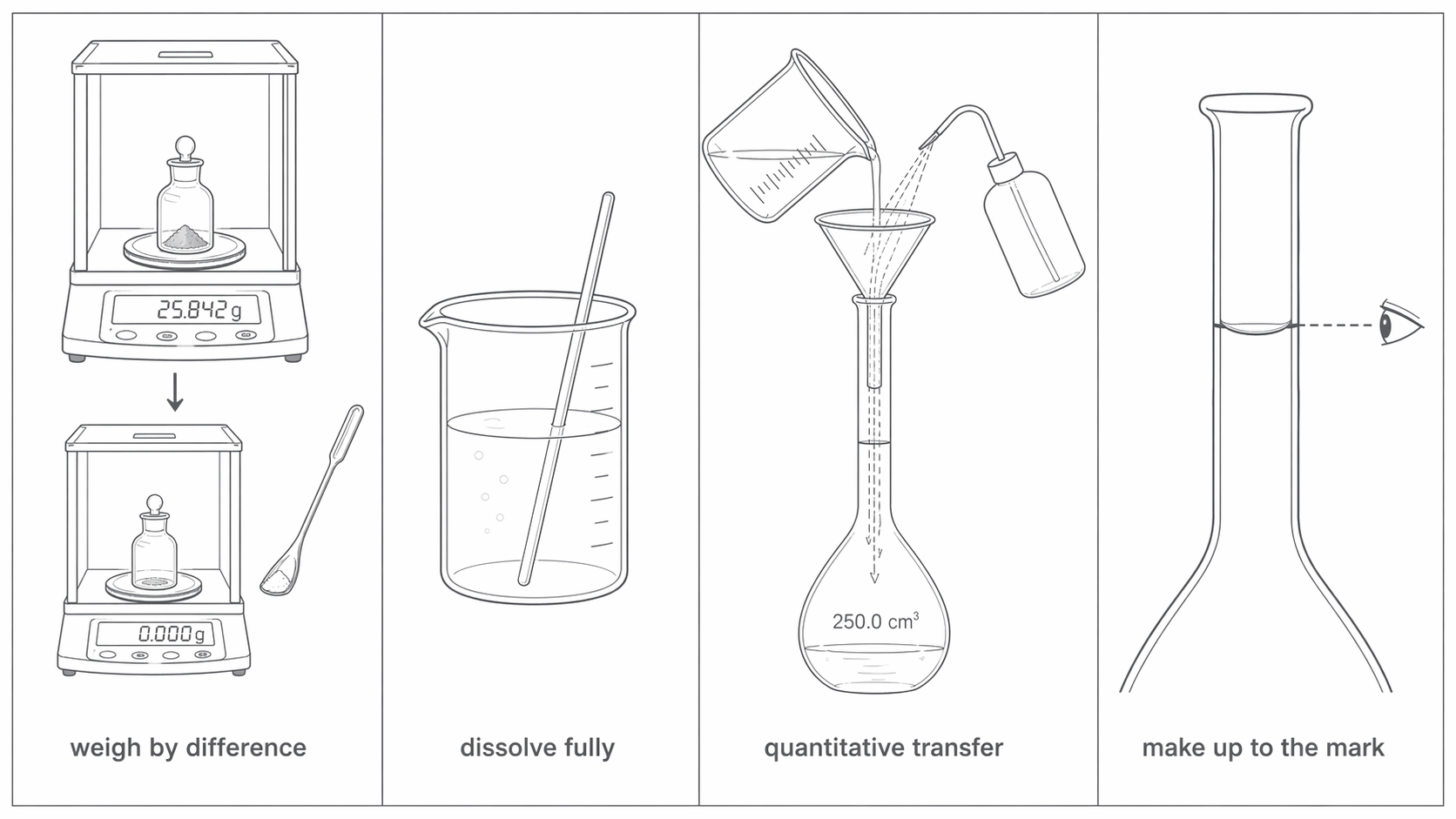
Each of those details protects the quality of the solution. Washing the apparatus reduces loss of solute. Using the mark on the volumetric flask fixes the volume accurately. Inverting the stoppered flask ensures the concentration is the same at the top and bottom.
Carrying Out The Titration Properly
Once the standard solution has been made, it can be used to find the concentration of another acid or alkali. The titration works because the reacting solutions are combined in accurately measured amounts until the reaction is just complete.
The burette delivers a variable volume accurately. The pipette delivers one fixed volume accurately, usually 25.0 cm^3. The conical flask is used because it can be swirled without the liquid easily spilling. A white tile under the flask makes the indicator colour change easier to see.
Titre
The volume delivered from the burette during a titration.
Before starting, rinse the burette with the solution that will go into it and rinse the pipette with the solution it will measure. That prevents leftover water from diluting those solutions. The conical flask, however, should be rinsed only with deionised water. Any water left in the flask does not change the number of moles already delivered by the pipette, so it does not change the result.
Fill the burette so that the jet is full and contains no air bubbles. Record the initial reading from the bottom of the meniscus. Readings should be given to 2 d.p., for example 24.80 cm^3, not 24.8 cm^3.
Transfer 25.0 cm^3 of the other solution into the conical flask using a pipette filler. Add two or three drops of indicator. If phenolphthalein is used and the flask contains an alkali, the solution usually starts pink; the end-point is the first permanent colourless result. The important word is permanent. A brief colourless flash while swirling does not mean the titration is complete.
Add solution from the burette while swirling the flask continuously. Near the end-point, add it dropwise. You can rinse the inside walls of the conical flask with deionised water during the titration, because this changes only the total volume, not the number of moles of acid or alkali present. The diagram below shows the standard titration set-up, including the pipette transfer into the flask and the burette reading from the bottom of the meniscus.
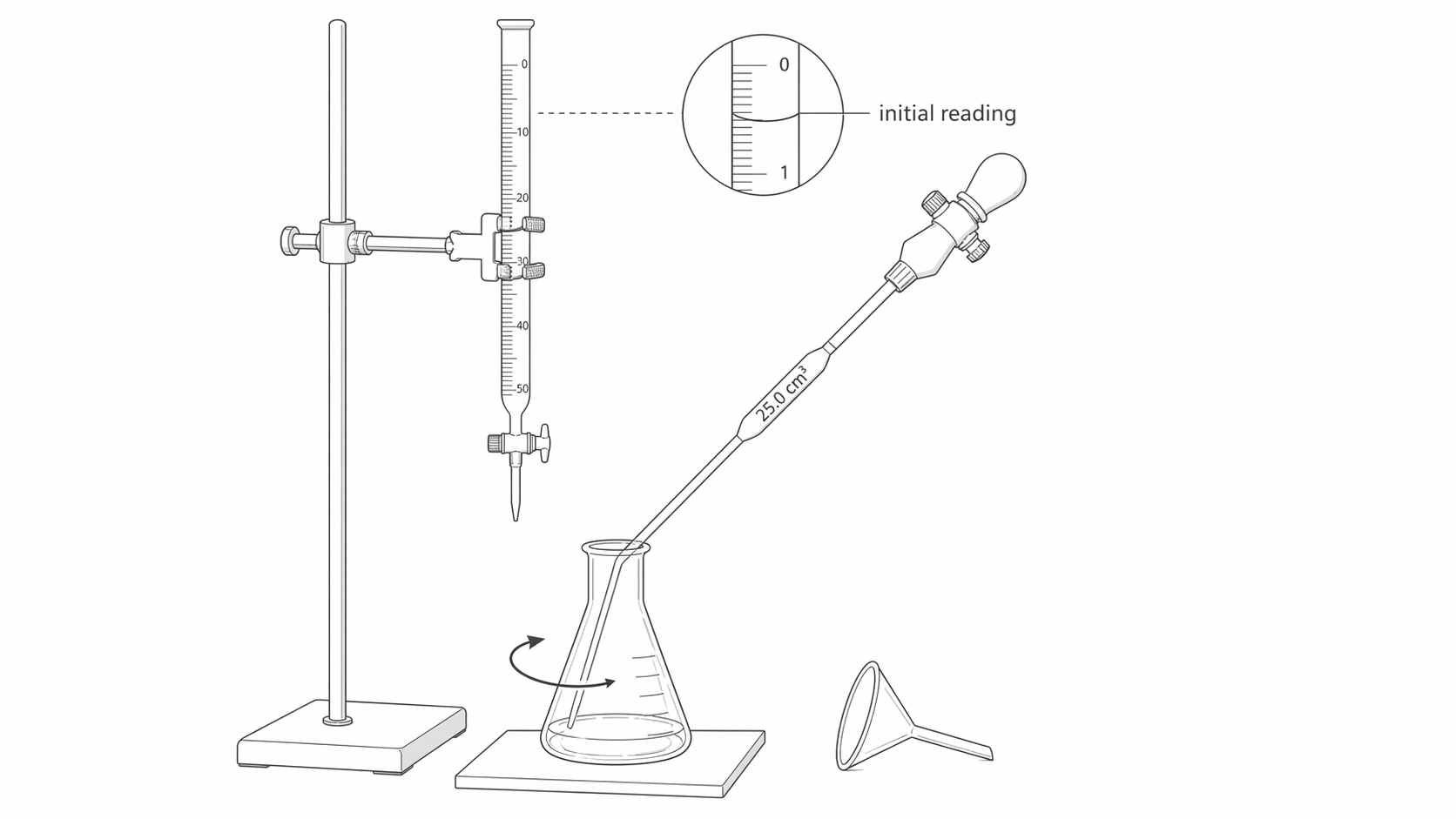
The first run is often rough, used to estimate the end-point. After that, repeat the titration until you obtain concordant titres, usually values within 0.10 cm^3 of each other. Only concordant titres should be averaged.
Using Concordant Titres In A Calculation
The chemistry behind the calculation is simple: use the titre to find the moles of the solution from the burette, then use the equation to find the moles in the flask, then divide by the flask volume to get concentration.
Concordant titres
Titre values that are close enough to each other to show the technique is consistent, typically within 0.10 cm^3.
Suppose HCl(aq) of concentration 0.100 mol dm^-3 is in the burette and 25.0 cm^3 of NaOH(aq) is in the flask.
The equation is:
HCl(aq) + NaOH(aq) -> NaCl(aq) + H2O(l)
This is a 1:1 ratio, so at the end-point:
- moles of
HCldelivered = moles ofNaOHoriginally in the flask
Now use these concordant titres: 24.80 cm^3, 24.75 cm^3, 24.80 cm^3.
- average titre =
24.78 cm^3 - moles of
HCl = 0.100 x (24.78 / 1000) = 2.478 x 10^-3 mol - moles of
NaOH = 2.478 x 10^-3 mol - concentration of
NaOH = (2.478 x 10^-3) / 0.0250 = 0.0991 mol dm^-3
The easiest ways to spoil this calculation are using cm^3 instead of dm^3, averaging a rough titre with accurate ones, or forgetting to use the mole ratio from the equation when it is not 1:1.
Accuracy, Uncertainty, And Practical Judgement
Good practical chemistry is not just about following the method; it is also about judging how reliable the result is. In this required practical, uncertainty comes from both the apparatus and the human judgement involved in spotting the end-point.
For a burette, there is uncertainty in both the initial and final reading. If each reading has an uncertainty of +/- 0.05 cm^3, then the titre has an apparatus uncertainty of +/- 0.10 cm^3. In real titrations there is often a little extra uncertainty because the exact moment of permanent colour change is judged by eye.
That is why a larger titre is usually better: the absolute uncertainty stays about the same, but the percentage uncertainty becomes smaller. Similarly, using a larger mass of solid when preparing a solution reduces the percentage uncertainty from the balance, and using weighing by difference improves confidence that the measured mass really was transferred.
The method also depends on disciplined observation. A rough titre helps you find the end-point safely. Concordant titres show that the technique is repeatable. A result table should include initial reading, final reading, and titre, because that lets another chemist judge whether the data handling was sound.
Safety matters too. Acids and alkalis can be corrosive or irritating, so eye protection is essential and gloves are often appropriate. Unknown substances should be treated cautiously. If sodium hydroxide is used, it should not be left sitting in the burette longer than necessary because it can attack glass fittings over time.
Acid-base titrations are widely used in quality control. A manufacturer can test samples from different batches of a product such as vinegar, a cleaning solution, or a pharmaceutical preparation to check that the concentration of the active acid or alkali is within specification.
The big picture is simple: accurate mass, accurate volume, careful transfer, careful readings, and sensible averaging. If those steps are secure, the final concentration you calculate is worth trusting, and that is the real purpose of Required Practical 1.