3.1.4.4 - Bond Enthalpies
When a reaction happens, some bonds must be broken and new bonds must form. Bond enthalpies let us estimate the overall enthalpy change by comparing the energy taken in for bond breaking with the energy released by bond formation. In this lesson, you will pin down the exact meaning of mean bond enthalpy, learn a reliable calculation method for gaseous reactions, and see why this method only gives an approximate value of .
What Mean Bond Enthalpy Means
Breaking a covalent bond always requires energy, so bond breaking is endothermic. Forming a covalent bond releases energy, so bond formation is exothermic. Bond enthalpy data give us a way to measure those energy changes.
Mean Bond Enthalpy
The enthalpy change required to break one mole of a stated bond, averaged over many different compounds, with all substances in the gaseous state.
There are three ideas packed into that definition. First, the value is for one mole of bonds, not one mole of molecules. Second, everything is in the gaseous state, because the data refer to bonds in gaseous molecules rather than liquids or solids. Third, it is a mean value. A C-H bond in methane is not exactly the same strength as a C-H bond in chloroethane, so the data book gives an average taken across many compounds.
That is why bond enthalpy values are useful but not exact for a specific reaction. They tell you the typical strength of a bond type. They do not tell you the precise bond enthalpy for that exact bond in that exact molecule.
One detail worth keeping in mind is that bond enthalpy values in a table are always positive. That is because the table tells you the energy needed to break bonds. The negative sign for an exothermic reaction appears only after you compare energy in with energy out.
The Core Calculation Method
For a gaseous reaction, the approximate enthalpy change comes from a simple energy balance. Imagine all the relevant bonds in the reactants being broken to give separate gaseous atoms. Then imagine those atoms joining to form the bonds in the products.
Estimating Reaction Enthalpy
The first sum is positive because bond breaking needs energy input. The second sum also uses positive table values, but we subtract it because bond formation releases energy.
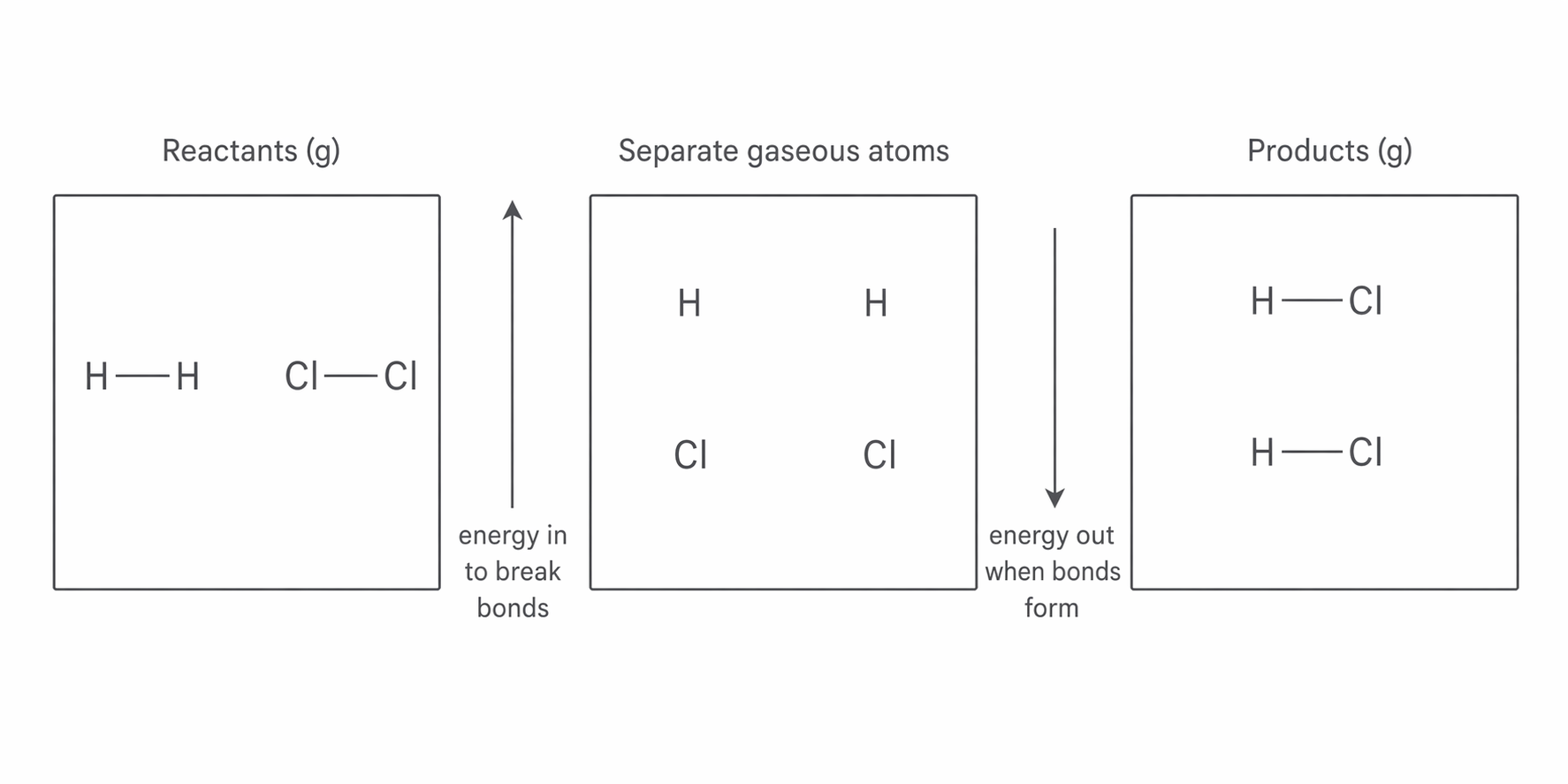
The diagram below shows this bond enthalpy method as an energy path. Energy is absorbed to break the reactant bonds into separate gaseous atoms, and energy is released when those atoms form the bonds in the products.
[DIAGRAM: asset_name: 1.4.4 - Bond Enthalpies - Diagram 1; asset_slug: 1.4.4 - Bond Enthalpies - Diagram 1; recommended_method: retained_png; description: Wide three-panel bond enthalpy energy-path diagram in clean monochrome chemistry style. Panel 1 labelled "Reactants (g)" shows one H-H molecule and one Cl-Cl molecule inside a simple box. Panel 2 labelled "Separate gaseous atoms" shows unbonded H, H, Cl, and Cl atoms spaced apart inside a box. Panel 3 labelled "Products (g)" shows two H-Cl molecules inside a box. Place a large upward arrow between panels 1 and 2 labelled "energy in to break bonds" and a large downward arrow between panels 2 and 3 labelled "energy out when bonds form".]
A reliable way to organise the calculation is:
- Write the balanced equation with state symbols.
- Identify the bonds broken in the reactants.
- Identify the bonds formed in the products.
- Add the bond enthalpies for each list.
- Use
broken - formed, then check whether the sign makes chemical sense.
Worked example:
For H2(g) + Cl2(g) -> 2HCl(g), use H-H = 436 kJ mol^-1, Cl-Cl = 243 kJ mol^-1, and H-Cl = 432 kJ mol^-1.
Energy in to break bonds:
436 + 243 = 679 kJ mol^-1
Energy out when bonds form:
2 x 432 = 864 kJ mol^-1
So:
The reaction is exothermic because more energy is released when two H-Cl bonds form than is needed to break the H-H and Cl-Cl bonds.
This method is limited to reactions in the gaseous phase for a good reason. If a reactant or product is a liquid or solid, changes of state would also affect the enthalpy change, and simple bond enthalpy data would not tell the whole story.
Making Larger Calculations Efficient
In bigger molecules, counting every single bond can be slow. A quicker approach is to focus on the bonds that actually change. Any bond present on both sides of the equation cancels out, because you would count it once as broken and once as formed.
Consider the reaction:
C2H6(g) + Cl2(g) -> C2H5Cl(g) + HCl(g)
Most of the molecule stays the same. You do not need to count the C-C bond or the five unchanged C-H bonds. Only these bonds change:
- broken: one C-H and one Cl-Cl
- formed: one C-Cl and one H-Cl
Using C-H = 413, Cl-Cl = 243, C-Cl = 346, and H-Cl = 432 in kJ mol^-1:
Energy in:
413 + 243 = 656
Energy out:
346 + 432 = 778
So:
This is not a different method. It is the same calculation, just simplified before the arithmetic. That shortcut is especially helpful in substitution reactions, where only a small number of bonds actually change.
A very common error is to reverse the subtraction and do formed - broken. Another is to miss the bond multiplicity: each NH3 molecule contains three N-H bonds, so 2NH3 contains six, not three.
Why Hess's Law Gives a Different Value
If you calculate an enthalpy change using Hess's law, you can use experimentally measured values such as enthalpies of formation or combustion for the actual substances involved. That makes Hess's law a more accurate route.
Hess's Law
The enthalpy change for a reaction is the same whatever route is taken, provided the initial and final states are the same.
A mean bond enthalpy calculation is different in two important ways. First, the bond enthalpies are average values. The real O-H, C-H, or C-Cl bonds inside a particular molecule may be slightly stronger or weaker than the mean table value. Second, bond enthalpy data refer to gaseous species. If you compare them with values based on substances in their standard states, state effects can create extra differences unless everything is gaseous.
So when a Hess's law value and a mean bond enthalpy value do not match, that does not mean the method has failed. It means the bond enthalpy method is an estimate built from average bond strengths, while Hess's law can use data for the exact substances and states involved in the reaction.
Use bond enthalpies for a quick estimate: calculate energy in to break bonds, subtract the energy released when new bonds form, and expect the result to be approximate rather than exact.
That is the key contrast to remember: average bond data versus exact substance data.