3.1.3.6 - Bond Polarity
Bond polarity explains why some covalent bonds have slightly positive and slightly negative ends instead of being perfectly even. The key idea is simple: if two bonded atoms attract the shared pair of electrons by different amounts, the electron distribution becomes uneven. In this lesson, you will learn how to recognise a polar bond, show it with partial charges, and explain why a molecule can contain polar bonds but still have no permanent dipole overall.
Electronegativity and unequal sharing
In a covalent bond, two atoms share a pair of electrons. If the two atoms are identical, they pull on that shared pair equally, so the electron density is spread symmetrically across the bond. That makes the bond non-polar.
Electronegativity
The power of an atom to attract the pair of electrons in a covalent bond.
If the atoms are different, they usually have different electronegativities. The more electronegative atom attracts the bonding pair more strongly, so the electron density shifts towards that atom. The bond is still covalent because the electrons are shared, but the sharing is unequal. That is what makes a polar covalent bond.
For example, in H-F, fluorine is much more electronegative than hydrogen, so the bonding pair spends more time closer to fluorine. In F-F, both atoms have the same electronegativity, so there is no unequal sharing and no polar bond.
The diagram below compares those two situations directly.
[DIAGRAM: asset_name: 1.3.6 - Bond Polarity - Diagram 1; asset_slug: 1.3.6 - Bond Polarity - Diagram 1; recommended_method: retained_png; description: Side-by-side comparison of F-F and H-F. For F-F, show an even electron cloud between the atoms. For H-F, show the electron cloud pulled towards fluorine, with fluorine labelled as the more electronegative atom.]
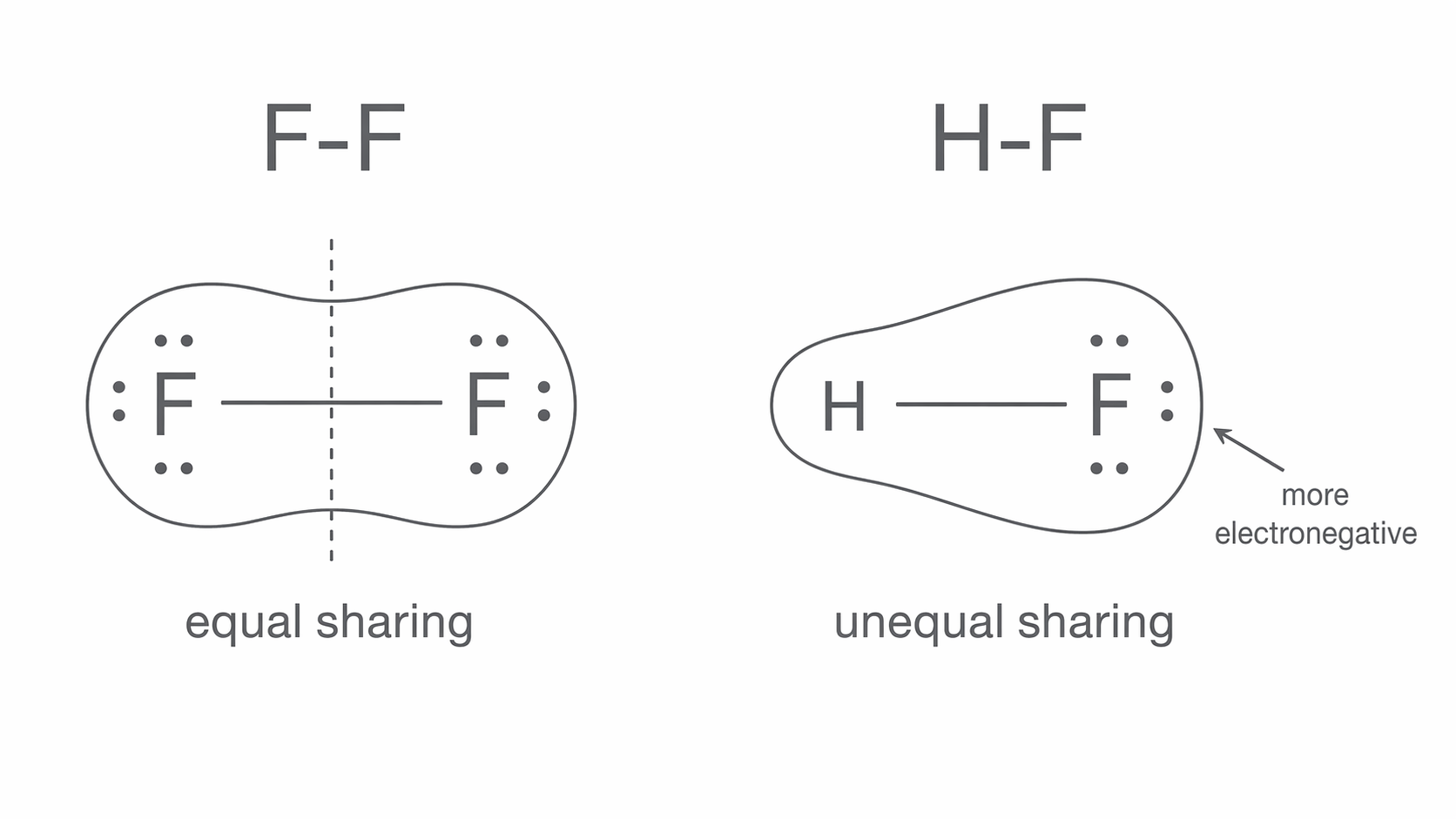
The greater the difference in electronegativity, the more uneven the electron distribution and the more polar the bond becomes. So bond polarity is a property of the bond itself, not automatically of the whole molecule.
Showing bond polarity with partial charges
To show that a bond is polar, chemists use partial charges. The more electronegative atom is labelled δ− and the less electronegative atom is labelled δ+.
The δ symbol matters. It means the charges are only partial, not full ionic charges. In hydrogen chloride, the bond is written as Hδ+ - Clδ−, not H+Cl-. The atoms have not turned into ions; the bond is still covalent. We are only showing that the electron distribution is unsymmetrical.
Worked example: in hydrogen fluoride, fluorine is more electronegative than hydrogen, so the correct labelling is Hδ+ - Fδ−. In a bond such as Br-Br, you would not add partial charges because there is no electronegativity difference and therefore no bond polarity.
The diagram below shows this notation side by side.
[DIAGRAM: asset_name: 1.3.6 - Bond Polarity - Diagram 2; asset_slug: 1.3.6 - Bond Polarity - Diagram 2; recommended_method: retained_png; description: Three short bond diagrams labelled Hδ+ - Clδ−, Hδ+ - Fδ−, and Br-Br. Add a small arrow under each polar bond pointing towards the more electronegative atom and no arrow under Br-Br.]
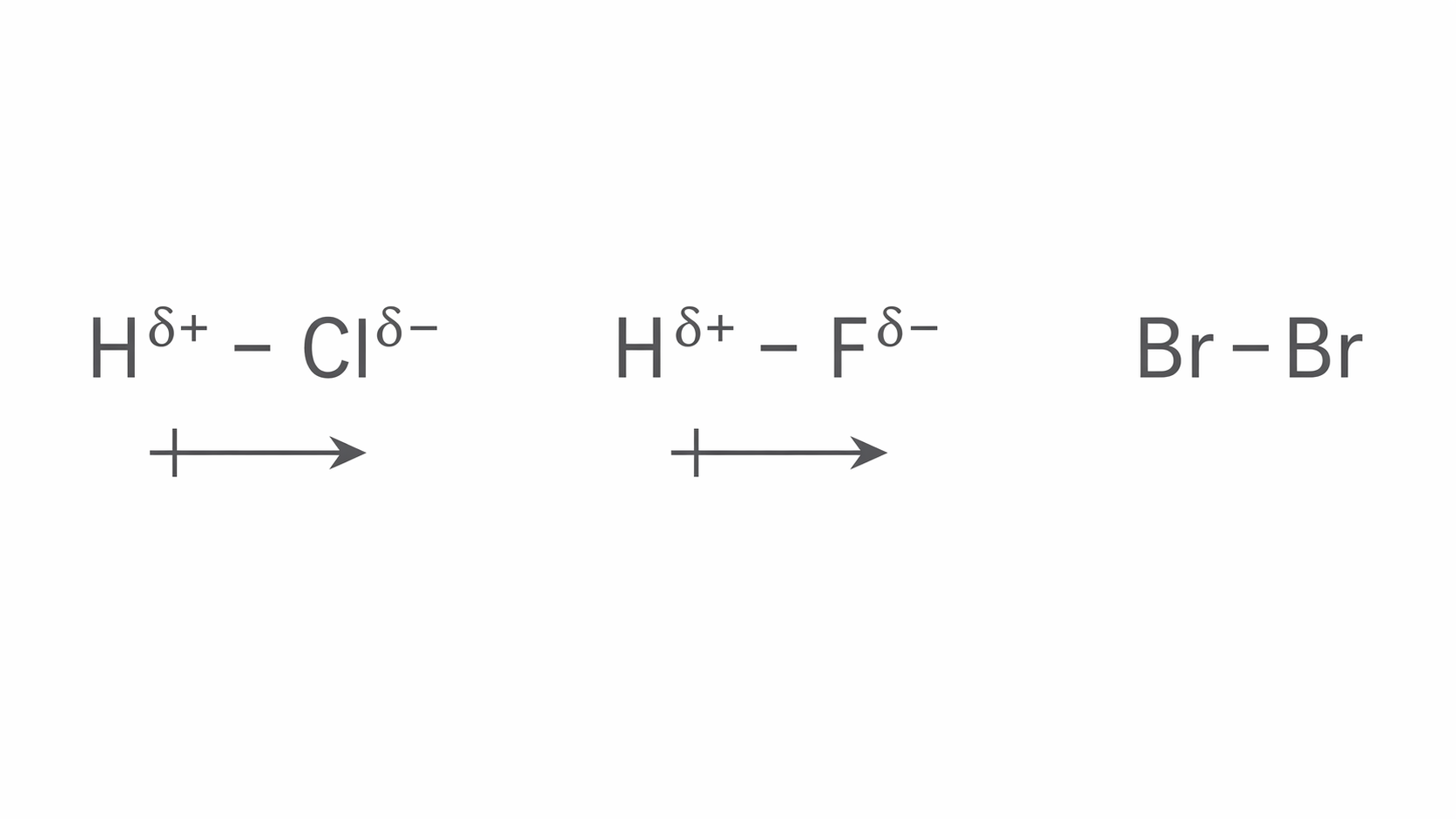
One very common slip is to reverse the symbols. Do not place δ− on the atom with less pull on the electron pair. Another common slip is to use full + and - charges, which would incorrectly suggest ionic bonding.
Bond polarity is not the same as molecular polarity
Each polar bond creates a bond dipole: one end is slightly negative and the other is slightly positive. A molecule only has a permanent dipole if these bond dipoles do not cancel.
Permanent dipole
An overall separation of charge across a molecule caused by polar bonds whose effects do not cancel.
A polar bond is about one bond. A permanent dipole is about the whole molecule.
Hydrogen chloride, HCl, has one polar bond, so there is no second bond dipole to cancel it. The molecule therefore has a permanent dipole. Carbon dioxide, CO2, is different. Each C=O bond is polar because oxygen is more electronegative than carbon, but the molecule is linear. The two bond dipoles are equal and opposite, so they cancel and the molecule has no permanent dipole.
The same logic applies to symmetrical molecules such as CCl4. Each C-Cl bond is polar, but because the molecule is symmetrical, the bond dipoles cancel overall. By contrast, in a molecule such as water, the O-H bonds are polar and the molecule is not symmetrical, so the dipoles do not cancel. Water therefore has a permanent dipole.
The diagram below compares those two outcomes.
[DIAGRAM: asset_name: 1.3.6 - Bond Polarity - Diagram 3; asset_slug: 1.3.6 - Bond Polarity - Diagram 3; recommended_method: retained_png; description: Compare CO2 and H2O. Show CO2 as linear with two equal bond-dipole arrows pointing towards the oxygen atoms and a note saying "dipoles cancel". Show H2O as bent with two bond-dipole arrows towards oxygen and a resultant overall dipole towards the oxygen end.]
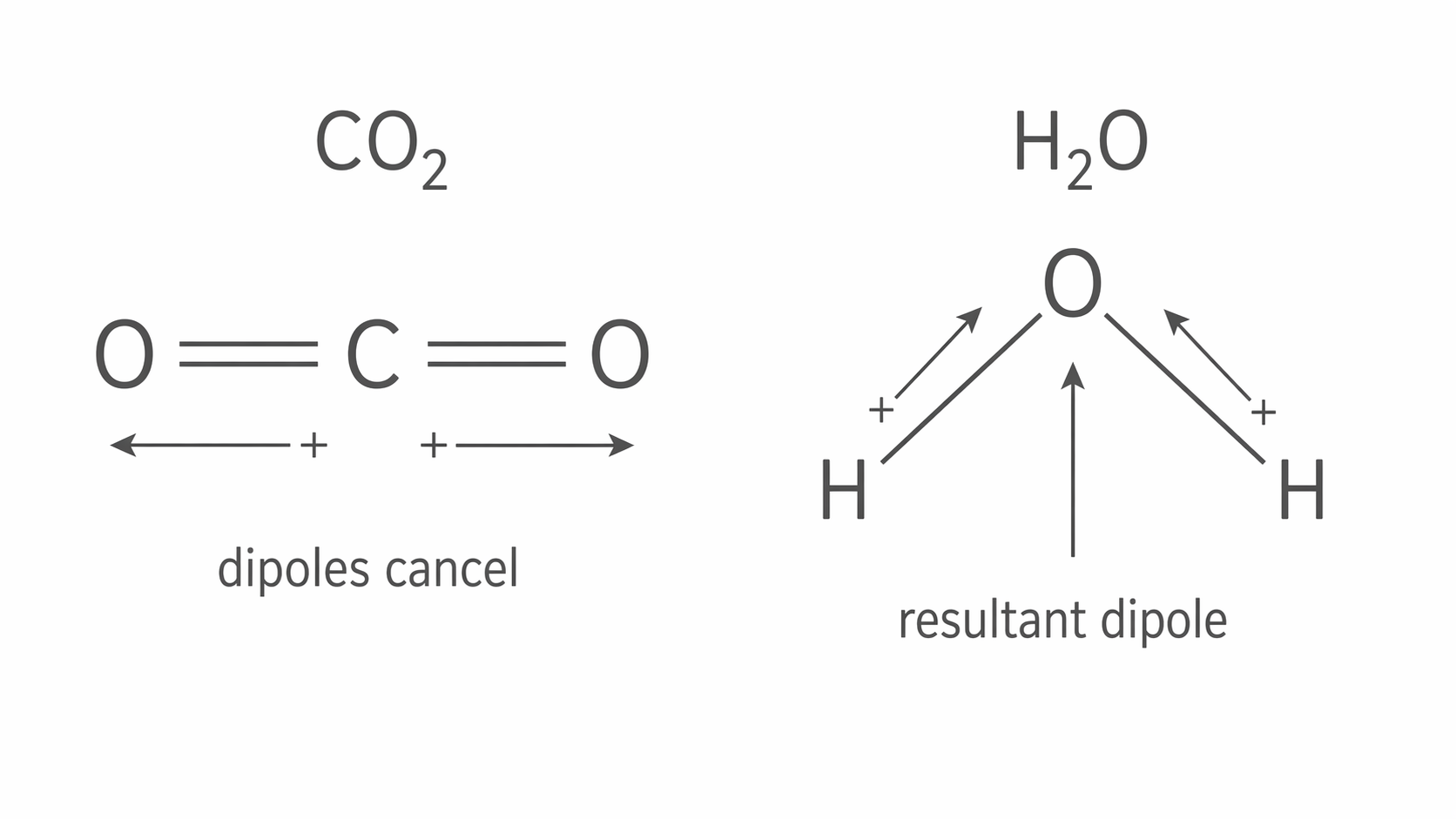
So a molecule can contain polar bonds and still have no permanent dipole if its shape makes the bond dipoles cancel out.
One clean way to remember this is: polar bonds are necessary for a permanent dipole, but they are not sufficient on their own.
A quick way to decide molecular polarity
When you want to decide whether a molecule has a permanent dipole, use this three-step method.
- Identify whether each bond is polar by comparing the electronegativities of the bonded atoms.
- Add partial charges or imagine a bond dipole pointing towards the more electronegative atom.
- Decide whether the bond dipoles cancel because of the molecule's symmetry.
If they cancel, there is no permanent dipole. If they do not cancel, the molecule does have a permanent dipole.
This method also helps you avoid a tempting shortcut: "It has polar bonds, so it must be polar." That is not always true. You must consider the arrangement of those polar bonds in the molecule.
So the two key ideas are simple: use δ+ and δ− to show bond polarity, and do not decide molecular polarity until you have checked whether the bond dipoles cancel.