3.1.3.5 - Shapes of Simple Molecules and Ions
The shape of a simple molecule or ion is not chosen at random. It comes from how pairs of electrons around a central atom repel each other and spread out in three dimensions. In this lesson, you will learn how to count those electron pairs, predict the arrangement they make, and explain why lone pairs change both shape and bond angle.
Counting electron pairs and understanding repulsion
To predict a shape, start with the central atom and count the pairs of electrons in its outer shell. Each bonding pair and each lone pair acts as a region of negative charge, often described as a charge cloud, and these charge clouds repel one another.
Electron pair repulsion theory
Pairs of electrons in the outer shell of a central atom repel each other and arrange themselves as far apart as possible to minimise repulsion.
A useful sequence is:
- identify the central atom
- count the outer-shell electron pairs around that atom
- decide how those pairs arrange themselves in space
- name the shape from the positions of the atoms, not from the lone pairs
The bond angle is the angle between two covalent bonds around the central atom. If there are only bonding pairs, the bond angle is the ideal angle for that arrangement. If lone pairs are present, the angle is usually reduced.
The strength of repulsion is not the same for every pair. A lone pair is held by one nucleus only, so its charge cloud is slightly closer to the central atom and more spread out. A bonding pair is shared between two nuclei, so it is pulled into a narrower region of space. That is why the repulsion order is:
lone pair-lone pair > lone pair-bond pair > bond pair-bond pair
The diagram below shows why lone pairs squeeze bonding pairs more strongly than bonding pairs squeeze one another.
[DIAGRAM: asset_name: 1.3.5 - Shapes of Simple Molecules and Ions - Diagram 1; asset_slug: 1.3.5 - Shapes of Simple Molecules and Ions - Diagram 1; recommended_method: retained_png; description: Three side-by-side electron-pair repulsion mini-sketches around a central atom labelled bond pair-bond pair, lone pair-bond pair, and lone pair-lone pair. Draw lone pairs as larger, more spread-out electron clouds than bonding pairs, and add a left-to-right arrow labelled increasing repulsion.]
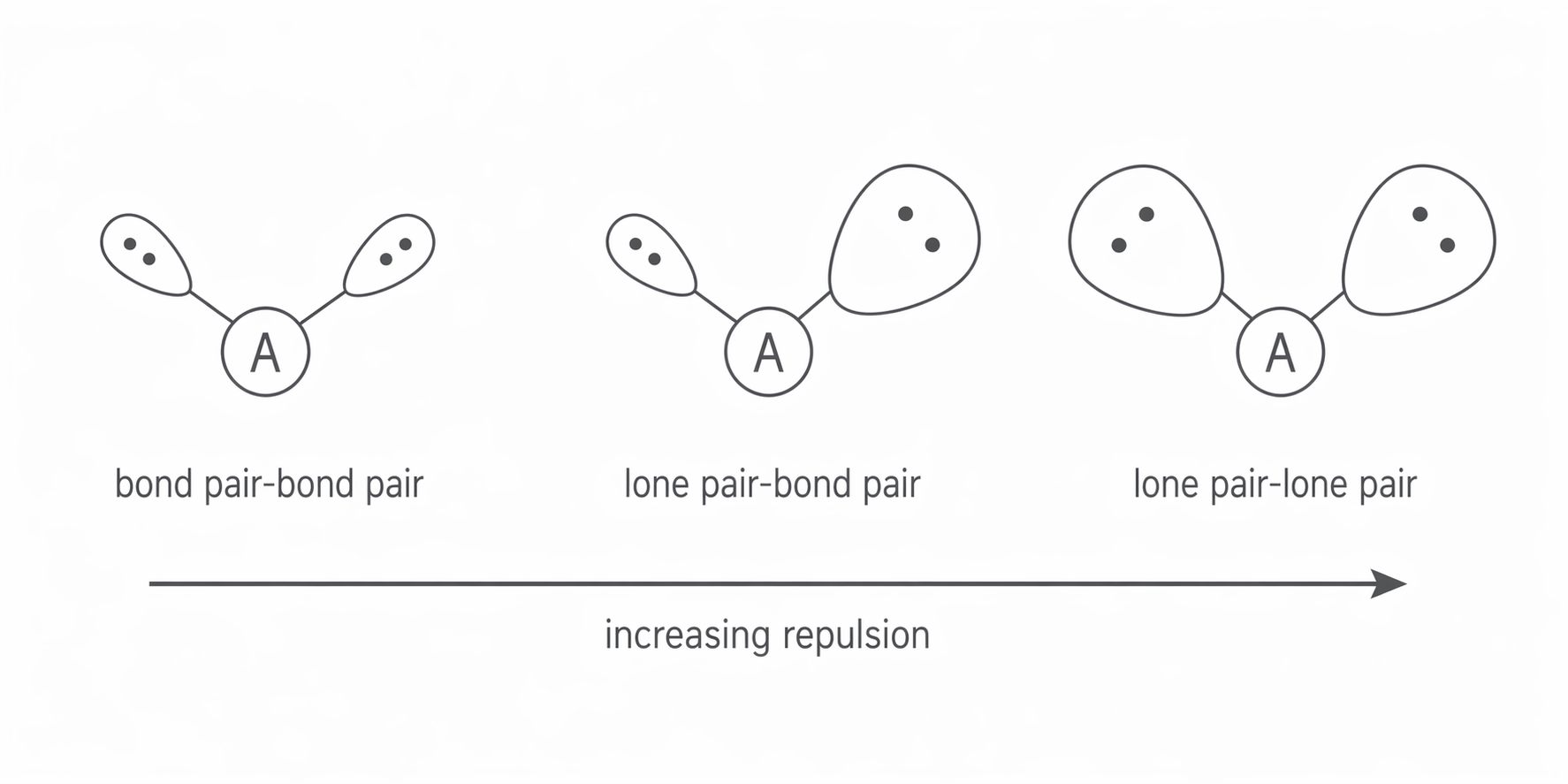
This ranking is the reason lone pairs squeeze bonding pairs closer together and reduce bond angles.
The base arrangements for two to six electron pairs
If a central atom has only bonding pairs, the molecular shape matches the electron-pair arrangement directly.
- 2 electron pairs: linear,
180 degrees, as inBeCl2(g) - 3 electron pairs: trigonal planar,
120 degrees, as inBF3 - 4 electron pairs: tetrahedral,
109.5 degrees, as inCH4orNH4+ - 5 electron pairs: trigonal bipyramidal, with bond angles of
120 degreesand90 degrees, as inPCl5 - 6 electron pairs: octahedral,
90 degrees, as inSF6
These five geometries are the starting point for any harder example with lone pairs.
The diagram below summarises these five base arrangements in one place.
[DIAGRAM: asset_name: 1.3.5 - Shapes of Simple Molecules and Ions - Diagram 2; asset_slug: 1.3.5 - Shapes of Simple Molecules and Ions - Diagram 2; recommended_method: retained_png; description: Five separate labelled 3D sketches showing linear (180 degrees), trigonal planar (120 degrees), tetrahedral (109.5 degrees), trigonal bipyramidal (120 degrees and 90 degrees), and octahedral (90 degrees) arrangements. For trigonal bipyramidal, show three equatorial positions in one plane and two axial positions above and below. For octahedral, show four positions in one square plane with one above and one below.]
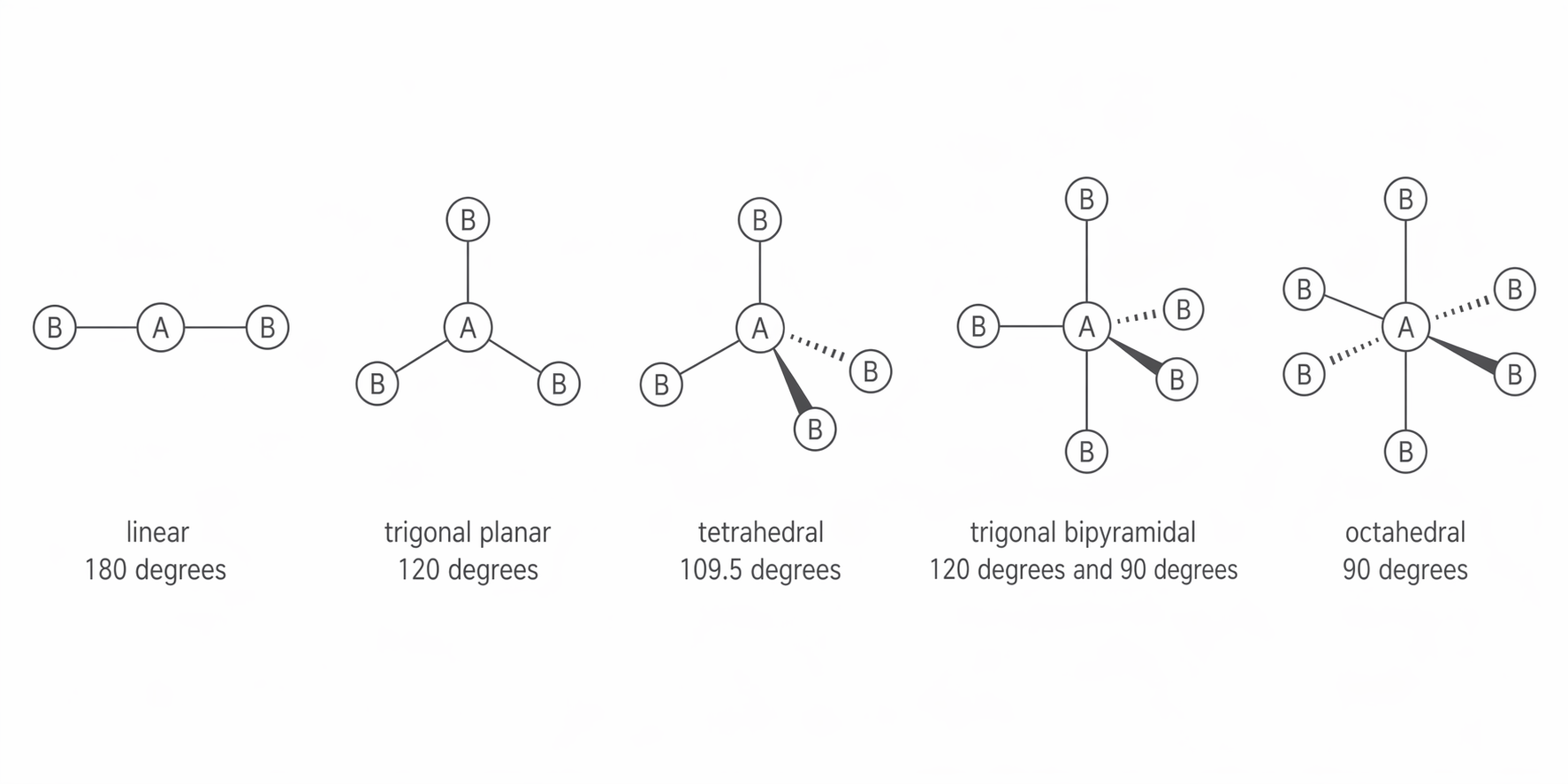
The geometry matters. A trigonal bipyramid is not a flat five-point shape. It has three equatorial bonds 120 degrees apart in one plane, and two axial bonds that are each 90 degrees to the equatorial bonds. An octahedron has six positions, not eight: four in a plane, one above, and one below.
For ions, the same approach still works. The overall charge changes the total electron count, but once you have counted the electron pairs around the central atom, the repulsion rules are exactly the same.
How lone pairs change both shape and bond angle
Lone pairs are the reason many real molecules do not keep the ideal bond angle of the base arrangement.
Lone pair
A pair of outer-shell electrons on the central atom that is not shared in a covalent bond.
The most important family to compare is the set with four electron pairs around the central atom.
In methane, CH4, there are four bonding pairs and no lone pairs. The shape is tetrahedral and the bond angle is 109.5 degrees.
In ammonia, NH3, there are still four electron pairs in total, but one of them is a lone pair. The electron pairs are arranged tetrahedrally, yet the shape of the molecule is called trigonal pyramidal because only the atoms are used to name the shape. The lone pair repels the bonding pairs more strongly than a bonding pair would, so the H-N-H angle is reduced to about 107 degrees.
In water, H2O, there are again four electron pairs, but now two are lone pairs. The electron-pair arrangement is still tetrahedral. However, with only two bonded atoms visible, the molecular shape is non-linear (or V-shaped). Because there are two lone pairs, the bonding pairs are squeezed even closer together, so the H-O-H angle is reduced further to 104.5 degrees.
The diagram below compares these three four-pair examples and shows how extra lone pairs steadily reduce the bond angle.
[DIAGRAM: asset_name: 1.3.5 - Shapes of Simple Molecules and Ions - Diagram 3; asset_slug: 1.3.5 - Shapes of Simple Molecules and Ions - Diagram 3; recommended_method: retained_png; description: Three side-by-side examples labelled CH4, NH3, and H2O, all based on the same tetrahedral electron-pair arrangement around the central atom. Show no lone pairs on CH4, one lone pair cloud on NH3, and two lone pair clouds on H2O. Label the molecular shapes tetrahedral, trigonal pyramidal, and non-linear, and label the bond angles 109.5 degrees, 107 degrees, and 104.5 degrees.]
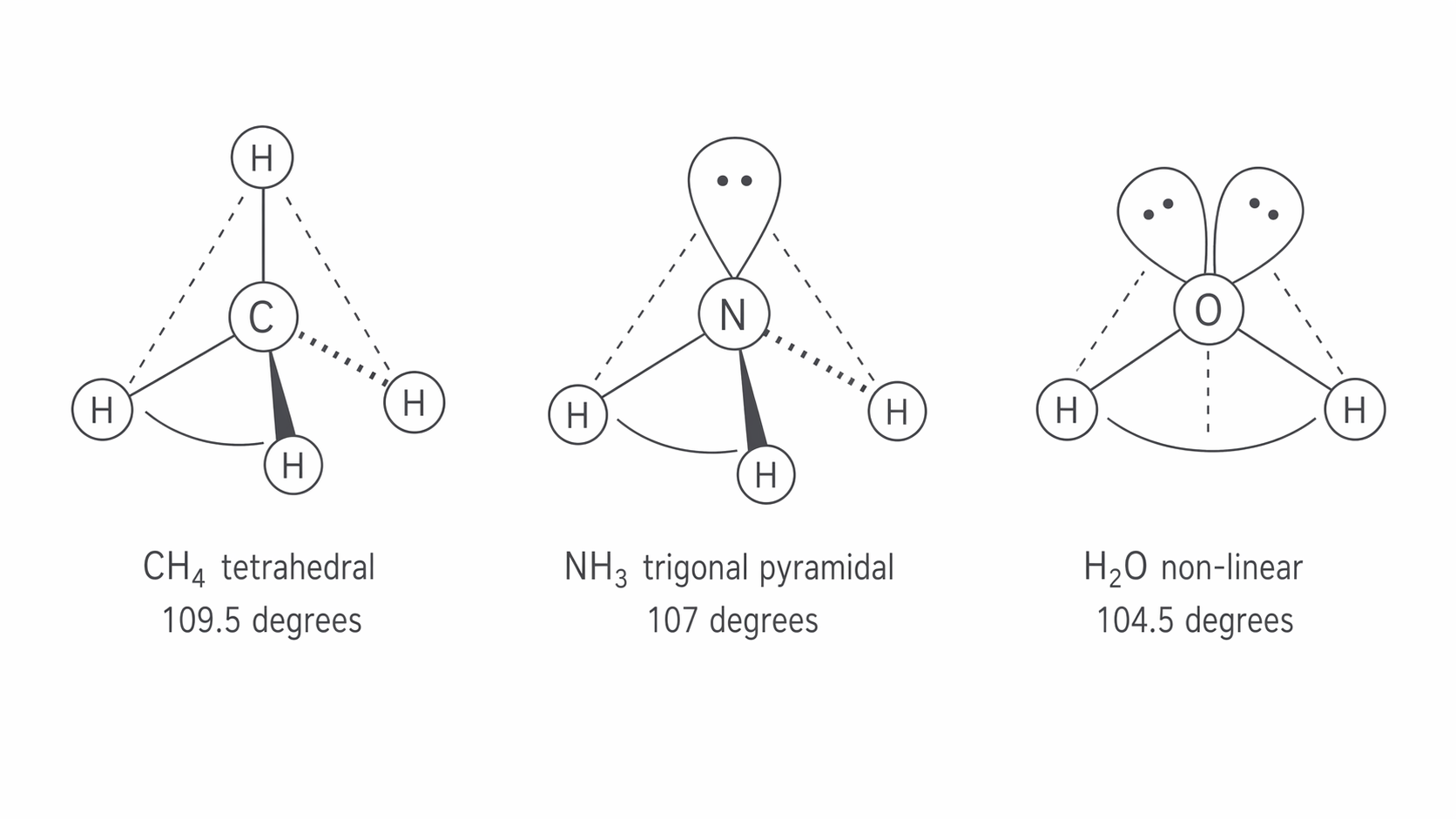
The logic is simple: the total number of electron pairs tells you the underlying arrangement, but the number of bonded atoms tells you the named molecular shape. This is why NH3 is not called tetrahedral even though its electron pairs are tetrahedrally arranged.
Do not treat lone pairs as causing one fixed drop in angle in every case. The key idea is stronger repulsion and greater squeezing, with the exact angle depending on the arrangement.
Applying the method to ions and six-pair geometries
The same reasoning works for ions as well as molecules. For example, the ammonium ion, NH4+, has four bonding pairs and no lone pairs around nitrogen, so it is tetrahedral with bond angles of 109.5 degrees. The positive charge does not create a new shape rule; it just changes the electron count you start from.
For higher pair numbers, careful geometry matters. If there are five electron pairs, begin from a trigonal bipyramidal arrangement. The equatorial positions are 120 degrees apart from each other and 90 degrees from the axial positions, so a lone pair prefers an equatorial position because that gives fewer close 90 degree interactions. If there are six electron pairs, begin from an octahedral arrangement and place lone pairs as far apart as possible.
It helps to model the counting explicitly for an ion. In the chlorine tetrafluoride ion, ClF4-, chlorine starts with 7 outer-shell electrons and the -1 charge adds 1 more, so there are 8 outer-shell electrons to place around chlorine. Four Cl-F bonds use four bonding pairs, leaving two lone pairs on the central atom. That makes six electron pairs in total.
Six pairs give an octahedral electron-pair arrangement, but the two lone pairs repel most strongly, so they occupy opposite positions. That leaves the four fluorine atoms in one plane around the chlorine atom.
The shape is therefore square planar. Adjacent F-Cl-F bond angles are 90 degrees, while fluorine atoms across the square are 180 degrees apart. The diagram below shows how that square planar shape comes from an octahedral electron-pair arrangement once the two lone pairs occupy opposite positions.
[DIAGRAM: asset_name: 1.3.5 - Shapes of Simple Molecules and Ions - Diagram 4; asset_slug: 1.3.5 - Shapes of Simple Molecules and Ions - Diagram 4; recommended_method: retained_png; description: A two-step diagram for ClF4-. Left: an octahedral electron-pair arrangement around chlorine with six positions marked, two lone pairs opposite each other above and below the plane, and four Cl-F bonds occupying one square plane. Right: the resulting square planar molecular shape showing only the four fluorine atoms around chlorine. Label adjacent F-Cl-F angles as 90 degrees and opposite F-Cl-F as 180 degrees.]
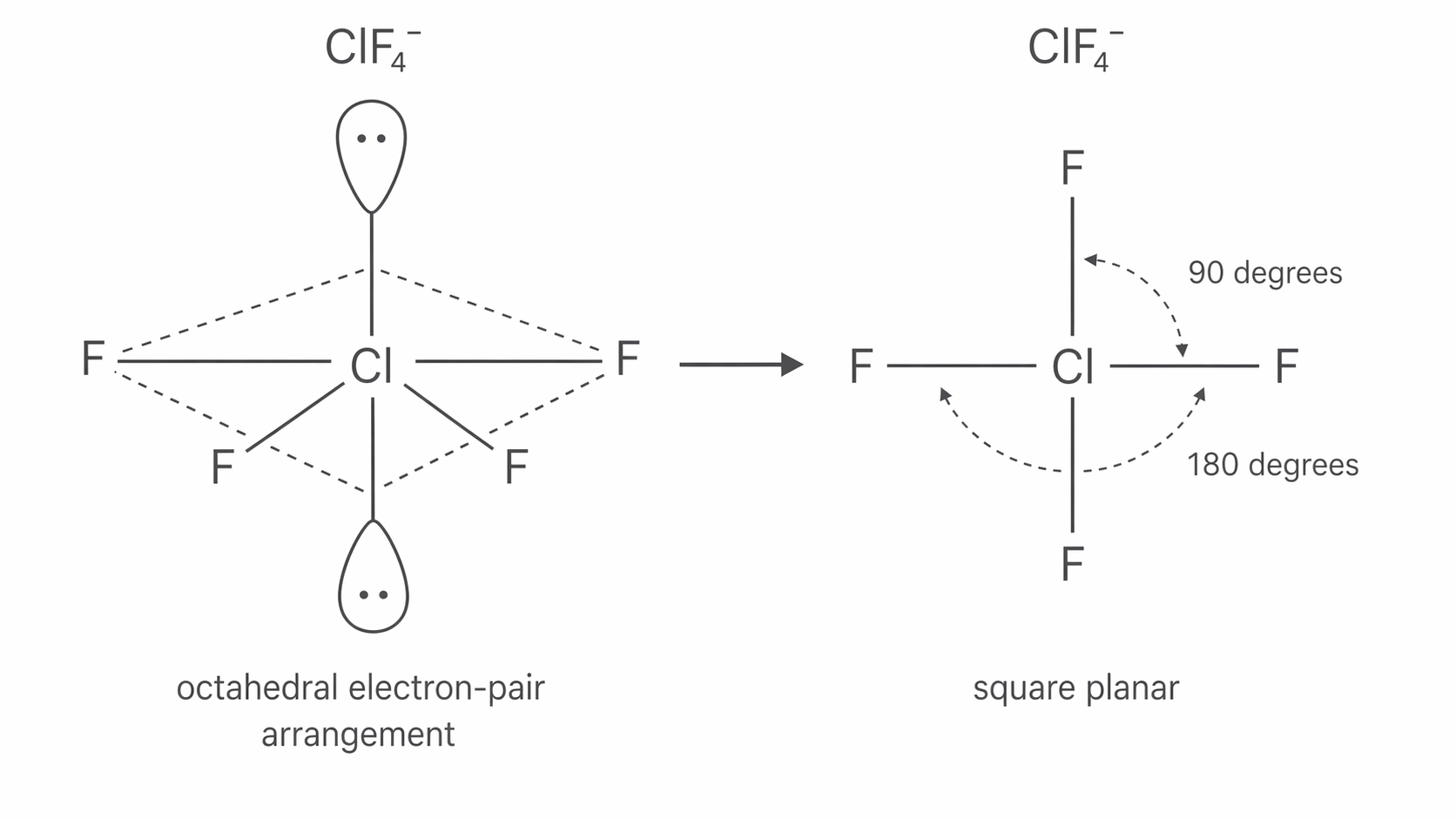
The same pattern gives you the other higher-pair shapes as well:
| Total electron pairs | Bonding pairs + lone pairs | Molecular shape | Key idea |
|---|---|---|---|
| 5 | 4 bonding + 1 lone pair | seesaw | the lone pair takes an equatorial position |
| 5 | 3 bonding + 2 lone pairs | T-shaped | both lone pairs take equatorial positions |
| 5 | 2 bonding + 3 lone pairs | linear | the two bonds end up opposite each other |
| 6 | 5 bonding + 1 lone pair | square pyramidal | one lone pair sits in the octahedral arrangement |
| 6 | 4 bonding + 2 lone pairs | square planar | the two lone pairs sit opposite each other |
No separate rule is needed for each named ion or molecule. The logic is always the same: count the pairs, choose the base arrangement, place the lone pairs to minimise repulsion, then name the shape from the atoms only.
The same reasoning can be summarised as:
- count all electron pairs around the central atom
- choose the base electron-pair arrangement
- place lone pairs where repulsion is smallest overall
- name the final shape from the positions of the atoms only
Taken together, these ideas let shapes and bond angles across simple molecules and ions be predicted from electron-pair repulsion rather than memorised one by one.