3.1.5.4 - Effect of Concentration and Pressure
This lesson is about one simple but powerful idea: reactions go faster when reacting particles collide more often. We will follow that idea in two different settings, changing concentration and changing gas pressure. The key is to connect what changes in the container to what happens to collision frequency.
Concentration and collision frequency
Collision theory says that reacting particles must collide before a reaction can happen. If collisions happen more often each second, there are more opportunities for successful collisions, so the rate of reaction increases.
Collision frequency
Collision frequency is the number of collisions between reacting particles in a given time.
In a solution, increasing concentration means there are more reacting particles in the same volume. That could mean more acid particles, more ions, or more dissolved molecules packed into the same space. Because the particles are closer together on average, they collide more frequently.
The diagram below compares the same volume at low and high concentration and shows why the more concentrated mixture gives more collisions each second.
[DIAGRAM: asset_name: 1.5.4 - Effect of Concentration and Pressure - Diagram 1; asset_slug: 1.5.4 - Effect of Concentration and Pressure - Diagram 1; recommended_method: retained_png; description: Two same-sized boxes representing the same volume at the same temperature, labelled "low concentration" and "high concentration". The low-concentration box contains a small number of identical reacting particles spread out. The high-concentration box contains many more of the same particles in the same volume. Add arrows and collision markers to show that collisions happen more often in the more concentrated box.]
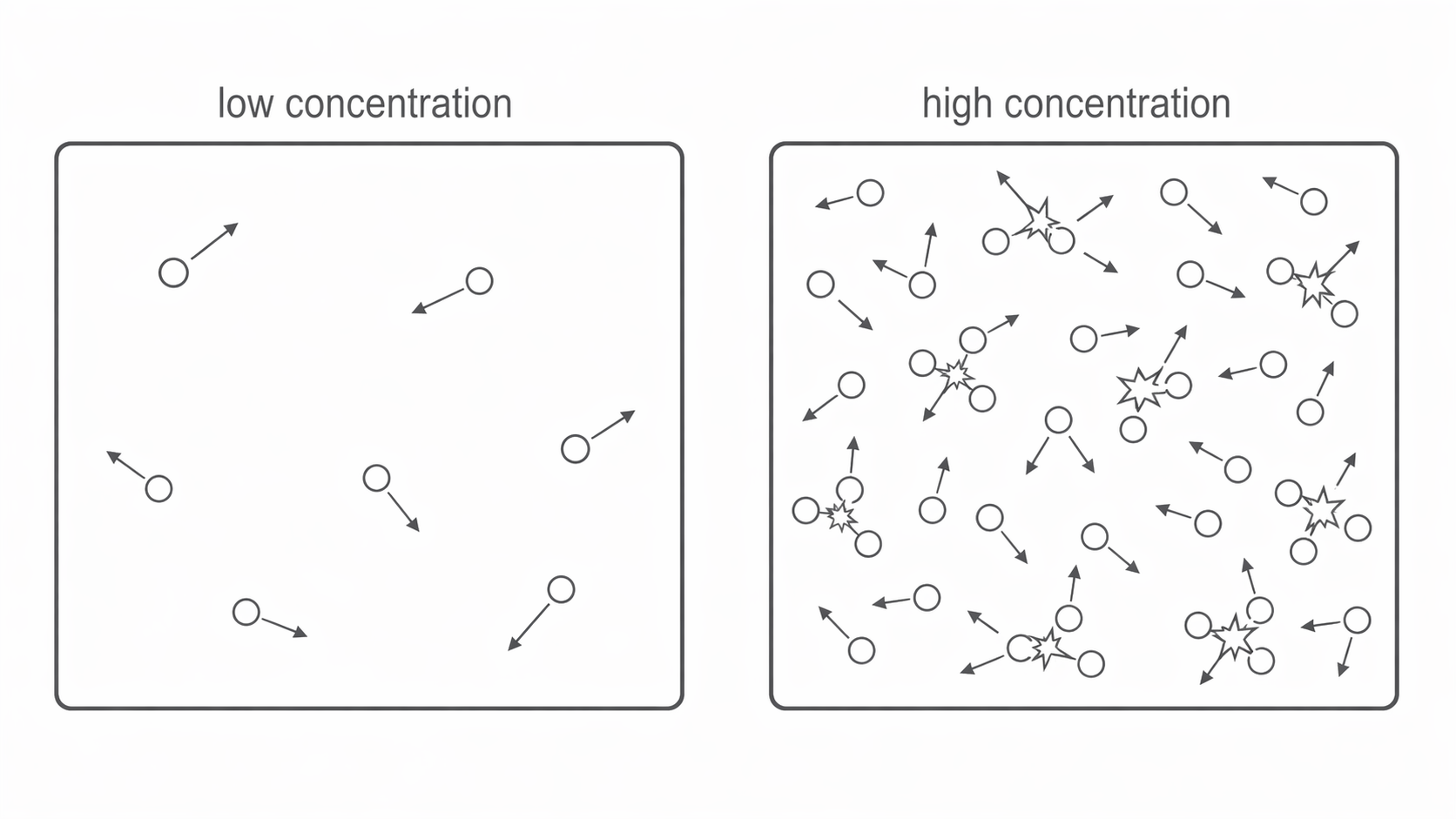
That increase in collision frequency is the reason the rate increases. This does not mean the particles are moving faster. At the same temperature, their average energy has not increased. The change is that there are simply more encounters per second.
You can use the same logic for many common reactions. If magnesium reacts with dilute hydrochloric acid, increasing the acid concentration puts more H+(aq) particles into each cm3 of solution. More H+(aq) particles reach the metal surface each second, so the reaction happens faster.
As a reaction goes on, the opposite often happens: reactants are used up, concentration falls, collision frequency decreases, and the rate slows down.
Pressure in gas reactions
Pressure matters when the reactants are gases. Gases can be compressed, so changing the pressure changes how many gas particles are crowded into a particular volume.
Pressure
Pressure is force per unit area. In a gas, pressure increases when gas particles collide more often with the walls of the container.
If a gas reaction is carried out at a higher pressure, the gas particles are squeezed into a smaller volume. The particles are closer together, so they collide with each other more frequently. That increases the reaction rate.
The explanation follows exactly the same pattern as for concentration: higher pressure means more particles per unit volume, which means a higher collision frequency. Because there are more collisions each second, there are more successful collisions each second.
This applies only to reactions involving gases. Increasing the pressure of a solid or a liquid has very little effect because they are already packed closely together and are not easily compressed.
The diagram below shows the same number of gas particles before and after compression at the same temperature, so the higher-pressure sample has particles closer together and collides more often.
[DIAGRAM: asset_name: 1.5.4 - Effect of Concentration and Pressure - Diagram 2; asset_slug: 1.5.4 - Effect of Concentration and Pressure - Diagram 2; recommended_method: retained_png; description: A horizontal gas syringe shown in two states at the same temperature with the same number of gas particles in both. The first has a larger volume and lower pressure with the particles spread out. The second has a smaller volume and higher pressure with the plunger pushed in so the particles are closer together. Add collision markers and arrows to show more frequent collisions in the compressed sample.]
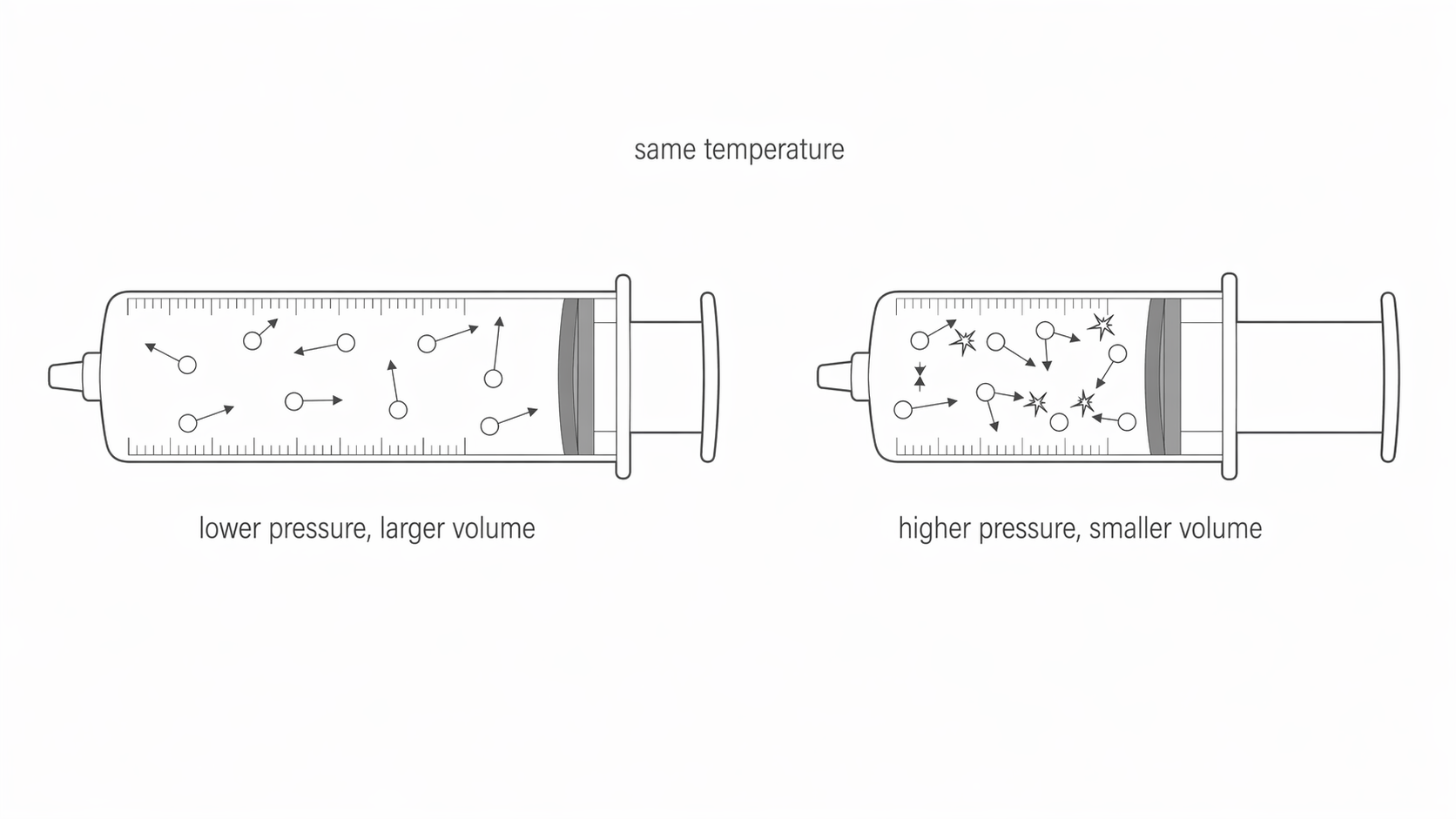
A common mix-up is to confuse pressure with temperature. Increasing pressure does not mean the particles suddenly have more energy. At constant temperature, the particles are just closer together, so collision frequency rises.
Pulling the idea together
The chemistry chain here is short. Something changes in the container, the particles become closer together or more numerous in a given volume, collision frequency increases, and the rate increases.
Changing concentration or gas pressure changes reaction rate because it changes how often particles collide, not because it changes activation energy or makes particles move faster at the same temperature.
For concentration, the key idea is more particles per unit volume. For gas pressure, the key idea is gas particles closer together in a smaller volume. In both cases, the final step is more frequent successful collisions per second. Activation energy does not decrease, and the Maxwell-Boltzmann distribution does not shift to the right, because neither change is being caused here.
Worked example: nitrogen monoxide reacts with oxygen in the gas phase. If the gases are compressed into a smaller container at the same temperature, the pressure increases. The gas particles are closer together, so collisions between reacting particles happen more often each second. The initial rate therefore increases.
That same chain explains both concentration changes and gas-pressure changes.